New version of Quotations from Chairman Mao, the world’s second most published book, to hit Chinese shelves in November
October 10, 2013 Leave a comment
Mao’s Little Red Book to get revamp
New version of Quotations from Chairman Mao, the world’s second most published book, to hit Chinese shelves in November
Tania Branigan in Beijing
The Guardian, Friday 27 September 2013 15.54 BST
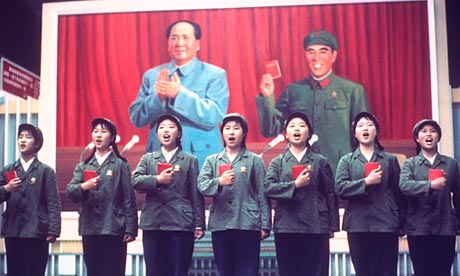
Chinese singers perform with their copies of the Little Red Book in hand in 1971. Photograph: Frank Fischbeck/Time & Life Pictures/Getty Image
It will not be especially little, and the cover will be only partly red. But a new version of the world’s second most published book is due to appear on Chinese shelves, decades after it fell from favour with the end of Maoism. The re-emergence of Quotations from Chairman Mao – better known as the Little Red Book – comes amid an official revival of the era’s rhetoric.China‘s leader, Xi Jinping, has embraced Maoist terminology and concepts, launching a “mass line rectification campaign” and this week even presiding over a televised self-criticism session.Only the Bible has been printed more often than the Quotations, which was a keystone of Mao’s personality cult. A billion copies circulated in the Cultural Revolution – the population pored over it in daily study sessions; illiterate farmers memorised chunks by heart. In the west, translations were brandished by radicals.
But the political frenzy ebbed, and production of the Little Red Book had mostly stopped long before Mao’s death; afterwards, as China embarked on reform and opening up, officials began to pulp copies. Later, in a more relaxed age, commercial reprints and introductions to his thought appeared, but no new editions of his works: “This has been a very sensitive topic,” said Daniel Leese, author of Mao Cult and an expert on the era at the University of Freiburg.
The new version is due for release in November, just before the 120th anniversary of Mao’s birth. Its chief editor, Chen Yu – a senior colonel at the Academy of Military Science – describes it as a voluntary initiative. “We just want to edit the book, as other scholars work on the Analects of Confucius… We don’t have a complicated political purpose,” said Chen.
But Leese suggested it was a “trial balloon” from Maoist sympathisers: “If they hadn’t seen how the general tone towards the Maoist heritage had changed, I don’t think they would have dared. This is party internalpolitics popping up in the public sphere.”
Chen said his team of 20 had worked for two years on the project, under pressure from left and right. The title may not include the word “quotations”, he said, and will be attributed to Mao Zedong instead of Chairman Mao because the former is more neutral.
The best-known editions are the military versions covered in red plastic and shrunk to fit the pocket of an army uniform – hence the book’s nickname in the west.
Many knew the text well enough to cite quotes by page number; they became ideological weapons to be wielded in any political struggle. Under siege by Red Guards, the then foreign minister reportedly retorted: “On page [X] it says Comrade Chen Yi is a good cadre …”
But they also coloured even commonplace exchanges, as described by one historian: “Serve the people. Comrade, could I have two pounds of pork, please?”
This time the cover will be at most partially red, said Chen. The new book will draw on other compilations of Mao’s sayings and writings, remove quotes wrongly attributed to Mao and correct those which have become distorted.
An “internal reference” version with limited distribution will run to double the length – 240,000 characters – and include “thoughts about the Cultural Revolution and other special events confirmed as wrong by the government”, Chen said, so that people could study Mao comprehensively.
Leese noted that unlike other collections of Mao’s thought, the Little Red Book covered his later years in power – which saw the purges of theAnti-Rightist Campaign , the Great Famine and Cultural Revolution.
Mao still occupies a place of honour in modern China. His body lies in state in Tiananmen Square; his portrait hangs from its gate; and his face gazes from banknotes. Others have appropriated his heritage in unexpected ways: “There is a whole industry of Mao’s thought as managerial wisdom, much as became of Sun Tzu’s Art of War,” said Jeremy Paltiel, a Carleton University expert on the Communist party.
But the party has drawn a veil over the later years of Mao’s rule since its 1981 resolution proclaimed that he was 70% right, 30% incorrect. The return to that period’s terminology has confused and in some cases concerned observers.
“[Xi] might not be the initiator, but he certainly endorses it,” said Joseph Cheng, a political scientist at the City University of Hong Kong.
Some perceive a tactical manoeuvre, designed to appeal to leftwingers estranged by the trial of Bo Xilai and concerned that financial and economic reforms will be unveiled at a key party meeting in November.
Others see genuine conviction: “Xi believes in Maoism. He wants to completely revive Mao’s policy and he has already started it,” said political scientist Zhang Ming.
That does not mean a return to class struggle or abandonment of the market. Rather, it is about the Great Helmsman as a guide for party leadership.
“It is not the same era any more,” said Beijing-based historian Zhang Lifan. “He will not actually do exactly what Mao did. He just makes a gesture as if he will.”
 About bambooinnovator
 Bamboo Innovator