High Bar for Foreign Nurses in Japan
October 11, 2013 Leave a comment
October 10, 2013, 1:45 p.m. ET
High Bar for Foreign Nurses in Japan
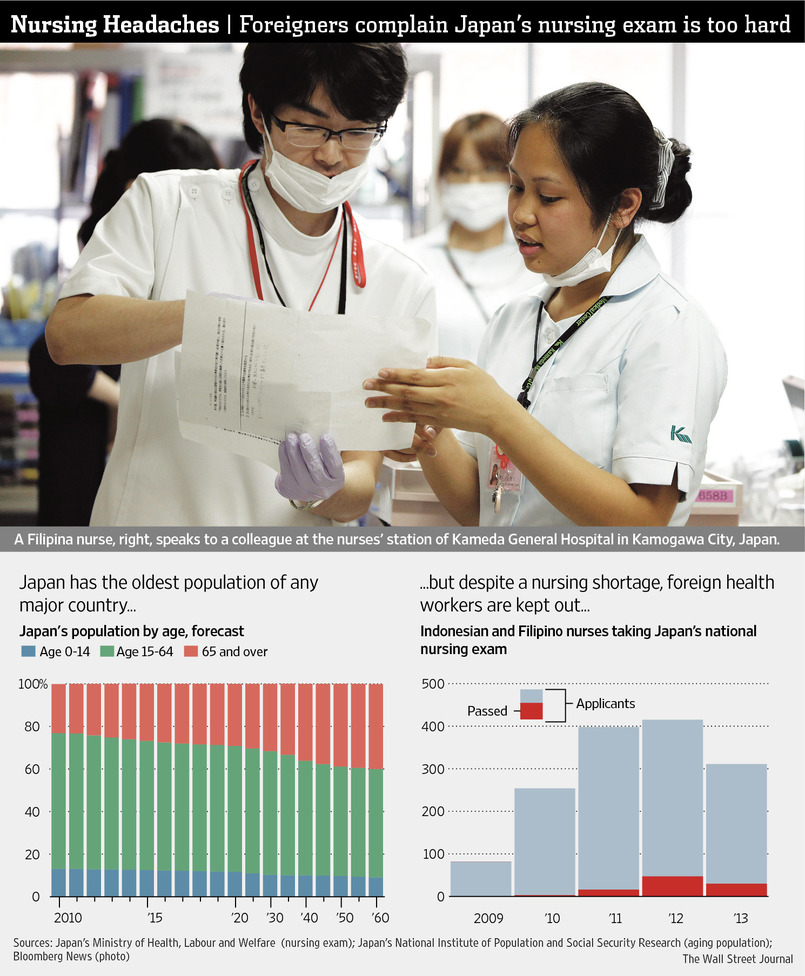
TOKYO—Dewita Tambun wants to become a nurse in Japan, a country with an aging population and a shortage of hospital staff. But the 29-year-old Indonesian first has to battle the country’s tough immigration policy. The biggest obstacle facing Ms. Tambun is a seven-hour, 240-question test in Japanese that only 96 of the 741 nurses brought here from Indonesia and the Philippines in the past five years have passed. Ms. Tambun, who has been in Japan since 2011, has failed the test twice and has one more shot at it in February before being sent home.“I became a nurse because I wanted to work overseas. But Japanese is a very difficult language, and the exam is so hard,” said Ms. Tambun, who spends the morning helping to feed and change the clothing of elderly patients at Tokyo’s Eisei Hospital and her evenings cramming for the test.
An influx of people like Ms. Tambun should make economic sense for Japan. The country faces a shortage of young, productive workers because of a falling birthrate. About a quarter of Japan’s 130 million people are older than 65, and this is expected to grow to 40% by 2055, adding to strains on the social security system.
Already there is a shortfall of 43,000 nurses, according to the Health Ministry, and nurses attribute this fact to poor pay and work conditions.
The difficulty of balancing work and family responsibilities forces many Japanese women to stay home to care for elderly relatives, further deepening the shortage. The International Monetary Fund estimates that measures to boost Japan’s female labor participation rate could add half a percentage point a year to its gross domestic product.
“Facing this demographic bomb, Japan simply needs to accept a significantly larger number of foreigners in its workforce, including nurses and caregivers,” said Hidenori Sakanaka, director of the Japan Immigration Policy Institute, an immigration advocacy group.
Yet few observers expect Prime Minister Shinzo Abe‘s government to move forward with changes to Japan’s immigration policy. Mr. Abe, who returned to power last year, has marshaled monetary stimulus and government spending to help rekindle growth after years of deflation. The economy is expected to expand 2% this year, among the fastest rates in the industrialized world.
But the so-called third arrow of Mr. Abe’s grand strategy—economic overhauls aimed at underpinning longer-term growth—has yet to take flight. Many of the possible changes, including freer competition in agriculture and a more flexible labor force, face opposition from vested interests.
Immigration is equally contentious in Japan, where an insular, island nation mentality still prevails. Despite police statistics showing crime by immigrants is declining, many Japanese fear that allowing in more foreigners will lead to rising crime, dilute Japan’s culture and undercut wages. According to a national poll in 2012 by the Japan Association for Public Opinion Research, only 1.7% of respondents said Japan should promote immigration. There are currently only two million foreigners in Japan, or 1.6% of the population.
Mr. Abe has talked of spurring growth by expanding the opportunities for women in the workforce. But there are no signs that the ruling Liberal Democratic Party will propose wide-ranging immigration overhauls when Japan’s Diet fall session begins Oct. 15.
Japan has been reluctant to rely on foreigners to meet the nursing shortfall. Five years ago, the government agreed to accept nurses from Indonesia and the Philippines as part of broader economic pacts with those nations.
A nurse must pass the annual national exam in Japanese within three years or go home. In the meantime, they work as nursing aides. Hospitals pay their board and provide Japanese language training.
The scope of the agreement was limited. Japan allowed only a few hundred nurses to come, a small number compared with Japan’s one million nurses. Most end up returning home, unable to master written Japanese, which is required for the national nursing license examination. Only 11% of the 415 foreign nurses who took the test in 2012 were successful.
“The program is a complete failure. The test is throwing almost everybody off. It’s almost as if the government is not interested in accepting them in the first place,” Mr. Sakanaka said.
Some efforts have been made to improve the passing rate, including allowing foreigners extra time for the test and allowing some nurses who fail three times to apply for a special one-year extension. But the government doesn’t see foreigners as the answer. A spokesman for Japan’s Health Ministry says the program was never intended to fill a nursing gap, but was in response to a request from Indonesia and the Philippines, which face high unemployment.
Instead, Japan is focusing on luring back some of the nation’s 700,000 licensed nurses through counseling and other placement services. Despite the shortage, wages haven’t risen because the government, which shoulders most medical costs, already is dealing with a large public debt and has been reluctant to increase remuneration for health-care professionals.
Morale in Japan’s nursing industry is poor due to low base wages near $2,500 a month and long hours, said Yusuke Ito, a spokesman for the Japanese Nursing Association. A recent study by the group found that half of full-time nonmanagerial nurses were considering quitting their jobs, largely because of pay.
Still, the association backs the stringent tests for foreigners, saying proficiency in Japanese is a safety requirement. Senior members of the group also have raised concern that an influx of foreign nurses could further lower wages for Japanese workers.
Others say the government should do more to help foreign nurses settle in, including helping move their families to Japan.
“I just can’t see the government really working to facilitate the anchoring of foreign nurses in Japan. Even those who struggled hard to pass the exam often decide to return home,” said Yuko Hirano, a professor at Nagasaki University’s Graduate School of Biomedical Sciences. Ms. Tambun worked for five years as a nurse in Indonesia, before coming to Japan. She learned about the program through a friend. She now makes $1,270 a month and gets free accommodation—four times what she would make as a nurse in Indonesia. She sends more than two-thirds home to support her family and help pay for her younger siblings’ college education.
“I’ve promised myself that if I work in another country, I will help my family because I’m here for them,” she said.
 About bambooinnovator
 Bamboo Innovator