Marlboro in the Middle Kingdom: Chinese Kids Know Their Smokes; nearly nine out of 10 Chinese children aged 5 and 6 can identify at least one cigarette brand, and roughly one out of five say they expect to smoke when they grow up
October 11, 2013 Leave a comment
October 10, 2013, 1:43 PM
Marlboro in the Middle Kingdom: Chinese Kids Know Their Smokes
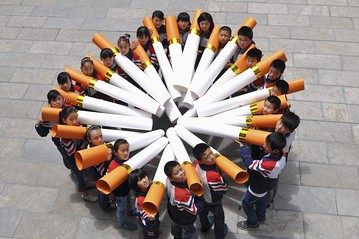
Students posed with cigarette models made from waste paper during a campaign ahead of the World No Tobacco Day in Handan, Hebei province, in May.
Nearly nine out of 10 Chinese children aged 5 and 6 can identify at least one cigarette brand, and roughly one out of five say they expect to smoke when they grow up. Those are some of the breathtaking results of arecent study by Johns Hopkins University on the effects of tobacco marketing on children in low- and middle-income countries.The survey, which questioned 396 children Jialing town in Qi County, Shanxi province, found that 71% of Chinese 5- and 6-year-olds had someone who used tobacco in their household while 86% could identify at least one cigarette brand – higher than survey counterparts in Brazil, India, Nigeria, Pakistan or Russia.
The researchers said they chose Jialing, a small town in China’s northwest, rather than a place like Beijing or Shanghai because they thought it would be representative of what a typical child in China might see. Previous surveys have found smoking rates to be higher in the Chinese countryside than they are in cities.
The study also found that 22% of the Chinese children said they planned to smoke when they grow up, second only to India, where 30% planned to puff away as adults. And 43% of the Chinese children recognized the Malboro brand, the highest of all the countries studied.
A representative of Philip Morris China, the local affiliate of the maker of Malboros, declined to comment.
Though the numbers seem staggering, they’re comparable to the 1991 landmark study in the U.S. that found 91% of 6-year-olds recognized cigarette cartoon character Joe Camel, the results of which helped to spur the U.S. to crack down on tobacco marketing and advertising.
“The results of that study, even though it was of small sample, had a great impact on tobacco advertising in the U.S.,” said the new study’s co-author Dina Borzekowski. “But the question remained, where have Malboro man and Joe Camel gone? Did they go abroad? So we set out to look at places where kids are vulnerable to smoking these days.”
China is the world’s largest cigarette consumer and producer, accounting for about one-third of world consumption, with more than 300 million smokers. With so much smoke floating around, it probably comes as no surprise that Chinese children are familiar with cigarettes brands than children in similarly developed countries.
Smoking is a scourge in China, where two million people are expected to die each year from the habit by 2025, according to a report by researchers at Fudan University in Shanghai, and where viral images of children lighting up are commonplace.
“They’re immersed in a smoking culture,” Ms. Borzekowski said. “They’re in households where parents and adults smoke, they’re walking to school past retail shops selling cigarettes, and their teachers smoke.”
The country has taken some steps in recent years to alleviate the problem, joining a World Health Organization’s initiative in 2005. Its advertisement law bans tobacco advertising on radio or TV or in movies, newspapers or magazines, but not on billboards, at points of sale, online or in the sponsorship of events. But bans are not always complied with, and smoking can be seen in TV series and movies, despite a2011 directive stating otherwise.
“They have regulation in China, but compliance and whether people are abiding by the law are different,” Ms. Borzekowski said.
Critics charge that a plan aiming to strengthen existing advertising bans and to reduce the adult smoking rate by 10% by 2015 doesn’t go far enough. The World Health Organization gives China just a three out of 10 for compliance with indirect advertising bans.
Cigarettes are cheap in China, with the WHO noting that a pack of the most-sold brand of cigarettes in the country go for just 5 yuan (82 cents). It’s also hard for authorities to encourage too much cutting back on an industry that in 2011 accounted for 424 billion yuan ($69 billion) in tax revenue.
“It appears that China is indeed recognizing how harmful tobacco products are for smokers, their families, and their communities. There have been some positive steps taken—Harbin has strong smoke-free requirements—but a lot more could be done,” said Joanna Cohen, co-author of the study, who said she was surprised at the high levels of recognition among Chinese children.
“Clearly, more needs to be done to reduce tobacco advertising and promotion in China.”
 About bambooinnovator
 Bamboo Innovator