Mistresses help keep the property bubble aloft in Beijing; state-run Beijing Evening Daily estimated back in 2010 that there were 200,000 mistresses living in apartments in Beijing alone

Mistresses help keep the property bubble aloft in Beijing

By Heather Timmons 4 hours ago

Keeping a mistress is a normal part of life for successful Chinese businessmen and government officials, and in some ways they have become more visible in recent years, playing roles in corruption scandals and even, sometimes, turning in their lovers. They and their big-spending partners may also be contributing to ever-increasing real estate prices in some of China’s biggest cities. That’s because these women, often from rural areas, are regularly kept in apartments that their lovers buy for them in urban centers, near his work or home. The practice has created entire neighborhoods of apartments in big Chinese cities filled with women who would otherwise be living at home with their families, or perhaps sharing a rental. Read more of this post


Liu Yonghao is China’s wealthiest investor: Hurun

Liu Yonghao is China’s wealthiest investor: Hurun

Staff Reporter

2013-10-10

C608N0112H_2013資料照片_N71_copy1

Chinese millionaire Liu Yonghao — chairman of the agricultural industry giant New Hope Group — is the richest investor in China, after Liu’s assests were made public in a sub-list of the Hurun China Rich List 2013 on Oct. 9, reports the new portal Sichuan Online. Liu and his family have increased their wealth since 1996, when Liu and several company owners launched the China Minsheng Bank, the largest private bank in China. Liu is now the major share holder of the bank with 6.7% of its shares, while he also possesses shares in other businesses across the country. Meanwhile, Gong Hongjia and wife Chen Chunmei, leading angel investors in the Chinese technology sector, came in second on the Hurun sub-list. The couple, who own Hikvision Digital Technology, a leading supplier of video surveillance products and solutions, saw their company grow 300% over the past three years. Lu Jiqiang checked in as the third richest investor on the list. Lu is also one of the major share holders of the China Minsheng Bank, possessing 2.46% of the shares. The 22 investors on the list possess assests totaling 212 billion yuan (US$34.6 billion). Among the top 20, 36.8% of them are in the IT business and 26.3% are in banking, the report said.

Huawei Trains Its Gaze Inward; Chinese Telecom-Gear Supplier Won’t Seek Big Acquisitions in Near Term

Huawei Trains Its Gaze Inward

Chinese Telecom-Gear Supplier Won’t Seek Big Acquisitions in Near Term

JURO OSAWA

Oct. 10, 2013 10:15 a.m. ET

SHENZHEN, China—Huawei Technologies Co. of China won’t consider any major acquisitions at least for the next five years, as the world’s second-largest supplier of telecommunications-network equipment focuses on ways to improve management efficiency and sustain growth, a board director said. “For the next five to 10 years, we will stay focused on internal management improvement,” said Chen Lifang , a Huawei senior vice president in charge of the company’s external relations and one of its 13 board directors. She added that as Huawei is already a sizable company with 150,000 employees, more effort needs to be spent on making its decision-making faster and management leaner. Read more of this post

Marlboro in the Middle Kingdom: Chinese Kids Know Their Smokes; nearly nine out of 10 Chinese children aged 5 and 6 can identify at least one cigarette brand, and roughly one out of five say they expect to smoke when they grow up

October 10, 2013, 1:43 PM

Marlboro in the Middle Kingdom: Chinese Kids Know Their Smokes

OB-ZF405_csmoke_E_20131009075653

Students posed with cigarette models made from waste paper during a campaign ahead of the World No Tobacco Day in Handan, Hebei province, in May.

Nearly nine out of 10 Chinese children aged 5 and 6 can identify at least one cigarette brand, and roughly one out of five say they expect to smoke when they grow up. Those are some of the breathtaking results of arecent study by Johns Hopkins University on the effects of tobacco marketing on children in low- and middle-income countries. Read more of this post

Google to Bring Chromebook to India in co-branding with Acer for 22,999 rupees ($371), and with HP for 26,990 rupees

October 10, 2013, 4:57 PM

Google to Bring Chromebook to India

R. JAI KRISHNA

In India, the Chromebook will be sold under a co-branding with Acer Inc.2353.TW -0.50% and Hewlett-Packard Co. Google Inc. is bringing its low-priced Chromebook laptops to the Indian market next week, escalating competition with Microsoft Corp.MSFT +0.89% in the market. Google’s laptop is a tad cheaper than most, because consumers don’t have to pay for software that typically comes preloaded. Google already leads with its Android mobile software both within and outside India.

Read more of this post

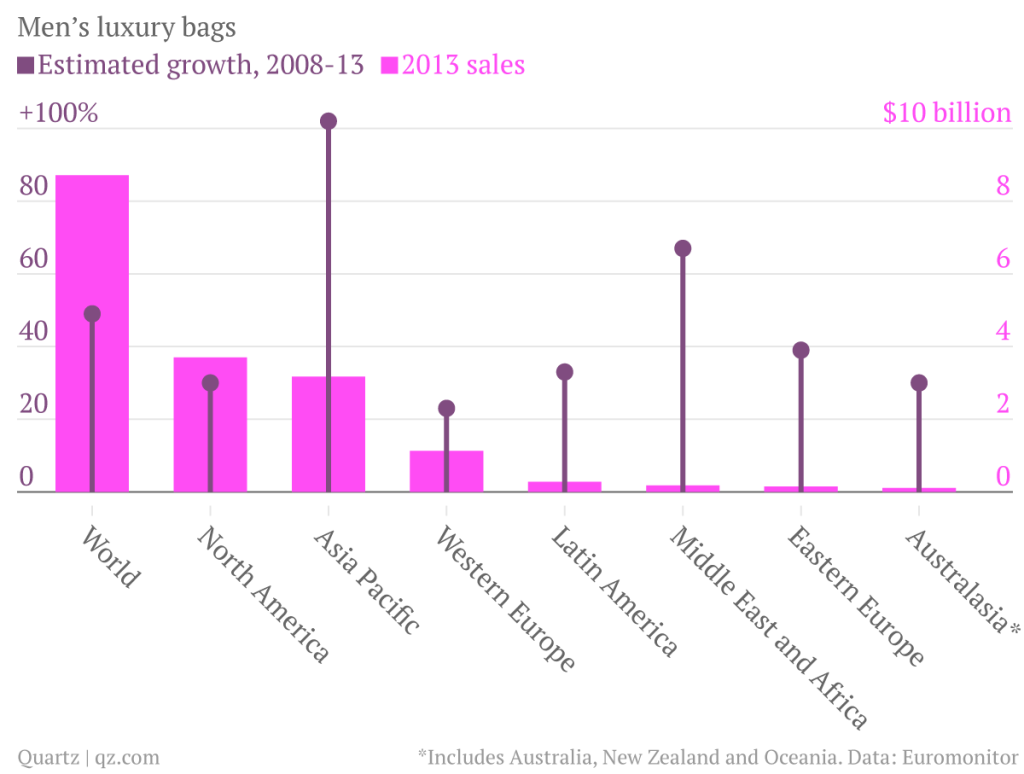
Don’t laugh at the “man purse”—it’s now a $9 billion luxury business

Don’t laugh at the “man purse”—it’s now a $9 billion luxury business

By Jason Karaian @jkaraian 6 hours ago

handbag-growth-forecast-2012-to-2018-growth-2008-13-sales-2013-bn-_chartbuilder handbag-growth-forecast-2012-to-2018-men-s-women-s_chartbuilder_1

All is not well in the luxury world. Stalwart luxury buyers in China are cutting back, according to recent statements from Burberry and Richemont, among others. New data from research firm Euromonitor International confirms that the industry is in a bit of a slump. Global luxury sales are on track to grow by 3% this year, the slowest rate in four years. Euromonitor reckons that growth will pick up next year, though, driven by its strongest segment in recent years: accessories, specifically men’s accessories. The luxury goods industry has been “manning up” of late, says Fflur Roberts of Euromonitor. A host of luxury brands are opening men’s only stores, tapping a less saturated market undergoing significant shifts in tastes.

Read more of this post

Whole Foods Selling K-Cups in Challenge to Green Mountain

Whole Foods Selling K-Cups in Challenge to Green Mountain

Whole Foods Market Inc. (WFM) started selling organic private-label coffee pods that fit into Green Mountain Coffee Roasters Inc.’s Keurig machines, providing more competition for the single-serve coffee company’s K-Cups. A 12-pack of 365 Everyday Value brand K-Cups is $8.99 at U.S. Whole Foods stores, and there are five varieties, Emily Wright, a spokeswoman for the Austin, Texas-based company, said in an e-mail. Whole Foods, the largest natural-goods grocer in the U.S., has no relationship with Green Mountain, she said. A 24-pack of Green Mountain brand French Roast K-Cups sells for $16.49 on its website. Read more of this post

BlackBerry Breakup Looms as Investors Lose Faith in Buyout

BlackBerry (BBRY) Ltd. is more open to a breakup of the company amid concerns that Fairfax Financial Holdings Ltd. (FFH) may be unable to line up funding or partners for a $4.7 billion buyout, a person with knowledge of the matter said. Companies such as SAP AG (SAP), Cisco Systems Inc. (CSCO) and Samsung Electronics Co. (005930), which were approached last week by BlackBerry advisers, have indicated they’re only interested in parts of the company, people familiar with the discussions said. A breakup would let parties bid for BlackBerry’s most valuable pieces, such as its patents or enterprise network, said the people, who asked not to be identified because the talks are private. Read more of this post

Rail to Royal Mail: the dangers of flawed privatisations

October 10, 2013 11:21 am

Rail to Royal Mail: the dangers of flawed privatisations

By Philip Augar

Intervention addresses the symptoms but not the causes of malfunctioning, writes Philip Augar

Is the UK’s privatised utilities market broken? It is a fair question on the day when Royal Mail – once seen as an untouchable public asset – makes its stock market debut, when Ed Miliband, Labour party leader, finds public resonance with the idea of a price freeze in the energy sector and when the government has to step in to cap rail commuter fares. The need for price intervention illustrates the risks of privatising a state-owned utility. If the regulatory balance is wrong or the competitive structure ineffective, the public ends up paying too much, corporate profits become too high and private sector shareholders get a free ride from taxpayers. Read more of this post

The fast-approaching end of the jumbo jet era; Airlines now want midsized aircraft that are cheap to fly and easy to deploy

October 9, 2013 7:32 pm

The fast-approaching end of the jumbo jet era

By John Gapper

Airlines now want midsized aircraft that are cheap to fly and easy to deploy

With its sale of composite, fuel-efficient A350 jets to Japan Airlines this week, Airbus entered a market that Boeing has, until now, controlled. It also provedBoeing’s point. The era of the grand aviation project, symbolised by Airbus’s decision more than a decade ago to build the A380 as a superjumbo rival to the Boeing 747, is over. Airlines do not want jumbos. They want midsized aircraft that are cheap to fly and easy to deploy – as the Boeing 787 will be if the company can stop its lithium-ion batteries catching fire. Read more of this post

Big fund managers go into battle over tougher US capital rules

October 10, 2013 2:19 pm

Big fund managers go into battle over tougher US capital rules

By Stephen Foley in New York and Gina Chon in Washington

The world’s largest fund managers are preparing a lobbying push to forestall tougher capital rules in the US and greater oversight of their activities, which have been mooted in the name of financial market stability. The industry has reacted angrily to a report last week that suggested companies with trillions of dollars under management might be considered “systemically important”. Read more of this post

SMEs in peripheral eurozone face far steeper borrowing rates

October 10, 2013 2:15 pm

SMEs in peripheral eurozone face far steeper borrowing rates

By Patrick Jenkins, Banking Editor

Small and medium-sized businesses in theperipheral eurozone are having to pay as much as triple the interest rate levied on German SMEs’ bank borrowing, according to a new report on eurozone credit conditions. The higher cost of credit and the contraction of its availability – legacies of the financial crisis and the regulatory crackdown on bank capital – are “starving” SMEs, according to the report, jointly authored by the Institute of International Finance, the global banking industry body, and Bain & Co, the consultancy. Read more of this post