U.S. Shale-Oil Boom May Not Last as Fracking Wells Lack Staying Power
October 11, 2013 1 Comment
U.S. Shale-Oil Boom May Not Last as Fracking Wells Lack Staying Power
By Asjylyn Loder October 10, 2013
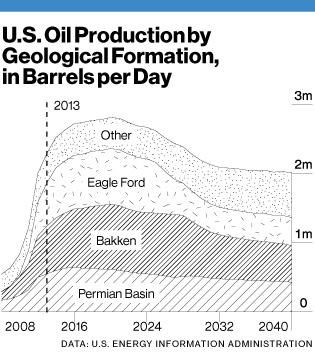
Chesapeake Energy’s (CHK) Serenity 1-3H well near Oklahoma City came in as a gusher in 2009, pumping more than 1,200 barrels of oil a day and kicking off a rush to drill that extended into Kansas. Now the well produces less than 100 barrels a day, state records show. Serenity’s swift decline sheds light on a dirty secret of the oil boom: It may not last. Shale wells start strong and fade fast, and producers are drilling at a breakneck pace to hold output steady. In the fields, this incessant need to drill is known as the Red Queen, after the character in Through the Looking-Glass who tells Alice, “It takes all the running you can do, to keep in the same place.”The U.S. is producing 7.8 million barrels of oil a day, more than it has in a quarter-century. Crude from shale formations has cut reliance on imports and put the U.S. closer to energy independence than it’s been since 1989. The International Energy Agency predicted last year that the U.S. would overtake Saudi Arabia by 2020 as the world’s largest producer.
Whether current production can hold up is the subject of debate. David Hughes, a geoscientist and president of Global Sustainability Research, has examined the life span of shale wells. “The Red Queen syndrome just gets worse and worse and worse,” he says. “The higher production goes, the more wells you need to offset the decline.”
The U.S. Energy Information Administration estimates that about 29 percent of U.S. oil production today comes from so-called tight oil formations. These dense layers of rock and shale are cracked open by blasting water, sand, and chemicals deep underground, creating fissures that allow the oil to flow into horizontal pipes, some of them thousands of feet long. Production from wells bored into these formations declines by 60 percent to 70 percent in the first year alone, says Allen Gilmer, chairman and chief executive officer of Drillinginfo, which tracks the performance of U.S. wells. Traditional wells take two years to slide 50 percent to 55 percent, and they can keep pumping for 20 years or more.
In North Dakota’s Bakken shale, a well formally known as Robert Heuer 1-17R put out 2,358 barrels in May 2004, when it went live. The output proved there was money to be made drilling in the Bakken and kicked off an oil rush in North Dakota. Continental Resources (CLR), the well’s operator, built a monument to it. Production declined 69 percent in the first year. “I look at shale as more of a retirement party than a revolution,” says Art Berman, a petroleum geologist who spent 20 years with what was then Amoco and now runs his own firm, Labyrinth Consulting Services, in Sugar Land, Tex. “It’s the last gasp.”
There are plenty of people who disagree. Aubrey McClendon, founder and former president and CEO of Chesapeake, called Berman a “third-tier geologist” in a 2011 interview on CNBC’s Mad Money With Jim Cramer. Harold Hamm, the chairman and CEO of Continental, estimated in 2010 that there were 24 billion barrels of recoverable oil in the Bakken and other formations underlying the Williston basin. Now, Hamm says improved technology could eventually boost that number to 45 billion: “We’re just getting started,” he says. Since Continental drilled the Robert Heuer, North Dakota’s oil production has increased more than 10-fold to 874,000 barrels a day, beating Ecuador and Qatar, the two smallest members of the Organization of Petroleum Exporting Countries.
Global Sustainability’s Hughes estimates the U.S. needs to drill 6,000 new wells per year at a cost of $35 billion to maintain current production. His research also shows that the newest wells aren’t as productive as those drilled in the first years of the boom, a sign that oil companies have already tapped the best spots, making it that much harder to keep breaking records. Hughes has predicted that production will peak in 2017 and fall to 2012 levels within two years.
“The hype about U.S. energy independence and ‘Saudi America’ is deafening if you look at the mainstream media,” Hughes says. “We need to have a much more in-depth and intelligent discussion about this.” On Oct. 7, Abdalla Salem el-Badri, OPEC’s secretary general, said at a conference in Kuwait that U.S. shale producers are “running out of sweet spots” and that output will peak in 2018.
If the boom goes bust, it will profoundly affect the fortunes of states such as Oklahoma, which from 1907 to 1923 was the biggest oil-producing state in the U.S. Its production has increased more than 80 percent since Chesapeake drilled the Serenity well near the Kansas border, propelled by oil prices that have averaged more than $85 a barrel since the start of 2009. Drills are targeting the Woodford shale, the Mississippi Chat, and the Mississippi lime, hardened deposits left by a shallow sea that covered Oklahoma 350 million years ago.
The cost of drilling a horizontal shale well ranges from $3.5 million in the Mississippi lime to $9 million or more in the Bakken. That’s far more than the cost of a similar vertical well, which goes from $400,000 to $600,000, according to Drillinginfo.
In September, Steve Slawson, vice president for Slawson Exploration, sat in a trailer about 35 miles north of Oklahoma City, watching monitors as his crew shattered the Mississippi lime thousands of feet below. The well, known as Begonia 1-30H, will cost about $3.7 million. One-third of that is the cost of fracking: First, thin pipes loaded with explosives are threaded into the hole to blast the ancient reef. Then, at a cost of about $80,000, the Begonia will consume 50,000 gallons of hydrochloric acid to dissolve the limestone; another $68,000 will pay for 1,000 gallons of antibacterial solution to kill microorganisms that chew up the pipes; $110,000 goes for a soapy surfactant to reduce friction; $10,000 covers a scale inhibitor to prevent lime buildup; and $230,000 purchases 2 million pounds of sand to prop the fractures open so the oil and gas can flow into the well. Then there’s $300,000 in pumping charges, plus the cost of equipment rental, pipe, and water, which brings the price tag for fracking the well to $1.2 million. A host of other things, from cement to Porta Potty rentals, accounts for the rest of the cost.
There’s little doubt Begonia will produce oil, Slawson says. The question is whether it will be enough to cover the cost of drilling and how quickly. Slawson Exploration’s first Mississippi lime horizontal well, the nearby Wolf 1-29H, produced the equivalent of almost 1,185 barrels a day when it started flowing last year and has paid for itself twice over, Slawson says. After the Wolf, a third of his wells were “dogs,” and only a third have come even close to it.
Slawson sees a few more years of growth in U.S. production if prices stay high. Below $70 a barrel, the number of rigs hunting for oil will drop, and production won’t be far behind, he says. “Like anybody else who is over the age of 50 and has been through the boom-and-bust cycle, I am concerned,” he says.
Companies that borrow heavily to pay for drilling will be hit especially hard if prices decline. Since natural gas prices started falling, Chesapeake has been forced to sell off assets to pay for drilling. It’s also started cutting jobs. Chesapeake would not comment for this story.
Oklahomans know about bubbles. In the Osage Nation, a tribal territory, derelict oil pumps rust away on the prairie, part of the Burbank oil field. Discovered in 1920, the field saw its production peak in 1923 at a daily average of 72,000 barrels. A town of thousands, including 300 businesses, sprang up. The locals called it Whizbang. Today, other than a few farmhouses and a street sign, Whizbang has vanished into the grass.
The bottom line: America needs 6,000 new wells a year, at a cost of $35 billion, to maintain current oil production.
 About bambooinnovator
 Bamboo Innovator
Pingback: Frack, Like Crack, Is Whack: A Compendium of #cdnpoli Questions and Facts… | Dump Harper!