IKEA’s Path to Selling 150 Million Meatballs: The Swedish furniture giant’s IKEA Food division is a behemoth, rivaling Panera Bread and Arby’s
October 17, 2013 Leave a comment
IKEA’s Path to Selling 150 Million Meatballs
Ordering Up a Simple Swedish-Influenced Menu to Fuel Shoppers
JENS HANSEGARD
Oct. 16, 2013 7:58 p.m. ET
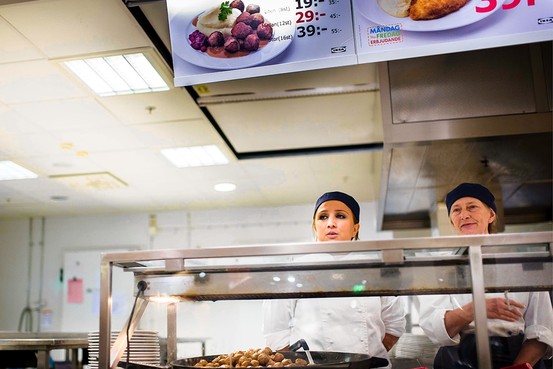
Meatballs are on the menu at an IKEA in Stockholm, shown—and around the world. Ellen Emmerentze Jervell for The Wall Street Journal
When IKEA decided to sell food, it chose to do it in much the same way it sells furniture: a few standardized staples, sold in large quantities. The result: 150 million meatballs. That is the number IKEA estimates will be dished out in store cafeterias this year. Though the Swedish company is better known for its inexpensive, assembly-required furniture, its IKEA Food division is a behemoth, rivaling Panera Bread and Arby’s, with nearly $2 billion in annual revenue. The company estimates about 700 million people this year will eat in one of the cafeterias that are located in 300 IKEA stores world-wide.The food push started nearly 30 years ago, when then-store manager Sören Hullberg drew the assignment to create a food department. IKEA’s frugal founder, Ingvar Kamprad, was worried that too many shoppers were browsing the company’s shelves on empty stomachs. IKEAs are huge, and visitors can get fatigued after walking the floor for hours at a time. Mr. Hullberg said he was told to come up with a plan that would be thoroughly Swedish and in line with the company’s penny-pinching ways.
The solution? Salmon, roast beef, smoked reindeer steak and Sweden’s beloved meatballs. Stores in each country were also allowed to choose one type of local fare to spice up the menu. (Swedes like their native söndagsteak or shrimp.) These basics were designed to be the bedrock ingredient of any dish IKEA served, whether a salad, a sandwich or a starter. The menu has evolved over the years, and individual stores can make some decisions, but generally, the offerings are tightly limited.
“We decided upon five dishes because you can’t have 25 items on a menu in a store that is supposed to serve 5,000 customers on a Saturday,” Mr. Hullberg said. “The guests will have too much to choose from. It won’t work. The staff won’t have time to get the food out and the inventories will be too big,” added Mr. Hullberg, who later left IKEA. He spoke at one of the chic but inexpensive Story Hotels he now owns in Stockholm. Mr. Kamprad declined to comment.
The idea of making a lot of food on site was considered too complicated. IKEA decided to outsource meatball production. While IKEA came up with the formula and specifications, a Swedish food supplier, Gunnar Dafgård AB, was contracted to supply them.
Mr. Hullberg, 63, may have moved on to the hotel industry, and Mr. Kamprad, 87, is now retired, but the philosophy remains—driving some of the items on the menu toward the same level of popularity as the Billy bookcase or Lack table.
Michael La Cour, the current head of IKEA Food, says the goal is to conserve costs. IKEA is famous for crafting new logistics schemes and shaving its energy bills in an effort to keep cutting prices on an annual basis, and the cafeterias are central to this strategy.
“The menu is completely in line with the way we develop furniture,” Mr. La Cour says. “We begin with the end price.”
As a result, IKEA’s restaurant tab is easy on the wallet. In Brooklyn, for example, a plate of 15 meatballs is $5. Kids’ meals start out at $2.99, and breakfast, including eggs, bacon and potatoes, starts out at 99 cents.
Earlier this year, traces of horse meat were found in the meatballs sent to IKEA from Dafgård, the supplier. IKEA pulled all suspicious products from the shelves, resulting in a string of bad publicity.
But the incident doesn’t appear to have dented demand for the meatballs. On Monday, Patrick Krumbholz was in Stockholm to see the world championship soccer game between his native Germany and Sweden. One trip he and a friend had to make while in town was a jaunt to IKEA.
“We’re staying in downtown, but we took the trip to IKEA to eat meatballs for dinner,” said Mr. Krumbholz, sitting with a plate of meatballs, mashed potatoes and lingonberry jam. “They’re tasty and cheap.”
Originally, the idea of IKEA selling meatballs didn’t get a strong reception. When Mr. Hullberg first took his plan to Dafgård, in 1985, he said, “they laughed at us.” He was asked, “What do you mean IKEA? Why do you want meatballs?’ “
Years later, eating meatballs has become an essential rite for many people visiting the store. “IKEA in Dublin is worshiped like a new church,” Annie Morris, a 44-year-old English woman living in Ireland, said in an email. “On Sunday, the car park is always bursting at the seams.” Ms. Morris never fails to stop into the cafeteria after her 40-minute drive to the store. She leaves with bags of frozen meatballs, which can be heated in 15 minutes and make a convenient meal for her four children.
In special circumstances, changes have been made to the menus. Mark Malkoff, an American comedian who is a vegetarian, lived in a New Jersey IKEA for a week in 2008, sleeping in store beds, eating in the cafeteria, and documenting the experience on his website. “I probably drank my weight in lingonberry juice,” he said. “They prepared tofu meatballs for me.”
 About bambooinnovator
 Bamboo Innovator