Norway Debates Demolishing Modern Buildings Containing Picasso Murals in Oslo; Government panel recommended tearing down buildings damaged in 2011 attack; Picasso Administration calls idea “unbelievable”
October 18, 2013 Leave a comment
Norway Debates Demolishing Modern Buildings Containing Picasso Murals in Oslo
Government panel recommended tearing down buildings damaged in 2011 attack; Picasso Administration calls idea “unbelievable”
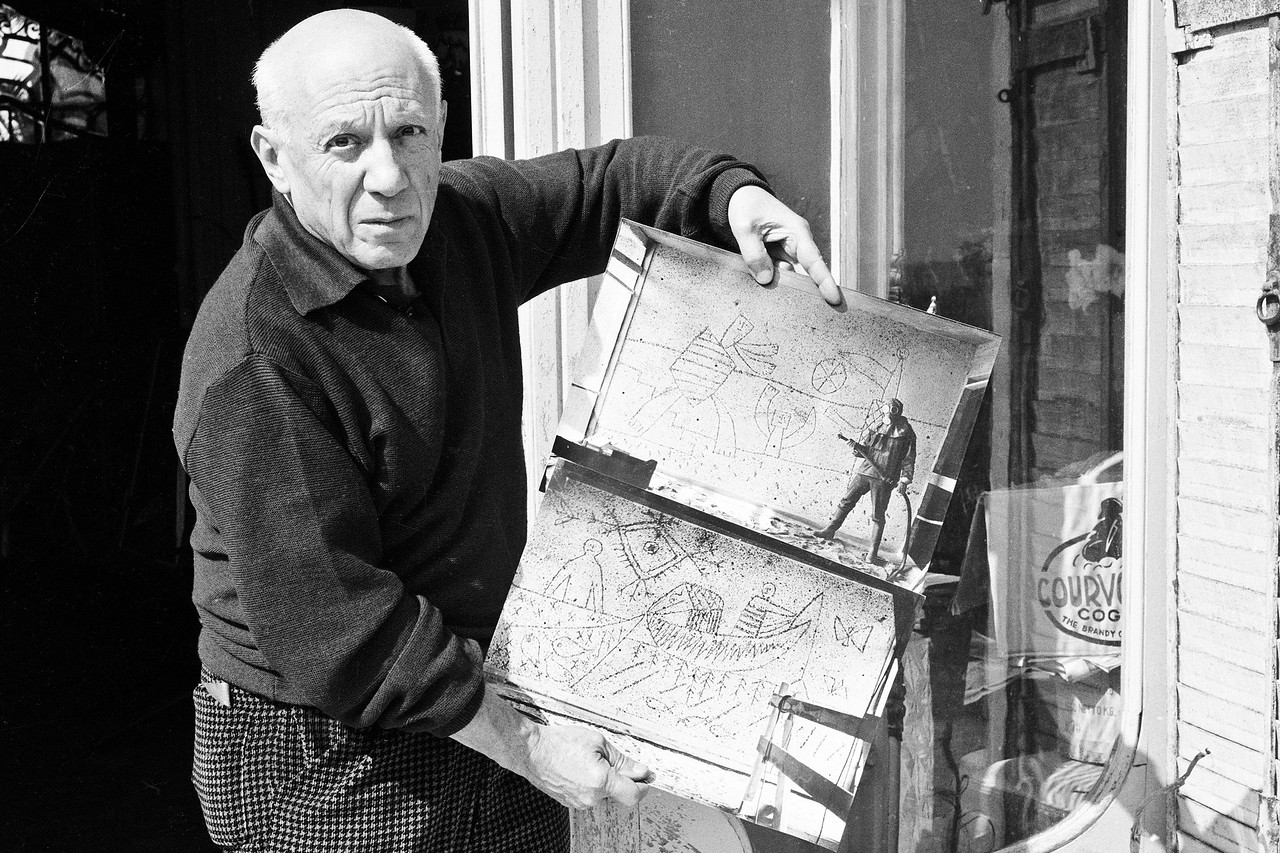
Pablo Picasso is shown here holding photographs of his works for Norwegian architect Erling Viksjo’s buildings in Oslow, Norway. See more images of the murals that might be destroyed. Andreas Harvik/Nasjonalmuseet
CLEMENS BOMSDORF
Oct. 17, 2013 5:32 p.m. ET
Many Norwegians never fully embraced the boxy fortresslike style of architecture known as “Brutalist” that came into vogue in the 1950s. Now, a fierce debate is under way here about whether to demolish two of this city’s signature Brutalist buildings, H and Y-block—which also happen to include four concrete murals by Pablo Picasso.Last summer, a panel of architects hired by Norway’s Ministry of Government Administration, Reform and Church Affairs recommended tearing down the two buildings that were severely damaged in a terrorist bombing attack in July 2011. Since then, the buildings have been abandoned—fenced off behind white protective tape with broken windows—while the government decides what to do with them.
In its decision, the panel said it would be too expensive to repair the buildings. It calculated that it would cost 400 million Kroner ($68 million) and that open-plan offices are more suitable these days. It advised tearing them down and possibly moving the concrete murals, completed in the early 1950s, to another location. The largest mural, “The Fishermen,” is 26-feet tall and 42-feet long and was sandblasted into one of the exterior concrete walls of Y-block by Norwegian artist Carl Nesjar.
The government’s decision has met with a storm of protest by some in the art world, not least of all the Paris-based Picasso Administration, which administers the Spanish artist’s estate.
“It is unbelievable that the report recommended tearing down these buildings without contacting us,” said Claudia Andrieu, legal manager of the Picasso Administration. She added that she found it “very surprising” that the suggestion of demolishing the buildings didn’t include a detailed plan about what should happen with the art.
Ms. Andrieu isn’t enthusiastic about moving the murals either. They “are not like paintings that you can easily take down and move around,” Ms. Andrieu said. “He made those works for these particular buildings and not any other.” She said it is too early to say whether the Picasso Administration could agree on demolition of the buildings under any circumstances.
Ministry officials said they haven’t contacted the artist’s representatives because plans are still preliminary. “We are still in an early phase of the process,” said Michel Midré, deputy director general at the ministry. “It would be natural to get in touch […] in case the need arises, for example due to a move of artworks.”
Norwegian architect Erling Viksjo designed the buildings, which are similar in style to Le Corbusier’s buildings in Marseille and the United Nations headquarters in New York. Karin Hellandsjo, an Oslo art historian, says the main buildings in both Oslo and New York are tall and rectangular (the one in Oslo is therefore called high block) while the “Y-block” is a relatively flat building and has a curved facade—just like the second building in New York.
The modernist architectural style has long been controversial, with critics frequently labeling it totalitarian looking and cold. In a poll conducted by the Oslo newspaper Verdens Gang, 40% were in favor of demolition while 34% were against it.
“Those buildings are simply not beautiful, but ugly and should be demolished,” said Dag Hole, an Oslo-based painter. He isn’t a fan of the art works either. “Not everything that Picasso created was great and the works Nesjar applied for Picasso are not worth keeping.”
Even so, many in the art world condemn the government’s decision. “We have to preserve the works and the buildings,” said Ms. Hellandsjo. “It is not only the first time Picasso worked this way with concrete and an important part of Picasso’s public oeuvre. But it is also the start of his collaboration with Nesjar.”
She also worries that the murals could get damaged if they are removed from the buildings and moved. Ms. Hellandsjo curated an exhibition called “Picasso-Oslo Art and Architecture in the Government Buildings.” The show, on view in the Norwegian Museum of Architecture earlier this month, focused specifically on Picasso’s work in Oslo.
The first Picasso murals in the government buildings were made in the 1950s. Mr. Nesjar executed several other concrete works by Picasso in the following years including the statue “Head of a Woman” at Princeton University.
Mr. Nesjar, now 93 years old, said the buildings should be “kept, repaired and rehabilitated.”
He is against the possibility of moving the murals since “the works of all the artists are site specific and part of those two buildings”.
Jorn Holme, head of the Directorate for Cultural Heritage, says the buildings deserve to be preserved because they represent a “breakthrough of modernism in Norway,” and because they contain Picasso’s murals.
They are also central in Norwegian political history after the World War II, he said.
“The Pantheon in Rome is definitely not an energy-efficient building, still it does not get demolished,” Mr. Holme says. “The current report does not really take conservation into consideration and argues only with cost.”
A final decision is expected early next year. Demolition could start as early as five years from now.
 About bambooinnovator
 Bamboo Innovator