Oshin, a poor girl who perseveres and triumphs against the odds, is said to be inspired by the story of the late Katsu Wada, the woman who founded Japanese departmental chain Yaohan, which is now defunct
October 18, 2013 Leave a comment
Tears flow easily for new Oshin
Friday, October 18, 2013 – 09:27
Yip Wai Yee
The Straits Times
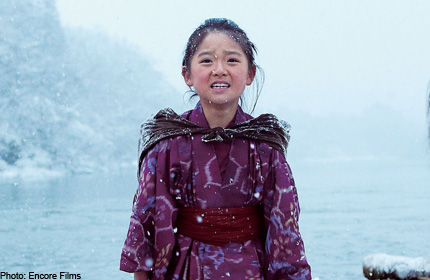
As soon as Japanese child actress Kokone Hamada appears on the webcam for her video interview with Life!, everyone in the room automatically starts cooing. The sweet-faced nine-year-old is fielding media questions over Skype about her movie Oshin, in which she plays the title role of a poor girl who perseveres and triumphs against the odds. Oshin, which openned in cinemas on thursday, is the movie remake of the iconic 1983 Japanese TV drama of the same name which was a global hit that aired in 59 countries, including Singapore. Here, it was so popular that it was dubbed in Mandarin, English and Malay. It is said to be inspired by the story of the late Katsu Wada, the woman who founded Japanese departmental chain Yaohan, which is now defunct.Dressed for the Skype interview in a dark blue kimono with her hair in a bun, the rosy-cheeked Kokone is, really, pretty darn cute. In fact, she is a lot cuter than actress Ayako Kobayashi, now 41, who played the same role in the original TV series and has a role as Mino, one of Oshin’s employers, in the movie.
Speaking in Japanese with a shy smile, she introduces herself ever so politely: “Hello, I’m Kokone and I’m so happy to talk to you today.”
Sitting next to her is the director of the movie Shin Togashi, 53, who chuckles when he sees everyone’s reaction to the girl.
He says he picked the first-time actress out of more than 2,500 audition hopefuls for the role because she “looks like a very good girl at first glance”.
He adds in Japanese via a translator: “She just has the look of a really lovable girl. Also, since the story is set 110 years ago, I needed someone whose face is not too modern, and also with a countryside feel.
“The original Oshin as played by Ms Kobayashi was beloved by audiences, so I knew I had to find a girl who looks like she could have the same impact in the role. In fact, the casting decision for the role was one of the biggest challenges in making the movie. But don’t you think I made the right choice?”
It is only natural that he would feel some pressure in casting the lead part.
The highly rated original TV drama was watched and loved by viewers all over Japan, drawing up to 62.7 per cent of the country’s viewers at its peak.
The story about relentless perserverence in the face of hardship also inspired audiences well beyond Japanese shores. Even now, there are updates of gushy words for the show on YouTube from fans hailing everywhere from Argentina to Ghana.
The story of Oshin revolves around the title character, a poor girl who is sent to work for another family at the age of seven as a babysitter and live-in servant. She grows up and continues to bravely endure all sorts of other hardships, including the death of loved ones and almost getting sold into prostitution.
While the TV drama spans Oshin’s entire life, the movie version focuses on only her childhood.
Says Togashi, who previously made films including coming-of-age tale Sorry (2002) and romantic drama The Angel’s Egg (2006): “The scenes of Oshin when she was young were the scenes that touched the hearts of every Japanese viewer, because they are among the most moving parts of the movie.
“So I wanted to focus on only that part for the movie. There’s no way you can move everything from the TV drama into the movie, as it was so long and it’d just become a mess. Of course, if this movie becomes a big hit, we can think of continuing the story and making part two and part three.”
Explaining the 30-year lag for the movie version of the series, the film-maker adds: “We did this to celebrate the 30th anniversary of Oshin. And I wanted to tell audiences that even after 30 years, there are some things that never change, like the inspirational story of perseverance.
“After the earthquake and tsunami in Japan in 2011, it’s nice to have someone like Oshin to remind people to cherish those around them, and to keep going no matter what happens.”
Though he watched the original TV drama when it aired, he made a deliberate effort not to re-watch it too many times before filming the movie as he “did not want to be affected”.
“I worked with the original script, however, to stay close to the story. But I didn’t want to keep watching the TV show, or I may copy too much from it.
“Since we had a brand new cast, it was important that we worked around and adjusted certain things with the new cast, and not just blindly followed the old one. But the essence of the story of Oshin is definitely still there.”
With no acting experience before this, Kokone admits that she was “nervous” during filming. But she has the director and her fellow cast members to thank for their advice.
“They told me not to just memorise lines and follow the script. They said I had to really put myself in Oshin’s shoes and feel her emotions,” she says sweetly.
Asked how she managed to get the tears flowing for the movie’s many crying scenes, she says after a pause: “I do two things. The first thing is that I’ll think of my parents dying – that will make me cry.
“Or, I just really think I’m Oshin. The things that she had to go through were so tough, so once I think I’m her, I will cry. There was one scene especially when Oshin had to leave her family for the first time, and just kept crying out, ‘Mother, mother’. I cried very easily at that time.”
Togashi says: “Kokone really met, and even exceeded, all of my expectations of her for the role. She is a perfect Oshin.”
 About bambooinnovator
 Bamboo Innovator