As stock splits wane, more may follow Google to $1,000
October 19, 2013 Leave a comment
As stock splits wane, more may follow Google to $1,000
4:17pm EDT
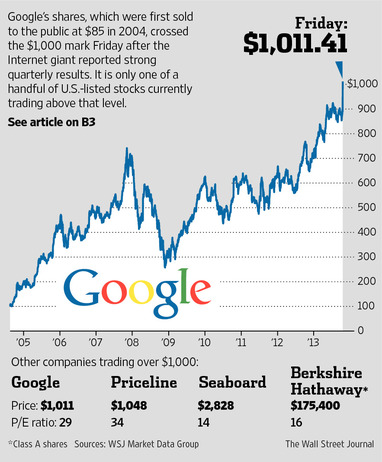
NEW YORK (Reuters) – With its surge on Friday, Google Inc became the latest member, though not likely the last, of a tiny fraternity of companies that boast $1,000 share prices. In a market where stock splits have become rarer, there may be more of this to come than just the two stocks with four-digit stock prices in the Standard & Poor’s 500 index – Google and Priceline.com, which hit $1,000 earlier this year. Historically, once share prices got too high – even around $125 a share – companies split shares to make them more accessible to Main Street investors. But splits have become few and far between, and big numbers are more the norm for familiar names like Apple Inc, Chipotle Mexican Grill Inc, Netflix Inc and Visa Inc. Stock splits peaked in 1986 and 1987, when there were 114 and 111 splits, respectively, and they surged again in the go-go days of the dot-com bubble, with 102 splits in 1997, back when retail investors hungrily chased the tech boom, according to S&P Dow Jones Indices.That frenzy ended after the bubble burst, and has diminished further since the last peak in 2007. The trend now, according to Richard Peterson, director of S&P Capital IQ Global Markets Intelligence group, is for companies to let prices rise as retail and individual investors are not as likely to balk as they once were.
“Many retail investors have migrated off to exchange-traded funds or mutual funds. And many of the trading companies don’t want a split because if you split the shares you inherently increase the trading costs,” said Peterson.
Peterson added that if the trend continues, the market could see more companies join Priceline and Google above the $1,000 a share mark.
“Maybe next year or the year after we could see double digits reach the four digit,” he said.
In 1980, just two stocks in the S&P 500 had a price above $125, and 64 companies split their stocks. That figure has slowly dwindled, and in 2013, there were 41 stocks with share prices north of $125 – and just 11 splits, according to S&P Dow Jones Indices.
Meanwhile, outside of the S&P 500, only a couple have such massive prices: Berkshire Hathaway’s A-class shares, which at $175,748.00 trade just a few hundred shares daily.
The company’s B shares – first issued in 1996 to attract “investors with a long-term perspective,” as Buffett put it then, are the more active. That security was once a $1,000 stock until Warren Buffett’s conglomerate bought railroad Burlington Northern Santa Fe in 2009. The B shares edged down 0.04 percent to $116.97 on the New York Stock Exchange on Friday.
Another $1,000 name is Seaboard Corp, which at $2,810.98 also only trades a few times daily.
To be sure, companies are splitting more now than they did during and immediately after the recession when share prices took a tumble. In 2008, nine S&P companies split their stock, followed by 10 in 2009.
Google Surpasses $1,000 for First Time on Ad Optimism
(Corrects to show record high instead of gain in second paragraph.)
Google Inc. reached $1,000 for the first time amid optimism about new advertising for wireless devices and online video, joining a small club of U.S. stocks.
The world’s largest search-engine company gained 13 percent to a record $1,007.40 before retreating to $1,001.99 at 12:17 p.m. New York time. The stock, sold at $85 in a 2004 initial public offering, has risen every year since except for 2010 and 2008, when it slumped 56 percent during the recession.
The Internet company is benefiting from ads for new formats after expanding beyond delivering advertisements alongside search results on desktop computers. Google should take 33 percent of the global online-advertising market this year, up from 31 percent in 2012, according to EMarketer Inc.
Google, based in Mountain View, California, already has one of the highest market capitalizations in the U.S. at about $330 billion, trailing only Apple Inc. and Exxon Mobil Corp. Among the few companies with a stock price above $1,000: online-travel company Priceline.com Inc. and Seaboard Corp., a producer of turkey and hog with a market value of just $3 billion.
A majority of analysts are predicting further stock gains for Google, with 35 recommending to buy the shares and 13 advising to hold them, data compiled by Bloomberg shows. None has a sell rating. Google is trading at a price-to-earnings ratio of 28, the data show, lower than Facebook Inc.’s 237 and Yahoo Inc.’s 29.
Ad-Price Drop
The stock jumped today after Google reported third-quarter sales and profit that beat estimates yesterday.
As the company navigates a shift to mobile promotions from pricier search-based ads on desktops, it is relying on a simple maxim: volume, not just price. Last quarter, the volume of clicks on advertisements climbed at the fastest pace this year, compensating for a drop in average-ad prices.
“As long as we continue to see that higher-than-expected volume coupled with the lower pricing, I’m OK with it,” said Josh Olson, an analyst at Edward Jones & Co., who rates the stock a buy. “It just signals they have good demand for that mobile business.”
Google also stepped up investments to boost capacity and introduce services that encourage marketers to direct more spending toward wireless devices.
Volume Gains
Third-quarter revenue, excluding sales passed on to partner sites, was $11.92 billion, exceeding the average projection for $11.64 billion, according to estimates compiled by Bloomberg.
Profit excluding certain items was $10.74 a share, topping the average projection of $10.36. Net income jumped 36 percent to $2.97 billion from the year-earlier period.
“They continue to grow — for a company this size, very solid growth, still very profitable despite all the investments they’re making,” said Colin Sebastian, an analyst at Robert W. Baird & Co. who rates the stock the equivalent of a buy.
The push to boost volumes — which rose 23 percent in the second quarter and 20 percent in the first — took its toll on Google’s gross profit margin, which shrank to 56.9 percent, the lowest level this year, based on data compiled by Bloomberg.
The search provider has been working to address falling prices. This year, it introduced an advertising service called “enhanced campaigns,” encouraging marketers to funnel more of their spending to wireless devices.
The campaigns and other initiatives should help average ad prices recover in the next year or so, according to Victor Anthony, an analyst at Topeka Capital Markets Inc.
‘Best of Class’
“The results clearly demonstrate that Google remains kind of the best of breed, best of class in the online advertising space, really within the Internet space itself,” Anthony said.
Revenue at Google’s sites, including the search page and YouTube, expanded 22 percent, faster than the 18 percent in the previous quarter.
“My goal was to ensure that Google maintains the passion and soul of the startup as we grow,” Chief Executive Officer Larry Page said in a call with analysts yesterday. “That’s why I worked so hard to increase the velocity and execution.”
Page, who became CEO in 2011, said that he won’t join every earnings call in the future, citing a need to prioritize his time. The co-founder last missed a call in July 2012 after he lost his voice, which forced him to miss other company events as well. In May, Page disclosed a health condition resulting in hoarse speech and labored breathing, noting that it wouldn’t impede him from running the company.
Ad Growth
Google is making other changes. Earlier this month, the search provider said it would update its marketing rules to allow users’ names and photos to be used in more promotions.
The company and Facebook are taking market share from Yahoo, which earlier this week reported a decline in revenue, while profit was bolstered by the Web portal’s stake in China’s Alibaba Group Holding Ltd.
Google is pushing for better results in other areas, including in hardware. Its Motorola mobile unit, which the company bought last year in its biggest acquisition ever, announced a flagship Moto X smartphone in August, an effort to boost sagging market share. Revenue in the division declined 34 percent to $1.18 billion.
“Google has a lot of things going for it,” said Sameet Sinha, an analyst at B. Riley & Co, who rates the stock a buy and doesn’t own it. “Google has its fingers in every pie.”
To contact the reporter on this story: Brian Womack in San Francisco at bwomack1@bloomberg.net
A ‘Grand’ Moment for Google: Mobile Push Spurs Milestone
Shares Cross $1,000 as Company Shows Mobile Advertising Is Working
DON CLARK
Updated Oct. 18, 2013 7:07 p.m. ET
The mobile Internet appears to be helping, rather than hurting, Google Inc.GOOG +13.80% ‘s lucrative advertising machine, easing investor worries and propelling its shares past a major milestone.
The Internet giant’s stock leapt 14% Friday to close above $1,000, a rarity among public companies that underscores Google’s relentless progress since its August 2004 IPO at $85 a share.
The spurt made Google the third most-valuable U.S. company by market capitalization, with a value of $338 billion, behind only Apple Inc. AAPL +0.87% andExxon Mobil Corp. XOM +0.08% A $1,000 investment in the IPO would now be worth $11,899.
Investors reacted positively to Google’s financial results Thursday, which showed that the company can make very good—or even better—money as users around the world conduct searches on smartphones rather than personal computers.
The rise of mobile devices had raised fundamental questions for the company: Would users conduct as many searches as on PCs? Would they click on as many ads? Would advertisers pay as much for a fingernail-sized spot on a phone as they do on a PC?
The numbers Google disclosed Thursday undercut those fears. The number of “paid clicks”—the times a user clicks on an advertiser’s link during a search—surged 26%, the highest growth rate in a year.
As has been the case recently, the amount paid per click declined, this time by 8%. But the total volume of searches, driven by the rise of mobile devices, far outweighed the falling per-click rates.
Google doesn’t disclose the actual number of paid clicks. But Mark Mahaney, an analyst at RBC Capital Markets, estimates the total will reach nearly 125 billion in 2013, up 24% from the prior year and nearly triple the figure of five years ago.
That is the rough equivalent of 36 clicks on Google ads this year from each of the world’s approximately 3.4 billion PCs, smartphones and tablets.
Such numbers, Mr. Mahaney says, help to show that mobile devices are prompting people to conduct more searches than before—just as mobile phones led people to make more calls.
“This ‘mobile is a cannibalization threat’ has just been shown to be factually not true,” he says.
If so, steadily increasing sales of mobile devices could help Google for a long time. “What all this leads up to is that investors just feel this is a longer-term story,” says Gene Munster, an analyst at Piper Jaffray.
The positive trend could help raise investor sentiment in Twitter Inc., which is planning an IPO this year and said it makes 70% of its revenue from mobile ads. Shares of companies with a stake in mobile advertising, including Facebook Inc., Pandora Media Inc. and Yahoo Inc., all showed strong gains on Friday.
Advertisers large and small participate in Google’s automated online auctions, where they bid to have their ads placed in the best spot when users search for particular terms. The company is only paid if a user clicks on the advertiser’s link.
The rise of mobile devices raised complications for advertisers. For one thing, they needed to separately devise ad campaigns for mobile devices, adapting them to the smaller screen and other features. They faced decisions such as creating ads specifically for Android or Apple Inc. devices. Some advertisers simply opted not to try mobile ads because of the headaches, Google has said.
So the company developed a new system called “Enhanced Campaigns,” which was designed to let advertisers set one basic ad campaign for smartphones, tablets and PCs. Google introduced it in July, and analysts said it seems to be spurring more advertisers to bid on mobile ads.
Google’s Mr. Page made a case that mobile ads bring particular benefits to advertisers, prompting users to visit or call retailers. He told analysts on Thursday that more than 40 million calls are driven by Google ads every month, twice as much as a year ago.
At the same time, Google is becoming a greater factor on other devices consumers encounter—including TVs, through a recent device that helps display results from a laptop or tablet on a TV screen, another opportunity for advertisers beyond PCs and smartphones.
“Screens are proliferating in the home as well as wearable screens like watches and Google Glass,” Mr. Page said.
 About bambooinnovator
 Bamboo Innovator