European Pharmaceuticals’ Health Kick Could Sicken on Emerging Markets
October 21, 2013 Leave a comment
European Pharmaceuticals’ Health Kick Could Sicken on Emerging Markets
Drug Makers May Find a Tough Road Ahead
HELEN THOMAS
Oct. 20, 2013 8:59 p.m. ET
Talk about a pick-me-up. European pharmaceutical companies have proved the drug of choice for investors, with the sector’s valuation expanding to about 13 times forward earnings today from about 10 times a year ago. The sector’s old-world stocks still lag behind their U.S. peers, where astronomical multiples awarded to Bristol-Myers Squibb BMY +0.10%and Eli Lilly LLY -0.28% flatter the group’s average. Still, European pharma’s newfound well-being remains notable. The problem is that progress from here looks tougher. The sector’s run has been supported by a broader rally: Its valuation relative to the European stock market remains effectively unchanged, notes Bank of America Merrill Lynch.
But there are other reasons to justify European pharma’s good fortune. The sector is tantalizingly close to putting behind it years of revenue declines due to successful drugs losing patent protection. Excluding AstraZeneca,AZN.LN -0.02% which remains stalled, earnings per share among Europe’s pharmaceutical companies are expected to expand at a compound annual rate of 9% from 2014 to 2017, notes BofA, up from about 5% a year ago.
There is mounting evidence, too, of more success with research and development. The European sector looks set to deliver 13 to 15 major new drug approvals this year, which could generate peak annual sales totaling $23 billion, Deutsche Bank says.
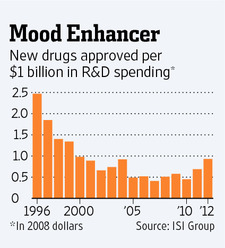
Measuring R&D productivity is challenging. But analysis from Mark Schoenebaum at ISI Group suggests that the industry is getting more for its money. The number of new drugs approved for each $1 billion of R&D spending has been rising since 2010 and is near its highest level in a decade.
The catch: In the near term, the European sector faces potential headwinds. Currency volatility is likely to have hit sales in the third quarter, particularly for those companies reporting in euros.
The bigger unknown is what sort of impact recent ructions in emerging markets will have on growth.
Probes into pricing and marketing practices in China have added uncertainty, thoughRoche Holding, RO.EB -0.90% among the strongest companies in the sector, on Thursday reported 16% sales growth in China for the third quarter.
A broader slowdown remains a risk. Roche’s emerging-market sales rose 9% in the quarter, just half the rate reported in the same quarter last year. That is a particular issue for European companies, which make between 20% and 35% of their pharmaceutical and vaccine sales in the developing world, according to Deutsche.
Moreover, investors betting on Europe’s improving prospects are switching into cyclical sectors and away from those like pharma with traditionally defensive properties.
The health of European pharmaceuticals has certainly improved. But investors will need to back the fittest athletes to win from here.
 About bambooinnovator
 Bamboo Innovator