Profit warnings from small UK companies rise

October 20, 2013 2:25 pm

Profit warnings from small UK companies rise

By Alison Smith, Chief Corporate Correspondent

The proportion of the UK’s largest companies issuing profit warnings over a three-month period fell to its lowest level for four years, while warnings from smaller companies were on the rise, according to a report from EY. Analysis by the professional services firm, formerly known as Ernst & Young, also showed that this was only the second quarter since 1999 in which no general retailer issued a warning. Read more of this post

More Businesses Want Workers With Math or Science Degrees

More Businesses Want Workers With Math or Science Degrees

JAMES R. HAGERTY

Oct. 20, 2013 7:30 p.m. ET

MALTA, N.Y.—New York state got an influx of high-tech jobs five years ago when its offer of more than $1 billion of incentives, including cash and tax breaks, persuaded Globalfoundries Inc. to set up a semiconductor plant near Saratoga Lake in this town 25 miles north of Albany. There has been one hitch: Because it is hard to find enough people with the right technical skills around here, about half of the 2,200 jobs at the plant were filled by people brought in from outside New York, and 11% are foreigners. In terms of basic math and science skills, “we’re really floundering here in the U.S.,” Mike Russo, Globalfoundries’ director of government relations, said in an interview. Read more of this post

Every year Germans throw 217m sickies as a result of backaches; the average German worker takes a whole week off work every year, compared with a day in the UK, and barely an hour in Greece

October 20, 2013 4:41 pm

Distraction beats doctors for back pain relief

By Lucy Kellaway

Germany, strong enough to carry southern Europe on its back, stays home at the slightest twinge

Backache is common, hurts like hell and no one has the first idea how to cure it. Neither do they know what brings it on. It can be too much jogging. Or lifting something. Or sitting hunched over a computer all day. Or, as happened to me, it can result from standing on one foot trying to insert the other into a sock. Given that the whole of Europe jogs, lifts things, sits slumped over desks and puts on socks, you might have expected the incidence of bad backs in Europe to be evenly spread. Possibly, at the margin, backs ought to be slightly healthier in richer countries where there are stricter rules on how to lift things, and where more gets spent on ergonomic office furniture. Read more of this post

Combining opposites produces a clear plan for investing

October 20, 2013 6:46 pm

Combining opposites produces a clear plan for investing

By John Authers

Nudging investment industry in right direction deserves a prize

It is now a week since the Royal Swedish Academy of Sciences announced that it would ask Eugene Fama and Robert Shiller to share this year’s prize for economics in memory of Alfred Nobel. At first, many wondered if the Swedish dignitaries had a sick sense of humour. The two are famous for taking opposite sides on whether markets are efficient. A more practical question might be: “What does it mean to say that markets are efficient or inefficient, and in any case what can we do about it?” Read more of this post

American Debt, Chinese Anxiety

October 20, 2013

American Debt, Chinese Anxiety

By MENZIE D. CHINN

Madison, Wisconson — Last week, the United States once again walked up to the precipice of a debt default, and once again the world wonders why any country, much less the world’s largest economy, would endanger its financial reputation and thus its ability to borrow. Though a potential global financial crisis was averted at the last minute, one notable development has been a string of warnings by Chinese officials. Prime Minister Li Keqiang told Secretary of State John Kerry that he was “highly concerned” about a possible default. Yi Gang, deputy governor of China’s central bank, warned that America “should have the wisdom to solve this problem as soon as possible.” An opinion essay in Xinhua, the state-run media agency, called “ for the befuddled world to start considering building a de-Americanized world.” Read more of this post

The Value of Corporate Culture

The Value of Corporate Culture

Luigi Guiso, Paola Sapienza, Luigi Zingales

NBER Working Paper No. 19557
Issued in October 2013
We study which dimensions of corporate culture are related to a firm’s performance and why. We find that proclaimed values appear irrelevant. Yet, when employees perceive top managers as trustworthy and ethical, firm’s performance is stronger. We then study how different governance structures impact the ability to sustain integrity as a corporate value. We find that publicly traded firms are less able to sustain it. Traditional measures of corporate governance do not seem to have much of an impact.

Turkey must show allegiance to west as doubts rise over ties

October 20, 2013 12:48 pm

Turkey must show allegiance to west as doubts rise over ties

By Daniel Dombey in Istanbul

Has Turkey, a member of Nato for 61 years, parted company with the west? It is a question Turkey’s allies have begun to face. Three issues have converged to create the doubt: Ankara’s decision to buy a Chinese missile defence system; its alleged ambivalence towards al-Qaeda affiliated fighters in Syria; and, most recently, allegations that Turkey betrayed Iranians spying for Israel to Tehran. Read more of this post

$11.6 Trillion Treasuries Market Losing Cachet With Weakest Foreign Demand Since 2001

Treasuries Losing Cachet With Weakest Foreign Demand Since 2001

The $11.6 trillion U.S. government bond market is losing some of its luster. America’s borrowing costs are on the cusp of exceeding the rest of the world for the first time since 2010 as a political stalemate over public funding triggered a 16-day government shutdown and jeopardized the nation’s ability to pay its debt. Yields on Treasuries, which averaged less than 1 percent as recently as May, are now within 0.2 percentage point of the 1.57 percent for sovereign debt outside the U.S., according to Bank of America Merrill Lynch indexes.

Read more of this post

Struggling bingo operators fear for future of the game

October 20, 2013 2:42 pm

Struggling bingo operators fear for future of the game

By Roger Blitz and Duncan Robinson

In the parlance familiar to its players, the health of bingo is 28 (in a state), to be a bingo operator is to be 43 (down on your knees) and the game’s prospects are looking rather 44 (droopy drawers). Even those with a rudimentary knowledge of the game may be starting to wonder whether its number is up. Bingo is in trouble. Gala Coral, the biggest operator, is packing up its bingo cards and looking at selling its clubs, a deal that a senior executive admitted would be hard pushed to attract interest. Read more of this post

How to Pay Millions and Lag Behind the Market; Rhode Island’s pension investments in hedge funds have trailed returns earned by the S&P 500-stock index and have cost the state $70 million in fees in a single year

October 19, 2013

How to Pay Millions and Lag Behind the Market

By GRETCHEN MORGENSON

Today’s low-interest-rate environment has made the hunt for investment income tougher than ever. Many overseers of public pension funds, desperate to bolster returns and meet ballooning retiree obligations, have turned from traditional investments like stocks and bonds to hedge funds and private equity. These so-called alternative investments now account for almost one-quarter of the roughly $2.6 trillion in public pension assets under management nationwide, up from 10 percent in 2006, according to Cliffwater, an adviser to institutional investors. Investments in public companies’ shares, by contrast, fell to 49 percent from 61 percent in the period. Read more of this post

China Seeks Clearer View of Government Debt Mountain; Local Governments Have Borrowed a Pile of Money in Recent Years, Leaving Even Beijing Wondering How Much

China Seeks Clearer View of Government Debt Mountain

Local Governments Have Borrowed a Pile of Money in Recent Years, Leaving Even Beijing Wondering How Much

SHEN HONG

Updated Oct. 20, 2013 9:36 p.m. ET

MI-BZ180_CMUNI_NS_20131020173011

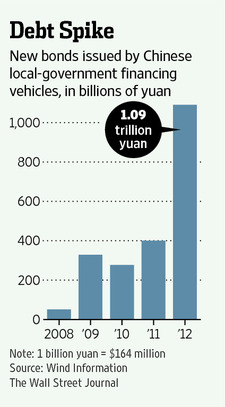
SHANGHAI—In the next few weeks, the Chinese government is expected to release the results of an ambitious effort to calculate a seemingly simple figure: just how much the country’s local governments have borrowed from banks and investors in the past few years. Estimates vary so widely they are almost meaningless. Government officials, analysts and economists have offered numbers that range from 15 trillion yuan to 30 trillion yuan ($2.46 trillion to $4.92 trillion), which equals nearly 30% to 60% of gross domestic product. “The most scary thing is that even the central government doesn’t really know how large the size of the local government debt is,” said Hu Yifan, economist at Chinese brokerage firm Haitong International. The size of the debt and the uncertainty about how much is out there also underscore a major risk facing the Chinese financial system: how little control the central government has over borrowing by cities and towns. Read more of this post

What each country leads the world in

Doghouse Maps J_0

Nordic Hotel Billionaire Petter Stordalen Returns to Scene of Biggest Failure in Denmark; For the former triathlete, the trick is to make every hotel opening a lavish event that dazzles guests and steals newspaper headlines

Nordic Hotel Billionaire Returns to Scene of Biggest Failure

download (27)

Billionaire Petter A. Stordalen, Scandinavia’s biggest hotel owner, says the one time in his career that he did everything wrong ended up being a lesson in how to protect his fortune. The Norwegian national, who won a reputation for building his hotel empire at breakneck speed last decade, learned his lesson after rushing into the Danish market. He lost 800 million kroner ($133 million) from 2000 to 2011 following a property bust that forced him to sell all 12 hotels there. He has now returned to the scene, cherry picking two hotels in Copenhagen. “Last time we did business in Denmark we did everything wrong,” Stordalen, 50, said in interview over breakfast at The Thief, his newest six-star hotel in Oslo. “I expanded too fast. This time we do it differently with brands that are better defined, stronger management and a plan to stay only in Copenhagen.” The lessons are helping Stordalen build his empire, and his personal fortune, even as much bigger competitors including Starwood Hotels & Resorts Worldwide Inc. and InterContinental Hotels Group Plc (IHG) sell properties. For the former triathlete, the trick is to make every hotel opening a lavish event that dazzles guests and steals newspaper headlines. In the past, that’s included arriving on a hotel roof by a bright blue helicopter. He’s even descended from a ceiling with a disco ball while playing drums for an opening in Gothenburg, Sweden. At a hotel opening outside Oslo, he set fire to a guitar for dramatic effect. Read more of this post

Elderly Dying in Crashes Seen Spurring Self-Driving Car Demand

Elderly Dying in Crashes Seen Spurring Self-Driving Car Demand

Self-driving cars being planned by Google Inc. (GOOG) and global automakers may help counter slumping demand from younger customers by tapping the fastest-growing demographic in the world’s largest vehicle markets: the elderly. As baby boomers age in markets including the U.S. and Japan, rising numbers of older drivers being killed or injured in accidents may spur demand for autonomous vehicles. With as many as 90 percent of traffic accidents caused by human error, a key benefit of the technology is boosting safety, executives from automakers including General Motors Co. (GM) and Toyota Motor Corp. said at an industry conference in Tokyo last week. Read more of this post

Aussie Wine Wizard Breaks Rules With $110 Pinot Noir

Aussie Wine Wizard Breaks Rules With $110 Pinot Noir

Start with a mysterious, mega-rich, wine-loving Indonesian entrepreneur living in Singapore. Then tap a talented young Australian winemaker known for his silky, savory pinot noirs. Add in a property in the Yarra Valley north of Melbourne that once belonged to the father of flamboyant 19th-century opera diva Nellie Melba. The result is one of Australia’s most ambitious if polarizing new wine projects, Thousand Candles, whose first two vintages debut in the U.K. this month and in the U.S. in January. They’re already on shelves in Hong Kong, Japan, New Zealand and Norway. The price for each, A$100 ($110), has been widely criticized in the U.K. and Australian press. “We have been accused of hubris,” admits winemaker William Downie. Read more of this post

Delhi hospitals overflow with hidden dengue epidemic

Delhi hospitals overflow with hidden dengue epidemic

Sunday, October 20, 2013 – 12:49

AFP

NEW DELHI – Factory worker Mohammad Awwal is gripped by fever, sweats and the sort of agonising aches that mean his condition is sometimes called “breakbone disease”. It’s an annual plague in India and a hidden epidemic, say experts. Dengue fever is a mosquito-borne disease with no known cure or vaccination that strikes fear into the citizens of New Delhi when it arrives with the monsoon rains – just as the scorching heat of the summer is subsiding. Read more of this post

Resilient cities are the next big thing

Resilient cities are the next big thing

Monday, October 21, 2013 – 06:30

Cheong Suk-wai

The Straits Times

SINGAPORE – The true test of how ready a city is to tackle all threats is how well it operates in storms as well as in sunny conditions. Urban resilience has long been the desired goal for urban planners and city dwellers alike. Now, such resilience is a must-have because deep-pocket corporations and investors are saying they want to move their assets only to cities that will not be shaken easily by sudden or prolonged shocks, whether they are flash floods, smog or a dearth of younger skilled workers. That’s according to global government and education chief Jeffrey Rhoda of technology giant IBM, the company that has long been a champion of the idea of smart cities. Read more of this post

Storm in a doughnut over pricing; many consumers want to know why they are paying twice as much for a bite as their American counterparts. Doughnuts sold here cost more than the ones “in expensive places like London”

Storm in a doughnut over pricing

Customers of Krispy Kreme here are paying more than some of their foreign counterparts. For example, an original glazed doughnut here is priced at S$2.60, while it costs US$0.99 (S$1.20) in the United States and RM2.50 (98 cents) in Malaysia.

Adrian Lim and Samantha Boh

My Paper

Monday, Oct 21, 2013

A top doughnut brand’s entry into the Singapore market has created a buzz. But, for now, the discussion is not focused on the taste and texture of the famous doughnuts. Instead, many consumers want to know why they are paying twice as much for a bite as their American counterparts. Krispy Kreme made its local debut here on Oct 12, with an original glazed doughnut priced at S$2.60. The same doughnut retails at US$0.99 (S$1.20) in the United States and RM2.50 (98 cents) in Malaysia. A dozen of the glazed doughnuts here cost S$23.40, but they go for A$15.95 (S$19.10) in Australia. Krispy Kreme is in good company. Hong Kong dimsum eatery Tim Ho Wan and Sichuan hotpot chain Hai Di Lao Hotpot also charge more in Singapore than in other places. Read more of this post

As body ages, Jackie Chan longs for Hollywood’s full embrace

As body ages, Jackie Chan longs for Hollywood’s full embrace

3:35pm EDT

By Eric Kelsey

BEVERLY HILLS, California (Reuters) – Jackie Chan wasn’t in the mood for proclamations. The Hong Kong martial arts film star, who declared last year at France’s Cannes film festival that he was retiring from action films, now says that after more than a decade of contemplating quitting, he is going to let his body decide. “When I was 40-something the media would ask me and then I said another five years, and then five years and five years until now,” the Kung Fu actor said in an interview promoting his 2012 Chinese action film “Chinese Zodiac,” which will be released in U.S. cinemas on Friday. “Six more months and I’m going to be 60,” Chan said. “And I (will) see how far I can go until my body tells me, ‘Stop.'” Read more of this post

Buy it or hate it, New Yorkers flock to Banksy’s art

Buy it or hate it, New Yorkers flock to Banksy’s art

Sat, Oct 19 2013

By Elizabeth Dilts

(Reuters) – Famously jaded New Yorkers are getting swept up in the hype over Banksy, the renegade graffiti artist who is leaving his mark across the city this month. Known for his anti-authoritarian black-and-white stenciled images, which have sold at auction for upwards of $2 million, the British street artist is treating New Yorkers to a daily dose of spray-painted art – while eluding the police and incurring the wrath of New York Mayor Michael Bloomberg. “Graffiti does ruin people’s property,” Bloomberg said in a press conference Wednesday. Read more of this post

How the Billionaires’ Shadow Government Works

How the Billionaires’ Shadow Government Works

There is no shortage of billionaires — the Koch brothers, Carl Icahn, Dan Loeb and, yes, Mike Bloomberg, to name a handful — who are willing to use their vast wealth to push a particular political agenda or to advocate for a specific social reform. That’s hardly a revelation. Then there’s Tom Steyer, a former Goldman Sachs Group Inc. arbitrager who was mentored by Robert Rubin and eventually formed the San Francisco hedge fund Farallon Capital Management. Since then, Steyer has made a bloody fortune. He has never spoken publicly about how he raked it in at Farallon. Nor has he talked on the record about his years at Goldman. (He didn’t respond to my interview requests when I was writing a book about Goldman in 2011.) Read more of this post

Mexico Tries Taxes to Combat Obesity; The House passed the proposed measure to charge a 5% tax on packaged food that contains 275 calories or more per 100 grams

Mexico Tries Taxes to Combat Obesity

AMY GUTHRIE

Updated Oct. 18, 2013 1:24 a.m. ET

WO-AP870C_MEXTA_G_20131017185103

MEXICO CITY—Congress’s lower house of Congress passed late Thursday a special tax on junk food that is seen as potentially the broadest of its kind, part of an ambitious Mexican government effort to contain runaway rates of obesity and diabetes. The House passed the proposed measure to charge a 5% tax on packaged food that contains 275 calories or more per 100 grams, on grounds that such high-calorie items typically contain large amounts of salt and sugar and few essential nutrients. The tax, which was proposed just this week, is sure to stir controversy among big Mexican and foreign food companies that operate here. It comes on top of another planned levy on sugary soft drinks of 1 peso (8 U.S. cents) per liter that was passed by the same committee, an effort that New York Mayor Michael Bloomberg supported. Read more of this post

Lane Crawford president Andrew Keith talks about why selecting the right mix of goods for Chinese consumers is like conducting an orchestra. Unlike most department stores in the region, which lease store space to individual brands, Lane Crawford buys its own inventory and attracts customers who trust its fashion choices

Lane Crawford Taps Into Chinese Lifestyle

Company president Andrew Keith talks about why selecting the right mix of goods for Chinese consumers is like conducting an orchestra.

JASON CHOW and

WEI GU

Oct. 20, 2013 11:43 a.m. ET

Few luxury brands have been in Asia as long as Lane Crawford, the department store founded in 1850 by Scottish merchants in Hong Kong. But until now, its expansion into mainland China, an important luxury market, has been slow, and has yielded mixed results. Last month, Lane Crawford returned to Shanghai with a new 150,000-square-foot store, after closing one in 2006. In the first half of 2014, the company is planning to open a new store in the western city of Chengdu, its fourth store in mainland China. The company is picking up speed at a time when affluent Chinese consumers start to look for good quality products beyond big brand names. Lane Crawford specializes in bringing lesser-known brands to Asia. Unlike most department stores in the region, which lease store space to individual brands, Lane Crawford buys its own inventory and attracts customers who trust its fashion choices. That means the company’s merchandising is key to the company’s success. Andrew Keith, the president of Lane Crawford and former head of its men’s department, spoke to The Wall Street Journal about why Chinese men are fashion trendsetters and why selecting the right mix of goods for Chinese consumers is like conducting an orchestra. Edited excerpts: Read more of this post
Q&A: KKBOX’s Founder Chris Lin on Profitable Music Streaming in Asia

Oct 20, 2013

Q&A: KKBOX’s Founder on Profitable Music Streaming in Asia

EVA DOU

BN-AB009_kbox_D_20131018051715

With music piracy rampant in East Asia, can a paid music streaming service succeed? Chris Lin is the Stanford-educated founder of KKBOX, Taiwan’s largest cloud-based music service provider and a service sometimes described as an Asian Spotify. Both music streaming companies have been expanding in Asia as they seek to tap this vast market. Unlike Spotify, KKBOX is now profitable. But Mr. Lin said in an interview with The Wall Street Journal that there are still many challenges to hitting it big in Asia, especially in its  key target market like Japan.  Edited excerpts:

WSJ:  How did KKBOX get started?

Mr. Lin: Back in late 2004, iTunes and the iPod were hot, and we decided there was a chance for us to get into the music business. The problem for us in Asia was piracy. But there was piracy in the U.S. too. We thought, if Apple was able to solve the problem, why couldn’t we do it here? People aren’t that accustomed to buying music in Asia, so we didn’t try to sell individual tracks. Rather we decided to sell access. Read more of this post

European Pharmaceuticals’ Health Kick Could Sicken on Emerging Markets

European Pharmaceuticals’ Health Kick Could Sicken on Emerging Markets

Drug Makers May Find a Tough Road Ahead

HELEN THOMAS

Oct. 20, 2013 8:59 p.m. ET

MI-BZ177_PHARMA_NS_20131020163903

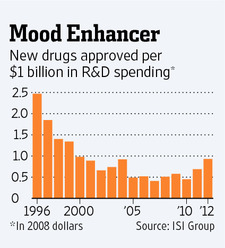
Talk about a pick-me-up. European pharmaceutical companies have proved the drug of choice for investors, with the sector’s valuation expanding to about 13 times forward earnings today from about 10 times a year ago. The sector’s old-world stocks still lag behind their U.S. peers, where astronomical multiples awarded to Bristol-Myers Squibb BMY +0.10%and Eli Lilly LLY -0.28% flatter the group’s average. Still, European pharma’s newfound well-being remains notable. The problem is that progress from here looks tougher. The sector’s run has been supported by a broader rally: Its valuation relative to the European stock market remains effectively unchanged, notes Bank of America Merrill Lynch.

Read more of this post

Todd Y. Park, co-founder of medical technology companies Athenahealth and Castlight Health, Among Team Assembled to Fix Obamacare

Entrepreneur Park Among Team Assembled to Fix Obamacare

Todd Y. Park, the entrepreneur who became the U.S. chief technology officer last year, is among a team of the “best and brightest” now rushing to bring the hobbled Obamacare health insurance websites up to speed. Park, a co-founder of medical technology companies Athenahealth Inc. (ATHN) and Castlight Health Inc., is assisting in trying to fix healthcare.gov, Jason Young, a spokesman for the Department of Health and Human Services, said in a phone interview today. The government last week also asked the site’s main contractor, a unit of Montreal-based CGI Group Inc. (GIB/A), to add staff and assign its “A-Team” to the efforts, Young said. Read more of this post

Will Twitter Have Second-Class Shareholders?

Will Twitter Have Second-Class Shareholders?

When a company goes public, it must tell shareholders how it plans to govern itself. The new owners are promised a piece of the profits and a say in how the company is run. The standard arrangement for apportioning control is “one share, one vote.” That’s a good, tried-and-tested design, but it seems to be going out of fashion. Upcoming initial public offerings by two large Internet companies, Twitter Inc. and Alibaba Group Holding Ltd., are putting a spotlight on dual-class ownership, which gives certain shareholders fewer voting rights, or none. Dual shares, often known as Class A and Class B stock, until recently were out of favor, but they are making a spectacular comeback, especially among technology companies. Google Inc. led the way with its 2004 IPO, followed by LinkedIn Corp., Groupon Inc., Zynga Inc. and Facebook Inc., which all have two or more share classes. Read more of this post

Queue-Jumping Apps Aim to Boost Buzz at British Pubs

Queue-Jumping Apps Aim to Boost Buzz at British Pubs

At Frank’s, a hipster hangout atop a parking garage in South London, drinkers keen for a Negroni or Aperol spritz had to line up for 25 minutes at the height of the summer season. Ben Floyd has a way to jump the queue. Floyd is a co-founder of Bar Pass, an app that lets drinkers order and pay for a round at their table, then collect their beverages when the bartender has poured or pulled them. Frank’s says the app, tested at the bar this summer, cut wait times and helped boost sales. Read more of this post

Motorola looking to exit wireless LAN business

Motorola looking to exit wireless LAN business – sources

Fri, Oct 18 2013

By Nadia DamouniSoyoung Kim and Nicola Leske

NEW YORK (Reuters) – Motorola Solutions Inc is exploring the sale of its underperforming wireless LAN business, which has grappled with declining share in a market dominated by rivals such as Cisco Systems Inc, people familiar with the matter said. An exit from the wireless LAN market would come as Motorola, the provider of data communications and telecommunications equipment, seeks to focus on its core government and public safety division. Read more of this post

Big data heralds return of the Cray supercomputer

Big data heralds return of the Cray supercomputer

7:33am EDT

By Bill Rigby

SEATTLE (Reuters) – “Big data” means big computers, and good news for Cray Inc. The pioneer of supercomputers in the 1970s stood on the brink of obscurity 20 years ago but is now surging back to prominence. Its shares have almost doubled over the past 12 months. The explosion of data – measuring weather, traffic, health and countless other areas – coupled with a desire to tease meaning out of it, demands greater computing power than is accessible via standard machines. Read more of this post