Market attention has been focused on Dongbu Group in recent weeks, based on fears that the group is dogged with an impending liquidity shortage like the ailing Tongyang Group
October 22, 2013 Leave a comment
2013-10-21 17:22
Dongbu’s health still in question
By Kim Rahn
Market attention has been focused on Dongbu Group in recent weeks, based on fears that the group is dogged with an impending liquidity shortage like the ailing Tongyang Group. Despite the face saving denial by its chief, analysts remain skeptical of the group’s financial strength. This recent speculation has been influenced by the failure of some of Tongyang’s affiliates to pay maturing debts and filing for court receivership at the end of last month.A report by Korea Ratings said many of Dongbu’s subsidiaries have had poor earnings, while more than half of their debts are expected to mature within a year, fears that any liquidity problem at any of the units could have rippling effects on the whole group.
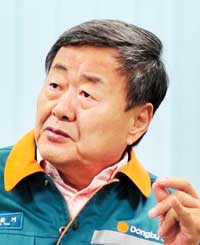
These gloomy forecasts panicked investors, prompting Dongbu Chairman Kim Jun-ki himself to move to calm fears surrounding the health of the group, and especially that of Dongbu Steel, the group’s core affiliate.
On Saturday, he said during the group’s executives meeting at Dongbu Steel’s factory in Dangjin, South Chungcheong Province, that the affiliate does not have corporate bills to repay ㅡ in an apparent attempt to distinguish itself from Tongyang which sold a huge amount of bills to retail investors and inflicted losses to them in the process.
“Some 76 percent of Dongbu Steel’s debts are held by banks and 24 percent are corporate bonds,” he said, indicating the company can borrow money without issuing corporate bills.
“People say the company has a high debt ratio of 270 percent. But such ratio has come temporarily while we have been investing in new businesses, and it is not at a worrisome level,” the chairman said.
Dongbu Steel has corporate bonds worth 105 billion won that will mature in December. Kim said the steel unit recently applied for a government arrangement in which the company repays 20 percent of the bonds while the state-run Korea Development Bank and other creditor banks underwrite the remaining 80 percent.
He said the debt ratio will go below 210 percent next year.
Despite the chairman’s confident remark, analysts say the group still has potential risks.
“Market watchers think Dongbu Steel’s application for the government arrangement is a signal that the company’s cash flow is not good,” Hi Investment & Securities researcher Kim Ik-sang said.
Nice Investors Service economist Kwak No-kyung said in a recent report that Dongbu Group’s financial affiliates are showing good earnings and a fine financial structure, while the non-financial ones are experiencing reduced sales.
“The group is having growing debts as it is carrying out a thermal power generation construction project, which requires huge funds at the beginning stage, and it took over Daewoo Electronics earlier this year,” he said in the report.
An analyst from a credit ratings company also said many of the group’s subsidiaries have seen poor earnings. “The group invested huge money in the steel affiliate but has not gained expected profits. If such a situation continues, the group will face financial difficulty,” he said on condition of anonymity.
But he said Dongbu is different from Tongyang: while the latter sold corporate bills to retail investors, the former’s debts are mainly held by banks and offered tangible assets as securities.
“Dongbu’s financial affiliates can help the steel and other non-financial units within the legal boundaries, and we presume they can offer up to 1 trillion won,” he said.
To relieve the concerns in the market, the analyst said, “The group will have to show a sign to the market that it is actively making efforts to secure funds, such as selling its stake in a port facility in Dangjin. It will be able to secure some 300 billion won through the sale.”
 About bambooinnovator
 Bamboo Innovator