A Crocodile’s Bumpy Road From Farm to Handbag
October 25, 2013 Leave a comment
A Crocodile’s Bumpy Road From Farm to Handbag
By Janice Kew and Andrew Roberts October 24, 2013
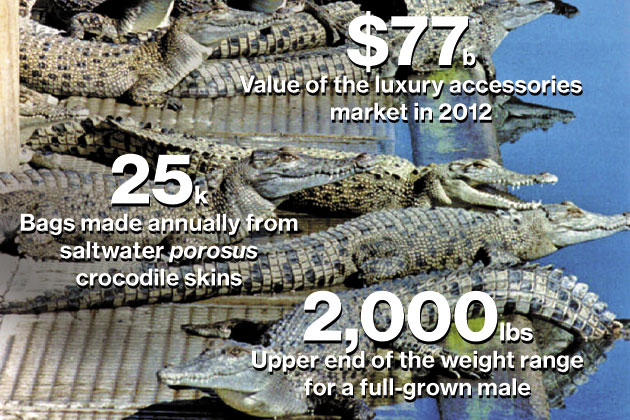
These days, women of every economic stripe can be seen carrying pricey leather handbags. Not so with totes made of crocodile, one of the most difficult luxury materials to obtain, especially in the pristine condition wealthy fashionistas expect. As demand from the world’s elite surges for the skins, luxury goods companies such as LVMH Moët Hennessy Louis Vuitton (MC:FP) and Kering (KER:FP), the owner of Gucci, are making acquisitions to secure a supply of the beasts, whose habits make even collecting their eggs a matter of life and death. Keeping crocodiles from scratching or biting each other as you raise them from hatchling to arm candy is another major challenge.“Louis Vuitton, Prada (1913:HK), and Gucci are trying to elevate the level of perceived exclusivity of their brands, and exotic-skin products really help,” says Mario Ortelli, an analyst at Sanford C. Bernstein. Such skins make up almost 10 percent of the total revenue for luxury brands’ handbag sales, at least double their share a few years ago, he estimates. The incentive for luxury goods companies, many of which are wrestling with sluggish demand for their most widely available products, is clear: Crocodile handbags can cost more than 10 times similar leather ones.
An Hermès International (RMS:FP) Birkin bag, a staple of the wealthy, sells for about $10,000 in leather; the croc version runs about $50,000—with a five-year wait. For those who lack such patience, they’re available used on EBay(EBAY) for as much as $150,000. “There are women who don’t care about money that love the beautiful things,” says Gianluca Brozzetti, chief executive officer of fashion house Roberto Cavalli. “Demand for crocodile and alligator is large because I think it is one of the trends that never ends. It is a classic.”
Although saltwater porosus crocodiles can fetch higher prices, freshwater Nile crocs found in Africa aren’t as territorial or aggressive—although they’re hardly friendly. “If I’d known how hard this business was before I’d got into it, I may not be here today,” says Stefan van As, a former investment banker and owner of South Africa’s Le Croc breeding farm and tannery, which sends about 5,000 Nile crocodile skins to Europe each year.
Cow-leather hides are a byproduct of animals raised for beef. For a crocodile farmer, it’s the skins that pay the bills. (Some people consider croc meat a delicacy, but growers such as Van As simply feed it to the other animals.) An average handbag can be crafted from as few as two skins, for which Van As gets as much as $600 each.
While cows can ruminate for hours on their own in a meadow, from the moment a crocodile hatchling snaps its way out of the egg, Van As has to provide a calm environment to keep the critter from getting restless and damaging its hide. So the reptiles have their pens cleaned daily and are kept on a strict feeding schedule. They dine mostly on chicken and vitamin-fortified oils to improve their skin. All this care promotes growth, reduces stress, and helps keep the contented crocs’ jaws off each other. “The bottom line is that one cannot expect to harvest a first-grade skin from an animal which has been abused,” Van As says.
Nile crocodiles grow to about 16 feet long and weigh up to 1,500 pounds, or about two-thirds the size of the biggestporosus. And they’ll eat almost any prey that ends up in the water. Van As says a rival farmer was killed after falling in. “These are prehistoric animals that rely on instinct to protect themselves,” says Loic Bellet, a marketing executive at Via la Moda, which makes crocodile handbags in Johannesburg. “Obtaining a perfect skin is not easy.”
To protect the belly—the best part for bags—the slaughter, skinning, and even some of the tanning process at Le Croc are done by hand. At about three years of age, when they weigh roughly 50 pounds and are about 6 feet long, the animals are slaughtered. Van As carefully stuns his crocs twice, then cuts the nape of their necks and scrambles their brains with a needle. Some farmers are less gentle, Ben Williamson, a spokesman for People for the Ethical Treatment of Animals, said in an e-mail. This “often results in the crocodile enduring multiple blows, leading to a slow and painful death.”
To help avoid slaughter of wild crocodiles, each skin needs a certificate proving it’s not in violation of international protocols protecting endangered species. Thanks to the success of farming, which yields higher-quality skins, crocs no longer face extinction.
LVMH in February bought an Australian crocodile farm for $2.5 million to assure a steady flow of the animals. The following month, Kering bought tannery France Croco, a Normandy-based operation specializing in the sourcing and processing of crocodile skins for makers of leather goods. “It’s complicated to buy exotic skins,” says Jean Cassegrain, CEO of luxury house Longchamp, which sometimes purchases croc skins from rival luxury houses. “The supply is very limited.”
The bottom line: Accessories made from pristine crocodile skins can cost up to 10 times as much as those made of cow leather.
 About bambooinnovator
 Bamboo Innovator