‘Aristocratic’ Ways Are Getting Tired at P&G; Dividends and Buybacks Have Become Procter & Gamble Stock’s Only Source of Return

‘Aristocratic’ Ways Are Getting Tired at P&G

Dividends and Buybacks Have Become Procter & Gamble Stock’s Only Source of Return

SPENCER JAKAB

Oct. 24, 2013 1:54 p.m. ET
MI-BZ286A_AOT_NS_20131024180303

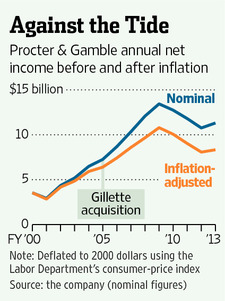
Get ready to hear an aristocrat speak Friday when Procter & Gamble Co. PG -0.37%unveils fiscal first-quarter results. No, revered Chief Executive A.G. Lafley hasn’t been knighted and, oddly, isn’t slated to be on the earnings call. The blue blood is the company itself. Nobody will confuse Cincinnati with Versailles, even if P&G’s headquarters has more floor space than the historic palace. But, by dint of having increased its dividend annually for at least a quarter century, the company is a “dividend aristocrat.” Read more of this post
Indian Banks Head Out to the Country; India’s largest private-sector banks are ramping up their rural networks, building hundreds of backwater branches as a slowing Indian economy squeezes business in the cities. “We are not like a biscuit company that sells you something, you eat it, burp and the work is done”

Indian Banks Head Out to the Country

NUPUR ACHARYA

Updated Oct. 24, 2013 5:10 p.m. ET

MI-BZ297_IBANK_NS_20131024175703

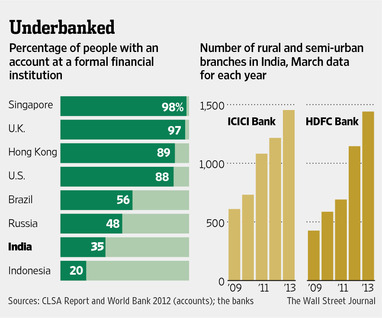
CHOMU, India—Until last year, Anita Yogi had never had a bank account. She would stash what little savings she had around the house. Today, the 26-year-old seamstress from this village in the northwest state of Rajasthan has a new account and a small loan for materials to make saris, the traditional, draped garment worn by women in India. “Now I want to expand my business and save more for my children’s educations,” Ms. Yogi said, showing off her new automated-teller-machine card from HDFC Bank Ltd.500180.BY +1.38% India’s largest private-sector banks are ramping up their rural networks, building hundreds of backwater branches as a slowing Indian economy squeezes business in the cities. Bankers say operations in small towns and villages are booming because they are capturing first-time savers and borrowers in pockets of the country that were previously ignored. This group of customers—and there are hundreds of millions of them in India—is set to be the next big opportunity for the country’s banking industry, which already has a total loan book of close to $1 trillion, according to the Reserve Bank of India, the country’s central bank. Read more of this post

Wal-Mart to Accelerate China Expansion With 110 New Stores

Wal-Mart to Accelerate China Expansion With 110 New Stores

Wal-Mart Stores Inc. (WMT), the world’s largest retailer, plans to add as many as 110 stores over three years in China, while shutting some outlets and remodeling dozens more as it seeks to overhaul its business there. The Bentonville, Arkansas-based company plans to open the new stores from 2014 to 2016 in the world’s second-largest economy, it said in a statement today. The retailer expects to shutter up to 30 under-performing outlets over the next 18 months, Greg Foran, its China chief, said at a media briefing in Beijing today. Read more of this post

Hong Kong aircraft maintenance giant Haeco buys US firm Timco for $389 million to expand global reach

Hong Kong’s Haeco buys US firm Timco to expand global reach

Friday, 25 October, 2013, 3:23am

Charlotte So charlotte.so@scmp.com

Hong Kong aircraft maintenance giant boosts services and product range with purchase of Timco for HK$3 billion

Hong Kong Aircraft Engineering Co (Haeco) has expanded into the United States by acquiring Timco Aviation Services for HK$3 billion, bringing it one step closer to its ambition to be a global player in aircraft maintenance. The acquisition also enables Haeco to strengthen its capabilities in cabin modification, design engineering, testing and certification services. It also could expand its product range to some smaller domestic jets. Read more of this post

Asia exports’ sluggish showing a puzzle

Asia exports’ sluggish showing a puzzle

Friday, Oct 25, 2013

Fiona Chan

The Straits Times

The rebound among developed economies is fuelling a synchronised world recovery, but the good times have yet to start rolling for Asian exporters. Regional manufacturers should be working flat out to meet the increased demand in the United States, Japan and Europe, yet the opposite seems to be happening. Shipments from China, South Korea, Singapore and Taiwan fell last month from the year before, while exports from here for the first nine months of the year are now about 7 per cent lower than in the same period a year ago, according to data out last week. Read more of this post

Return-Hungry Investors Tap ‘Frontier’ Markets; As Growth Elsewhere Becomes Elusive, Riskier Economies Get Noticed

Return-Hungry Investors Tap ‘Frontier’ Markets

As Growth Elsewhere Becomes Elusive, Riskier Economies Get Noticed

ERIN MCCARTHY

Oct. 24, 2013 7:23 p.m. ET

MI-BZ299A_MKTLE_NS_20131024180905

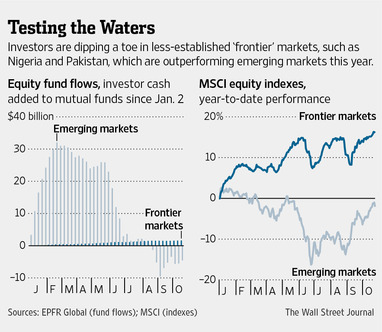
Stock investors are looking for new frontiers. Faced with sluggish growth in developed markets and a recent bout of volatility in emerging markets, fund managers are heading toward riskier countries like Pakistan and Nigeria in the hope of bigger returns. So-called frontier markets—the developing economies considered among the riskiest places to invest—are up 16% this year, according to MSCI Inc. MSCI +0.95% That compares with a 2% drop for stocks in more mainstream developing economies. Read more of this post

Bank Born Out of Black Death Struggles to Survive

Bank Born Out of Black Death Struggles to Survive

Siena, the medieval city renowned for its Palio horse races, is home to the world’s oldest bank. Within its aging walls lies a distinctly 21st century tale of devastation wrought by local politicians and global financiers. Banca Monte dei Paschi di Siena SpA, Italy’s third-largest lender, is struggling to survive as it seeks to repay a second bailout or face nationalization. Its downfall proved a boon to global investment banks. They offered merger and investment advice to executives beholden to politicians that helped wipe out 93 percent of Monte Paschi’s value. Then they sold it complex derivatives that hid, even worsened the losses. Read more of this post

Fed to propose banks would have to hold enough easy-to-sell assets to survive a 30-day credit; estimates a shortfall of about $200 billion in liquid assets across all institutions as a result of the rule

Fed to Propose Banks Hold Funds for Credit Drought

By Jesse Hamilton and Jim Brunsden  Oct 24, 2013

(Corrects spelling of law firm in last paragraph.)

Banks would have to hold enough easy-to-sell assets to survive a 30-day credit drought under a rule to be proposed today by the Federal Reserve that may have the greatest effect on banks with big trading operations such as JPMorgan Chase & Co. (JPM) and Goldman Sachs Group Inc. (GS) The demand for 30 days of liquidity is intended to satisfy global Basel III accords for strengthening the financial system. Increasing the banks’ liquid assets is meant to make them less vulnerable in a crisis like the one that struck in 2008. Read more of this post

Buying spree puts Qatar emir’s daughter atop art’s ‘power list’

Buying spree puts Qatar emir’s daughter atop art’s ‘power list’

5:09am EDT

By Michael Roddy

LONDON (Reuters) – The daughter of the emir of Qatar was named as the art world’s most powerful figure on Thursday after the tiny Gulf state went on an unprecedented spending spree at auction houses and in private sales around the world to fill its new museums. Sheikha al-Mayassa al-Thani, who also heads the Qatar Museums Authority, tops ArtReview magazine’s annual Power 100 list, the second year in a row that a woman has taken the No. 1 spot. Read more of this post