Big Banks Are Padding Profits With ‘Reserve’ Cash; As Revenue Slows, Some Banks Increasingly Use Loan-Loss Reserves to Boost Income
October 27, 2013 Leave a comment
Big Banks Are Padding Profits With ‘Reserve’ Cash
As Revenue Slows, Some Banks Increasingly Use Loan-Loss Reserves to Boost Income
MICHAEL RAPOPORT
Updated Oct. 25, 2013 7:23 p.m. ET
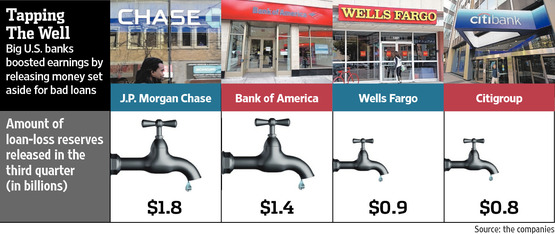
Federal regulators have warned banks to be careful about padding their profits with money set aside to cover bad loans. But some of the nation’s biggest banks did more of it in the third quarter than earlier this year. J.P. Morgan Chase JPM +0.55% & Co.,Wells Fargo WFC +0.40% & Co., Bank of America Corp. BAC +0.64% and CitigroupInc., C -0.18% the nation’s largest banks by assets, tapped a total of $4.9 billion in loan-loss reserves in the third quarter, up by about a third from both the second quarter and the year-ago quarter after adjustments. All the banks except Citigroup showed significant increases compared with the second quarter.Accounting rules allow the money to flow directly into profits. In all, it made up 18% of the banks’ third-quarter pretax income excluding special items, the highest percentage in a year, according to an analysis by The Wall Street Journal.
The moves come at a time when banks are being slammed by revenue slowdowns. Big commercial banks have suffered from a double whammy of plunging mortgage lending and trading activity. Third-quarter revenue for the four banks dropped an average of 8% from the previous quarter. The KBW Bank Index has declined 2% in the past three months, while the S&P 500 stock index has gained 4% over the same period.
The accounting maneuvers show how banks can prop up earnings when business hits a rough patch.
“You’ve seen reserve releases improve the stated numbers,” said Justin Fuller, a Fitch Ratings analyst. “Going forward, I think there’s fewer levers to pull for the banks.”
Investment banks are feeling the squeeze as well. Goldman Sachs Group Inc. cut the funds it set aside for compensation in the third quarter, a move that bolstered its results in the face of a 20% revenue decline from the same quarter a year earlier.
Such moves are “very emblematic of what’s going on,” said Charles Peabody, partner in charge of research at Portales Partners LLC, a financial-services research firm. The degree to which the banks’ earnings rely on loan-loss reserves “exposes the lack of growth” in their traditional businesses, he said.
The banks justify the releases. They cite improvements in credit quality and economic conditions—which make it less necessary for them to hold large amounts of reserves as a cushion against loans that go sour—and they say they are following accounting rules that require them to release funds as losses ease.
A Bank of America spokesman said “the significant impact in credit quality we’ve seen in the last 12 months” has driven the reserve releases. J.P. Morgan, Wells Fargo and Citigroup all pointed to previous comments their top executives recently made indicating that reserve releases were merited because of factors like improving credit quality and the recent increase in housing prices.
But the Office of the Comptroller of the Currency, which regulates nationally chartered banks and federal savings associations, is reiterating warnings to banks about overdoing it.
In a statement to the Journal, Comptroller Thomas Curry said the OCC is monitoring banks’ loan-loss allowances “very closely” and that “we continue to caution banks not to move too quickly to reduce reserves or become too dependent on these unsustainable releases.” He didn’t comment specifically on the banks’ third-quarter releases, but said OCC examiners “will continue to challenge allowances on a bank-by-bank basis if necessary.”
If the regulator finds problems with a bank’s reserves, it can issue a “matter requiring attention,” a specific finding of a deficiency that a bank must address, an OCC spokesman said. The agency has thousands of such findings outstanding on a variety of subjects, but the OCC spokesman wouldn’t say how many, if any, were related to banks’ reserve releases.
Mr. Curry has been vocal on the issue for more than a year. In September 2012, he called it a “matter of great concern,” warning banks that “too much of the increase in reported profits is being driven by loan-loss-reserve releases.”
Last month, Mr. Curry said in a speech that when economic growth is slow, as it is now, banks might take more risks to maximize their returns, and so it is “particularly important” they maintain appropriate reserves. While some level of reserve releases is “certainly warranted,” he said, the ease of boosting earnings through the practice “has proved habit-forming” at some banks, though he didn’t single out any specific institutions.
Mr. Curry said his previous concerns initially seemed to get banks’ attention, and reserve releases temporarily eased, but that was “an anomaly.” Since then, he said, the releases have increased again, despite “loosening credit underwriting standards” that suggest banks are facing higher risks.
The OCC isn’t alone in its concern. Last year, Federal Deposit Insurance Corp. Chairman Martin Gruenberg said the trend of earnings driven by lower loan-loss provisions “cannot go on forever.” An FDIC spokesman said Friday, “We will continue to evaluate and confirm the ongoing adequacy of reserves during our regular examinations.”
Other banks are releasing reserves, as well, though the amounts drop off drastically below the top four. In the second quarter, the most-recent period for which industrywide figures are available, nearly 40% of all FDIC-insured banks released reserves, according to the FDIC. As of June 30, the industry’s bad-loan reserves had fallen to their lowest level as a percentage of total loans since before the financial crisis began, according to FDIC data.
J.P. Morgan released $1.8 billion in the third quarter, including $1.6 billion from its consumer and community banking unit, accounting for 19% of its pretax income after the bank’s giant litigation expenses in the quarter are excluded. That is higher than in recent quarters, though the bank’s nonperforming assets have declined 18% over the past year, helping to justify a larger release.
Bank of America released $1.4 billion, comprising 29% of pretax income, and Wells released $900 million, or 11% of pretax income, its biggest release in more than two years. Citigroup released $778 million, down slightly from the second quarter, and the release amounted to 18% of pretax income. At all three, the percentage of pretax income was up from the second quarter, and nonperforming assets have fallen at all four banks at least 18% compared with a year ago.
Bankers say current accounting rules essentially compel them to release reserves when loan losses ease, because the rules use past and current loan losses as the criteria for determining the proper level of reserves. James Dimon, J.P. Morgan’s chairman and chief executive, has been particularly vocal on the issue—at one point in 2012, he said that, while the bank wants to be conservative on its reserves, “the accountants look at a whole bunch of numbers. They make you take it down. So we had to take it down.”
But critics said banks have more discretion than that, and rule makers at the Financial Accounting Standards Board have proposed changes that would require banks to recognize losses based on expectations of further losses. Such a move would lead banks to record loan losses sooner and set aside reserves more quickly, analysts say.
Those potential changes are still pending, and Mr. Curry said in his speech last month that he supports the “thrust” of the FASB proposal.
 About bambooinnovator
 Bamboo Innovator