The Indian Motorcycle Returns in All Its Glory; The classic motorcycle, with troubled financial past, is back and it looks wonderful
October 27, 2013 Leave a comment
The Indian Motorcycle Returns in All Its Glory
The classic motorcycle, with troubled financial past, is back and it looks wonderful
DAN NEIL
Updated Oct. 25, 2013 6:13 p.m. ET
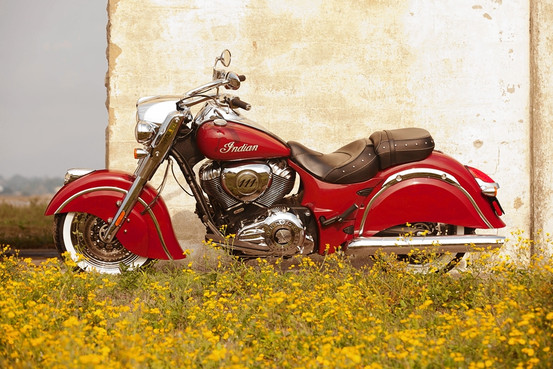
2014 Indian Chief Dan Neil/The Wall Street Journal
WOULD YOU LIKE to hear some good news? After decades of sordid mismanagement and cyclical bankruptcy, the great Indian Motorcycle brand has been reborn in the American heartland (Spirit Lake, Iowa) with alluring retro-modern cruisers powered by beautiful/vulgar 111-inch V-twin engines. Imagine the velvety crumple and flap coming from the streamlined Deco exhaust pipes, the chirr of pushrod tappets ricocheting off canyon walls, the snapping pennants at full throttle. Get a load of this thing coming around a corner. You got a permit for this event?The new bikes look fantastic, sound superb and—if my Chief Classic tester was any indication—they ride like buttah. Excuse me while I slip into something leathery.
This bike has awakened some sort of motorcycle sleeper cell in my soul. The whole wicked, bigger-than-Harley longueur of it—103.5 inches from the fat front tire to fatter rear, over a 68.1-inch wheelbase, with a 29-degree rake and 6.1 inches of trail. The steering geometry gives the Indian an arrow-straight riding demeanor, and if you set the cruise control to 60 mph, you can sit back, take your hands off the grips, lean against the wind, and pretty soon, well, you’re in Utah. A great overland bike.
It is also what you might call joyously enormous. The undressed Chief, with 5.5 gallons of fuel onboard, weighs 812 pounds. That is one 98-pound weakling more than the Moto Guzzi 1400 California I rode a few months back and it is about 100 pounds more than a Harley Softail. The new Indian represents some significant technical achievements—the two-cylinder, 1.8-liter engine is an insanely optimized upgrade of an architecture that was obsolete 50 years ago, for example—but the people responsible for the new Indian weren’t sweating the pounds.
Indeed, if this bike has a fault, it’s the slight sluggishness in the handlebars at low speed. And small wonder. By way of fealty to Indian’s historic, gotta-have-’em design cues, the new Indian front end sports a mirror-chromed steel headlamp housing the size of a serving tray, with separate dual high-beams and turn signals arrayed across a chromed light bar; mighty mirror-chromed telescopic shocks (119 mm); the signature front fender valance with its translucent Indian chief fender ornament, now illuminated with LED. All of which builds inertia around the steering axis, even before you get a quick-release cop windshield on the Chief Classic or opt for the full fairing that comes with the Chieftain. In short, you have to muscle the handlebars around in tight maneuvering.
In a concession to physics, the Chief has front disc brakes, a lot of them: dual, crossed-drilled floating rotors with four-pot calipers and ABS. There is also a single-rotor rear brake with a carlike brake pedal near the right floorboard, though I confess I can’t get used to rear braking.
“‘This bike has awakened some sort of motorcycle sleeper cell in my soul.’”
In the pageant of cruiser bikes currently set before affluent middle-aged dudes, the Guzzi and the Indian are two proofs of the same motorcycle theorem: grandeur over performance, leverage (by way of a low center of gravity) over weight savings, style over speed. At this point in my riding career, that works for me.
The original Indian Motorcycle Company of Springfield, Mass., went belly up in 1953 and since then, there have been numerous attempts to revive the brand, all ignominious. There was much to salvage, after all. Prewar Indians are core curricula in 20th century American industrial design, to be esteemed like Chris Craft wooden motor yachts, early Airstream trailers or Yankee Clipper flying boats. Those days won’t come again.
While Indian made all kinds of bikes, from the hardy, lightweight Scouts to boardtrack racers, the ultimate Indian, the culturally eidetic form, is the 1940-1949 Chief, a rakish thoroughbred,with its scalloped front- and rearwheel fairings, softtail stance, low sprung saddle, wide bars and the charismatic Indian Chief front fender light.
The combination of European-inspired Deco design (the scalloped fairings are a quote from French coachbuilder Panhard-Levassor) and the company’s deeply felt Old West nostalgia (fringed saddles and handlebar tassels, for examples) make the big Chiefs Ground Zero for American Cool.
In 2011, Polaris Industries—the Medina, Minn.-based maker of power sports vehicles such as side-by-side ATVs and snowmobiles—bought Indian after yet another bankruptcy-court filing, this time under the ownership of London-based private equities firm, Stellican Limited, which had moved operations to Kings Mountain, N.C.
Stellican’s business model was particularly obnoxious in that it attempted to reimagine Indian as a low-volume, aspirational luxury brand, i.e., bikes for rich suckers. The mechanicals of these bikes were painfully dated; their 45-degree, single-cam V-twins kind of generic; and the prices outrageous. A 2013 Indian Chief Limited Edition—the last model-year of the Stellican-era bikes—had a base price of $26,499. The 2014 model, our test bike, has an MSRP of $18,999, a drop of 28%.
The comparable Harley-Davidson is the Heritage Softail, with a base price of $18,099; but with anything like a decent paint job, the Softail comes in just over $19,000.
Polaris also owns the Victory Motorcycle brand, which it began in 1998 as a rival to Harley-Davidson. It moved Indian’s final assembly to the Victory plant in Spirit Lake. A trio of all-new bikes—the Chief Classic, the soft bagger Chief Vintage and a hard bagger (with fairing) Chieftain—are powered by a torquey double-pumper of the company’s design: the Thunder Stroke 111 V-Twin, a 49-degree, air-cooled engine, using a three-cam valvetrain geometry in order to re-create the distinctive parallel pushrod tubes of the vintage 80-inchers.
The engine’s aesthetic details are pitch perfect: the Indian chief logo cast into the aluminum primary-drive housing; the delicate Chief’s head embossment on the oil filler; the air cleaner cover polished to numismatic brightness with the antique script “111” on it.
The official specification is 119 pound-feet of torque at 3,000 rpm for this two-piston ass-kicker. At idle, the counterbalance shaft-equipped engine has a bit of a checka-chucka thing going on—the powertrain guys have actually programmed in a little vintage lumpiness into the engine-management software. Crack the throttle and the locomotive breaths come faster, the torque becomes more urgent, but this engine, with its 4.449-inch stroke, doesn’t have a lot of revs in it. The engine is out of steam by about 5,000 rpm, where I estimate the engine is putting out around 70 horsepower (the company doesn’t provide the data).
And it’s all quite civilized. Indian will offer a Stage 1 exhaust pipe option—code for “louder”—but if you want the feral glissades of a straight-pipe V-Twin, this Indian isn’t you bike.
The artistic achievement here is that the Indian, with so much heritage observed, manages to be, somewhat covertly, a modern bike. The frame is cast aluminum; the engine is fuel-injected with by-wire throttle control; and the Indian has ABS, keyless start, cruise control and more.
Look, I get it. It’s a faux collectible, a semblance, a manqué. But Indian is one of the few brands for which I’m willing to suspend disbelief. Again.
2014 Indian Chief
Price, as tested: $18,999
Powertrain: Naturally aspirated, fuel-injected 1.8-liter (111-inch) overhead valve V-twin with by-wire throttle control; six-speed transmission; wet, multi-plate clutch; belt drive
Horsepower/torque: 75 hp at 5,000 rpm (est.)
Length/weight: 103.5 inches/812 pounds (Chief Classic)
Wheelbase: 68.1 inches
Seat height: 26 inches (unladen)
0-60 mph: 6 seconds
Fuel econ: 35 mpg (combined, est.)
 About bambooinnovator
 Bamboo Innovator