Better Than a Tweet? In Four Characters, a New World of Meaning

OCTOBER 27, 2013, 6:22 PM

Better Than a Tweet? In Four Characters, a New World of Meaning

By AMY QIN

There is a Chinese idiom that might be used to describe the place of idioms in Chinese literary tradition: jianding buyi (坚定不移), meaning “firm and unchanging.” The use of such expressions, especially the classical set phrases known as chengyu (成语), has long been seen as a mark of erudition in China. Most chengyu consist of only four characters, but they don’t follow the grammar and syntax of modern Chinese, and as many frustrated Mandarin students can tell you, they are often indecipherable without some knowledge of their origins, usually in ancient Chinese literature dating to the centuries before and after the birth of Christ. Some of the most popular Chinese idioms in use today, though, are of a more modern provenance, having been forged in what is currently the hottest space for linguistic innovation in China — the Internet. These sayings retain the four-character format of the classic idioms but are distinguished by their ironic, contemporary, and sometimes political themes. Popular among Chinese youth, the new idioms may not be considered highbrow, but they offer a window into the humor, culture and concerns of China’s millennial generation. Read more of this post


Wikipedia China Becomes Front Line for Views on Language and Culture

October 27, 2013

Wikipedia China Becomes Front Line for Views on Language and Culture

By GRACE TSOI

HONG KONG — The Chinese-language version of Wikipedia has become more than an online encyclopedia: it is a battlefield for editors from ChinaTaiwan and Hong Kong in a region charged with political, ideological and cultural differences. Wikipedia editors, all volunteers, present opposing views on politics, history and traditional Chinese culture — in essence, different versions of China. Compounding the issue are language differences: Mandarin is the official language in mainland China and Taiwan, while the majority in Hong Kong speak Cantonese. But mainland China uses simplified characters, while Taiwan and Hong Kong use traditional script. Read more of this post

Media Outlets Embrace Conferences as Profits Rise

October 27, 2013

Media Outlets Embrace Conferences as Profits Rise

By LESLIE KAUFMAN

Financially struggling media companies are racing to add conferences, festivals and other live events to their business strategy, convinced they can provide a reliable revenue stream and expand the reach of their brands. The number of organizations staging live events has surged in recent years, say publishers and their business partners, and concerns over conflict of interest, though still a delicate issue at some media companies, are largely bygone relics at others. Read more of this post

Army of Chinese fast food firms challenge McDonald’s, KFC and other foreigners in China

Updated: Monday October 28, 2013 MYT 8:22:21 AM

Army of Chinese fast food firms challenge McDonald’s, KFC and other foreigners in China

SHANGHAI: Bearing rice burgers and lotus roots, an army of Chinese fast food firms is cooking up a challenge to McDonald’s Corp and Yum Brands Inc, tempting cost-conscious diners with healthy, homegrown fare and causing a drag on growth for the U.S. chains in the country’s $174 billion fast food market. McDonald’s said last week it was thinking of slowing expansion in China as diners are tempted by local rivals. KFC-parent Yum warned this month economic weakness in China would drag on a recovery in sales dented by a food safety scare at the end of last year. Read more of this post

Forging an Art Market in China; In China’s growing art market, now the second largest in the world, outsize auction results often overshadow false sales data and forged art

Forging an Art Market in China

By David Barboza, Graham Bowley and Amanda CoxAdditional Reporting by Jo Craven McGintyBEIJING, October 28, 2013

点击查看本文中文版 | Read in Chinese »

When the hammer came down at an evening auction during China Guardian’s spring sale in May 2011, “Eagle Standing on a Pine Tree,” a 1946 ink painting by Qi Baishi, one of China’s 20th-century masters, had drawn a startling price: $65.4 million. No Chinese painting had ever fetched so much at auction, and, by the end of the year, the sale appeared to have global implications, helping China surpass the United States as the world’s biggest art and auction market. But two years after the auction, Qi Baishi’s masterpiece is still languishing in a warehouse in Beijing. The winning bidder has refused to pay for the piece since doubts were raised about its authenticity. Read more of this post

China Won’t Lose Its ‘Voice’ Despite New TV Restrictions

October 25, 2013, 10:22 AM

China Won’t Lose Its ‘Voice’ Despite New TV Restrictions

Fans of ”The Voice of China,” have no fear. The show is staying put.

Broadcaster Zhejiang Satellite TV has confirmed it will continue airing the hit show despite new regulations that take aim at broadcasts based on formats developed abroad, and said it is tweaking other shows to make sure they conform with the new restrictions. “The Voice of China” is based on a Dutch show, “The Voice of Holland,” that has done well in its international iterations, including as “The Voice” in the U.S. Read more of this post

Are Eager Investors Overvaluing Tech Start-Ups?

OCTOBER 27, 2013, 11:00 AM

Disruptions: Are Eager Investors Overvaluing Tech Start-Ups?

By NICK BILTON

Pinterest is a kind of Internet message board where people post their favorite images of clothes or furniture. It’s a three-year-old company and though it has an estimated 50 million unique monthly users, it doesn’t have any revenue yet. Still, the investors behind a $225 million round of financing that was announced last week estimated the company’s value at $3.8 billion. Read more of this post

Disney Show Will Appear First on App for Tablets

October 27, 2013

Disney Show Will Appear First on App for Tablets

By BROOKS BARNES

LOS ANGELES — A cat in a pink cowboy hat is leading Disney’s television operation deeper into the Wild West of mobile viewing, where it hopes to connect with the company’s core audience. Noting that tablet computers like the iPad are increasingly the “first screen” for pre-school-age viewers, Disney executives said they would make the first nine episodes of a prominent new series available on mobile devices first. The series, “Sheriff Callie’s Wild West,” will arrive on the Watch Disney Junior app and a related Web site on Nov. 24. Then, early next year, the series will have its debut on two traditional TV networks, Disney Channel and Disney Junior. Read more of this post

Debt: A deceptive calm: Investors are wary that the tranquility in eurozone bond markets could breed complacency

October 27, 2013 7:55 pm

Debt: A deceptive calm

By Ralph Atkins in London

Investors are wary that the tranquility in eurozone bond markets could breed complacency

James Carville, an adviser to former US President Bill Clinton, wanted to be reincarnated as the bond market, complaining that it was more powerful than presidents or popes. “You can intimidate everybody,” he moaned. He should have moved to Rome. This year, Italy has had an inconclusive election, a government often on the brink of collapse and an economy struggling to leave a deep recession. But the bond markets have been noticeably quiescent. Rather than Rome’s borrowing costs rising as investors worried about the security of Italy’s public debt, the difference – or “spread” – between the yield on 10-year Italian and German government bonds has fallen to levels unseen since the eurozone crisis hit the country more than two years ago. Read more of this post

Beijing’s caution on reforms: China does not have the luxury of deferring all changes until conditions suit, says Eswar Prasad

October 27, 2013 6:57 pm

Beijing’s caution on reforms makes sense – for now

By Eswar Prasad

But China does not have the luxury of deferring all changes until conditions suit, says Eswar Prasad

Cataloguing China’s economic risks has become a popular parlour game. In the past decade, a steady drumbeat of warnings has predicted imminent collapse. Rising state and local government debt, a weak financial system and multiplying inefficiencies in the economy certainly pose big risks. The reforms needed to maintain growth and improve its quality have been painfully slow. Read more of this post

Forget China: Growth is ‘driven by knowledge – at the level of society, not the individual’

October 27, 2013 2:57 pm

Forget China and switch to Zimbabwe, Mexico or Egypt

By John Authers

Growth is ‘driven by knowledge – at the level of society, not the individual’

Where does growth come from? Why do some countries “emerge” and take on “developed” status, while others flounder before reaching that stage? Some once highly unlikely candidates have emerged as powerful economies. South Korea, for example, grew in two generations from a peasant economy devastated by war, to a fully paid-up member of the developed world. Others once far better placed have stumbled. Read more of this post

Regulators have growing concerns about the mortgage vehicles amid concerns that a rapid rise in interest rates could trigger a sell-off

October 27, 2013 6:07 pm

Fed probes banks’ exposure to mortgage vehicles

By Tracy Alloway, Arash Massoudi and Michael Mackenzie in New York

Regulators at the New York Fed have been probing banks’ exposure to a type of mortgage investment vehicle that has proliferated since the financial crisis amid concerns that a rapid rise in interest rates could trigger a sell-off. The private discussions, described by one person as a “deep dive” into the topic, underscore regulators’ growing concerns about the rapid expansion of mortgage real estate investment trusts. MReits finance their purchases of long-term mortgages with short-term borrowings, known as repo, secured from dealer banks. Read more of this post

Wave of private equity money flows into shipping

October 27, 2013 2:23 pm

Wave of private equity money flows into shipping

By Mark Odell and Ajay Makan

The shipping industry has endured its worst crisis in 25 years. But there are some signs it may be navigating its way out of choppy waters – not least a surge in the amount of“smart” money from private equity flowing into the sector. The record influx of funds so far this year is seen by many as a watershed after five years of weathering the storm that caused several ship operators and owners to collapse during the economic downturn. Read more of this post

Markets’ animal spirits need taming; QE froth is great for asset prices, less so for the real world

October 25, 2013 11:51 am

Markets’ animal spirits need taming before a hard fall

By Michael Mackenzie in New York

QE froth is great for asset prices, less so for the real world

History may not repeat itself but will it rhyme with a messy denouement for risky assets? In the final quarter of 1999, a surfeit of central bank liquidity thanks to concerns over Y2K pumped up the technology bubble before the bottom fell out of the market the following year. Fast forward to 2014 and there is no getting away from massive central bank stimulus propelling asset prices and allowing investors to downplay fundamental factors. Read more of this post

Why Real-Time Bidding Is Going To Completely Change The Equation For Mobile Advertising

Why Real-Time Bidding Is Going To Completely Change The Equation For Mobile Advertising

MARCELO BALLVE OCT. 26, 2013, 2:27 PM 3,785 4

bii_rtb_mktshare

Real-time bidding is to digital advertising what high-frequency trading is to Wall Street. Computerized, algorithm-driven trading allows for the quick buying of ad impressions according to pre-set parameters. Desktop programmatic buying of display is already hugely popular. The coming impact on mobile stands to be even more significant. RTB should allow ad buyers to take full advantage of mobile’s virtues — its ability to reach users in real-time, and target potential customers according to demographics, location, and context. RTB should help sellers effectively monetize the huge, and growing, mobile audience. In a recent report from BI Intelligence, we explain what has kept mobile advertising prices depressed and how targeted RTB buying may in the long run help solve the mobile advertising CPM problem, detail RTB’s recent impact and successes on ad buyers and sellers, examine the potential obstacles to its widespread adoption, and look at how the holy grail of mobile advertising — simultaneous control, scale and efficiencies — may be reached through its use. Here’s an overview of why RTB or real-time bidding could make the difference in mobile, digital advertising’s new frontier: Read more of this post

Singapore’s penny stock mystery increases pressure on exchange

Singapore’s penny stock mystery increases pressure on exchange

5:05pm EDT

By Rachel Armstrong and Anshuman Daga

SINGAPORE (Reuters) – Singapore Exchange Ltd (SGXL.SI: QuoteProfileResearchStock Buzz)’s role as the city-state’s equity market regulator is coming under increasing scrutiny in the fall-out from a penny stock crash earlier this month. The sudden implosion of Blumont Group Ltd (BLUM.SI: QuoteProfileResearchStock Buzz), LionGold Corp (LION.SI: QuoteProfileResearchStock Buzz), and Asiasons Capital Ltd (ASNS.SI: QuoteProfile,ResearchStock Buzz) – after huge run-ups in their share price earlier in the year had turned them briefly into billion dollar companies – left many in the market mystified and raised question marks over whether the exchange missed red flags and was too slow to act. Read more of this post

China Seen Losing Sheen for IBM to Nike as Hurdles Mount

China Seen Losing Sheen for IBM to Nike as Hurdles Mount

Companies from IBM to Starbucks are struggling with new obstacles in China as Communist Party officials tussle over the direction and depth of economic reforms. China’s state-controlled media last week accused Starbucks Corp. (SBUX) with charging too much for coffee and said Samsung Electronics Co.’s smartphones don’t work properly. International Business Machines Corp. (IBM) IBM’s China revenue slipped 22 percent in the third quarter, contributing to the first-ever sales decline in the company’s growth-markets division, as state-owned companies started delaying orders, including mainframes and servers. Read more of this post

The F in CFO stands for future

The F in CFO stands for future

BY SHYAM MAMIDI –

4 HOURS 21 MIN AGO

CFO stands for Chief Financial Officer. But increasingly, this role is becoming of greater significance. At top-performing companies, the “F” has taken on the meaning of “Future”. The CFO is the person, in most organisations, who is in the best position to harness the ever-expanding deluge of data that can inform and drive corporate strategy. CFOs cannot only be scorekeepers. They are heavily focused on integrating the information across the enterprise and need to help their firm score big, which is to say, discover new revenue growth opportunities. Read more of this post

Smart cities? The truly great have soul

Smart cities? The truly great have soul

When I was a child, I admired James Bond very much because, whenever he was in enemy territory facing imminent danger, he intuitively knew which switches to press to get the desired results.

BY ASIT K BISWAS –

4 HOURS 37 MIN AGO

When I was a child, I admired James Bond very much because, whenever he was in enemy territory facing imminent danger, he intuitively knew which switches to press to get the desired results. When we consider smart and resilient cities, I have no idea which switches to press to get the desired outcomes. Sadly, no one else really knows either. In fact, we do not even know if the right switches are on the switchboard for us to press. Read more of this post

Emphasise various assessments, not just national exams: Expert

Emphasise various assessments, not just national exams: Expert

SINGAPORE — As Singapore prepares to take part in a global study measuring skills acquired by citizens during their schooling journey, one expert feels that the education system here could place greater emphasis on a variety of assessments, instead of relying solely on high-stakes national exams.

BY NG JING YNG –

4 HOURS 39 MIN AGO

SINGAPORE — As Singapore prepares to take part in a global study measuring skills acquired by citizens during their schooling journey, one expert feels that the education system here could place greater emphasis on a variety of assessments, instead of relying solely on high-stakes national exams. This could involve a “multi-layer framework”, where a student receives daily verbal feedback on his strengths and weaknesses, is assessed regularly at the class and school level, and then evaluated in national exams, said Mr Andreas Schleicher, who is Deputy Director for Education and Skills at the Organisation for Economic Co-operation and Development (OECD). Read more of this post

The invisible poor in Singapore: There are 105,000 households earning below $1,500 a momth. 10% of Singapore’s resident households earn an average of $1,644. This figure is all the more surprising given that Singapore has one of the world’s highest annual incomes per head, of $65,000.

The invisible poor

Monday, October 28, 2013 – 07:30

Robin Chan

Radha Basu

The Straits Times

While attending university in the United States, Singaporean Kevin Seah remembers being struck by the snaking lines outside soup kitchens and homeless shelters. “That was my impression of poverty. Begging, homelessness. But in Singapore you don’t see all that,” said Mr Seah, 27, a former Anglo-Chinese School (Independent) boy who admitted his life until then had been quite sheltered. So he was surprised to find some startling statistics about the poor here, when he first started working on a marketing campaign to raise awareness of poverty in Singapore when he returned after graduating from Buffalo University in upstate New York. “There are 105,000 households earning below $1,500 a month. I knew there are some issues which we are facing. But it’s quite hidden,” he said. Hidden they may be, but they are certainly there. According to latest official data, 10 per cent of Singapore’s resident households, comprising an average of 3.5 members and with at least one working person, earn an average of $1,644. This figure is all the more surprising given that Singapore has one of the world’s highest annual incomes per head, of $65,000. Read more of this post

Mohnish Pabrai Columbia Business School Presentation Oct 27, 2013 (3 minute video)

Explore Online 3-D Printing Services; Shapeways, Cubify and i.materialise let everyone in on the 3-D printing revolution—no technical know-how required

Explore Online 3-D Printing Services

Shapeways, Cubify and i.materialise let everyone in on the 3-D printing revolution—no technical know-how required.

MATTHEW KRONSBERG

Updated Oct. 25, 2013 11:28 p.m. ET

BN-AD362_3dprin_OZ_20131024173339

1. Bracelet Constructionist Sleek (top), about $225, i.materialise.com, and Spring Bracelet, $100, cubify.com. 2. Cookie cutter designed at cookiecaster.com 3. Personalized 3-D Printed Star Trek Figurine, $70, cubify.com 4. Birdsnest Eggcups, $8.50 each, shapeways.com 5. Ora Pendant, $100, shapeways.com 6. Snowflame.MGX candleholder, about $17, i.materialise.com F. Martin Ramin/The Wall Street Journal

ACCORDING TO THE futurists, one day it will be commonplace to make just about anything—houses, chocolate bars, human tissue—using 3-D printers, those cutting-edge machines that can manufacture fully formed objects, as if by magic. Lose a button on your jacket? Need a new pair of glasses? No problem. Just print one up. Read more of this post

How Mobile Technology Is Changing the Way We Dine Out; Touch screens are becoming as integral to the restaurant experience as knives and forks

How Mobile Technology Is Changing the Way We Dine Out

Touch screens are becoming as integral to the restaurant experience as knives and forks

The ubiquity of smartphones can eclipse some of the very reasons we eat out: relaxation, discovery, camaraderie and a fleeting escape from our machine-driven lives.

BRYAN MILLER

Oct. 25, 2013 6:39 p.m. ET

Mobile technology is changing the way we eat out—from how we choose a restaurant and make a reservation to the way we order, pay the bill and share the experience with others. But are diners really better off? Photo Illustration by F. Martin Ramin/The Wall Street Journal, Styling by Anne Cardenas; Marcus Nilsson/Gallery Stock (salmon); Brett Stevens/Gallery Stock (salad)

OVER THE MANY years I made my living as a restaurant critic, I dined out 5,123 times, not counting the office cafeteria and numerous airport eateries that I described as “fast food served slowly.” Whenever people learn about my immoderate profession, they invariably ask, “How did you choose where to go?” My strategy was quite simple, at least in the unplugged 1980s: I asked around. Then came the World Wide Web, with its breathtaking search capabilities and lightning interactivity. This spawned all sorts of restaurant voting sites, as well as a nationwide upsurge of self-anointed restaurant reviewers sounding off around the clock, issuing so many contradictory opinions that they can be more confusing than constructive. Read more of this post

Amazon Puts Groceries in Its Shopping Cart

Amazon Puts Groceries in Its Shopping Cart

Online Retailer Pushes Into Produce Aisle

MIRIAM GOTTFRIED

Oct. 27, 2013 3:32 p.m. ET

MI-BZ327_AMAZON_G_20131027162404

Even if it is huge already, Amazon.com AMZN +9.39% can’t help but try to find ways to get even bigger. The e-retailer, selling everything from auto parts to videogames, may eventually become known for pushing kale and cucumbers. AmazonFresh, its grocery-delivery effort, is still in its infancy: After testing it in Seattle since 2007, Amazon brought the service to parts of Los Angeles in June. Read more of this post

The former chief executive of crisis company Boart Longyear has spoken for the first time since his sacking, and expressed his sadness at the mining services company’s recent struggles.

Boart’s demise ‘hard to watch’, says former CEO

October 28, 2013

Peter Ker

The former chief executive of crisis company Boart Longyear has spoken for the first time since his sacking, and expressed his sadness at the mining services company’s recent struggles. Craig Kipp, who led Boart to both record revenues and profits in June 2012 before being sacked three months later, said Boart remained a ”great business” that had been hit by two monumental downturns over the past five years. ”It has been hard to watch, I am trying to help as many former employees as I can. I am pulling for them and for Boart,” he said. ”The impact on the investors, employees and suppliers has been devastating.” Read more of this post

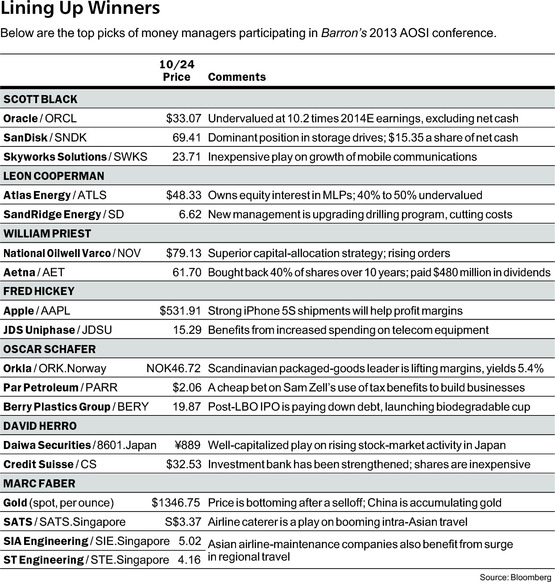
Barron’s: Bargain-Hunting for Stocks and Other Investments Around the World

SATURDAY, OCTOBER 26, 2013

Bargain-Hunting for Stocks and Other Investments Around the World

By LAUREN R. RUBLIN | MORE ARTICLES BY AUTHOR

Our savvy Art of Successful Investing panelists find value in tech, energy, Europe, and Japan.

ON-BC554_AOSI10_G_20131026025632

Be it ever so humbled, there’s no place like home. So said more than one investment patriot at this year’s ninth annual Art of Successful Investing conference, in reference to the allure of U.S. stocks. Sure, our politics are messy, our economy weak, and our market at all-time highs, but it still is possible to find U.S..-traded companies with good growth prospects, sound management, and cheap shares. Then again, there is also no place like Europe, Japan, or one of Asia’s new tourist meccas if it’s zaftig investment returns you’re after. All offer opportunities to reap outsize gains, especially in stocks that the crowd has dissed or ignored. The key, as always, is knowing where to look for value, and especially, how to spot it. Read more of this post

Energy Boom Puts Wells in America’s Backyards; Hydraulic Fracturing Largely Driving Transformation of the Nation’s Landscape. More than 15 million Americans now live within one mile of a fracking well. The shale boom is creating conflicts between those who are profiting from the wells and those who aren’t

Energy Boom Puts Wells in America’s Backyards

Hydraulic Fracturing Largely Driving Transformation of the Nation’s Landscape

More than 15 million Americans now live within one mile of a fracking well. The shale boom is creating conflicts between those who are profiting from the wells and those who aren’t. Photo: Benjamin Rasmussen for The Wall Street Journal

RUSSELL GOLD and TOM MCGINTY

Oct. 25, 2013 11:00 p.m. ET

P1-BN706A_NEARW_G_20131025232602

Over the summer, something sprang up in the view from Dorsey Johnson’s back deck north of Denver, where she watches sunsets over Colorado’s front range. It was a noisy, towering rig, drilling a new oil well. “There was clanking. There were trucks going by,” she says. All she wanted was for the rig to go away. Across the U.S., new oil and gas wells have turned millions of people into the petroleum industry’s neighbors. For many, the oil and gas companies are welcome newcomers bearing checks. Others consider the new arrivals loud, smelly and disruptive. The drilling boom is firing up resentment in some communities when one person’s financial windfall means their neighbors abut a working well. Read more of this post

Wal-Mart Now Draws More Solar Power Than 38 U.S. States

Wal-Mart Now Draws More Solar Power Than 38 U.S. States

Solar power and keg stands have one thing in common: Wal-Mart wants to profit from them.

In the race for commercial solar power, Wal-Mart is killing it. The company now has almost twice as much capacity as second-place Costco. A better comparison: Wal-Mart is converting more sun into energy than 38 U.S. states. Read more of this post

NQ 54% Plunge Rebuilds Muddy Waters Shorts Credibility

NQ 54% Plunge Rebuilds Muddy Waters Shorts Credibility

NQ Mobile Inc. (NQ), a Chinese mobile services provider, spent six years preparing to go public. It took Muddy Waters LLC one hour to erase half of the company’s market capitalization. NQ Mobile started last week with a value of more than $1 billion and lost 57 percent of its value after Carson Block, the Muddy Waters founder whose short sales outside of China have borne little fruit, said on Oct. 24 that it fabricated revenue and lied about its cash. The shares of the Beijing-based company extended a two-day slump to 54 percent even as the company said the assertions were false. Read more of this post