Fund manager Tan Teng Boo, dubbed Maalysia’s Warren Buffett, says country’s progress to advanced status hindered
October 29, 2013 Leave a comment
Updated: Tuesday October 29, 2013 MYT 8:54:08 AM
Fund manager says country’s progress to advanced status hindered
BY YVONNE TAN
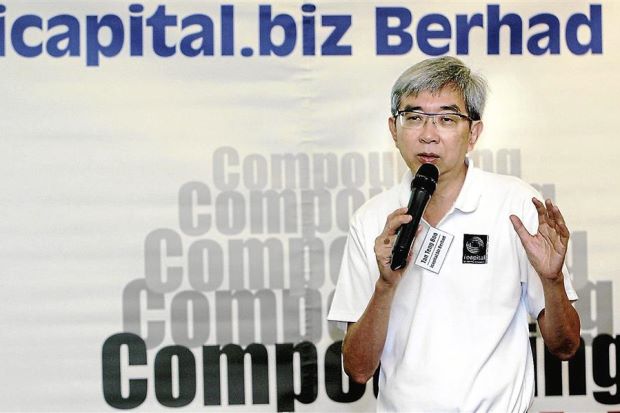
Tan:‘Services is a sector where sustained productivity is extremely difficult to achieve.’
KUALA LUMPUR: The decline in manufacturing activities is hindering Malaysia’s progress in becoming a developed nation, says a well-known fund manager. “For us to reach developed-economy status, manufacturing must be emphasised and we are not doing that,” said Tan Teng Boo, managing director of Capital Dynamics Asset Management Sdn Bhd and fund manager of icapital.biz Bhd. Capital Dynamics manages icapital.biz, the only close-end fund listed on the Main Market of Bursa Malaysia.Tan, famous for his value-investing strategies and economic views, said that at present the contribution to Malaysia’s gross domestic product (GDP) came from the services sector.
“I get very worried (every time) our politicians say they want to focus on services,” he said at a media luncheon.
Malaysia’s manufacturing strength as a percentage of GDP peaked many years ago and is now about 24% and declining.
The services sector, which is anticipated to grow 5.7% next year compared with 5.5% this year, is the largest contributor to the country’s GDP growth.
Citing the United States as an example, Tan noted that manufacturing there had almost disappeared.
“That’s why they need to have all kinds of protectionism measures there. Look at South Korea. Even though it has become so advanced, 30% of its GDP is made out of manufacturing.
“In Singapore and Germany, the per capita income is about seven to eight times higher than in Malaysia. Singapore’s per capita income is more than US$50,000 (RM156,586), ours is about US$7,000.
“In these two economies, manufacturing still makes up more than 20% of GDP.”
Tan said the reason why such countries were not reliant on services was because one could not obtain productivity gains from services.
“Services is a sector where sustained productivity is extremely difficult to achieve.
“Economic growth stemming from the services sector is the wrong growth source for Malaysia.”
He said Malaysia was stuck in its middle-income trap because the country was importing a lot of low-skill, low-wage workers and exporting its high value-added activities.
“We used to manufacture textiles, shoes… then Vietnam and Bangladesh came and took away all those jobs. What we could have done is move up the value chain; instead of making the same cheap shoes, why couldn’t we have made more expensive shoes?
“Instead of lower-end apparel, we could have moved towards higher-end products. But to have done that, we would have needed good textile and fabric cutters. Why didn’t we invest in those skills?
“That is why our manufacturing sector has hollowed out, because we cannot compete on low wages as well as skills.”
Drawing an example from the recent budget, Tan noted that there were some incentives for four-star and five-star hotels.
“The hotel industry is a very labour-intensive services sector. You may employ one general manager, but the rest are all housekeepers – low-skill, low-wage workers. The problem with services is that there is no productivity growth,” he reiterated.
Tan said Malaysia’s import growth had been growing at a much faster pace compared with export growth in the past few years. Consequently, its current account surplus, previously about 15% of GDP, had “almost disappeared” now.
“The reason why the rupiah and rupee have dropped so much is because they have a budget deficit and a current account deficit.
“We have a budget deficit (4% of 2013 GDP) and we are almost there in terms of a current account deficit.”
Going back to Budget 2014, Tan opined that “the only thing we did correctly” was to take away the sugar subsidy “because that was costing the country a lot of unnecessary healthcare expenses. Other than that, I cannot agree with anything else in the budget”.
Since its listing on Oct 19, 2005 until August, icapital.biz has generated returns of 192% as opposed to the FTSE Bursa Malaysia KL Composite Index’s return of 89%.
Meanwhile, icapital.biz made a net profit of RM1.2mil on a revenue of RM3.4mil for its first quarter ended Aug 31 compared with a net profit of RM2.6mil on a revenue of RM5.2mil for the same period a year earlier. It had also declared 9.5 sen dividend per share.
 About bambooinnovator
 Bamboo Innovator