Finally, a Good Time to Sell the Business; More small businesses are being sold this year
October 30, 2013 Leave a comment
Finally, a Good Time to Sell the Business
SARAH E. NEEDLEMAN
Updated Oct. 23, 2013 9:08 p.m. ET
Three years ago, Peter Schoon of Orono, Minn., wanted to sell the technology-services firm he founded with his wife and retire. But the economic downturn put those plans on hold as the company’s valuation took a hit. In March, however, the 64-year-old Mr. Schoon finally handed over the keys to System Support Solutions Inc. to buyer Jon Von Rentzell, a laid-off operations executive who financed more than half of the deal with a loan backed by the U.S. Small Business Administration.The company, which had steadily increased its revenue and profit since 2010, fetched six offers. It was sold for $2.3 million, 15% more than the original asking price, Mr. Schoon said.
The transaction illustrates how the small-business-for-sale market is warming up as more sellers can point to three years of gradual or increasing revenue—the typical track record that banks and buyers look at when assessing a deal.
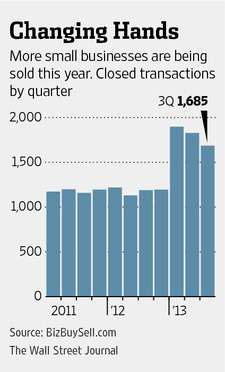
There were 1,685 small businesses sold between July and September, up from 1,189 during the same period in 2012, according to BizBuySell.com, an online small-business marketplace. It was the third year-over-year quarterly increase in a row, the online marketplace found.
The trend is helping to relieve pent up demand among business owners of the baby boomer generation who have struggled in recent years to sell their companies due to the weak economy.
“People who wanted to retire and feel like they missed the boat are absolutely seeing their businesses come back to the point where they’re saying they’re not going to miss it this time,” said Andy Cagnetta, chief executive of Transworld Business Advisors LLC, a brokerage in West Palm Beach, Fla.
By industry, sales of small businesses so far this year have mostly been service companies, followed by retailers and restaurants, according to BizBuySell. It defines small businesses as those with fewer than 500 employees, and it tracks transactions reported by business brokers across the U.S.
BizEquity.com, an online valuation provider for small businesses, said the median valuation for businesses using the site rose to $1.3 million in the third quarter from $860,000 during the same period in 2012.
“Now there’s a better balance-sheet story,” said Dave Rader, head of SBA lending at Wells Fargo & Co., which closed 12% more small-business loans, excluding real estate transactions, between January and September of this year compared with the same period in 2012. “Cash flows are positive, profits are improving and you have buyers who saved over the last few years,” he said.
Small-business lending has been rising. The SBA backed 12,976 so-called 7(a) loans totaling $5.3 billion in the third quarter, up from 11,442 loans totaling $4.3 billion a year earlier, according to the SBA. These loans can be used to assist in the acquisition of an existing business as well as to establish a new business or expand an existing one, among other uses.
Baby boomers who couldn’t find buyers a few years ago and are looking to sell now aren’t alone. They’re joined by others who plan on retiring this year or switching jobs.
Enlarge Image
Jon Von Rentzell updates software at Systems Support Solutions in Chaska, Minn. He bought the business from Peter Schoon, allowing Schoon and his wife to retire early. Jenn Ackerman for The Wall Street Journal
In August, Suzanne and John Fain, both in their mid-60s, sold the Houston health-food business they started in 1971 for about $500,000. The business had been on the market for less than six months and included a retail store and a restaurant located in a shopping center.
“Our lease was coming up for renewal and it seemed like a good time to stop,” said Mrs. Fain. She isn’t sure what she wants to do next; her husband is pursuing a second career as an acupuncturist, she said.
Last month, Linda Hendrickson sold the Maid Brigade franchise she had owned for 7½ years for about $350,000 to relocate from the San Francisco Bay area to Southern California.
“I have wanted a change of lifestyle for many, many years,” she said. The 54-year-old is now shopping for a new business.
The improving small-business marketplace is drawing some concern that sellers could soon outnumber buyers, as more of the nation’s 76 million baby boomers—people born between the years 1946 and 1964—look to retire.
“We see a lot of gray hair,” said Chris Jones, executive vice president of Sunbelt Business Brokers Midwest, which reports a 20% increase in small-business transactions from a year ago and a 40% increase in listings.
One potential thorn that could hamper future small-business transactions: higher lease rates.
In the third quarter, annual leases for U.S. office properties averaged $23.38 a square foot, up from $22.94 a square foot during the same period, according to data from CoStar Group Inc., a commercial real estate services firm in Washington. At the same time, vacancies declined to 12.2% from 12.8%.
The trend was similar in the retail and industrial sectors. Annual retail-property leases averaged $15.17 a square foot in the third quarter, up from $15.04 a square foot a year earlier, while retail vacancies fell to 6.8% from 7.2%, according to CoStar data. Industrial-property leases averaged $5.72 a square foot in the third quarter, up from $5.49 during the same period in 2012. Meanwhile, vacancies fell to 8.4% from 9.2%.
For Mr. Schoon, waiting to sell his business paid off. “Timing is critical,” he said, adding that he and his wife, Carla, now spend time at a cabin they own in northern Minnesota in between traveling across the country in a recreational vehicle.
 About bambooinnovator
 Bamboo Innovator