Google Nears Smartwatch Launch; Company In Talks With Asian Suppliers for Mass Production
October 30, 2013 Leave a comment
Google Nears Smartwatch Launch
Company In Talks With Asian Suppliers for Mass Production
EVA DOU and LORRAINE LUK
Oct. 29, 2013 6:03 a.m. ET
Google’s smartwatch is in late-stage development and the device, which will run on Android, will be integrated with Google Now, the company’s digital assistant. The WSJ’s Yun-Hee Kim speaks with Eva Dou about what to expect from Google’s smartwatch. TAIPEI— Google Inc. GOOG +2.09% ‘s smartwatch is in late-stage development and the company is in talks with Asian suppliers to begin mass production of the device, people familiar with the matter said.The new device, which will run on Android, will be integrated with Google Now, the company’s intelligent personal assistant that can answer questions, make recommendations and predict what information users need based on what they are doing, a person familiar with the situation said. Google has also been working to reduce power consumption on the smartwatch so it won’t require frequent battery charges, the person said.
The smartwatch will be able to communicate with other devices such as a smartphone, and draw information such as travel schedules from a user’s email through Google Now, the person said. The device could be ready for mass production within months, the person said.
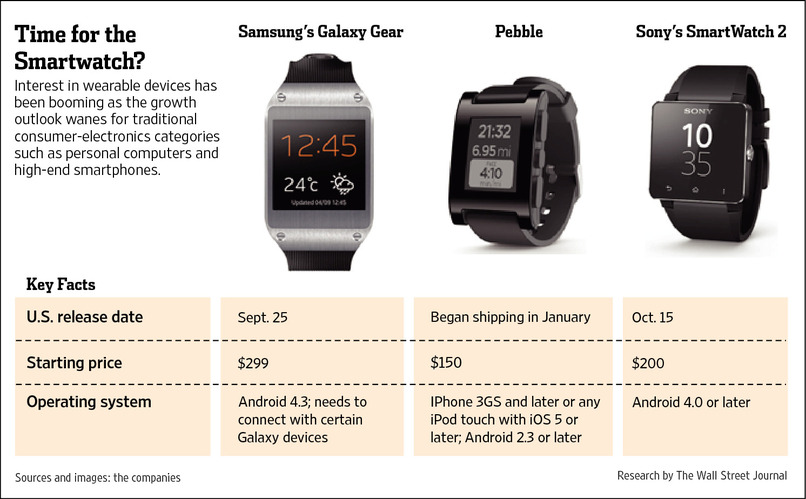
With its wristwatch, Google is aiming to address two criticisms of smartwatches that skeptics have long made: usefulness and battery life. While several smartwatches are on the market already, including one from Samsung Electronics Co. 005930.SE -0.13% , they have yet to gain a widespread following as they still have limited functions and a relatively high price. However, analysts say that with the development of improved applications, wearable devices will become increasingly mainstream and a growing battleground for tech industry heavyweights like Google and Apple Inc. AAPL -2.49% Annual sales of wearable devices are projected to reach 485 million units by 2018, according to market-research firm ABI Research.
For Google, the launch of a wristwatch would be an effort to secure a leading position in the growing wearable devices sector following its development of Google Glass. It would also be a play to keep users in its Android ecosystem and out of competing systems from Apple andMicrosoft Corp. MSFT -0.14%
The Wall Street Journal first reported in June that Google was exploring a wristwatchlike device.
Interest in wearable devices has been booming as the growth outlook wanes for traditional consumer electronics categories such as PCs and high-end smartphones. Although device makers have yet to prove that they can make wearable devices profitable, most of the industry’s heavyweights are exploring the prospects of this sector. Microsoft is testing prototypes for Web-connected eyewear similar to Google Glass, according to a person familiar with the situation. Samsung beat most of its competitors to the punch in September, launching the $299 Galaxy Gear digital watch that can run apps and interact with Samsung smartphones. The company is also preparing electronic eyewear, according to patent filings with authorities in South Korea.
In Taiwan, home to the contract manufacturers that build the majority of the world’s PCs and other consumer electronics, engineers say that major technology firms have been considering wearable devices for years. The contract manufacturers themselves have also long had watch prototypes that they would show to potential clients. Companies had previously dismissed the devices as not useful enough of an accessory for the relatively high cost to produce them.
It hasn’t been until the past two years that wearable devices have begun to gain momentum, as industry heavyweights from Google to Apple put their bets on the new category.
Apple has also been developing its own wristwatch, according to people familiar with the matter. Chief Executive Tim Cook said in May that wearable computers will be a “key branch” in technology.
 About bambooinnovator
 Bamboo Innovator