Singapore Regulators Reviewing Small-Cap Crash; Tumble in Asiasons, Blumont, LionGold Wiped Out Billions in Market Value

Singapore Regulators Reviewing Small-Cap Crash

Tumble in Asiasons, Blumont, LionGold Wiped Out Billions in Market Value

CHUN HAN WONG

Oct. 24, 2013 12:38 p.m. ET

SINGAPORE—Singapore regulators are reviewing recent volatility in three small-capitalization stocks that saw sharp plunges this month wipe out billions of dollars in market value and months of big gains, the city-state’s central bank said Thursday. Asiasons Capital Ltd. 5ET.SG -10.87% , Blumont Group Ltd. A33.SG -7.50% and LionGoldCorp. A78.SG -11.86% have lost more than eight billion Singapore dollars (US$6.5 billion) in combined market value this month. Their prices tumbled on Oct. 4, sparking a broader selloff in small-cap stocks and prompting Singapore Exchange Ltd. S68.SG 0.00% to briefly suspend the stocks and to ban short selling and margin trading on them for two weeks. Read more of this post

Best-selling author James Patterson reflects on success as the first author to achieve 10 million in ebook sales

Best-selling author Patterson reflects on success

12:59pm EDT

By Chris Michaud

NEW YORK (Reuters) – When it comes to bestselling authors James Patterson is hard to beat. He has been called the busiest man in publishing and is the first author to achieve 10 million in ebook sales. His thriller, “Mistress,” soared to the top of the Publishers Weekly bestseller list shortly after its August release, where it spent three weeks. Patterson, 66, spoke with Reuters about his unprecedented success, his characters and why he thinks his books are so popular.

Q: ‘Mistress’ was a recent No. 1 bestseller. Is that kind of benchmark getting old, or is it still a surprise?

A: I still get a kick out of it, but I’m not competitive. If it’s number one I like that. If it isn’t, I’m okay with it. So I can still be the first author and go, ‘Wow, I’m published, and there’s the book.’ And that still is fun. It has never gotten old for me. I can’t say it’s a surprise. It would be if it wasn’t even on the list, I’d go, ‘Whaaat? It’s not there, oh, we did something wrong.’

Q: Why do you think your books are so popular?

A: The three rules of this kind of fiction for me are story, story, story. I’m telling a story, and I sort of have the sense that I’m talking to one person and I don’t want them to get up until I’m finished. And the books are emotional. I think I’m pretty emotional. I think that’s one of my strengths and I think that comes through to people. There are a lot of thrillers that are exciting, but there isn’t much humanity to them. I do create characters that people are comfortable with and that they want to know what happened to them next. Even the villains, I think, there’s just a humanity to them as diabolical as they may be, there’s something recognizably human, which I think is one of the keys to creating villains that are interesting. Read more of this post

Hey, Wall Street: If You Want Efficiency, Buy a Blender; The view of prices as being in a perpetual equilibrium helped to discourage the development of more realistic theories of markets as ecologies of interacting strategies which never reach any benign resting point. Worst of all, easy acceptance of the phrase “markets are efficient” has for several decades helped to feed a complacency surrounding the global financial system

Hey, Wall Street: If You Want Efficiency, Buy a Blender

It is a supreme irony that a man whose ideas could have helped us avoid the most recent financial crisis now shares a Nobel with one whose work went a long way toward making it possible. The two economists — Robert Shiller of Yale University and Eugene Fama of the University of Chicago, winners of the 2013 memorial prize in economics — are both admirers of the power of financial markets. As Shiller rightly argues, finance is a technology that can be just as beneficial as any other, from electric power to the Internet. Without finance, how would we pool our collective resources to fund the vast undertakings required for medical research, oil exploration or even education? How would we insure ourselves against the staggering costs of earthquakes and other natural catastrophes? How many of us would ever own a house? Read more of this post

Samsung Pursuing Glasses That Answer Calls in Google Challenge; “Samsung is willing to throw things at the wall just to see what sticks”

Samsung Pursuing Glasses That Answer Calls in Google Challenge

Samsung Electronics Co. (005930), Asia’s largest technology company, registered a design in South Korea for eyeglasses that can show information from a smartphone and enable users to take calls. The device will have transparent or translucent lenses, include earphones for listening to calls or music, and has been registered as “sports spectacles,” according to documents posted on the Korea Intellectual Property Rights Information Service website. Samsung applied for protection in March, and the patent was registered Oct. 2. Read more of this post

Laps to laptops: Formula One sells its big data know-how

Laps to laptops: Formula One sells its big data know-how

5:07pm EDT

By Jeremy Wagstaff

SINGAPORE (Reuters) – Wander around the pits at a Formula One car race and you’re as likely to bump into a laptop-wielding scientist or engineer as a mechanic with a spanner. And the lessons they are drawing from sensors on F1 tracks, cars and drivers are finding their way into a surprising range of industries – from drilling oil wells to making toothpaste. “By chance or whatever we’ve ended up that F1 is a very strong metaphor for how the world is developing around a more industrialized Internet,” says Peter van Manen, managing director of McLaren Electronic Systems, part of a group which makes F1 cars. “You take information and you measure things, and from that you try to adapt how things behave and flow, so you can make performance better.” Read more of this post

South Korea’s Naver’s Line app to list on Tokyo exchange by next summer at $8-$10 billion market value

Line voice app developer plans to list on Tokyo exchange: Nikkei

4:03pm EDT

(Reuters) – The developer of the Line free voice calling and messaging app plans to list on the Tokyo Stock Exchange by next summer, the Nikkei said. Line Corp, owned by South Korea’s Naver Corp (035420.KS: QuoteProfileResearchStock Buzz), will have a market capitalization of 800 billion yen to 1 trillion yen ($8-$10 billion) when it goes public, the Japanese business daily said. The Line app was developed by employees at Naver’s Japanese subsidiary who were forced to turn to the Internet to contact each other after the massive earthquake and tsunami in March 2011 that disrupted phone lines across the country. The Line app’s user base has grown to more than 270 million worldwide, the daily said. The company is expected use the proceeds on advertising and the development of new apps, the business daily said.

Malaysians Ponder Importance of Banana Leaves in Indian Food with shortage resulting in restaurant owners turning to paper versions

Malaysians Ponder Importance of Banana Leaves in Indian Food

Tradition-Bound Diners Resist Switching Plates

CELINE FERNANDEZ

Oct. 24, 2013 1:52 p.m. ET

AI-CE430_MALBAN_G_20131024143200

Khairi Kassim said he prefers eating Indian food off authentic banana leaves. Celine Fernandez/The Wall Street Journal

KUALA LUMPUR, Malaysia—A shortage of banana leaves prompted the owner of Kanna Curry House in Malaysia to turn to paper versions, setting off a debate among restaurateurs and enthusiasts about what the leaves mean to Indian cuisine. Muthu Kumar finds himself caught between his tradition-bound diners, who refuse to abandon banana leaves, which are used as plates, and an increasingly complex and expensive supply chain that sends machete-wielding workers deep into Malaysia’s jungles in search of the coveted leaves. “There is no point in insisting on keeping the tradition when I can’t get fresh leaves,” said the 25-year-old Mr. Kumar. Read more of this post

Indonesian designers defy stereotypes of Muslim fashion

Indonesian designers defy stereotypes of Muslim fashion

Models present creations by designer Somarta during a Fashion Week show in Jakarta

2:14am EDT

By Andjarsari Paramaditha

JAKARTA (Reuters) – As the world’s most populous Muslim country, Indonesia has high demand for clothing that adheres to religious rules emphasizing modesty for women. But as the stylish, colorful and cool outfits at Jakarta Fashion Week showed, the Southeast Asian nation also aims to be the global leader in the Muslim fashion industry that is worth nearly $100 billion by some estimates. Read more of this post

Hong Kong Needs Debate on Share-Class Rules, Exchange’s Li Says

Hong Kong Needs Debate on Share-Class Rules, Exchange’s Li Says

Hong Kong needs a debate on how to handle “innovative companies,” including whether to allow them to have multiple share classes, said Charles Li, head of the city’s stock exchange, after initial-offering talks with Alibaba Group Holding Ltd. broke down last month. Jack Ma, the billionaire founder of China’s largest e-commerce company, and his partners wanted to retain control after a Hong Kong listing through a partnership that would nominate a majority of board members. Hong Kong rules don’t permit such a structure. Alibaba Executive Vice Chairman Joseph Tsai said last month that the exchange operator should “adapt to future trends and changes.” Read more of this post

Questions remain over David Jones CEO Zahra’s hasty exit

Questions remain over Zahra’s hasty exit

October 23, 2013

Elizabeth Knight

The stage-managed and neatly packaged explanation of Paul Zahra’s impending departure from the top job at David Jones doesn’t pass the smell test. Six weeks ago Zahra told me over lunch, ”I couldn’t imagine myself doing anything else because I love the company”. Either Zahra’s next job is in acting or he did not envisage this week’s chief executive ”transition”. My money is on the latter. He made similar press comments a week later after he spoke with me. ”We have done a lot but there is still more to do,” he said. Chief executive’s don’t side-swipe investors with a decision like this if they are in control of the timing. Under normal circumstances they (and the board) prepare investors and analysts rather than issuing shock announcements. It was abundantly clear from talking with investors and reading the reports from investment bank retail analysts (both of which are generally plugged in) that Zahra’s news came as a surprise. Read more of this post

India eyes $15 billion rollover of subsidy costs into next budget

India eyes $15 billion rollover of subsidy costs into next budget

5:33pm EDT

By Rajesh Kumar Singh

NEW DELHI (Reuters) – India’s finance minister is finding it harder and harder to meet the government’s budget promises and may sweep as much as $15 billion in subsidy costs into next year’s accounts to ensure he hits fiscal targets ahead of national elections, ministry officials say. The finance minister, P. Chidambaram, insists that the fiscal deficit target of 4.8 percent of GDP for the year to March 31, 2014, is a red line that will not be breached. The worst economic downturn since 1991 and a fall in the rupee to a record low have undermined budget assumptions for some months. Read more of this post

Low prices mean highest U.S. sugar subsidy cost in decade

Low prices mean highest U.S. sugar subsidy cost in decade

5:24pm EDT

By Charles Abbott

WASHINGTON (Reuters) – The United States faces its highest sugar subsidy cost since 2000, an estimated $280 million, following a new wave of defaults by processors on government-backed loans. Nearly 382,000 tons were forfeited in the final two months of fiscal 2013, despite repeated Agriculture Department efforts to whittle down a mammoth surplus and bolster futures prices. The surplus was projected to persist for months to come. Read more of this post

‘Aristocratic’ Ways Are Getting Tired at P&G; Dividends and Buybacks Have Become Procter & Gamble Stock’s Only Source of Return

‘Aristocratic’ Ways Are Getting Tired at P&G

Dividends and Buybacks Have Become Procter & Gamble Stock’s Only Source of Return

SPENCER JAKAB

Oct. 24, 2013 1:54 p.m. ET

MI-BZ286A_AOT_NS_20131024180303

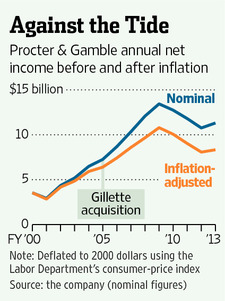
Get ready to hear an aristocrat speak Friday when Procter & Gamble Co. PG -0.37%unveils fiscal first-quarter results. No, revered Chief Executive A.G. Lafley hasn’t been knighted and, oddly, isn’t slated to be on the earnings call. The blue blood is the company itself. Nobody will confuse Cincinnati with Versailles, even if P&G’s headquarters has more floor space than the historic palace. But, by dint of having increased its dividend annually for at least a quarter century, the company is a “dividend aristocrat.” Read more of this post

Indian Banks Head Out to the Country; India’s largest private-sector banks are ramping up their rural networks, building hundreds of backwater branches as a slowing Indian economy squeezes business in the cities. “We are not like a biscuit company that sells you something, you eat it, burp and the work is done”

Indian Banks Head Out to the Country

NUPUR ACHARYA

Updated Oct. 24, 2013 5:10 p.m. ET

MI-BZ297_IBANK_NS_20131024175703

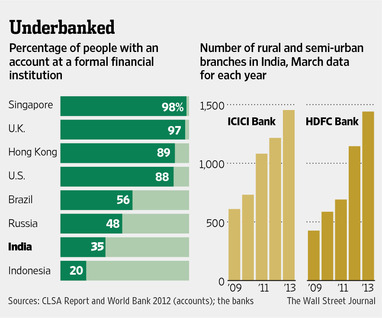
CHOMU, India—Until last year, Anita Yogi had never had a bank account. She would stash what little savings she had around the house. Today, the 26-year-old seamstress from this village in the northwest state of Rajasthan has a new account and a small loan for materials to make saris, the traditional, draped garment worn by women in India. “Now I want to expand my business and save more for my children’s educations,” Ms. Yogi said, showing off her new automated-teller-machine card from HDFC Bank Ltd.500180.BY +1.38% India’s largest private-sector banks are ramping up their rural networks, building hundreds of backwater branches as a slowing Indian economy squeezes business in the cities. Bankers say operations in small towns and villages are booming because they are capturing first-time savers and borrowers in pockets of the country that were previously ignored. This group of customers—and there are hundreds of millions of them in India—is set to be the next big opportunity for the country’s banking industry, which already has a total loan book of close to $1 trillion, according to the Reserve Bank of India, the country’s central bank. Read more of this post

Wal-Mart to Accelerate China Expansion With 110 New Stores

Wal-Mart to Accelerate China Expansion With 110 New Stores

Wal-Mart Stores Inc. (WMT), the world’s largest retailer, plans to add as many as 110 stores over three years in China, while shutting some outlets and remodeling dozens more as it seeks to overhaul its business there. The Bentonville, Arkansas-based company plans to open the new stores from 2014 to 2016 in the world’s second-largest economy, it said in a statement today. The retailer expects to shutter up to 30 under-performing outlets over the next 18 months, Greg Foran, its China chief, said at a media briefing in Beijing today. Read more of this post

Hong Kong aircraft maintenance giant Haeco buys US firm Timco for $389 million to expand global reach

Hong Kong’s Haeco buys US firm Timco to expand global reach

Friday, 25 October, 2013, 3:23am

Charlotte So charlotte.so@scmp.com

Hong Kong aircraft maintenance giant boosts services and product range with purchase of Timco for HK$3 billion

Hong Kong Aircraft Engineering Co (Haeco) has expanded into the United States by acquiring Timco Aviation Services for HK$3 billion, bringing it one step closer to its ambition to be a global player in aircraft maintenance. The acquisition also enables Haeco to strengthen its capabilities in cabin modification, design engineering, testing and certification services. It also could expand its product range to some smaller domestic jets. Read more of this post

Asia exports’ sluggish showing a puzzle

Asia exports’ sluggish showing a puzzle

Friday, Oct 25, 2013

Fiona Chan

The Straits Times

The rebound among developed economies is fuelling a synchronised world recovery, but the good times have yet to start rolling for Asian exporters. Regional manufacturers should be working flat out to meet the increased demand in the United States, Japan and Europe, yet the opposite seems to be happening. Shipments from China, South Korea, Singapore and Taiwan fell last month from the year before, while exports from here for the first nine months of the year are now about 7 per cent lower than in the same period a year ago, according to data out last week. Read more of this post

Return-Hungry Investors Tap ‘Frontier’ Markets; As Growth Elsewhere Becomes Elusive, Riskier Economies Get Noticed

Return-Hungry Investors Tap ‘Frontier’ Markets

As Growth Elsewhere Becomes Elusive, Riskier Economies Get Noticed

ERIN MCCARTHY

Oct. 24, 2013 7:23 p.m. ET

MI-BZ299A_MKTLE_NS_20131024180905

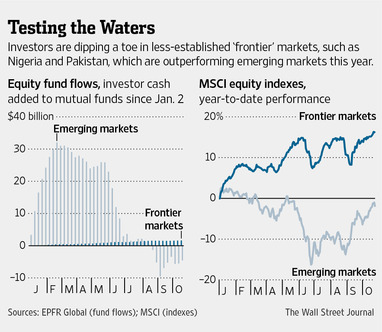
Stock investors are looking for new frontiers. Faced with sluggish growth in developed markets and a recent bout of volatility in emerging markets, fund managers are heading toward riskier countries like Pakistan and Nigeria in the hope of bigger returns. So-called frontier markets—the developing economies considered among the riskiest places to invest—are up 16% this year, according to MSCI Inc. MSCI +0.95% That compares with a 2% drop for stocks in more mainstream developing economies. Read more of this post

Bank Born Out of Black Death Struggles to Survive

Bank Born Out of Black Death Struggles to Survive

Siena, the medieval city renowned for its Palio horse races, is home to the world’s oldest bank. Within its aging walls lies a distinctly 21st century tale of devastation wrought by local politicians and global financiers. Banca Monte dei Paschi di Siena SpA, Italy’s third-largest lender, is struggling to survive as it seeks to repay a second bailout or face nationalization. Its downfall proved a boon to global investment banks. They offered merger and investment advice to executives beholden to politicians that helped wipe out 93 percent of Monte Paschi’s value. Then they sold it complex derivatives that hid, even worsened the losses. Read more of this post

Fed to propose banks would have to hold enough easy-to-sell assets to survive a 30-day credit; estimates a shortfall of about $200 billion in liquid assets across all institutions as a result of the rule

Fed to Propose Banks Hold Funds for Credit Drought

By Jesse Hamilton and Jim Brunsden  Oct 24, 2013

(Corrects spelling of law firm in last paragraph.)

Banks would have to hold enough easy-to-sell assets to survive a 30-day credit drought under a rule to be proposed today by the Federal Reserve that may have the greatest effect on banks with big trading operations such as JPMorgan Chase & Co. (JPM) and Goldman Sachs Group Inc. (GS) The demand for 30 days of liquidity is intended to satisfy global Basel III accords for strengthening the financial system. Increasing the banks’ liquid assets is meant to make them less vulnerable in a crisis like the one that struck in 2008. Read more of this post

Buying spree puts Qatar emir’s daughter atop art’s ‘power list’

Buying spree puts Qatar emir’s daughter atop art’s ‘power list’

5:09am EDT

By Michael Roddy

LONDON (Reuters) – The daughter of the emir of Qatar was named as the art world’s most powerful figure on Thursday after the tiny Gulf state went on an unprecedented spending spree at auction houses and in private sales around the world to fill its new museums. Sheikha al-Mayassa al-Thani, who also heads the Qatar Museums Authority, tops ArtReview magazine’s annual Power 100 list, the second year in a row that a woman has taken the No. 1 spot. Read more of this post

How to Sidestep the Excellence Trap

Published: September 26, 2013

How to Sidestep the Excellence Trap

Rita Gunther McGrath, author of The End of Competitive Advantage: How to Keep Your Strategy Moving as Fast as Your Business, introduces a passage about when—and when not—to demand excellence from Tipping Sacred Cows: Kick the Bad Work Habits That Masquerade as Virtues, by Jake Breeden.

“Don’t bring me any surprises. Don’t bring me a problem without a solution.” Do these phrases sound familiar? They are manifestations of a managerial mind-set that Jake Breeden rightly calls out in his new book, Tipping Sacred Cows, as an unhealthy obsession with excellence. The demand that employees get everything right is deadly for innovation, experimentation, and discovery. When excellence is defined as living in a world of no surprises, you aren’t going to get any…until it’s too late. Read more of this post

Abby Johnson, the rarely seen face of Fidelity; The quiet billionaire has taken the reins of a former fund juggernaut but given few signs of where she’ll take it

Abby Johnson, the rarely seen face of Fidelity

Thursday, October 24, 10:35 AM

When Abigail Johnson began her apprenticeship at Fidelity Investments 25 years ago, the Boston-based firm founded by her grandfather was the nation’s biggest mutual fund company and star manager Peter Lynch was enjoying a performance streak at the Magellan Fund — a 29 percent average return over 13 years — that ranks among the best in the industry’s history. Read more of this post

Mark Dixon, the billionaire founder of Regus, the world’s largest operator of serviced offices, has more than doubled his fortune in the past year as increased demand for flexible office space propelled the company’s share price to all-time high

Billionaire Doubles Fortune on Workspace Demand Surge

Mark Dixon, the billionaire founder of Regus Plc (RGU), the world’s largest operator of serviced offices, has more than doubled his fortune in the past year as increased demand for flexible office space propelled the company’s share price to an all-time high. Regus shares have surged 106 percent since last October, compared to a 30.3 percent gain in the FTSE 250 index. Dixon, 53, owns a 34.2 percent stake in the company valued at $1.1 billion, according to data compiled by Bloomberg. Read more of this post

The Cardiologist Who Spread Heart Disease

The Cardiologist Who Spread Heart Disease

Mehmood Patel still wakes up early, just as he did when he was a popular heart specialist seeing patients who waited hours for minutes of his time. Instead of surgical scrubs, he climbs into the khaki drabs of the Federal Correctional Complex in Oakdale, Louisiana. He leads health-conscious inmates on a morning walk, then cracks open one of the medical journals on his prison-approved reading list. Counseling fellow convicts to keep their blood pressure down is about the extent of the doctoring done by the man who once boasted he was the busiest cardiologist in the nation. Read more of this post

Cancer Radiation Rates Grow When Urologists Reap Profit

Cancer Radiation Rates Grow When Urologists Reap Profit

Urologists that buy their own equipment to provide expensive radiation treatment are much more probable to use it to treat prostate cancer even when its benefit for patients is unclear, research shows. Prostate cancer is the most common tumor diagnosed in the U.S., where an estimated 238,590 men were told they had the disease this year. While only about 12 percent, or 29,270 men, will die from it this year, all will have to decide how, and whether, they want to treat the cancer. Read more of this post

Return to Reaganomics Seen Reviving U.K. Biotechnology

Return to Reaganomics Seen Reviving U.K. Biotechnology

Though it has knowhow and wealth, the U.K. has never had much success creating biotechnology startups to rival such U.S. triumphs as Genentech Inc. and Amgen Inc. One explanation for this difference can be summed up in two words: Ronald Reagan. President Reagan’s overhaul of investment and tax rules at the dawn of the U.S. biotechnology industry in the early 1980s pushed pension funds toward riskier investments. That helped fuel the growth of giants including Genentech, today a unit of Roche Holding AG, and Amgen. Read more of this post

American Firms Find China Hard Work

October 24, 2013, 4:35 PM

American Firms Find China Hard Work

It’s hard to know whether things are getting better or worse for American businesses operating in China. One day they’re slammed for charging too much for coffee and just a couple days later, the president is praising them for providing insight into global economics. But if you ask American businesses how things are going, you’ll find that they have a long list of complaints about barriers to working in China. Read more of this post

Japan’s Meiji to Stop Baby Formula Sales in China on Competition

Japan’s Meiji to Stop Baby Formula Sales in China on Competition

Meiji Co., the Japanese confectioner and dairy products maker, said it will stop selling baby formula in China due to rising material costs and intensified competition in the world’s most populous nation. “There are so many players in the market,” Junji Ohashi, a spokesman for parent Meiji Holdings Co. (2269), said by phone today. “Our sales fell to one third of the peak in 2009.” Read more of this post

Hong Kong to Raise Subsidies to Replace Polluting Vehicles

Hong Kong to Raise Subsidies to Replace Polluting Vehicles

Hong Kong will offer HK$12 billion ($1.5 billion) in subsidies to replace old diesel vehicles, a 20 percent increase from an initial proposal, to clean up its smoggy streets. The increase from HK$10 billion for vehicle owners was made after consultation with the industry, Christine Loh, the city’s undersecretary for environment, said today. The money will be used to “clean up the dirtiest vehicles,” she said. Read more of this post