TAIPEI — Shares of Asustek Computer Inc., one of Taiwan’s leading personal computer vendors, fell sharply Wednesday as the local media reported that prosecutors had launched an investigation into an alleged scam involving the company, dealers said. After the negative leads surfaced, the stock faced heavy downward pressure upon market opening and fell almost 5 percent to the day’s low of NT$213.50 (US$7.26) at one point before rebounding. Read more of this post
Move over Gangnam Style — a new YouTube viral hit has taken China and the world by storm. The Fox (What Does the Fox Say?), a song written and performed by Norwegian comedy duo Ylvis, was uploaded to YouTube on Sept. 3 and has become an internet sensation with more than 146 million views as of Oct. 22, breaking the 100 million views mark in a little over 30 days. To put that achievement into perspective, last year’s viral smash, Gangnam Style by South Korean artist Psy, took 52 days to reach 100 million views. In the music clip, the performers, dressed in a variety of animal costumes, go through a list of animal sounds to a catchy tune before questioning the mysterious sound of foxes with the chorus line, “What does the fox say?” Like with Gangnam Style, Chinese netizens have quickly caught on to The Fox, with many commending its “lack of commercialism” and its children-friendly animal and fantasy elements. “The lyrics are silly but not vulgar like many other internet hits, and has an adorable atmosphere that people of all ages will like,” one netizen wrote. Ylvis members Bard and Vegard Ylvisaker say their unlikely hit started off as a joke, and that they are prepared for when enthusiasm for The Fox inevitably wanes. “You can’t be amazed for an entire month,” Vegard said. “At some point, it has to level off.” “There might come a song about wolves from Denmark in the next week, and then, suddenly, we’re off the hook,” Bard said. “That’s OK. Even if that happens, it’s been fun.” The Fox is currently sixth on the US Billboard Hot 100. Read more of this post
Paul Zahra’s warning: CEO burnout is a risk to company performance
Published 23 October 2013 11:50, Updated 23 October 2013 13:34
The abrupt resignation of Paul Zahra as chief executive of retailer David Jones raised serious questions about the company’s corporate governance: why was the company taken by surprise and why was there no obvious succession plan in place? (See: ‘Should have known better’.) But Zahra’s shock announcement that he intends to step down raises another important question: are Australian companies working their chief executives too hard?
The touchy task of grooming a CEO successor without losing the incumbent
Published 23 October 2013 09:55, Updated 24 October 2013 08:48
Michael Smith
Chief executive succession planning is a tricky balancing act for many boards. Leave it too late, and there is a leadership vacuum if a top executive quits or is sacked unexpectedly. But grooming internal candidates for the boss’s job too early can also backfire, as they may get impatient and leave to become top dog elsewhere. Paul Zahra’s abrupt resignation from David Jones on Monday highlights the challenges companies face in an era when the average tenure of a chief executive has fallen to just over four years. Read more of this post
THE long arm of American justice continues to bludgeon Swiss financiers who stand accused of aiding tax evasion. It emerged this week that Raoul Weil (pictured above), a former head of the wealth-management division of UBS, Switzerland’s largest bank, had been arrested on October 19th at a hotel in Italy, apparently while on holiday with his wife. He faces an extradition request from the United States, which branded him a fugitive after he failed to appear before authorities several years ago, leading to the issuance of an international arrest warrant. Mr Weil is the biggest fish to be netted since 2008, when America launched its brutal assault on tax-dodging citizens and those who assist them.
The benefits of parents seeing the edited highlights of your working day may outweigh the downsides
First it was our daughters, then our sons and, in some cases, even dogs. Now it is the turn of our mothers and fathers. LinkedIn’s decision to appoint November 7 “Bring in your parents to work day” has encouraged others to follow suit: Deutsche Bank, Edelman and Logitech have signed up. Google has already welcomed in its engineers’ parents. The idea was pioneered by staff at LinkedIn, the professional social networking site, who found it impossible to explain to their parents what they did at work. Read more of this post
Physicists have been lured into the financial market for decades, prized for their insights and data-crunching skills. But in a time of turbulence, flash crashes and high-frequency trading, can they really spot things that others miss? Markets may be more like a body of water whose surface is constantly disturbed by new events and information, creating great waves whose energy is dissipated beneath the surface. Gene Stanley raises his fork, holds it out flat, a few inches above his plate of risotto. “The majority of traders still use Gaussian models and, when something outside the Gaussian happens, they have all these phrases, like ‘outliers’, but the main phrase is ‘shit happens’.” Read more of this post
Australian government facing challenges on financial planning reforms
by Samuel Poon
CANBERRA, Oct. 24 (Xinhua) — The Australian government is facing intense challenge from banks and financial service providers to act on reforms of the financial advisers sector as crafted by the previous Labor government, collectively known as the Future of Financial Advice (FoFA). The new government has recently asked Treasury and the Australian Securities and Investment Commission(ASIC) for advice on whether the Labor Law designed to minimize financial planners’ conflict of interests should be watered down more than promised during the election. Assistant Treasurer Arthur Sinodinos, who has an obligation to deliver the changes the Coalition promised during the campaign, will stand for the government to respond to the industry pressure. The changes were designed to stop remuneration arrangements for financial advisers, which for many years created a conflict between the interests of clients and maximizing advisers’income. Read more of this post
I’ve lived in Japan on and off for several years, and I’ve always felt safe on my bicycle here, particularly as I often see young and old women alike biking at all hours of the night. But after an event a few weeks ago, I feel as if this false sense of security has been stripped away. Cycling home at 8:30 p.m. on a well-lit street in Tokyo, I sensed another biker by my side, so I slowed down to let him pass. At that point he suddenly cut over, trapped me against a parked car and grabbed my tire. Read more of this post
Branson recalls tears, $1 billion check in Virgin Records sale
Wed, Oct 23 2013
LONDON (Reuters) – Virgin Group founder Richard Branson recalled that selling his Virgin Records music label more than two decades ago was “like selling your children” even though he pocketed a billion dollars in the deal. Branson, 63, founded Virgin Records in 1972 with three other people, growing the label from a small successful record shop into a powerhouse of the music industry, helping usher in the progressive rock movement of the 1970s and new wave in the 1980s. The company was purchased by Thorn EMI for $1 billion in 1992, in part to fund Branson’s Virgin airlines. Read more of this post
With many companies nearing the first-to-second generation transfer phase, Asian family businesses have been forced to learn the art of succession planning quickly. When Chu Meng Yee, owner of billion-dollar Chinese real estate developer Hopson Development, named his daughter as its deputy chairman in July, it created ripples across the world of family businesses in Asia. Family business experts were overwhelmed with excitement – not only had Chu appointed a woman to take over the company, but he had taken a big step forward in moving the company from the first to the second-generation. Read more of this post
A leading consumer activist claims the corporate regulator has not only failed to investigate hundreds of cases of loan fraud put before it but, as a consequence, has covered up a systemic banking failure. As the deadline for submissions for the Senate Inquiry into the Performance of the Australian Securities & Investments Commission (ASIC) closed this week, veteran consumer rights activist Denise Brailey filed a brutal assessment of ASIC’s failure to investigate the cases of loan fraud. Read more of this post
Woolworths rekindles pharmacies in supermarkets battle with new trademark application
Published 24 October 2013 10:34, Updated 24 October 2013 10:57
Sue Mitchell
Woolworths has lodged a new application with IP Australia to register the trademark “Pharmacy-in-Supermarket”. Photo: Glenn Hunt
Woolworths has not given up on its ambitions to enter the $16 billion pharmacy market, despite federal government policy that has locked out major retailers since 1990. The retailer has lodged a new application with IP Australia to register the trademark “Pharmacy-in-Supermarket”. A previous application lapsed. The trademark covers six classes of goods and services, including the sale of pharmaceutical and medical products provided by pharmacists. Australia’s largest retailer has wanted to sell pharmaceuticals and prescription medicines since 2003, when it first registered the Pharmacy-in-Supermarket trademark and outlined plans to sell drugs, medicines, toiletries and tissue products from pharmacies within its stores. Under the federal government’s Community Pharmacy agreement, which has been in place since 1990, pharmacies must be owned by pharmacists. Woolworths believes consumers are paying too much for prescription and over-the-counter medicines because of the inefficiencies of independent pharmacies. In 2004, then Woolworths chief executive Roger Corbett called the pharmacy industry “the biggest anti-competitive gerrymander in Australia”.
Patrick Grove plans to float $100 million e-commerce company iBuy
Published 24 October 2013 11:44, Updated 24 October 2013 13:23
BRW Young Rich entrepreneur Patrick Grove is preparing to float his latest venture, e-commerce company iBuy, before the end of the year. Grove will list iBuy through broker Canaccord Genuity, a global investment bank focused on growth companies. The float of iBuy, a holding company of leading e-commerce sites selling branded consumer products at big discounts throughout south-east Asia, is expected to have a market capitalisation of $100 million. Read more of this post
Sixty-one scholars recently called for the industrialization of genetically modified (GM) rice in China, which has once again raised the public’s attention on the controversial technology, reports the Chinese-language Beijing News. The country’s Ministry of Agriculture plans to promote the industrialization of GM foods and technology, and accelerate the passing of amendments for related regulations, the paper said. Beijing has also approved GM cotton, rice, corn and papaya to be grown, but a researcher at the Chinese Academy of Agricultural Science added that only cotton and papaya have been allowed for commercial production. Read more of this post
The scandal-rocked dairy industry is changing, but the government’s goals remain uncertain
By staff reporters Qu Yunxu and He Chunmei, and intern reporter Huo Bingyi
Dairy operators pouring over the Chinese government’s latest industry-support policies and what speculators have been saying about future policy changes want to know whether the cup is full, half-empty or nonexistent. Clear answers are hard to find because mixed signals have been trickling out of the Ministry of Industry and Information Technology (MIIT), Ministry of Agriculture (MOA) and other policymaking agencies since last spring. Read more of this post
Global auto companies reap big sales in China from their partnerships with Chinese brethren. Might they someday be allowed to go it alone? Under current regulations, global auto makers can only own as much as half of their joint ventures in China. Most foreign car companies such as General Motors Co.GM -1.02% and Ford Motor Co.F -0.45% hold 50% shares. One notable exception isVolkswagen AGVOW3.XE -0.59%’s joint venture with FAW Group, the German automaker holds 40%. Read more of this post
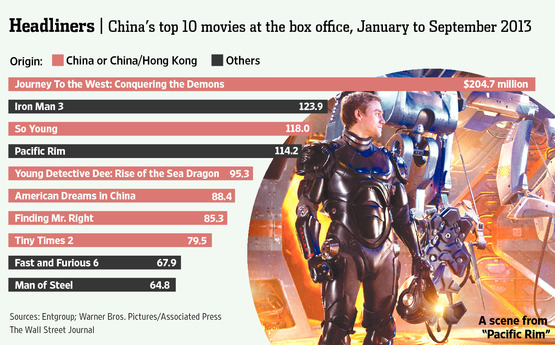
In the surprising battle for China’s box office so far this year, the Monkey King gave Iron Man an improbable beat down and a gaggle of Chinese college kids managed to hold their own against a group of tower-sized monster-destroying robots. If you want to be mega-successful in the movie business these days, you have to win the hearts of Chinese filmgoers. For years, Hollywood has raked in the lions share of China’s film spoils despite import restrictions designed to protect domestic movies. But as WSJ’s Wayne Ma and Laurie Burkitt report, that tide appears to have turned in 2013, with home-grown films taking six of the top 10 spots so far this year: Read more of this post
BEIJING (Reuters) – Wal-Mart Stores Inc (WMT.N: Quote,Profile, Research, Stock Buzz), the world’s biggest retailer, is expanding its China business as it seeks to raise profitability in a slowing retail sector. Wal-Mart will open up to 110 facilities in China between 2014 and 2016, in addition to the 30 it has already opened this year, it said at a press event in Beijing on Thursday. Read more of this post
Barring opposition, Lu Guanqiu, chairman of one of China’s leading auto parts makers, will finally achieve his longstanding dream of extending his business to making cars. On Oct. 22, the Ministry of Industry and Information Technology (MIIT) publicized a list of new auto manufacturing enterprises, which include Wanxiang EV, an electric car subsidiary of Wanxiang Group. Read more of this post
Panasonic, which makes chips in M’sia, to slash production worldwide
TOKYO: Panasonic Corp plans to dramatically cut back on chipmaking, slashing the business’s 14,000-strong workforce by half and possibly selling some plants, the Nikkei said Japanese companies are spinning off their chipmaking operations as profit margins shrink, mainly due to stiff competition from South Korea, the paper said. The move underlines Panasonic President Kazuhiro Tsuga’s determination to weed out weak operations as he focuses on higher-margin products to end years of losses at the consumer electronics conglomerate. Read more of this post
A long-debated proposal to lift Japan’s ban on casino gambling could finally come to fruition this year after a multi-party group of lawmakers agreed to submit a legalisation bill to the current session of parliament. Iwaya Tsutomu, a member of the ruling Liberal Democratic party who is part of the pro-casino group, said Tokyo’s selection last month as host of the 2020 Olympic games had given fresh impetus to its push for legalisation. Read more of this post
Foreign direct investment in Indonesia has fallen in US dollar terms for the first time in two years as southeast Asia’s biggest economy faces growing challenges from a widening current account deficit to rising economic nationalism ahead of next year’s elections. The government’s investment co-ordinating body (BKPM) said on Wednesday that realised FDI fell from $7.2bn in the second quarter to $7bn in the third quarter, the first quarter-on-quarter decline since 2011. That still represented a rise of more than 18 per cent compared with the third quarter of last year. Read more of this post
Electronic Retailer Courts Asia Breaks Ground for Its Megastore in Bekasi
ByJohan Mulyadion 11:00 pm October 23, 2013. Bekasi. Singapore-based Courts Asia, an electronics retailer, is hoping to tap the Indonesian market with its first store in Bekasi, West Java, on the outskirts of Jakarta. The ground-breaking ceremony at the site took place on Wednesday. The company plans to spend $20 million on the Bekasi megastore, expected to be operational by the second half of 2014. The store, to be located in Kota Harapan Indah, Bekasi, will occupy 13,000 square meters. It will stock a wide range of products from computer products and electronics, to home furnishings. “Big-box stores have lower rental cost per square meter and this should compensate for the lower shopping traffic as compared to shopping malls. A big-box store can also earn rent from food and beverage vendors located on the premises,” Courts Asia chief executive Terence Donald O’Connor said during the ceremony. Besides the Bekasi store, the company also plans to open another in Bumi Serpong Damai in Tangerang, Banten. It is expected to open some time in 2015. Courts Asia plans to open an additional 10 stores in Indonesia in the next five years, O’Connor said. The company raised S$44 million ($36 million) from an initial public offering early this month. It will use the bulk of the proceeds to finance its Indonesian expansion, which according to its website, will amount to about S$40 million. “Indonesia’s growth is driven by a burgeoning consumer market that is still under-penetrated. It is highly attractive. We plan to launch stores in urban areas to capture our target customers — the rising middle-class,” O’Connor said. Read more of this post
Agence France-Presse | Updated On: October 23, 2013 09:51 (IST)
Mumbai: The Centre One shopping mall on the outskirts of Mumbai is gloomy and bereft of customers, even during India’s annual festive and wedding season when retailers traditionally cash in. “Business is dull, usually weak,” said one bored-looking fashion salesman. The shopping centre’s empty look is no exception. In the past decade, supermarkets and malls have spread across India’s large cities and towns, fuelled by fast economic growth and excitement about middle-class buying power. Read more of this post
By Gregory Meyer in New York and Ajay Makan in London
Clive Capital has thrown in the towel. Deep into its third year of losses, what was onceone of the world’s largest commodity hedge funds shut down late last month. The closure is symptomatic of a broader trend – or more accurately, the lack of one. Hedge funds once feasted on wild action in oil. Now, volatility has fallen to historic lows. Plodding prices have forced traders to experiment with new ways to make money. Read more of this post
South Korea’s fashion industry dynamics are changing. For start, Cheil Industries, a leading player in the industry since 1970s, agreed to sell its fashion unit to Samsung Everland.
Cheil Industries, LG Fashion and Kolon Industries had dominated the fashion market, but their grip has dismantled since 2010. Now, Kolon Industries’ fashion operations generate 1.3 trillion won ($1.2 billion) in sales, only one third of the company’s total sales of over four trillion won. The fashion operations are no longer a flagship business of Kolon Industries. In contrast, E-Land has launched low and mid-priced brands and sold them in standalone stores and earned two trillion won in sales last year, surpassing Cheil Industries to take the top position. The sales figure excludes another two trillion won it brought in from abroad. Cheil Industries garnered 1.5 trillion won in sales in the local fashion market. The dominance of the three fashion conglomerates is giving way to an emergence of multiple companies, as large retailers including Lotte Department Store, Shinsegae Group and Hyundai Department Store are aggressively pushing into the industry. Shinsegae Group’s fashion arm Shinsegae International imports and sells luxurious brands such as Armani, Marni, and Dolce & Gabbana. Shinsegae International is also promoting domestic brands including Vov, G-Cut and Vidivici. Lotte Department Store’s global fashion business division has unveiled Niceclaup, Thyren, J-Press and Furla. Hyundai Department Store Group’s affiliate Hyundai Home Shopping, meanwhile, acquired local women’s clothes company Handsome, and opened new brand Iro.
With Corning deal, Samsung tightens grip on supply chain
Oct 24,2013
Samsung Electronics moved to strengthen its grip on vital electronics parts supplies as it looks to stay ahead of rival Apple Inc with new products in a fast-changing technology industry. The Korean group’s unlisted Samsung Display unit could become the biggest shareholder of Corning, maker of scratch-resistant Gorilla Glass used in many mobile gadgets, as part of a deal in which Corning buys Samsung Display out of a 1995 joint venture making glass for liquid crystal displays. Read more of this post
It is time to consign the dotcom bubble to the history books
In the long run, everything is a toaster. This is one of the more memorable lines delivered by Professor Bruce Greenwald, who teaches the class in Value Investing at Columbia Business School that was once taught by Benjamin Graham, and taken by Warren Buffett. The comment is a classic put-down by value investors against the overhyped hopes of rival “growth” investors. Great innovations may make money for a while, they say, but eventually they will be commodified and compete on price, like everyone else – much like a toaster. Read more of this post
NEW YORK (Reuters) – U.S. energy exploration companies leading a domestic oil boom increasingly are using stock options to find and maintain employees, evoking comparisons to the dot-com bubble of the late 1990s. Some compensation experts and investment analysts worry that employees of small- and medium-sized firms that are still searching for sizeable profits could be lulled by a false sense of financial security. Read more of this post
H.E.R.O. stands for “Honorable. Exponential. Resilient. Organization.” and is operationalized into a unique, systematic 4-step investment process to identify the winners. The investment objective seeks to capture long-term investment returns created by disruptive forces and innovation by focusing on high-quality and liquid listed equities in the Asia-Pacific region that ride on and benefit from them. Through our cross-sector and in-depth fundamental research process, the Fund aim to provide access to companies whom we believe are run by high-integrity, honorable and far-sighted owner-operators with a higher sense of purpose in solving High-Value Problems for their target customers and society, and have unique, scalable and wide-moat business models with sustainable competitive advantages and innovative products, services, and processes to create, expand and service their total addressable market, including the resiliency and balance sheet strength to maintain or grow profitability, pricing power and market positions through up/downturns in the economy.

 Bamboo Innovator