Stress of Childhood Poverty May Have Long Effect on Brain

Stress of Childhood Poverty May Have Long Effect on Brain

Children raised in poverty or in orphanages experience chronic stress early in life that can have long-lasting effects on the brain, setting them up for future mental and physical ailments as adults, two studies found. The stress of poverty may affect regions in a child’s brain that control emotion, according to research published today in the journal Proceedings of the National Academy of Sciences. A second study found that children who had lived in an orphanage were more anxious than those who hadn’t. Read more of this post

Europe Breakup Forces Mount as Union Relevance Fades

Europe Breakup Forces Mount as Union Relevance Fades

Thomas Bellinck, a Belgian theater director, has put a date on the European Union’s collapse: 2018.

The doomsday timeline of his Brussels exhibition called “Life in the Former EU: Final Years of the Long Peace,” presented the bloc’s six-decade run as a peaceful interregnum before the continent’s relapse into nationalism, an interlude where technocrats were too focused on regulating the diameter of tomatoes as their experiment in multinational democracy withered. Read more of this post

Survivor of 150 Years of Turmoil Faces Being Buried by Abenomics; “The cost of wages will go up while Abenomics will raise the price of everything, adding to our costs. We will be buried without a new source of revenue.”

Survivor of 150 Years of Turmoil Faces Being Buried by Abenomics

When Shigeo Aiba is worried about the survival of his company, it’s time to pay attention. Aiba is president of Togo Seisakusyo Corp., a Japanese maker of industrial springs that traces its roots back more than 150 years to when Jyouuemon Aiba began repairing farm equipment among the rice fields of Chita peninsula 270 kilometers (170 miles) southwest of Tokyo. The business, which survived the effects of the Great Kanto Earthquake, defeat in World War II, destruction by a typhoon and the collapse of the asset bubble in the 1980s, is now struggling to survive Abenomics. Read more of this post

China Mobile Posts Largest Profit Drop Since 1999 as Costs Rise

China Mobile Posts Largest Profit Drop Since 1999 as Costs Rise

China Mobile Ltd. (941), the world’s largest phone company by users, posted an 8.8 percent profit decline that was the most since 1999 as costs to build its new fourth-generation network increased. Net income fell to 28.4 billion yuan ($4.7 billion) in the third quarter, from 31.1 billion yuan a year earlier, according to figures derived from nine-month results released by the Beijing-based company today. The profit missed the 31.1 billion yuan average of five analysts’ estimates compiled by Bloomberg. Read more of this post

Netflix Poised to Pass HBO in Paid U.S. Subscribers; “We have more content, much more viewing per member, a broader brand proposition, are on-demand, on all devices, and are less expensive”

Netflix Poised to Pass HBO in Paid U.S. Subscribers

By Cliff Edwards  Oct 21, 2013

Netflix Inc. (NFLX) is poised to pass HBO in paid U.S. subscribers, showing Chief Executive Officer Reed Hastings is making progress toward a goal of transforming the streaming service to a Web-based television network. Netflix, based in Los GatosCalifornia, reports third-quarter results today after markets close. Already the world’s largest subscription-video service, the company probably reached 30 million paying U.S. customers as of Sept. 30, according to Needham & Co. HBO, Time Warner Inc. (TWX)’s premium cable-TV network, has about 28.7 million, according to researcher SNL Kagan. Read more of this post

India’s IT Firms Face Midlife Crisis

India’s IT Firms Face Midlife Crisis

ABHEEK BHATTACHARYA

Updated Oct. 21, 2013 9:34 a.m. ET

AM-BA767_ITHERD_G_20131021115704

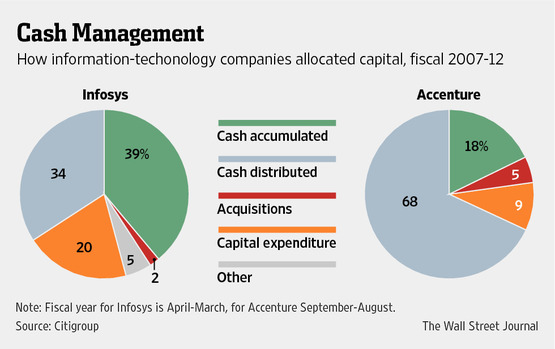
A good year for India’s information-technology companies doesn’t change the fact that they are battling a midlife crisis. A combination of factors has pushed IT stocks up 50% this year, even as India’s benchmark Sensex index is up only 8%. These outsourcing firms’ biggest markets in the U.S. and Europe are rebounding, which has boosted sales in the September quarter. Plus the Indian rupee has weakened 10% against the dollar this year, helping margins in the short term. Yet these companies are still suffering from a lack of strategic direction, which shows up in their growing cash hoards. Read more of this post

Gold-plated buildings a growing trend in China

Gold-plated buildings a growing trend in China

20131021_chinagold2_1

Monday, October 21, 2013 – 15:04

AsiaOne

CHINA – The new headquarters of People’s Daily, with its freshly gold-plated facade, highlights an increasing number of gilded buildings in China over the past decade. China’s rapid development and booming economy have lent a touch of glitz to various buildings in cities such as Beijing, Kunming, Jiangsu and Shenzhen, which range from office buildings, airports, hotels and tourist landmarks. These buildings with gleaming exteriors have captured the attention of many passers-by and sparked much discussion among both locals and foreigners. Despite their golden appearance, these buildings are actually clad in brass and dyed anodized aluminium. However, many people are still unimpressed by the ostentatious displays of wealth.

China to restrict satellite TV stations to one foreign program

China to restrict satellite TV stations to one foreign program

Sun, Oct 20 2013

SHANGHAI (Reuters) – China will allow satellite television stations to buy the right to broadcast only one foreign program each year from 2014 as part of new restrictions to push “morality-building” and educational shows, state media reported on Monday. The official Shanghai Securities Journal, citing an order by the General Administration for Press and Publication to domestic television stations, also said foreign programs could not be broadcast in prime-time viewing hours from 7:30 p.m. to 10 p.m. during the year in which the broadcasting rights were purchased. Read more of this post

Luxury Rents Fall in Hong Kong on Expatriate Budget Cuts

Luxury Rents Fall in Hong Kong on Expatriate Budget Cuts

Luxury-home rents in Hong Kong and Singapore, two of Asia’s most expensive cities for apartment leases, are declining for a third year as banks squeezed by slowing growth cut budgets for expatriate workers. Rents for Hong Kong homes that broker Jones Lang LaSalle Inc. categorizes as luxury fell about 1.1 percent in the first half of 2013, bringing their losses to about 13 percent since peaking in October 2011. The average monthly rent of Singapore condominiums that charge at least S$12,000 ($9,670) a month slid 0.2 percent to S$4.86 per square foot in the three months ended June, the lowest since the December 2009 quarter, London-based broker Savills Plc said. Read more of this post

Smog Puts Focus on Air Outside Beijing

October 21, 2013, 6:23 PM

Smog Puts Focus on Air Outside Beijing

A woman wearing a mask checks her mobile phone on the square in front of Harbin’s landmark San Sophia church, in China’s Heilongjiang province on Oct. 21. Although Beijing’s air pollution has somewhat abated since earlier this month, parts of northern China on Monday were covered in thick smog, forcing the closure of some schools, airports and highways in the region.

Read more of this post

Draghi challenged rules that would bar banks from accessing public aid unless they forced losses on junior bondholders, a central building block of European Union protocols for handling struggling banks

Draghi Challenges EU Bank-Aid Rules Over Forced Losses

European Central Bank President Mario Draghi challenged rules that would bar banks from accessing public aid unless they forced losses on junior bondholders, a central building block of European Union protocols for handling struggling banks. In a letter to EU Competition Commissioner Joaquin Almunia, Draghi said EU rules need to be clarified so regulators can order technically solvent banks to strengthen their balance sheets without scaring off investors. Draghi said public capital needs to be available — without wiping out subordinated debt holders or forcing them to convert to equity — if a bank’s holdings are above regulatory minimums and also below what supervisors deem necessary in a particular case. Read more of this post

Shale Overload to Spur U.S.-China Fuel Trade: Energy Markets

Shale Overload to Spur U.S.-China Fuel Trade: Energy Markets

U.S. exports of natural gas liquids, already at a record amid surging output from shale deposits, are poised to quadruple by 2020 as the expansion of the Panama Canal cuts shipping costs to Asia. Deliveries of the fuels to foreign buyers averaged 555,000 barrels a day in July, the most in U.S. government data going back to 1981. China’s imports of propane, butane and isobutane, with uses as varied as home heating, chemical manufacturing and refrigeration, jumped 23 percent in August from a year earlier, customs data show. Read more of this post

Not much of a festival season for Indians as gold runs dry

Not much of a festival season for Indians as gold runs dry

5:09pm EDT

By Siddesh Mayenkar

MUMBAI (Reuters) – In India’s biggest bullion market, Mumbai’s Zaveri Bazaar, gold dealers are busy — not filling orders for customers, but busy avoiding phone calls because they don’t have any gold to sell. Battling a huge trade deficit and a weak currency, the government has taken various steps this year to make it harder and more expensive for Indians to get hold of gold, the biggest item on the country’s import bill after oil. Read more of this post

Myanmar’s aviation industry booms despite grim safety record

Myanmar’s aviation industry booms despite grim safety record

5:22pm EDT

By Aubrey Belford and Min Zayar Oo

KONEMOE, Myanmar (Reuters) – Htay Aung was riding pillion on a motorbike last Christmas morning, wending through the cool hills of eastern Myanmar, when Air Bagan Flight 11 came down on top of him. The Fokker 100 – more than 24 tonnes of aircraft, plus 65 passengers and six crew – sheared its way through trees and powerlines, across the road and into a field short of nearby Heho airport. Htay Aung found himself sucked into a scorching maelstrom of debris. Read more of this post

Buffett’s Berkshire cuts Tesco stake by one-fifth -filing

Buffett’s Berkshire cuts Tesco stake by one-fifth -filing

6:15pm EDT

(Reuters) – Billionaire Warren Buffett’s Berkshire Hathaway Inc (BRKa.N: QuoteProfileResearchStock Buzz) last week slashed its stake in the world’s No.3 retailer, Tesco Plc (TSCO.L: QuoteProfileResearchStock Buzz), by about one-fifth, or 300 million pounds ($484.75 million), according to a stock market filing on Monday. The move came two weeks after Tesco posted a decline in its first-half profit as earnings from mainland Europe tumbled 68 percent, and the grocer struggled to regain market share in its main British market. Tesco has been losing market share to rivals that include Wal-Mart Stores Inc’s (WMT.N: QuoteProfileResearchStock Buzz) Asda and J Sainsbury Plc (SBRY.L: QuoteProfileResearchStock Buzz), which this month reported a 2 percent rise in second-quarter sales. Read more of this post

Legoland Operator Merlin Entertainments Plans IPO in London; owners are seeking an enterprise value, or the sum of Merlin’s equity and net debt of 1.3 billion pounds, of about 4 billion pounds

Legoland Operator Merlin Entertainments Plans IPO in London

Merlin Entertainments Group Ltd., the private-equity backed owner of Madame Tussauds and the London Eye, plans to raise 200 million pounds ($324 million) selling shares in a London initial public offering. Blackstone Group LP (BX), CVC Capital Partners Ltd. and Lego Group owner Kirkbi A/S are expected to sell part of their stakes in the offering, the company said today in a statement. The owners are seeking an enterprise value, or the sum of Merlin’s equity and net debt, of about 4 billion pounds, according to two people familiar with the matter, who asked not to be identified because the sale has yet to be completed. A London-based company representative declined to comment on the valuation. Read more of this post

Oil Patch Activism to Spur 2014 Dealmaking and Shakeups

Oil Patch Activism to Spur 2014 Dealmaking and Shakeups

Activist investors may spur a return to dealmaking in the energy industry as shareholders seek to reap greater value from oil and natural gas reserves. A new round of boardroom shakeups in the oil patch should force additional restructuring and asset sales in the next year, William D. Anderson Jr., a Goldman Sachs Group Inc. (GS) banker, said at the Bloomberg Link Oil & Gas Conference in Houston yesterday. Corporate takeovers may be less likely. Read more of this post

KKR to Goldman Skirmish for 3% Scraps as $48 Billion LBO Bankruptcy Looms

KKR to Goldman Joined in Scraps Skirmish as LBO Bankruptcy Looms

KKR & Co., Goldman Sachs Capital Partners and TPG Capital, the firms that led the $48 billion buyout of Energy Future Holdings Corp. in 2007, are fighting to receive barely 3 percent of their initial investment when the power generator files for bankruptcy as soon as this month. Negotiations with senior creditors including Leon Black’s Apollo Global Management LLC (APO) and Centerbridge Capital Partners LLC, which are poised to seize control of the former TXU Corp., are at a crucial juncture today when agreements that allow them to view nonpublic information to foster talks expire. A proposal disclosed last week that wasn’t accepted would have given the company’s owners as little as $270 million. Read more of this post

ETFs Churning Record Cash as $47 Billion Flows to Market; “There’s no doubt that ETFs have greater influence than before, and the swings in the ETFs are indicative of general market feelings. They become the market.”

ETFs Churning Record Cash as $47 Billion Flows to Market

Money has been flowing in and out of financial markets more rapidly than ever before this year, a bullish signal as the threat of a U.S. government default fades. About $47 billion has gone to exchange-traded funds that track everything from stocks to bonds to commodities since Sept. 1, according to data compiled by Bloomberg. That followed about $18 billion pulled in August, $40 billion added in July and $11 billion pulled in June, making it the most volatile period on record for flows. Almost $7 billion went to ETFs on Oct. 17 alone, as Congress passed legislation to avoid a default. Read more of this post

Latest China smog emergency shuts city of 11 million people in Heilongjiang’s Harbin

Latest China smog emergency shuts city of 11 million people

20131020_smog3 20131020_smog5 20131020_smog6_0

1:38pm IST

BEIJING (Reuters) – Choking smog all but shut down one of northeastern China’s largest cities on Monday, forcing schools to suspend classes, snarling traffic and closing the airport in the country’s first major air pollution crisis of the winter. An index measuring PM2.5, or particulate matter with a diameter of 2.5 micrometers (PM2.5), reached a reading of 1,000 in some parts of Harbin, the gritty capital of northeastern Heilongjiang province and home to some 11 million people. A level above 300 is considered hazardous, while the World Health Organisation recommends a daily level of no more than 20. Read more of this post

Infecting an Audience: Why Great Stories Spread

INFECTING AN AUDIENCE: WHY GREAT STORIES SPREAD

BY: JONATHAN GOTTSCHALL

In the second of a two-part series, Jonathan Gottschall discusses the unique power stories have to change minds, and the key to their effectiveness.

In his 1897 book What is Art? the great Russian novelist Leo Tolstoy defined art as “an infection.” Good art, Tolstoy wrote, infects the audience with the storyteller’s emotion and ideas. The better the art, the stronger the infection–the more stealthily it works around whatever immunities we possess and plants the virus. Tolstoy reached this conclusion through artistic intuition, not science, but more than a century after Tolstoy’s death this is exactly what psychologists are finding in the lab. When we enter into a story, we enter into an altered mental state–a state of high suggestibility. Read more of this post

Q&A: Nate Silver on China and the New FiveThirtyEight; how he uses data to eliminate bias, and how data from China can come from unexpected sources; I flew through Beijing [on the way to Hong Kong] – there was less physical brightness coming from Beijing than you would have seen from a comparable American city or European city

October 21, 2013, 3:40 PM

Q&A: Nate Silver on China and the New FiveThirtyEight

Nate Silver, founder of the FiveThirtyEight blog, is tired of politics.

Mr. Silver is renowned for his work on big data that led him to accurately predict the winner of the U.S. presidential election – twice. In the last U.S. election, he correctly declared the outcome in all 50 states, well before voters had headed to the polls. The writer and statistician has taken on a varied list of projects—he started in 2003 with a baseball analysis system and also achieved moderate success applying statistics modeling to World Series poker.  In April, Mr. Silver announced the end of his blog’s relationship with the New York Times, and a move over to ESPN—an opportunity to widen his appeal. In an interview, the FiveThirtyEight Editor-in-Chief talked about how he uses data to eliminate bias, and how data from China can come from unexpected sources. Edited excerpts:

How much of your predictions are your intuition, versus pure data analysis?

Once the model is designed there are no subjective tweaks made to it. In any type of complex system, there is judgment involved in the way you design a model. I don’t say, “I don’t like this result, so let me change the model” – it’s a matter of being completely disciplined in how you apply it. There is science, judgment, and experience – however you want to put it – in the principles of model design.

Can you apply good data analysis to poor data, for example, in China?

People in the United States and the United Kingdom overestimate the quality of economic data. Even if people are above board, it is simply hard to estimate something like the American economy. With China, you would have even more difficulty. I think the general lesson is that by looking at a broader consensus of indicators, you do well than just looking at one indicator or one sector. It is problematic to think about “how do you measure Chinese growth”. One way [is to look at] more public facing measures – by looking, for example, at the amount of light output emanating from China. I flew through Beijing [on the way to Hong Kong] – there was less physical brightness coming from Beijing than you would have seen from a comparable American city or European city. Read more of this post

Sharp Japan export slowdown dents ‘Abenomics’, flags Asia weakness

Sharp Japan export slowdown dents ‘Abenomics’, flags Asia weakness

7:26am EDT

By Leika Kihara and Tetsushi Kajimoto

TOKYO (Reuters) – Japan’s export growth fell well short of expectations in September as the country posted a record run of trade deficits, a sign that slowing demand in Asia is taking the shine off Prime Minister Shinzo Abe’s stimulus policies. In volume terms Japan’s exports fell on the month, adding to the weak picture for Asia’s trade-reliant economies, after China last week reported a surprise slide in exports for September. Taiwan’s export orders – a leading indicator of activity over the next two or three months – highlighted similar signs of slowing demand in the region. “There is really no change in the main thing that’s going on across Asia – which is no growth in exports the past two years. I think it’s weak global spending, it’s as simple as that,” said Tim Condon, regional economist for ING in Singapore. Read more of this post

BIITS Replacing BRICs as Emerging Markets No Longer Blanket Buy

BIITS Replacing BRICs as Emerging Markets No Longer Blanket Buy

Emerging markets risk shattering into BIITS.

Investors in these markets are becoming more discerning about where they put their money, shying away from countries such as Brazil, India (SENSEX), Indonesia, Turkey and South Africa. Behind the discrimination is a new-found focus on current-account deficits and structural weaknesses exposed by the likelihood of less stimulus from the Federal Reserve and cooling demand in China, according to economists from HSBC Holdings Plc, JPMorgan Chase & Co. and International Strategy & Investment Group LLC. Read more of this post

Banks Face Risk-Model Clampdown in Basel Trading-Book Review

Banks Face Risk-Model Clampdown in Basel Trading-Book Review

Banks face an overhaul of how they calculate possible losses on securities they hold in their trading books as global regulators target discrepancies in how lenders measure the riskiness of their investments. In a bid to address weaknesses uncovered by the financial crisis, the Basel Committee on Banking Supervision may publish draft proposals as soon as this month on capital rules for assets that banks intend to trade, according to members of the group. Read more of this post

The Technology in Domino’s Pizza: How Asian Firms Can Have Enduring Pizzazz (Bamboo Innovator Insight)

The following article is extracted from the Bamboo Innovator Insight weekly column blog related to the context and thought leadership behind the stock idea generation process of Asian wide-moat businesses that are featured in the monthly entitled The Moat Report Asia. Fellow value investors get to go behind the scene to learn thought-provoking timely insights on key macro and industry trends in Asia, as well as benefit from the occasional discussion of potential red flags, misgovernance or fraud-detection trails ahead of time to enhance the critical-thinking skill about the myriad pitfalls of investing in Asia at the microstructure- and firm-level.

  • The Technology in Domino’s Pizza: How Asian Firms Can Have Enduring Pizzazz, Oct 21, 2013 (Moat Report Asia, BeyondProxy)
Pizzazz

Dear Friends and All,

The Technology in Domino’s Pizza: How Asian Firms Can Have Enduring Pizzazz

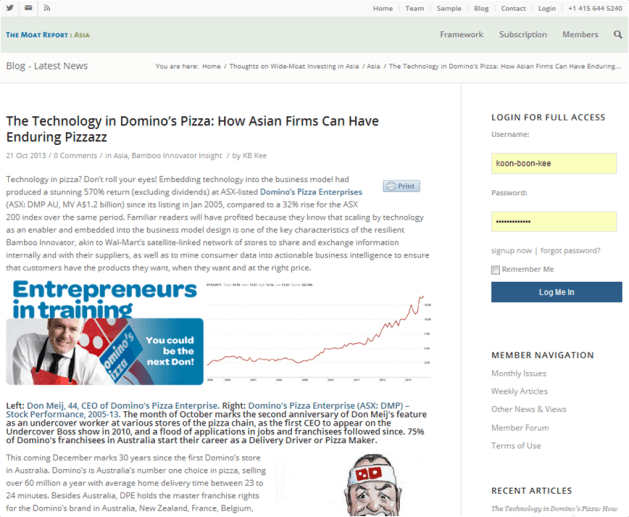
Technology in pizza? Don’t roll your eyes! Embedding technology into the business model had produced a stunning 570% return (excluding dividends) at ASX-listed Domino’s Pizza Enterprises (ASX: DMP AU, MV A$1.2 billion) since its listing in Jan 2005, compared to a 32% rise for the ASX 200 index over the same period. Familiar readers will have profited because they know that scaling by technology as an enabler and embedded into the business model design is one of the key characteristics of the resilient Bamboo Innovator, akin to Wal-Mart’s satellite-linked network of stores to share and exchange information internally and with their suppliers, as well as to mine consumer data into actionable business intelligence to ensure that customers have the products they want, when they want and at the right price.

This coming December marks 30 years since the first Domino’s store in Australia. Domino’s is Australia’s number one choice in pizza, selling over 60 million a year with average home delivery time between 23 to 24 minutes. Besides Australia, DPE holds the master franchise rights for the Domino’s brand in Australia, New Zealand, France, Belgium, Monaco and The Netherlands, and is the largest franchisee for the brand in the world. DPE also recently acquired 75% of Domino’s Japan from Bain Capital in Aug/Sep 2013 for A$128 million, plus agreeing to supply new debt funding of another A$96.4 million for a total of about A$225 million, adding 259 Japanese stores (216 corporate and 43 franchise) to increase DPE’s total store network to over 1,200 stores. Thus, for value investors seeking exposure to Japan but are wary of the governance risks of the domestic stocks, DPE provides an interesting alternative with significantly lower governance risk. Stocks listed outside of Japan with exposure to Japan could be an interesting topic of discussion in the highly insightful Japan Investing Summit on Nov 5-6. Long-time value investors in Japan are cognizant that stocks with high net cash or net current asset as a percentage of their market cap are potential value traps since the cash and liquid assets are “borrowed” by their powerful bank shareholders as part of the keiretsu network, a phenomenon documented empirically as the “keiretsu” valuation discount and investor activism pushing for change usually becomes an act of kicking the hornet’s nest. Empirical fans would find the research of Takeo Hoshi (Stanford University), Anil Kashyap and Douglas Skinner (Chicago Booth School of Business), and Suraj Srinivasan (Harvard Business School) to be particularly useful in understanding governance risks in Japan.

Back to pizza. What did Domino’s Pizza do to embed technology into its business model? What are the 5 Key Bamboo Innovator Takeaways?

The Moat Report Asia Members’ Forum has been getting penetrating quality dialogues from our existing institutional subscribers from North America, the Nordic, Europe, the Oceania and Asia, including professional value investors with over $20 billion in asset under management in equities. Questions range from:

  • The nuances of internal dealings in Asia, including the case discussion of the recent deal in which HK billionaire’s Lee Shau-kee Henderson Land acquiring Towngas or Hong Kong & China Gas (3 HK) from his family holdings, seemingly déjà vu from the early Oct 2007 transaction when the market peak.
  • The case of F&N Singapore spinning out its property unit FCL Trust and getting “free” special dividend-in-specie and the potential risk in asset swap restructuring to deleverage the hidden debt in the entire Group balance sheet.
  • The dilemma of whether to invest in a Southeast Asian-listed company and hidden champion with a domestic market share of 60% due to family squabbles.
  • Discussion of the wise and thoughtful 107-year-old Irving Kahn’s investment into a US-listed but Hong Kong-based electronics company with development property project in Shenzhen’s Qianhai zone and the possible corporate governance risks that could be underestimated or overlooked, as well as their history of listing some assets in HK in 2004.. This is also a case study of “buy one get one free” in John’s highly-acclaimed book The Manual of Ideas in which the “free” property is lumped together with the (eroding) core business to make the combined entity look cheap and undervalued. What are the potential areas that value investors need to watch out for when adapting the SOTP (sum-of-the-parts) method in Asia?
  • And many more intriguing questions.

Do find out more in how you can benefit from authentic and candid on-the-ground insights that sell-side analysts and brokers, with their inherent conflict-of-interests, inevitable focus on conventional stock coverage and different clientele priorities, are unwilling or unable to share. Think of this as pressing the Bloomberg “Help Help” button to navigate the Asian capital jungle. Institutional subscribers also get access to the Bamboo Innovator Index of 200+ companies and Watchlist of 500+ companies in Asia and the Database has eliminated companies with a higher probability of accounting frauds and  misgovernance as well as the alluring value traps.
Sydney Opera House celebrates 40 years

Sydney Opera House celebrates 40 years

AFP-JIJI

OCT 20, 2013

an20131021e1a-870x533

A giant birthday cupcake is displayed on the steps of the Sydney Opera House as the World Heritage-listed building celebrates its 40th birthday on Sunday. The distinctive performance hall, inspired by Danish architect Jorn Utzon’s childhood in the Aalborg shipyards, is one of Australia’s best-known landmarks and is a centerpiece of Sydney’s cultural scene. | AFP-JIJI

SYDNEY – The Sydney Opera House, World Heritage-listed as “one of the indisputable masterpieces of human creativity,” celebrated its 40th birthday Sunday with a flotilla of lifesavers, Aboriginal dancers and a gigantic cupcake. Huge crowds packed the steps for a distinctively Australian performance on the glittering harbor front, where three generations of Danish architect Jorn Utzon’s family were the guests of honor. It was a postcard-perfect day beneath the same cloudless blue skies that inspired Utzon’s winning design to build Sydney an opera house back in 1956 — the white sails drawn from his childhood in the Aalborg shipyards. “A building like this happens once in a lifetime,” Utzon’s son Jan told revelers on Sunday. “It is a unique Australian expression of will and enthusiasm and ‘let’s-go-do-it’ kind of spirit.”  Read more of this post

David Mong still uses the title of “vice chairman” of the Shun Hing Group, although in reality he is chairman. “The title doesn’t matter, as long as I am doing my job,” said the eldest son of the late William Mong, the famed rice-cooker tycoon

Son still shines
Imogene Wong
Monday, October 21, 2013

6_2013102101235898666Leader

David mong Tak-yeung still uses the title of “vice chairman” of the Shun Hing Group, although in reality he is chairman. “The title doesn’t matter, as long as I am doing my job,” said the eldest son of the late William Mong Man-wai, the famed rice-cooker tycoon. Perhaps, the younger Mong is quietly paying obeisance to his father, who was chairman of the group and passed away three years back. Read more of this post

A Lost Generation; the passing of years in our generation is marked not by increasing wisdom and charitable behavior, but by the diminishing, or even negative, contribution one makes to society

Desi Anwar: A Lost Generation

By Desi Anwar on 2:01 pm October 19, 2013.
A friend of mine tweets his disgust at how the country is increasingly full of corruption. It is as if with the passing of time, the number of corrupt individuals around is actually going up, instead of going down. Surely it was not like this in the past? This actually makes perfect sense. Given the increase in the country’s population and thus in the number of people entering the age when they’re mature enough in their life and career to hold a position of power, then the number of those chancing to enter the corruption market can only increase. Read more of this post

What’s That Smell? Exotic Scents Made From Re-engineered Yeast

October 20, 2013

What’s That Smell? Exotic Scents Made From Re-engineered Yeast

By ANDREW POLLACK

EMERYVILLE, Calif. — Vanilla, saffron, patchouli. For centuries, spices and flavorings like these have come from exotic plants growing in remote places like the jungles of Mexico or the terraced hillsides of Madagascar. Some were highly prized along ancient trading routes like the Silk Road. Now a powerful form of genetic engineering could revolutionize the production of some of the most sought-after flavors and fragrances. Rather than being extracted from plants, they are being made by genetically modified yeast or other micro-organisms cultured in huge industrial vats. Read more of this post