EBay, Ellison Embrace Microgrids in Threat to Utilities

EBay, Ellison Embrace Microgrids in Threat to Utilities

Oracle Corp. Chief Executive Officer Larry Ellison plans to build one to power the Hawaiian island he bought last year. EBay Inc. (EBAY) has one to run a data center. The University of California at San Diego and the federal government have invested tens of millions of dollars in the technology.

Microgrids are emerging as a credible threat to the dominance of America’s 100-year-old-plus utility monopoly. The small-scale versions of centralized power systems, once just used against blackouts, are now gaining thousands of customers as homeowners in states with high power costs turn to them as a way to manage rooftop solar systems, cut electricity bills and, in some cases, say goodbye to their power companies.

The systems use computer software and remote measuring devices to control energy sources such as rooftop solar panels and natural gas-fueled power generators. They allow a home or business owner, a college systems engineer or a farmer on a mountainside to generate, distribute and regulate their locally produced power with an ease and sophistication that only utilities had a few years ago.

Not much of a factor a decade ago, microgrids are expected to explode into a $40 billion-a-year global business by 2020, according to Navigant Research, a clean-technology data and consulting company. In the U.S., about 6 gigawatts of electricity — enough to power as many as 4.8 million homes — will flow through microgrids by 2020, Navigant said.

Utility Leapfrog

“Microgrids are going from evolutionary to revolutionary,” said Jon Creyts, a program director at the Rocky Mountain Institute, a nonprofit energy and environmental think tank. While microgrids control a sliver of generation in relation to the overall grid, they are being built with a speed and projected scale that is cause for utilities to worry, according to Creyts.

In the developing world, they may leapfrog the need for conventional utilities — the same way mobile phones leapfrogged the need for landlines — and bring power almost half of the 1.3 billion people on Earth who don’t have it.

While the earliest microgrids controlled simple generator backup systems, they have evolved into sophisticated smart grids. Operators can remain tethered to the larger grid and switch seamlessly between the electricity they generate and utility power, whichever is cheaper. They can even sell surplus electricity back to the utilities through a process known as net metering.

If the main grid goes down, a flip of a switch or automated computer program deploys their mix of green energy, backup generators and storage batteries to keep the lights on.

Eating Revenue

Microgrids have the potential to radically change the U.S. electricity paradigm as they proliferate and begin to eat into the utility revenue stream. For example, U.C. San Diego saves an estimated $850,000 a month on its electricity bill by self-generating and using its microgrid to fine-tune campus power consumption.

The 3,200 U.S. utilities are already facing what NRG Energy Inc. CEO David Crane calls a “mortal threat” to the industry. Forces including deregulation, green politics and an explosion of rooftop solar and other homemade energy — known as distributed generation — mean a reduction in the fossil-fuel electricity utilities sell.

Microgrids may be the mechanism through which this revolution in clean distributed generation will be carried out – – a portal for leaving the traditional power grid.

Mixed Reaction

For utilities, which sell $400 billion worth of electricity a year delivered by 2.7 million miles (4.3 million kilometers) of power lines, the reaction is mixed.

In California, epicenter of the rooftop solar revolution, utility executives have begun to complain to regulators that microgrid operators who remain tied to power lines should shoulder some of the costs of keeping the grid stable, perhaps through connection fees. Sempra Energy (SRE) and American Electric Power Co. are considering microgrid investments as a way to hedge the threat.

While only about 30 commercial-scale systems like those used by EBay and the U.S. Food and Drug Administration exist now, that number is projected to climb to 300 in just two years, said Steve Pullins, chief strategic officer for Green Energy Corp., a Tennessee-based builder of commercial-scale microgrids.

His company estimates that 24,000 U.S. commercial and industrial sites are ripe for large-scale microgrid conversions. Globally, about 400 additional big microgrid projects are under way. Lockheed Martin Corp. completed in May the U.S. Army’s first domestic microgrid at Fort Bliss in Texas. The military is already using them at sites in other countries to reduce fuel consumption.

Requests Increase

“We are seeing requests for proposals going up significantly, 30 to 40 percent higher than last year,” said Paul Orzeske, president of the Honeywell International Inc. unit that designs and builds commercial-scale microgrids. Honeywell built a $71 million microgrid for an FDA research center in Maryland and the agency is in the midst of a $213 million addition that will be online early next year. On the consumer level, San Francisco-based Gen110, which installs leased microgrid systems with no out-of-pocket costs to homeowners, is attracting utility customers put off by tiered pricing that penalizes them when their use exceeds a certain level. Read more of this post

Brazilian Drugstore Billionaire Open to CVS Partnership; “The Brazilian market requires knowledge of the complexity of the tax regime — that’s the main barrier.”

Drugstore Billionaire Open to CVS Partnership: Corporate Brazil

Empreendimentos Pague Menos SA, Brazil’s second-biggest drugstore company, would consider U.S. partners such as CVS Caremark Corp. and Walgreen Co. to expand amid heightened competition, its chief executive officer said. “We’ve been approached by some companies, but we would only do it with a strategic partner,” Francisco Deusmar de Queiros, 66, the billionaire CEO of the closely held chain, said in an interview at Bloomberg’s Sao Paulo office without naming any prospects. “The right partner has yet to appear — the right partner that enchants us to go to the ball and dance.” Read more of this post

American Funds Defends Active Investing After Massive Investor Retreat

American Funds Defends Active Investing After Massive Investor Retreat

By Christopher Condon October 17, 2013

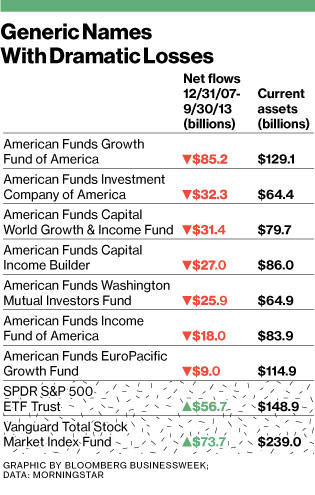
mf_active43table_315inline

On the eve of the financial crisis, Capital Group was king of the mutual fund business—even though most investors had never heard of it. The Los Angeles-based company’s American Funds unit ran seven of the nation’s 10 biggest funds, including the largest of all, the $193 billion Growth Fund of America. Eagerly sold by brokerages such as Merrill Lynch (BAC) and Edward Jones, the funds had no need for mass marketing to attract investors and even less for media attention. Capital Group has issued only three press releases in its 82-year history and politely declines most requests for comment. The idea was that the blandly named funds’ outstanding returns spoke for themselves. Read more of this post
HKMA has proposed that Chinese authorities remove a 20,000 yuan ($3,280) daily currency conversion limit on the city’s permanent residents

Hong Kong Proposes Removing Yuan-Conversion Limit on Locals

The Hong Kong Monetary Authority has proposed that Chinese authorities remove a 20,000 yuan ($3,280) daily currency conversion limit on the city’s permanent residents, according to Chief Executive Norman Chan. “The People’s Bank of China said this is feasible and it will pro-actively consider it,” Chan told reporters in Beijing today. “That’ll make it easier for banks to sell wealth-management products denominated in yuan.” Read more of this post
Brewing U.S. ethanol legal battle hinges on meaning of ‘supply’

Brewing U.S. ethanol legal battle hinges on meaning of ‘supply’

9:34pm EDT

By Cezary Podkul

CHICAGO (Reuters) – The fate of a landmark U.S. requirement to blend increasing amounts of biofuels into the nation’s gasoline pool rests on the meaning of three words tucked into a mammoth law: unless there is “inadequate domestic supply.” But “supply” of what? The law does not say. As a years-long battle over the future of the U.S. fuel supply begins to shift to the courts, the two fierce foes – the biofuel industry and oil refiners – are debating a definition that lawyers say leaves much room for interpretation. Read more of this post
40 Years After Embargo, OPEC Is Over a Barrel

40 Years After Embargo, OPEC Is Over a Barrel

Today marks the 40th anniversary of the Organization of the Petroleum Exporting Countries embargo against the U.S. and states that supported Israel after Egypt and Syria initiated simultaneous offensives against it on Yom Kippur in 1973. While it’s not an anniversary that many will celebrate, it’s a good opportunity to reflect on how much more secure our energy situation is, despite our continued heavy reliance on fossil fuels. Read more of this post
Billionaires Snubbed in Netherlands Show Phone Stocks Rebounding

Billionaires Snubbed in Netherlands Show Phone Stocks Rebounding

John Malone and Carlos Slim’s plans to expand their empires on the cheap in Europe’s beleaguered telecommunications market have been thwarted so far as companies in the region begin commanding higher prices. Both billionaires suffered recent setbacks in the Netherlands trying to turn leading stakes into full ownership. Cable company Ziggo NV (ZIGGO) rejected Malone’s offer and Slim’s America Movil SAB withdrew a 7.2 billion-euro ($9.8 billion) bid for Royal KPN NV after the targets said they wanted more. Read more of this post

Dynasties Reinforced as Mahathir Son in UMNO Bid: Southeast Asia

Dynasties Reinforced as Mahathir Son in UMNO Bid: Southeast Asia

Mukhriz Mahathir, the 48-year-old son of Malaysia’s longest-serving prime minister, will tomorrow contest the vice presidency of the nation’s biggest political party, staking his claim as a potential future national leader. The United Malays National Organisation, or UMNO, which has led coalitions to govern Southeast Asia’s third-biggest economy since independence from Britain in 1957, will elect party leaders who typically hold their posts for three years. As UMNO seeks to shore up its base after a May general vote that saw the government returned by its smallest margin, the meeting will provide an insight into policy priorities and leadership style ahead of the next election due in 2018. Read more of this post
Sri Lanka, for decades a destination for backpackers, religious pilgrims and beach-lovers, is building high-end hotels and casinos to woo wealthier tourists from India and China as it seeks to emulate the success of Singapore and Macau

Crown’s Sri Lanka Casino Resort Venture to Cost $400 Million

Crown Ltd. (CWN), Australia’s largest gambling company, said a casino resort it’s in talks over co-developing in Sri Lanka will cost about $400 million. The five-star resort will have about 450 hotel rooms and suites at Beira Lake in the center of the capital Colombo, the Melbourne-based company said in a regulatory statement today. Crown, controlled by billionaire Chairman James Packer, also said it’s seeking joint venture partners for the project. Read more of this post

In Myanmar, avoiding the traps of foreign investment; Aung San Suu Kyi warned against “reckless optimism” by investors

In Myanmar, avoiding the traps of foreign investment

As potential investors converge on the Golden Land from all over, Opposition leader Aung San Suu Kyi voiced her desire for “democracy-friendly investment”, in particular, foreign direct investment (FDI) that creates jobs Myanmar’s unemployed youth. She warned against “reckless optimism” by investors.

BY HTWE HTWE THEIN –

1 HOUR 32 MIN AGO

As potential investors converge on the Golden Land from all over, Opposition leader Aung San Suu Kyi voiced her desire for “democracy-friendly investment”, in particular, foreign direct investment (FDI) that creates jobs Myanmar’s unemployed youth. She warned against “reckless optimism” by investors. Western governments indeed are encouraging their businesses to act as role models in terms of setting labour standards, looking after the environment, giving back to society and so on. Meanwhile, Asian governments and businesses wrangle over Myanmar’s natural resources and infrastructure projects. Read more of this post

GS Engineering Falls Most in Six Months after it was sued by a group of investors over losses caused by unexpected cost increases on overseas environmental projects

GS Engineering Falls Most in Six Months on Lawsuit: Seoul Mover

GS Engineering & Construction Corp. (006360) fell the most in six months in Seoul trading after the South Korean builder said it was sued by a group of investors over losses caused by unexpected cost increases on overseas projects. GS Engineering dropped as much as 4.8 percent, headed for the biggest decline since April 15, to 35,400 won and traded at 36,050 won as of 12:35 p.m. South Korea’s benchmark Kospi index rose 0.3 percent. Fifteen investors filed the lawsuit against GS Engineering on Oct. 8 at the Seoul Central District Court, the Seoul-based company said in a regulatory filing today. The investors claim GS Engineering failed to make proper estimates in financial statements for costs that may arise from the projects, according to today’s statement. The builder said in April it expects an operating loss this year because of the cost increases. The company said it will appoint a lawyer to handle the case. GS Engineering in April reported an unexpected operating loss in the first quarter because costs increased for some of its overseas environment-related projects. That caused shares of builders to slump on concerns that other construction companies may face similar problems.

To contact the reporter on this story: Kyunghee Park in Singapore at kpark3@bloomberg.net

A supply glut in India’s hotel market is preventing an industry revival in the country after average revenue per room fell to a three-year low, says Accor SA (AC), Europe’s largest hotel operator

Europe’s Top Hotel Says Glut to Thwart Revival: Corporate India

A supply glut in India’s hotel market is preventing an industry revival in the country after average revenue per room fell to a three-year low, according to Accor SA (AC), Europe’s largest hotel operator. A key performance gauge, calculated by multiplying a hotel’s average daily room rate by its occupancy, dropped to the least since at least 2010 in the quarter through June, according to data provided by Cushman & Wakefield Inc. In contrast, that metric has risen in the developed markets of Europe and the U.S., said Michael Issenberg, Accor’s chairman for Asia-Pacific. Read more of this post

India’s Closed Shop. Excessive regulation turned Delhi’s retail opening into a failure

India’s Closed Shop. Excessive regulation turned Delhi’s retail opening into a failure.

Updated Oct. 17, 2013 5:37 p.m. ET

Wal-Mart WMT +0.24% last week announced it would close its retail outlets in India and part ways with local partner Bharti Enterprises. The American company says it can’t make a profit due to a government requirement that 30% of inventory be sourced from local channels, a rule that doesn’t apply to Indian firms. Wal-Mart’s exit means not a single multinational is taking advantage of India’s decision last year to allow foreign retailers to own 51% of joint ventures. Read more of this post

Lenovo will face obstacles in any BlackBerry deal

Lenovo will face obstacles in any BlackBerry deal: source

7:52pm EDT

By Nadia Damouni and Euan Rocha

NEW YORK/TORONTO (Reuters) – Chinese computer maker Lenovo, which has signed a non-disclosure deal to examine BlackBerry’s books, faces regulatory obstacles if it bids for all of the company and will likely pursue just parts, a source familiar with the matter said on Thursday. BlackBerry Ltd said in August it was exploring options that could include an outright sale. And the Canadian company, which helped pioneer smartphones, has since been linked with a string of potential buyers from private equity firms to rival technology companies. Read more of this post

Mistress-Driven Anticorruption in China: Study Says 15% of Accusers Are Lovers

October 17, 2013, 6:30 AM

Mistress-Driven Anticorruption: Study Says 15% of Accusers Are Lovers

In the early days of Chinese President Xi Jinping’s drive to clean up the Communist Party’s image, disciplinary authorities benefited from the work of a group of accusers with particularly intimate knowledge of corrupt bureaucrats’ nefarious activities: their extramarital lovers. A district party chief in the southwestern mega-city of Chongqing, a police chief in the northwestern region of Xinjiang and the former deputy head of China’s top economic planning body all were removed from office thanks in part to their illicit sexual activities. Read more of this post

Bid Battle Intensifies for Australian Dairy Producer Warrnambool Cheese & Butter

Oct 17, 2013

Bid Battle Intensifies for Australian Dairy Producer

GILLIAN TAN

It’s now a three-way battle for one of Australia’s largest-listed dairy companies. Australia’s Murray Goulburn Co-operative Co. Ltd has made a takeover offer for Warrnambool Cheese & Butter Factory Co. Holdings Ltd. that values the dairy producer at 420 million Australian dollar (US$404 million), trumping two rival bids. The combination of Warrnambool Cheese & Butter and farmer-controlled Murray Goulburn would make it one of Australia’s five largest food and beverage companies, with expected revenues of more than A$3.2 billion and export sales of A$1.4 billion to more than 60 countries.  It expects to process more than 4 billion liters of milk annually from more than 3,000 suppliers. Read more of this post

India’s Secret to Low-Cost Health Care

India’s Secret to Low-Cost Health Care

by Vijay Govindarajan and Ravi Ramamurti  |   10:00 AM October 15, 2013

A renowned Indian heart surgeon is currently building a 2,000-bed, internationally accredited “health city” in the Cayman Islands, a short flight from the U.S. Its services will include tertiary care procedures, such as open-heart surgery, angioplasty, knee or hip replacement, and neurosurgery for about 40% of U.S. prices. Patients will have the option of recuperating for a week or two in the Caymans before returning to the U.S. At a time when health care costs in the United States threaten to bankrupt the federal government, U.S. hospitals would do well to take a leaf or two from the book of Indian doctors and hospitals that are treating problems of the eye, heart, and kidney all the way to maternity care, orthopedics, and cancer for less than 5% to 10% of U.S. costs by using practices commonly associated with mass production and lean production.

Read more of this post

5 Powerful Tips For Getting More Done Every Day: Believe In What You Do. What happens when you see your work as a calling, not just a job that pays the bills? You are more thorough, engaged — and happier.

5 Powerful Tips For Getting More Done Every Day

ERIC BARKERBARKING UP THE WRONG TREE OCT. 16, 2013, 6:03 PM 2,440 2

Tomorrow (n.): A mystical land where 99% of all human productivity, motivation, and achievement is stored.

1) Know When You’re At Your Best

And plan accordingly. To be a productivity ninja focus less on time management, and more on managing your energy.  Charlie Munger, Vice-Chairman of Berkshire Hathaway, used a system like this to make sure he was always growing. He identified the hours when he was at his best — and then routinely stole one of those peak hours for learning.

Via The Idea Hunter: How to Find the Best Ideas and Make them Happen:

Charlie Munger hit upon one strategy when he was a young lawyer. He decided that whenever his legal work was not as intellectually stimulating as he’d like, “I would sell the best hour of the day to myself.” He would take otherwise billable time at the peak of his day and dedicate it to his own thinking and learning. “And only after improving my mind — only after I’d used my best hour improving myself — would I sell my time to my professional clients.” Are you a morning lark? A night owl? Tired after lunch? Best after a nap? Track Read more of this post

How the Precious Orchid Got So Cheap: Taiwan’s Efficient Growers, Who Copied Tech Industry, Bemoan Days When a Flower Fetched $100,000

How the Precious Orchid Got So Cheap

Taiwan’s Efficient Growers, Who Copied Tech Industry, Bemoan Days When a Flower Fetched $100,000

EVA DOU

Oct. 16, 2013 7:36 p.m. ET

MK-CH107_ORCHID_G_20131016183511

Taiwan has refined the breeding of orchids into a mass-production business. Most growers handle one step in the process, such as cloning orchids through tissue culture, pictured. Leanne Huang for The Wall Street Journal

WUSHU VILLAGE, Taiwan—A custard-yellow orchid dubbed P. Golden Emperor ‘Sweet’ changed hands between Taiwan breeders in 1978 for $100,000. Now, orchids roll out of greenhouses in Taiwan and onto the shelves of big-box retailers like Lowe’s for as little as $5.48. As with flat-panel televisions and laptop computers, the once-rare orchid has become a mass-market commodity. Orchids now are the best-selling potted flower in the U.S., with annual sales exceeding the poinsettia, according to the U.S. Department of Agriculture. Behind the shift are the entrepreneurs of Taiwan, who have brought to orchid-breeding the energy and methods applied to making consumer electronics. Read more of this post

National Geographic Asked Fans To Submit Their Best Travel Pictures And Got Some Amazing Results

National Geographic Asked Fans To Submit Their Best Travel Pictures And Got Some Amazing Results

MEGAN WILLETT OCT. 16, 2013, 5:53 PM 33,186 2

For 125 years, National Geographic has been photographing our sublime planet, bringing what few humans have witnessed into the average American living room. To celebrate its anniversary and encourage photographers to see the world through the lens, National Georgaphic launched a photo-sharing platform called Your Shot. Led by the magazine’s star photographer Cory Richards and his magazine photo editor Sadie Quarrier, the project asks photographers to submit three images “that convey how photography can help us explore our changing world.”  Richards and Quarrier will also provide tips and feedback for all those who participate, and their favorite photograph will be selected to appear in a future issue of the magazine. In order to participate, photogs must join the Your Shot community and submit photos by October 22nd. To learn more about submitting your photos and the competition, click here.

this-photograph-proves-patience-is-a-photographers-virtue-while-photographing-lilies-in-a-local-swamp-a-cloud-of-tadpoles-swam-by-numbering-in-the-thousands-all-following-along-in-a-trail

This photograph proves patience is a photographer’s virtue. “While photographing lilies in a local swamp, a cloud of tadpoles swam by numbering in the thousands, all following along in a trail.” Read more of this post

TED talks are lying to you. The creative class has never been more screwed. Books about creativity have never been more popular. What gives?

SUNDAY, OCT 13, 2013 07:00 PM MPST

TED talks are lying to you

The creative class has never been more screwed. Books about creativity have never been more popular. What gives?

BY THOMAS FRANK

The writer had a problem. Books he read and people he knew had been warning him that the nation and maybe mankind itself had wandered into a sort of creativity doldrums. Economic growth was slackening. The Internet revolution was less awesome than we had anticipated, and the forward march of innovation, once a cultural constant, had slowed to a crawl. One of the few fields in which we generated lots of novelties — financial engineering — had come back to bite us. And in other departments, we actually seemed to be going backward. You could no longer take a supersonic airliner across the Atlantic, for example, and sending astronauts to the moon had become either fiscally insupportable or just passé. Read more of this post

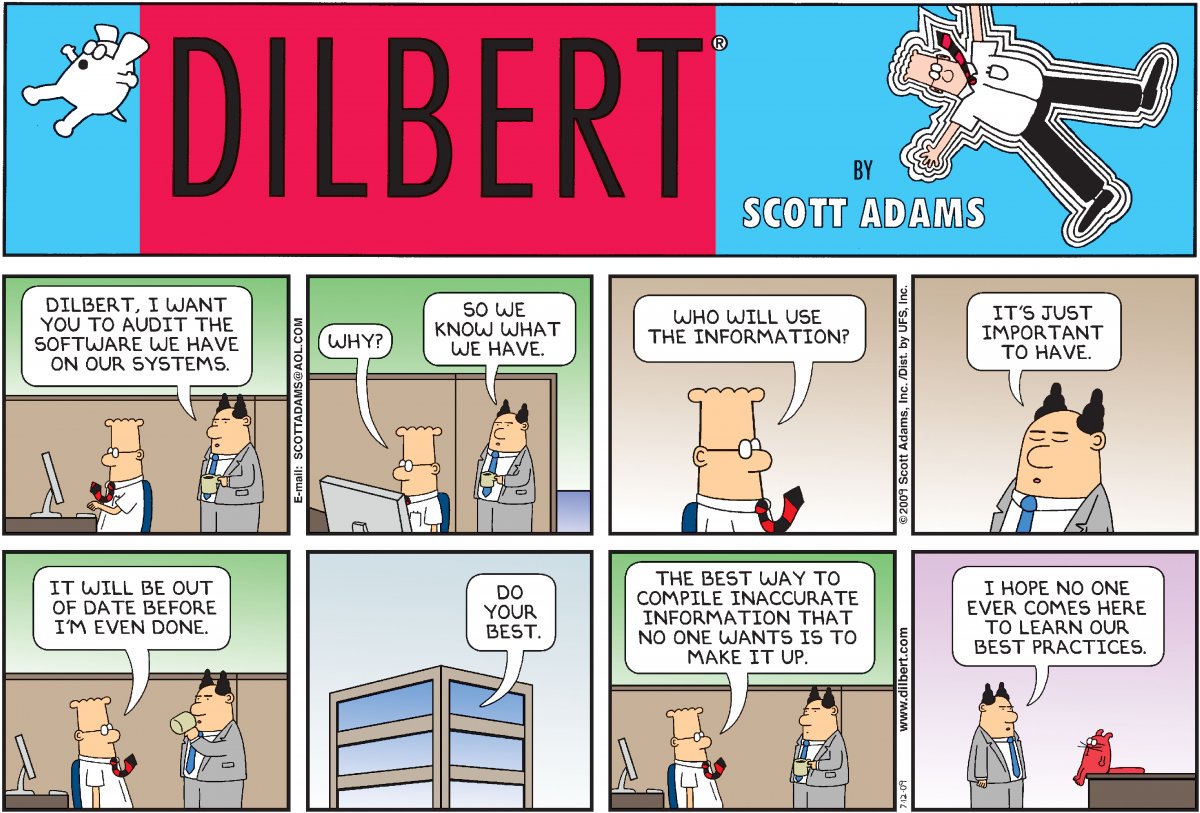
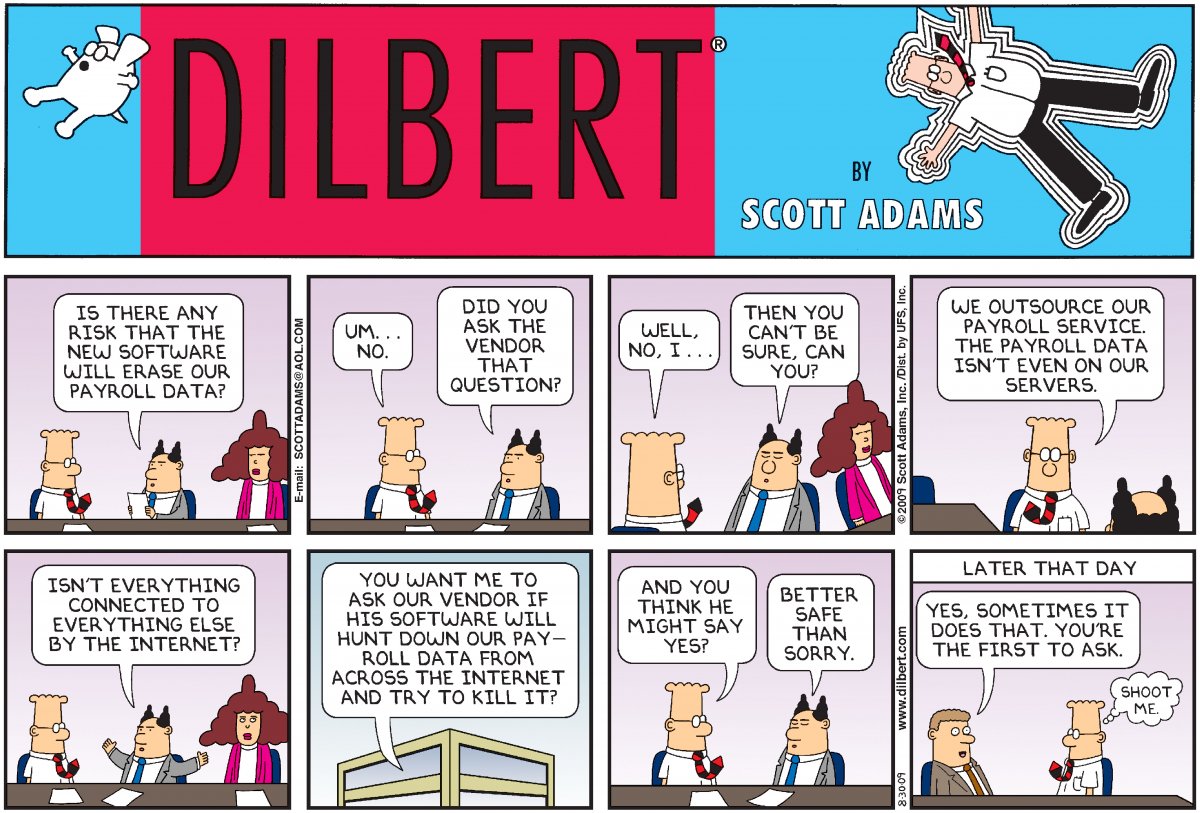
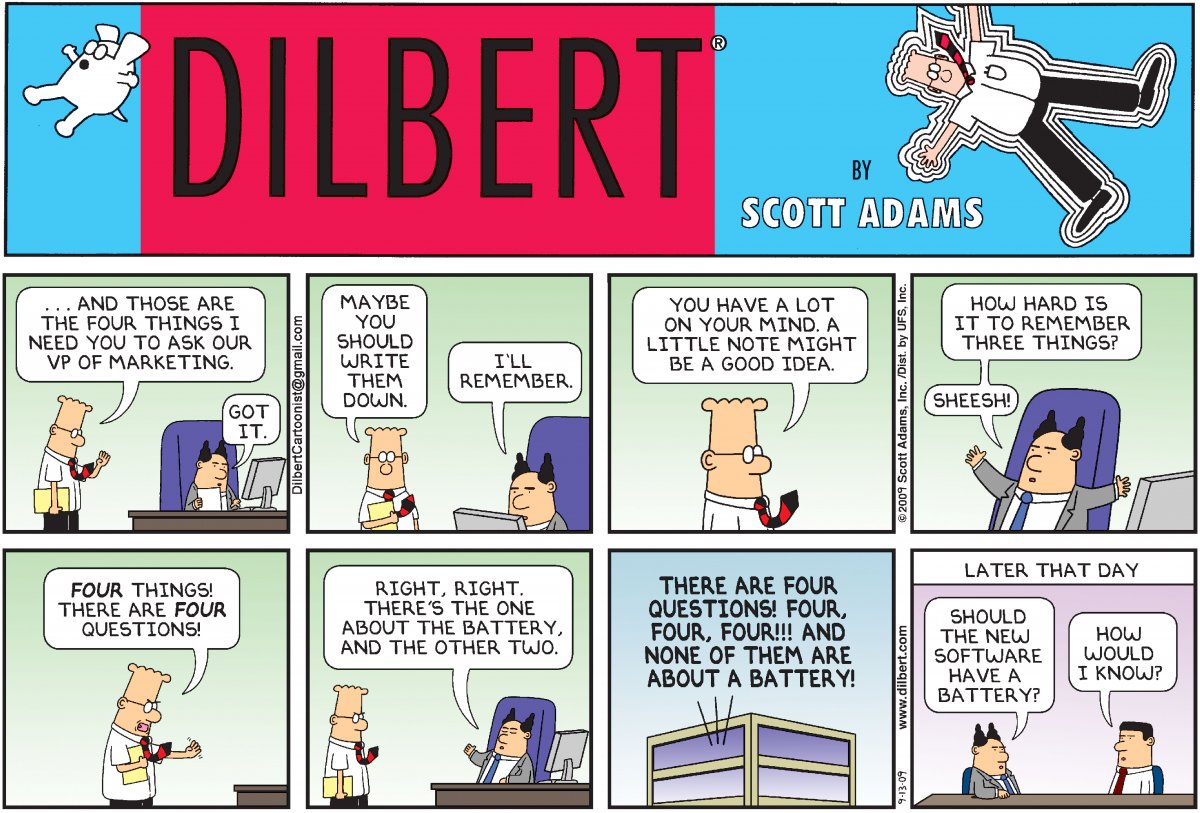
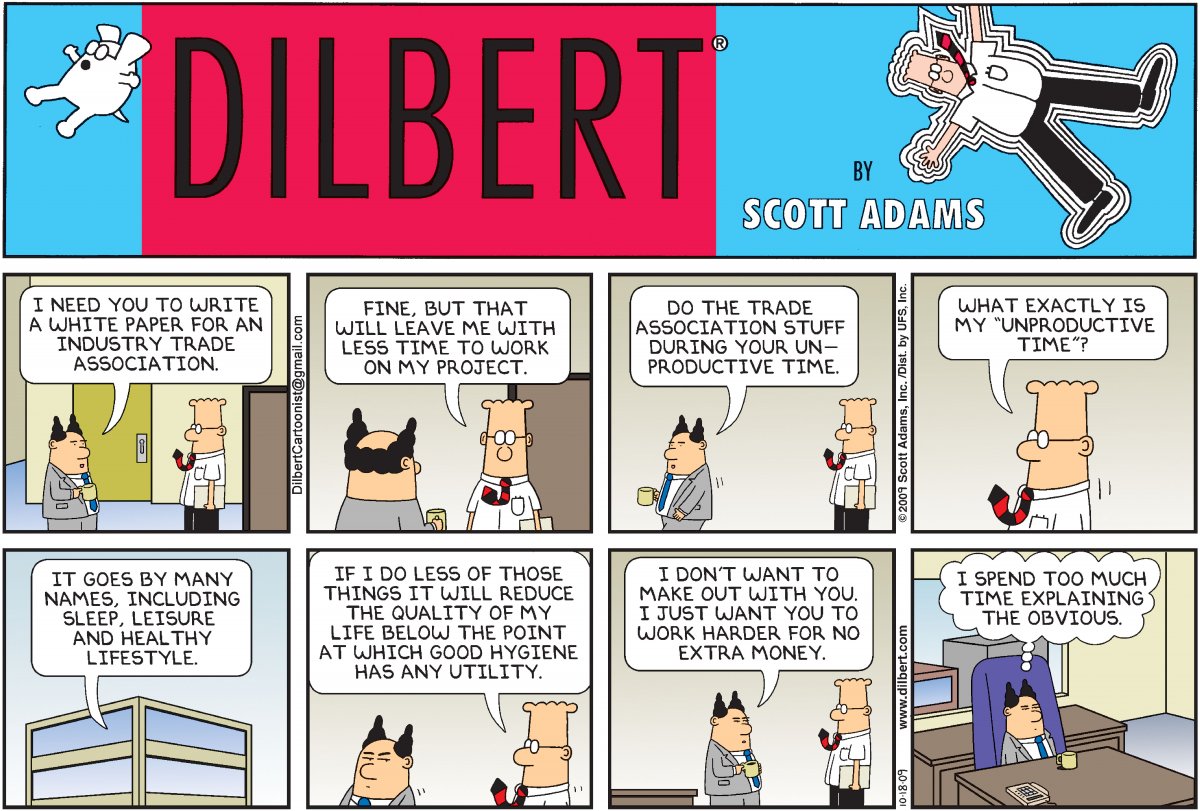
The 10 Best Pointy-Haired Boss Moments From ‘Dilbert’

The 10 Best Pointy-Haired Boss Moments From ‘Dilbert’

JENNA GOUDREAU OCT. 16, 2013, 9:59 AM 107,665 3

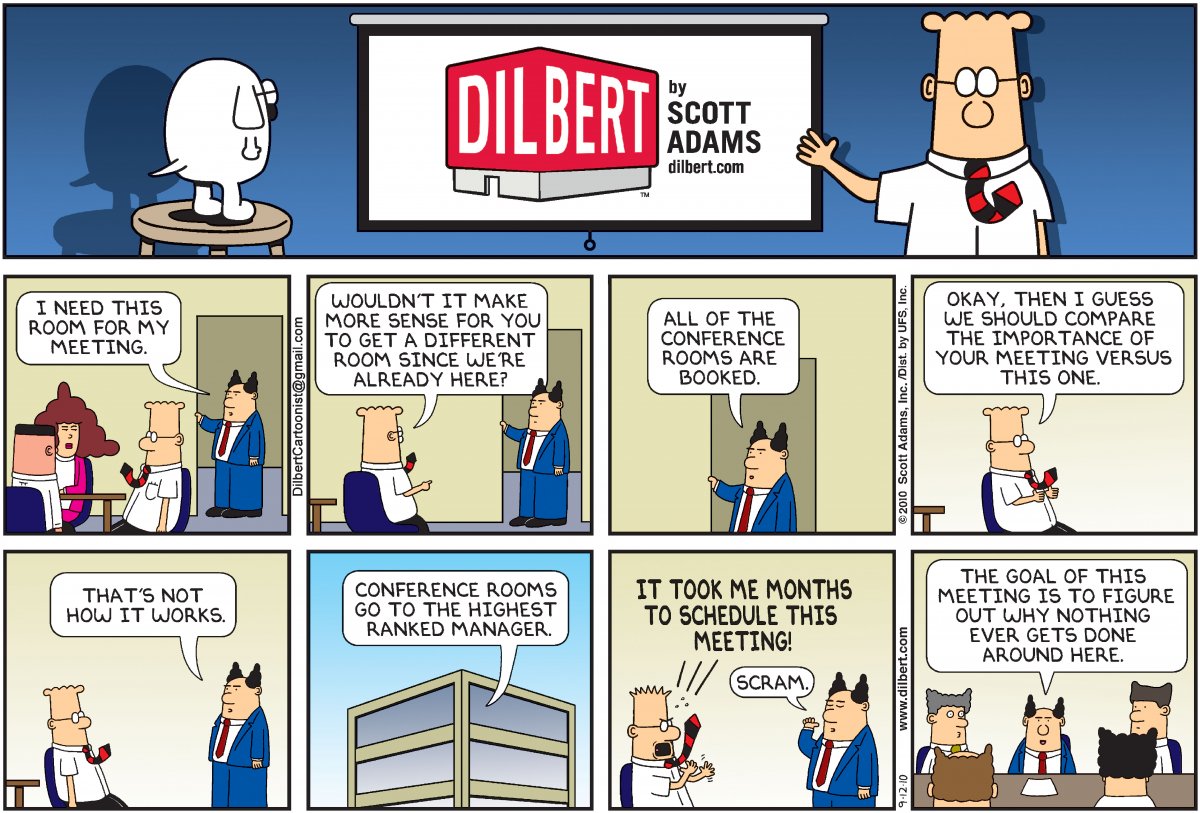
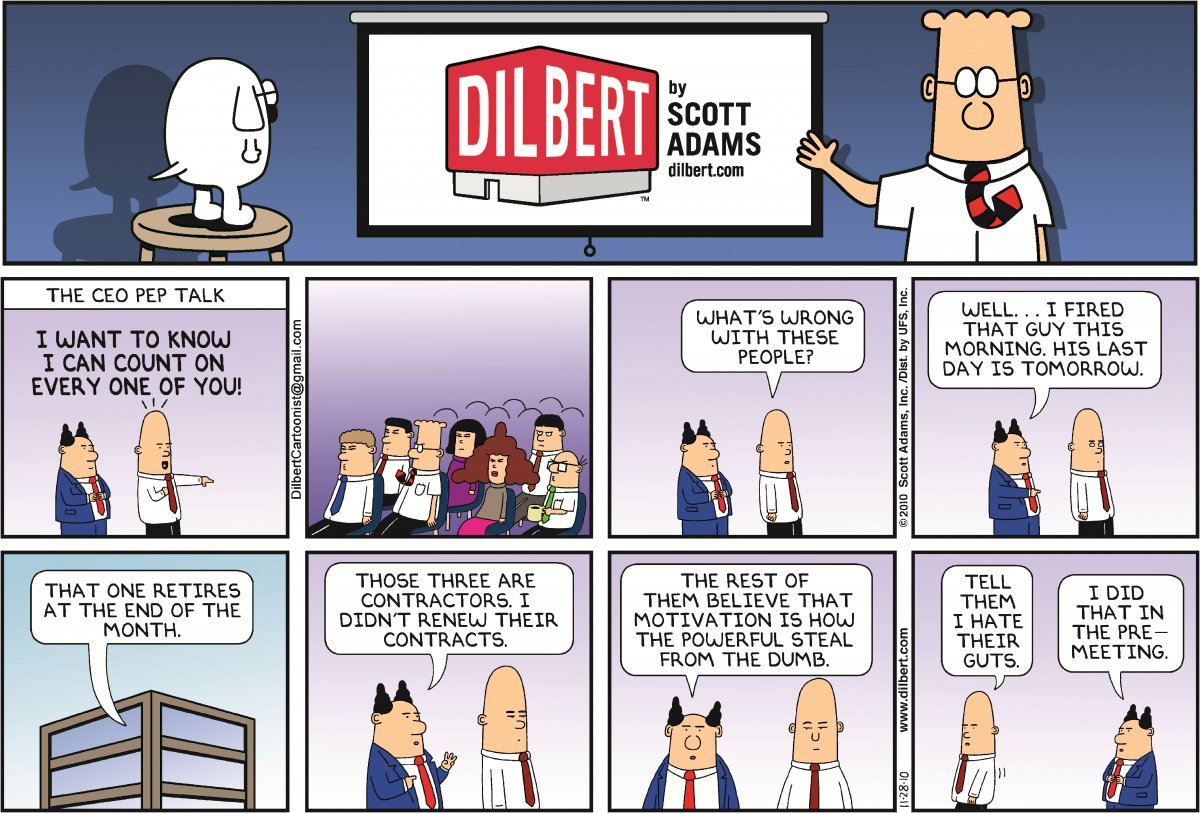
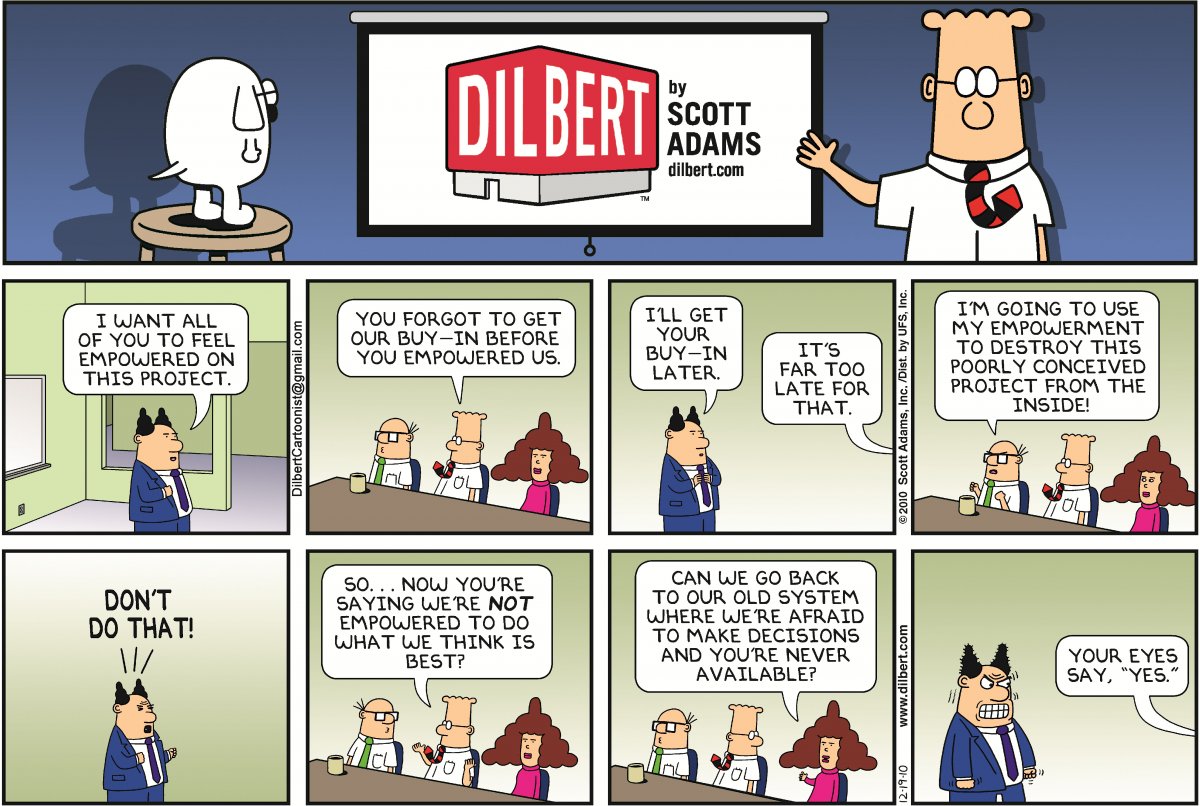
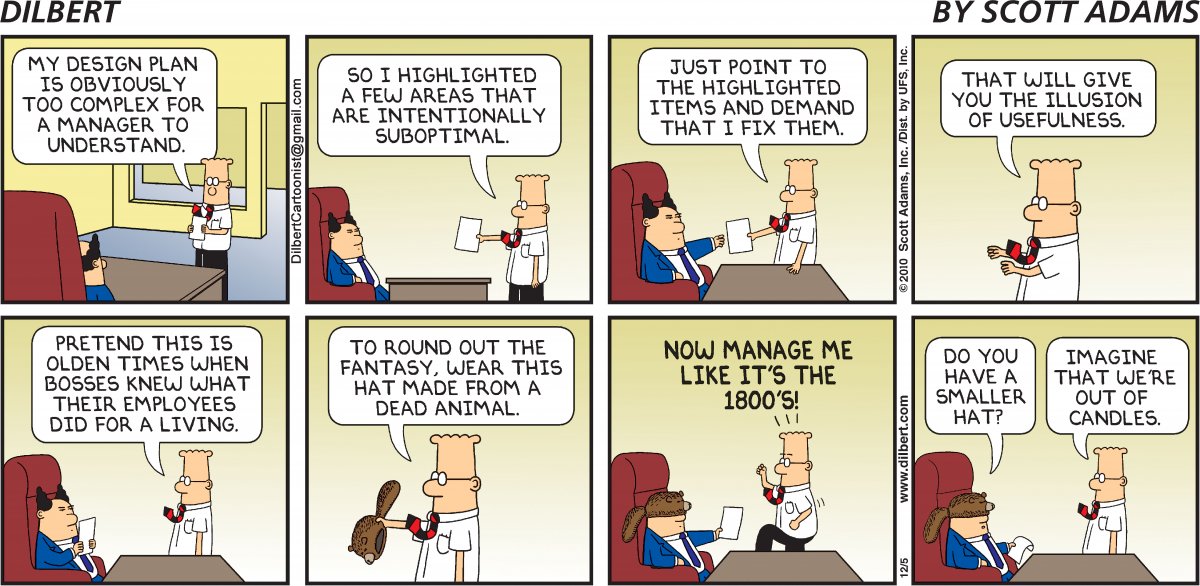
In over two decades of the popular office-centered comic strip Dilbert, the Pointy-Haired Boss has epitomized the idiocies of middle management. He manages by slogan, doesn’t understand what his employees do, and has meetings to discuss the productivity of meetings. The uselessness of management is one of the major themes of Dilbert, Scott Adams, the creator of Dilbert and author of new book “How to Fail at Almost Everything and Still Win Big,” tells Business Insider. “If you’ve ever had a boss, this probably hits home for you.”
For National Boss Day, Adams searched the archives of Dilbert.com and chose his 10 favorite Pointy-Haired Boss strips. Let this be a lesson in what not to do.

august-2001 july-2009 august-2009 september-2009 october-2009 october-2009 (1) september-2010 november-2010 december-2010 december-2010 (1)


Focus: The Hidden Driver of Excellence, by Daniel Goleman

October 16, 2013 6:41 pm

‘Focus: The Hidden Driver of Excellence’, by Daniel Goleman

Review by Adam Palin

Focus: The Hidden Driver of Excellence, by Daniel Goleman,HarperCollins/Bloomsbury, $28.99/£18.99

Please concentrate. Your ability to focus productively is being undermined by the daily bombardment of emails, text messages and audio-visual stimulation. This threat demands our at­tention, Daniel Goleman writes, because focus is the secret of success. A psychologist, former science journalist at The New York Times and author of bestselling book Emotional Intelligence, Goleman appears to have the measure of his readers. In Focus, he cleverly emp­loys short chapters littered with case studies to en­gage professionals swimming against a tide of electronic correspondence. Goleman’s prem­ise is that our ability to block out the massof digital distractions is diminished by the “cognitive exhaustion” they cause. Without finding ways to be focused, we cannot help but be distracted.

Mindlessness – when your thoughts are al­ways wandering – is potentially “the single biggest waster of attention in the workplace”, he says. Developing its opposite – the increasingly popular trait of mindfulness– by training the brain to pay complete attention to the current moment is crucial. Mindfulness al­lows us to concentrate on what is important, and not be distracted by the noise around us. Read more of this post

Innovation Requires More Than Systems and Tools

Innovation Requires More Than Systems and Tools

by Cyril Bouquet , Jean-Louis Barsoux and Julian Birkinshaw | Oct 14, 2013

Broad based engagement in innovation has to be carefully nurtured and actively monitored

Innovation ain’t what it used to be. Once the responsibility of a single department with a clear mission — new product development — today, it is everywhere and involves not just products and services, but processes, technologies, business models, pricing plans and performance management practices – the entire value chain.  As a result, innovation is now the responsibility of the entire organization.  Read more of this post

Chasing trends is a dangerous game; Momentum is a losing strategy for long-term investors

October 16, 2013 9:01 am

Chasing trends is a dangerous game

By Paul Woolley

Momentum is a losing strategy for long-term investors

Big investors currently pursue two very different strategies when appointing external managers. Their traditional approach is to hire fund managers for portfolios benchmarked to market indices with risks quite tightly controlled. They are simultaneously increasing their allocations to hedge funds, measured against cash and free to take every liberty under the sun. Both approaches generally produce disappointing results, especially for long-term investors such as pension funds. As it happens, this is for related reasons. Read more of this post

More Holes Than Cheese: Embracing the Growth Imperative

More Holes Than Cheese: Embracing the Growth Imperative

by Hans-Paul Bürkner, Kermit King, and Nor Azah Razali

OCTOBER 08, 2013

Corporate leaders can be forgiven for taking an increasingly cautious view of the future: growth in the developed markets remains slow while growth in the emerging markets is falling from a once-great height. But those who fail to pursue top-line growth and, instead, focus on cost cutting to improve the bottom line risk falling behind more enterprising competitors. Around the world, and in every industry, sector, and business, there are companies managing to grow fast and to build an enduring lead over their rivals.

BCG’s research (https://www.bcgperspectives.com/content/articles/corporate_strategy_portfolio_management_future_of_strategy_most_adaptive_companies_2012/) shows that the gap in operating margin between corporations in the top-performing quartile (companies achieving high growth and high operating margins) and those in the bottom quartile has widened dramatically as the global economy has become ever more volatile and unpredictable. In 1950, the gap was 13 percent. Sixty years later, it was 59 percent.

What is the secret of the fast-growing companies?

In essence, leaders at these organizations understand that there is a growth imperative. This drives them forward. They see opportunities everywhere, pursue them relentlessly, and never think that their job is done. For these leaders, there is always more commercial space to be conquered. There are always more holes than cheese. Read more of this post

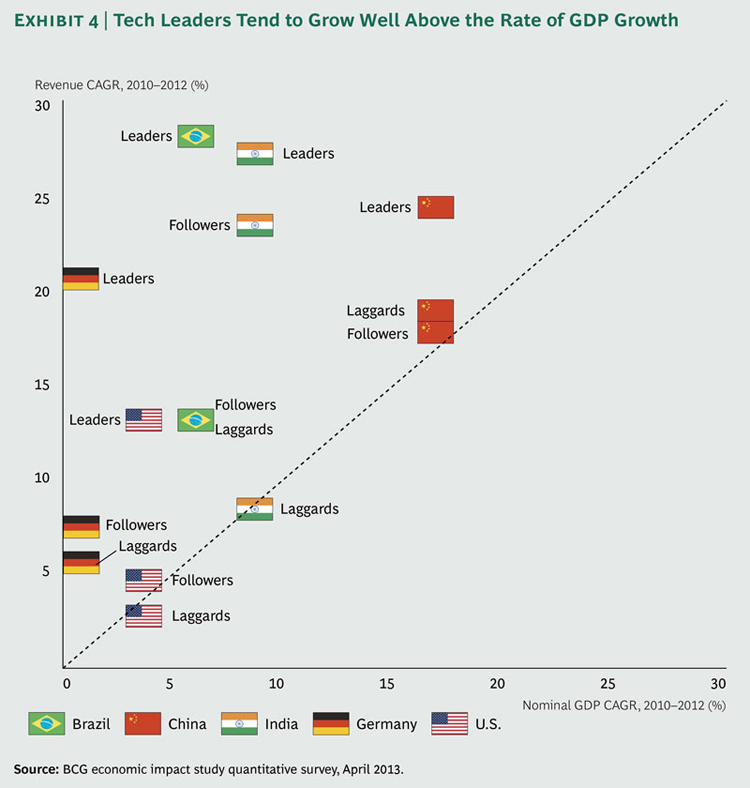
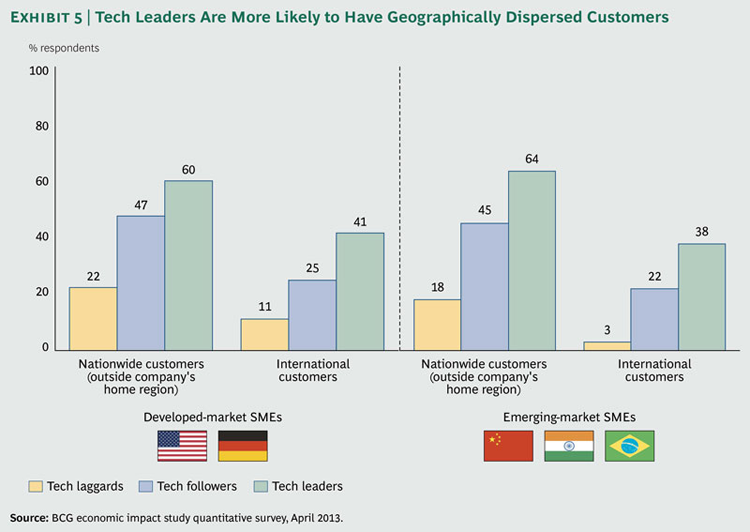
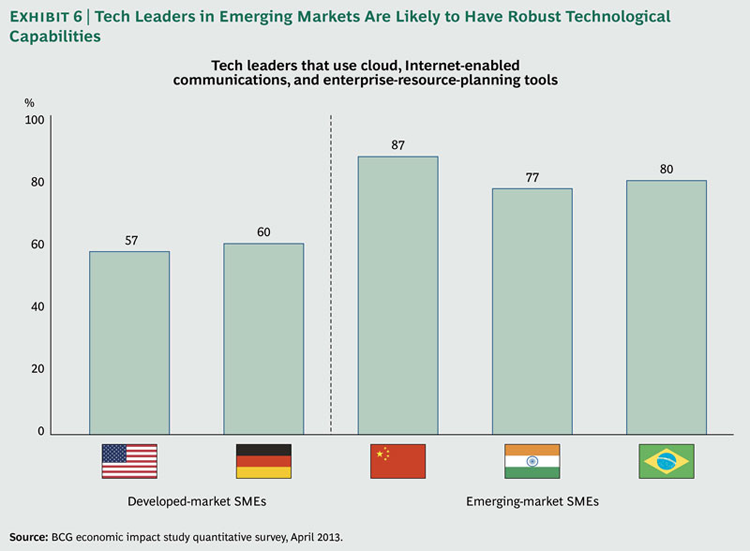
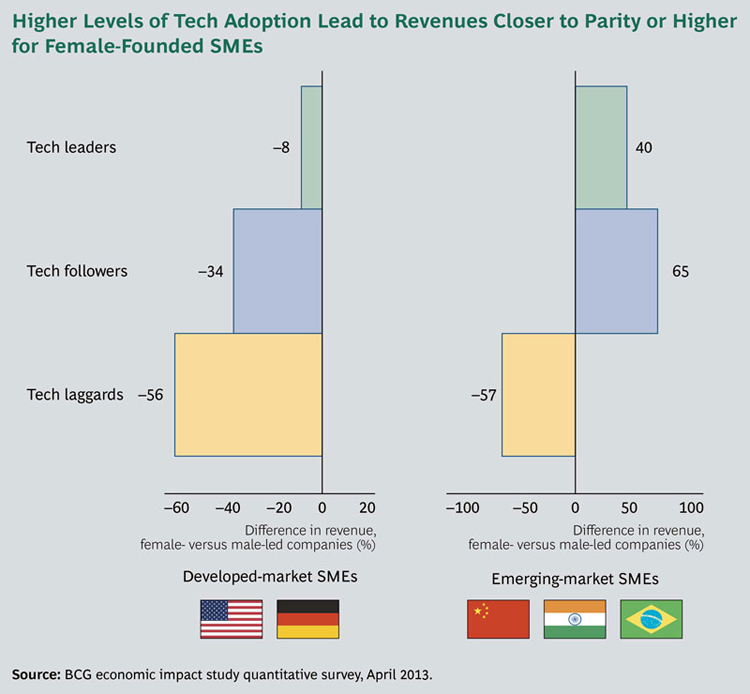
Lessons on Technology and Growth from Small-Business Leaders: Ahead of the Curve

Lessons on Technology and Growth from Small-Business Leaders: Ahead of the Curve

by David C. Michael, Neeraj Aggarwal, Derek Kennedy, John Wenstrup, Michael Rüssman, Ruba Borno, Julia Chen, and Julio Bezerra

OCTOBER 05, 2013

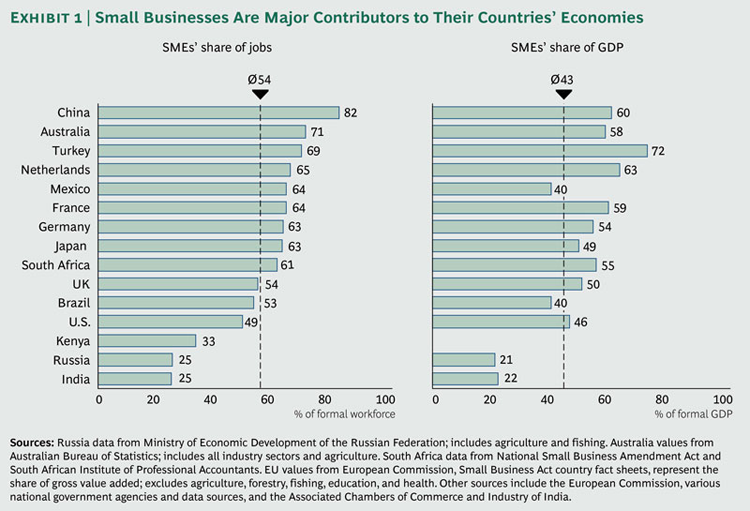
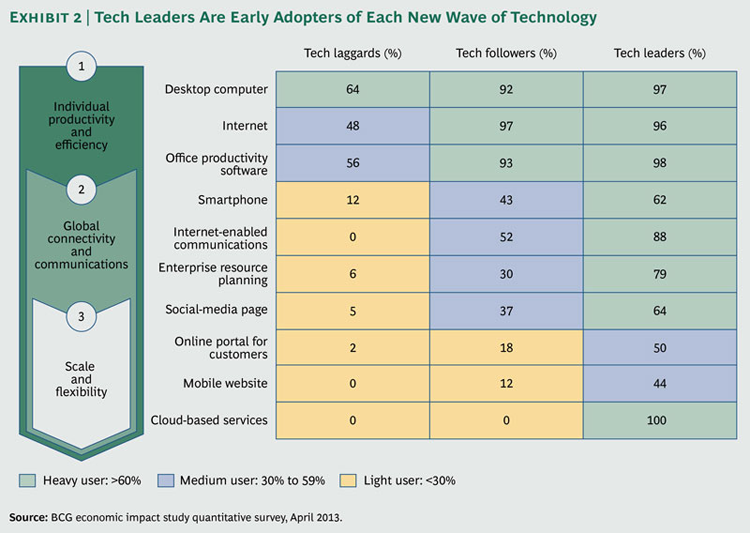
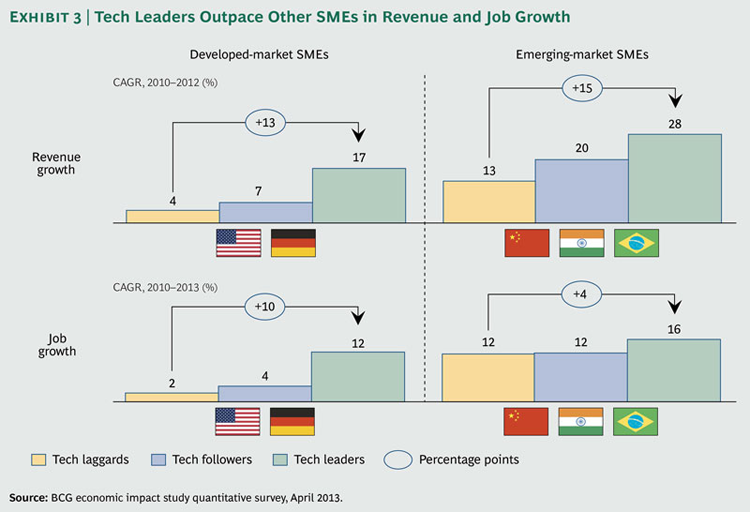
Ahead-of-the-Curve-NEW-ex1_large_tcm80-145777 Ahead-of-the-Curve-ex2_large_tcm80-145780 Ahead-of-the-Curve-ex3_large_tcm80-145783 Ahead-of-the-Curve-ex4_large_tcm80-145786 Ahead-of-the-Curve-ex5_large_tcm80-145789 Ahead-of-the-Curve-ex6_large_tcm80-145798 Ahead-of-the-Curve-ex7_large_tcm80-145792 Ahead-of-the-Curve-sidebar-ex_large_tcm80-145795

Overview

Small and midsize enterprises (SMEs) are critical to fueling economic growth and job creation around the world. Their success matters. As SMEs search for ways to grow, they have the opportunity to embrace a new wave of information technologies. With the advent of the cloud, SMEs can access many of the same technologies as giant multinational companies. Yet the adoption of the latest IT by smaller companies has been decidedly uneven. This new digital divide threatens to widen the performance gap of SMEs as the pace of innovation accelerates. Read more of this post

IKEA’s Path to Selling 150 Million Meatballs: The Swedish furniture giant’s IKEA Food division is a behemoth, rivaling Panera Bread and Arby’s

IKEA’s Path to Selling 150 Million Meatballs

Ordering Up a Simple Swedish-Influenced Menu to Fuel Shoppers

JENS HANSEGARD

Oct. 16, 2013 7:58 p.m. ET

PJ-BR130A_IKEA_G_20131016181835

Meatballs are on the menu at an IKEA in Stockholm, shown—and around the world. Ellen Emmerentze Jervell for The Wall Street Journal

When IKEA decided to sell food, it chose to do it in much the same way it sells furniture: a few standardized staples, sold in large quantities. The result: 150 million meatballs. That is the number IKEA estimates will be dished out in store cafeterias this year. Though the Swedish company is better known for its inexpensive, assembly-required furniture, its IKEA Food division is a behemoth, rivaling Panera Bread and Arby’s, with nearly $2 billion in annual revenue. The company estimates about 700 million people this year will eat in one of the cafeterias that are located in 300 IKEA stores world-wide. Read more of this post

EBay founder and philanthropist Pierre Omidyar is launching a “new mass media organization “to cover general interest news,” through which he will support “independent journalists,”

EBay Founder Plans News Venture

Pierre Omidyar to Work With the Guardian’s Greenwald

WILLIAM LAUNDER and KEACH HAGEY

Updated Oct. 16, 2013 6:01 p.m. ET

EBay Inc. EBAY -0.83% founder and philanthropist Pierre Omidyar is launching a “new mass media organization” to cover general interest news,” he disclosed in a Web posting, the latest sign of how Silicon Valley riches are flowing to the news business. Mr. Omidyar, who remains eBay chairman and the e-commerce company’s biggest shareholder with a stake valued at about $6 billion, is reportedly committing at least $250 million to the venture, according to an interview he gave media academic and blogger Jay Rosen, who wrote about it on his blog PressThink. Read more of this post

The wonderful world of Japanese law: Yōkoso to endless discovery

The wonderful world of Japanese law: Yōkoso to endless discovery

BY COLIN P.A. JONES

OCT 16, 2013

Having kindly published my intermittent ramblings on Japanese law and the occasional other subject over the years, The Japan Times has seen fit to give me a monthly column.

It seemed appropriate to welcome readers to the inaugural with a couple of headline slogans that the Japanese government has used to encourage tourism. I try to write for “tourists” — the general reader who may be sort of interested in law and the way it affects society but doesn’t do law for a living. Most of my readers are also probably non-Japanese, whose understanding of law is based primarily on what they have learned and experienced in their home country, a background that may make the Japanese system seem very quirky and different. Read more of this post