Era of mobile settlement already approaches in Korea

Era of mobile settlement already approaches

Lee Deok-ju, Won Yo-han

2013.10.04 17:29:55

??????

A Korean office worker in his 30s only named as his initial ‘K’ always touches his smartphone on the ticket turnstile instead of inserting a subway ticket into the device. His smartphone has a mobile T-money payment system of transport fares. The near field communication (NFC)-enabled smartphone works the same as the plastic payment card.
In his way to start the company, he decided to read a comic using his smartphone. When he chose his favorite comic book from an electronic shelf of Yes 24 and settled his deal on a simple payment method provided by KG Inisys. This is part of mobile settlement that is being shaped to cover all types of commerce with separate payment for each deal possible. According to the nation’s five major credit card companies on Friday, a total of 3.3 million mobile cards have so far been issued. Nearly 90 billion won ($84.1 million) worth of transactions were settled through these mobile cards in September alone. It represents just 0.21% of 43.4 trillion won settled monthly through all credit and check cards in Korea last year, but it’s a significant rise compared to 2010 when 55,000 mobile cards were issued with 1 billion won of transactions were settled. Attention is being paid to growth potential of mobile cards, as they have become part of our everyday life. “Telecom service providers, portals and even social network service firms have tapped into local payment gateway markets and the future business outlook is bright because mobile commerce users are increasing sharply,” said Kim Min-seok, head of SK C&C Mobile Business.

Looming corporate liquidity woes in Korea

2013-10-04 17:19

Looming liquidity woes

Alarmed by the sudden court receivership applications by the main affiliates of Tongyang Group earlier this week, creditor banks are reportedly pressuring some of the nation’s major conglomerates to improve their balance sheets. These moves are intended to prevent the financially troubled chaebol from following in the footsteps of Tongyang, the 38th-largest conglomerate, by forcing them to dispose of assets, restructure businesses and hurriedly secure liquidity. Read more of this post

Korean retail conglomerate E-Land Group’s M&A drive has raised concerns among investors that its aggressive growth strategy may deteriorate its financial health

2013-10-04 17:47

E-Land’s M&A drive draws concern

By Kim Tae-jong
E-Land Group’s merger and acquisition (M&A) drive has raised concerns among investors that its aggressive growth strategy may deteriorate its financial health. The group, a mid-tier conglomerate specializing in the fashion, leisure and retail sectors, is expected to acquire a resort in Pocheon, Gyeonggi Province. This will, if successful, be the group’s seventh M&A deal this year. According to industry sources, E-Land has recently signed a memorandum of understanding to acquire the Bears Town Resort as part of its efforts to strengthen its leisure business. Read more of this post

Why Qunar will travel with Baidu

Why Qunar will travel with Baidu

By Dan Primack June 24, 2011: 10:06 AM ET

baidu-logo

Chinese search giant Baidu (BIDU) is making a major push into the travel market, today agreeing to acquire a majority stake in privately-held Qunar for $306 million. So I spent some time on the phone this morning with venture capitalist Richard Lim, a Qunar board member and managing director of GSR Ventures. What follows is an edited transcript:

Fortune: What is your firm’s history with Qunar?

Lim: We were the first investor, leading the Series A round in 2006. Then we helped put together the Series B round a year or two later, and worked with them on the Series C round that closed in December 2009. Read more of this post

The new Facebook lives in China: Tencent’s WeChat

The new Facebook lives in China

BY HAMISH MCKENZIE 
ON OCTOBER 4, 2013

We’ve said it before, but because we’re just wrapping up a special report about mobile chat, it’s worth saying again. WeChat is, like, the biggest thing ever. China’s leading mobile chat app, a product of Tencent, the country’s largest Internet company and one of the top five in the world by market cap, has achieved virtual ubiquity in the Middle Kingdom, taking up residence on the handsets of the young and old. It enjoys the sort of dominance in China that Facebook enjoys in the US. And it’s only going to get bigger. Read more of this post

Sina CEO Charles Chao on How Weibo Is Changing China

Sina CEO Charles Chao on How Weibo Is Changing China

Published on October 4, 2013
by Liz Gannes

The microblogging platform Sina Weibo has brought transparency to China, according to Sina CEO Charles Chao, who can reel off example after example of Weibo acting as a democratizing force — loaded as that term may be. “It’s a check and balance in society, which makes Chinese society much, much better,” Chao said. “Before, if anything happened, any accident or disaster, the information can be withheld or contaminated by government media control; but now it’s impossible, almost, to withhold information,” Chao said in remarks at the Stanford University China 2.0 conference on Thursday. Sina Weibo has 56 million daily active users in China, who spend an average of one hour per day with the service. It’s an extremely valuable property; in April, Alibababought an 18 percent stake for $586 million. Read more of this post

China threatens closure of mobile news apps amid Internet crackdown

China threatens closure of mobile news apps amid Internet crackdown

Filed September 30, 2013

BEIJING – China on Monday launched a crackdown on several mobile news applications that provide news information services without approval from government regulators, threatening to shut down those who refuse to “rectify”.The ruling follows a government campaign to curb “online rumors”, as the government tries to rein in social media.The State Internet Information Office said that some of the news applications carried “pornography and obscene information and harm the physical and mental health of youngsters”, and others published false information.Some mobile news applications also provide a channel for subscribers in China to read articles published by foreign media outlets whose articles have been blocked in China, such as the New York Times.Mobile news applications identified include Zaker, which said it had more than 17.5 million users at the end of April, and Chouti whose slogan is: “Publish all that should not be published.”The state regulator has told authorities to further crack down on illegal mobile news applications, by requiring them to “rectify” according to the laws.The government will close down and ban those who refuse to rectify “to maintain order of news dissemination on the mobile internet”.China’s top court and prosecutor issued a regulation in September specifying that people will be charged with defamation if online rumors they create were visited by 5,000 internet users or reposted more than 500 times. Those responsible can be sentenced to three years in jail.Lawyers and activists called the latest crackdown a significant, if crude, expansion of powers to police the Internet and a blow to those who rely on microblogs to disseminate information that is often not monitored as strictly as traditional media.

Wal-Mart Stores Eyeing Acquisitions in China

October 4, 2013, 9:30 p.m. ET

Wal-Mart Stores Eyeing Acquisitions in China

Deal Could Include Another Foreign Player, Though Not Necessarily a U.S. or European Company, Executive Says

LAURIE BURKITT

BEIJING—Wal-Mart Stores Inc. WMT -0.49% is eyeing acquisitions in China, a top regional executive said, a key market where rivals are building up and where the U.S. retailer has struggled to copy the success it has enjoyed in the U.S. The retailer, which has 398 stores across 118 cities in China, is looking for deals to build market share in cities where it isn’t already the No. 1 or No. 2 player, said Scott Price, chief executive of Wal-Mart’s Asia division. Mr. Price declined to disclose details on regions or potential companies it would acquire. He said a deal could include another foreign player, though not necessarily a U.S. or European company. Read more of this post

Zhejiang official fled to the US with RMB 500 million; corrupt official tracked down in Orange County outside Los Angeles. He has at least 7 houses in the US, all paid for in cash

浙前政协委员卷款5亿逃美 行踪暴露债主上门

2013-10-02 05:37:54

2013100205341016576957

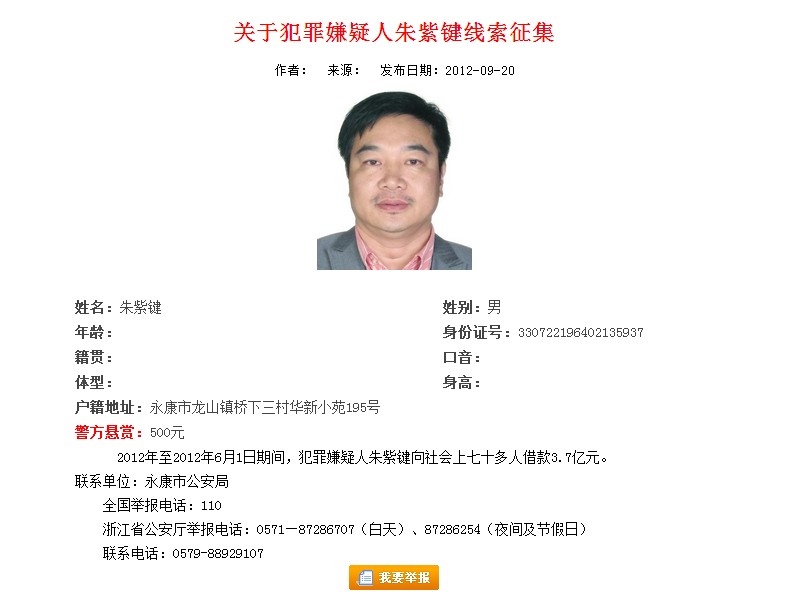
浙江省公安局征集犯罪嫌疑人朱紫键线索截图

【多维新闻】遭内地警方通缉、涉非法集资及于2012年卷款5亿元潜逃美国的浙江永康市前政协委员朱紫键,近期被内地债主聘请的私家侦探查出在美国加州多地拥有最少7处豪宅,并找出朱紫键行踪。据称朱紫键得悉对方是私家侦探时,吓到呆滞说不出话。多名债主已抵美国,与朱的代表律师商讨还钱事宜。据美国《世界日报》报道,朱紫键涉在2011至2012年间,用欺诈方式集资5亿元,并于2012年6月从上海搭机卷款潜逃至美国,连累不少债权人家破人亡,多名债主遂聘请美国赵姓华裔私家侦探追查。该私家侦探从一张交通罚单找到线索,追查到朱在加州洛杉矶和橙县等拥有最少7处豪宅,全是用现金一笔付清购买。赵佯装有意租用朱位于橙县布雷亚市一处豪宅,约朱夫妇二人见面。朱与赵见面时吹嘘不缺钱,白天饮茶晚喝红酒,不时泡温泉。对话过程被赵用针孔机偷拍,传给内地债主确认朱的身份。之后赵再登门与朱夫妇摊牌。据称赵表露身份时,朱吓呆了,半晌说不出话,脸上肌肉抖动。另内地官媒报道,朱是浙江永康春风健身器材公司创始人、永康市政协委员,涉非法集资的5亿元中,银行资金为1.3亿元,社会公众和企业家的资金为3.8亿元。

The maker movement (or DIY, for “do it yourself”) is gaining ground in China, challenging assumptions about the country’s capacity for innovation

October 4, 2013, 8:06 p.m. ET

In China, Lessons of a ‘Hackerspace’

Do-it-yourself hubs are giving a boost to tinkerers and inventors

EMILY PARKER

Several years ago, Peng Ziyun was at the Shanghai Conservatory of Music, studying music and technology. She learned about sound engineering and wanted to build something of her own. But she didn’t know how, and she didn’t have anyone to teach her. An Internet search led her to Xinchejian, China’s first formal “hackerspace,” a community-run workshop where ordinary people tinker with everything from art projects to robots. Read more of this post

Property database delay frustrates China’s anti-graft drive

Property database delay frustrates China’s anti-graft drive

Wed, Oct 2 2013

By Megha Rajagopalan

BEIJING (Reuters) – China’s plan for a nationwide property database, once hailed as an antidote to corruption, has stalled amid resistance from local governments that illustrates the difficulty Beijing faces in driving through reforms to tackle widespread graft. The database is not only seen as vital for authorities to control a frothy housing market – it would also force corrupt local officials to come clean about properties purchased from ill-gotten gains, industry experts say. Read more of this post

Inside the world of China’s “shadow banks”; Huang Fajing, otherwise known as ‘The Lighter King,’ believes that shadow banking -which had innocent beginnings in Wenzhou – has spiraled out of control throughout China

Inside the world of China’s “shadow banks”

The coastal city of Wenzhou, population 9 million, is considered the birthplace of China’s thriving shadow banking sector.

by Rob Schmitz

Marketplace for Thursday, October 3, 2013

P1090065

Huang Fajing, otherwise known as ‘The Lighter King,’ believes that shadow banking -which had innocent beginnings in Wenzhou – has spiraled out of control throughout China.

Wherever you go in the coastal city of Wenzhou, you hear the sounds of people working, spilling out of thousands of small factories which line the streets. One neighborhood makes most of the world’s metal cigarette lighters. A couple of miles away, there’s a neighborhood devoted to shoe soles. The district beyond that? Felt tip pens. Nearly all of them are small, privately-owned businesses getting zero help from the government. According to Wenzhou businessman Huang Fajing, this — combined with the city’s geography — has created some of the keenest businessmen on the planet. Read more of this post

Coming Your Way: China’s Rotten Apples

Coming Your Way: China’s Rotten Apples

By Adam Minter  Sep 30, 2013

The juice of rotten Chinese apples isn’t something that most American parents would serve to their children. But if a recent report from the Chinese press is accurate, they may very well have been doing so for years without anyone — including U.S. government inspectors — knowing it. The news was broken by the independent-minded 21st Century Business Herald, which sent reporters to a region of the country known for its fruit groves and fruit-juice manufacturers. They found three of China’s leading juice manufacturers purchasing rotten apples and pears from farmers unable to sell them for direct human consumption. Chinese regulators shut down two of the plants, despite failing to find stocks of rotten fruit on the factory premises, and investigations are ongoing. Nonetheless, as Quartz reported last week, two of the plants in question receive significant government export subsidies (and one of the plants supplies 27 percent of the apple juice that China exports to the U.S. and Canada, annually). Under such circumstances, it’s highly unlikely that China’s regulators will move to harm any reputations.

Read more of this post

Beijing Says “No” to “Land Kings” amid Concerns over Overheated Market

Beijing Says “No” to “Land Kings” amid Concerns over Overheated Market

09-29 14:57 Caijing

Land Kings have re-emerged in big cities like Beijing and Shanghai over the last few months as rising house prices fan hopes of a recovering market. China’s Ministry of Land Resources (MLR) is calling a halt to land kings as he warns about soaring housing prices promoted by activities in the country’s overheated real estate market. No new land kings shall be seen within the year, said Hu Cunzhi, the deputy minister while ordering first-tier cities to increase residential house supplies to tame prices.  Read more of this post

Two top Leighton Holdings executives secretly created a rival company with a suspected corrupt “bagman” while they were meant to be working for the construction group

Leighton: bagman’s inside job

PUBLISHED: 9 HOURS 38 MINUTES AGO | UPDATE: 9 HOURS 36 MINUTES AGO

21cd539c-2ce2-11e3-ba24-c68aeb341ab8_A65C1025--646x363

David Savage was Leighton’s top international executive when he created a rival company in late 2010.

AFR FAIRFAX EXCLUSIVE NICK MCKENZIE AND RICHARD BAKER

Two top Leighton Holdings executives secretly created a rival company with a suspected corrupt “bagman” while they were meant to be working for the construction group. Confidential company emails reveal that David Savage covertly launched “Project T” under the cover of his job as Leighton’s top international executive in late 2010. Project T sought to lure several Leighton senior figures, including the chairman of its Dubai-based joint venture Habtoor Leighton Group, Riad al Sadik, and a suspected corrupt Leighton global consultant Packianathan Srikumar, to a private firm operating in the same market as Leighton and which could conceivably compete with it to win work. Read more of this post

With box office takings in Asia growing faster than anywhere else in the world, more studios from Hollywood and beyond are seeking local partners to tap into the region

As Asian movie industry flourishes, industry looks to region for tie-ups

AFP-JIJI

OCT 4, 2013

BUSAN, SOUTH KOREA – With box office takings in Asia growing faster than anywhere else in the world, more studios from Hollywood and beyond are seeking local partners to tap into the region, industry players say. Many co-productions are visible at the 18th Busan International Film Festival that opened Thursday in South Korea, featuring a series of events aimed at facilitating cross-border deals. Read more of this post

Japan is one of the few countries in the world with no corporate-governance code, minimal disclosure about firms’ governance practices, and no rules whatever about director training

October 3, 2013, 12:50 p.m. ET

The Reform Abenomics Needs

Changes to corporate governance could spur growth without adding a yen to Japan’s deficit.

By Nicholas Benes

Speaking at the New York Stock Exchange NYX +2.48% last week, Japanese Prime Minister Shinzo Abe told investors, “Buy My Abenomics!” It was the sort of salesman’s chutzpah that Wall Street traders appreciate, but Japan’s economic program is a tougher sell than Mr. Abe may think. And it will remain so unless he delivers on the long-awaited “third arrow” of Abenomics: substantive structural reforms. Read more of this post

Potbelly (PBPB), the Chicago-based purveyor of made-to-order toasted sandwiches, began in 1977 as an antiques store that provided sandwiches and desserts to customers to boost sales. Now, It had 280 company-operated shops

Potbelly Jumps in Trading Debut After $105 Million IPO

Potbelly Corp. (PBPB), the Chicago-based purveyor of made-to-order toasted sandwiches, more than doubled in trading after pricing its IPO above an increased range. The shares surged to $31.28 at 10:12 a.m. in New York. The company and existing stockholders sold 7.5 million shares for $14 each, according to data compiled by Bloomberg, after offering them for $12 to $13. The company raised the range Oct. 2 after initially setting it at $9 to $11. Potbelly has been expanding in cities from Portland, Oregon, to New York and expects to open as many as 35 new shops this year, according to its prospectus. The company plans to use proceeds from the offering to support this growth, in addition to funding a dividend and paying back loans. Noodles & Co. (NDLS), the first U.S. restaurant IPO this year, also more than doubled in its June trading debut. The shares advanced 139 percent from the offering through yesterday. Read more of this post

State of Flux for Solid-State Drives

THURSDAY, OCTOBER 3, 2013

State of Flux for Solid-State Drives

MKM says smartphone and tablet sales are shifting from high-end to low-end.

MKM Partners

Following significant price increases in memory in late 2012 and the first half of 2013, DRAM appeared to be set for a return to a more normalized downward trajectory in the third quarter before a fire at Hynix’s Wuxi, China semiconductor fabrication plant (responsible for 12% of global DRAM output) in early September sent spot pricing dramatically higher. NAND prices, which had appeared to have stabilized, moved slightly higher in sympathy with DRAM on the possibility that some manufacturers, such as Samsung [of South Korea] and Micron Technology (ticker: MU) (rated at Neutral, $16 fair value) could switch capacity from NAND to DRAM to make up for the Hynix shortfall. Read more of this post

A Peek Behind the Curtain: No one has been willing to share private equity data – until now

A Peek Behind the Curtain

by Greg Brown | Oct 4, 2013

No one has been willing to share private equity data – until now

Historically, research into private equity topics runs into one major barrier: access to data.
Finance professor Greg Brown, an expert in private equity, is familiar with the challenges of finding and analyzing data sets, which by their nature are private.
Big, institutional, multibillion-dollar investors don’t like to disclose this information,” Brown said. “If you’re lucky, you get a large limited partner to share their portfolio with you, which would give you data on hundreds of funds.” Read more of this post

Return of the living dead, hedge fund edition

Return of the living dead, hedge fund edition

Dan McCrum

| Oct 03 10:51 | 10 comments | Share

We interrupt this blog to announce a zombie apocalypse has occurred. Please remain calm and do not adjust your allocations, many hedge funds remain open and fee structures are intact.

ScreenShot021

There are a lot of smart hedge fund managers out there, as well as a lot that are mediocre, lucky, or winging it. But it turns out they are outnumbered by the ranks of the discontinued, the dead, and the disappeared by almost two to one. Those numbers come to us via the Imperial College Centre for Hedge Funds Research, specifically a paper from last year revisiting “stylised facts” about hedge funds. It came to our attention after we wrote about a difficult comparison with the US stock market that many hedge funds will face in the new year. The UK’s Alternative Investment Management Association responded to our post citing the industry’s 20 year track record: Figures from Imperial College’s Centre for Hedge Research show the industry has generated over 4 per cent per annum of “alpha” or performance above the market, after fees. Very impressive, if you think there is such a thing as a 20 year track record for hedge funds that is relevant to the $2trn industry as it stands today. We do not, for a variety of reasons starting with the zombie hordes above. The academics at Imperial College put together data from the five major hedge fund databases, in order to avoid biases in individual data sets and to account for the fact that 70 per cent of hedge funds only report to one data provider. We document that the number of hedge funds ranges across data vendors from 6,772 for Morningstar to 9,719 for BarclayHedge. EurekaHedge is the largest data vendor in terms of 4,452 active hedge funds. Importantly, the proportion of alive and defunct funds varies significantly across databases. BarclayHedge, HFR and TASS (EurekaHedge and Morningstar) contain relatively more (fewer) defunct funds than alive funds. Read more of this post

Betting on a U.S.-Debt Doomsday: Budget Showdown Has Traders Crowding Into Derivatives That Pay Off if the Federal Government Defaults

October 4, 2013, 7:10 p.m. ET

Betting on a U.S.-Debt Doomsday

Budget Showdown Has Traders Crowding Into Derivatives That Pay Off if the Federal Government Defaults

KATY BURNE

BF-AF913A_MKTLE_G_20131004203307

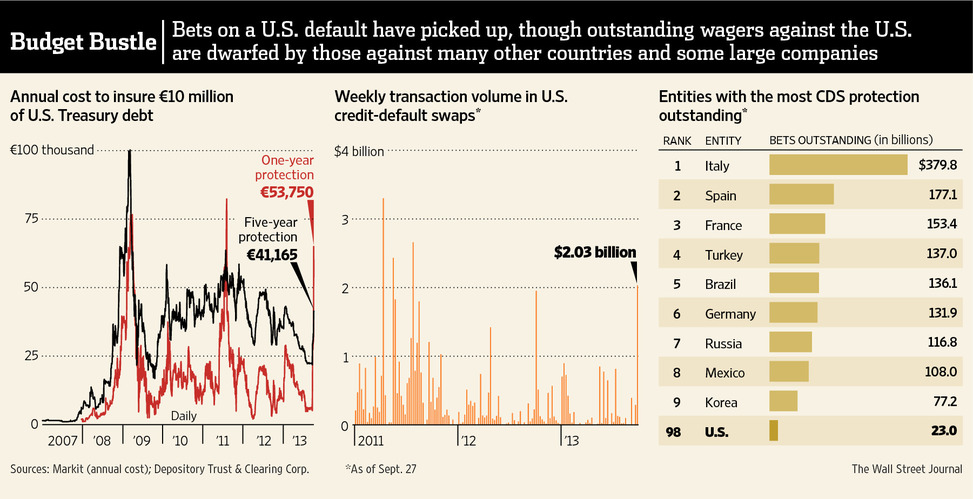
Washington’s budget showdown has sent traders and analysts crowding into a cobwebbed corner of the financial world, the market for derivatives that pay off if the federal government defaults on its debt. The cost of insuring against a U.S. default via credit-default swaps has risen sharply over the past two weeks. Volume has ticked up as well, though trading remains sparse and the number of bets against the U.S. pales in comparison to other large nations and companies. Read more of this post

Debt Armageddon puts game theory to test

October 4, 2013 5:09 pm

Debt Armageddon puts game theory to test

By Ralph Atkins in London

During the Cold War, when the world feared nuclear annihiliation, scientists developed “game theories” to predict possible scenarios – and the chances of reason prevailing. This week investment strategists have applied similar thinking to the US fiscal crisis: the political deadlock in Washington over the federal budget and the debt ceiling that, at least in theory, could plunge the world into the Armageddon of a US debt default. Read more of this post

CHART OF THE DAY: 87 Years Of Crisis And Stock Market Volatility

CHART OF THE DAY: 87 Years Of Crisis And Stock Market Volatility

SAM RO OCT. 4, 2013, 3:43 PM 1,972 1

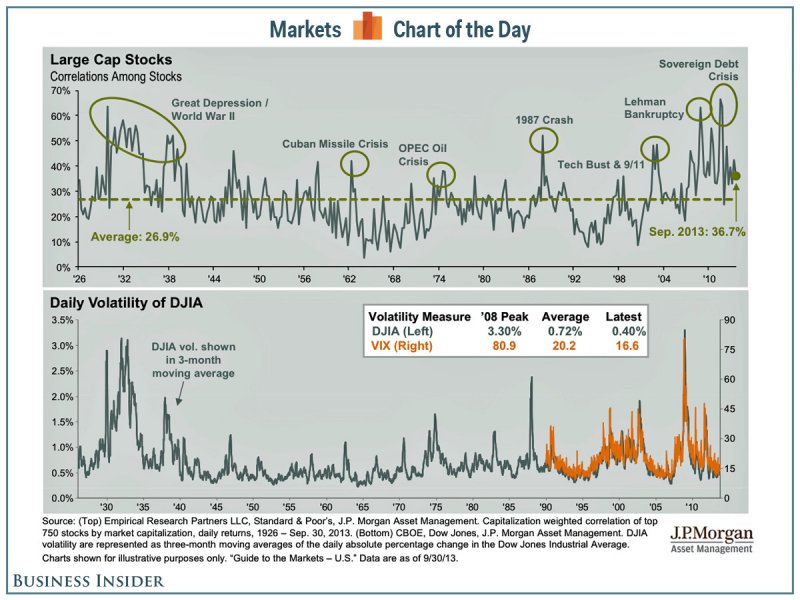
With the government shut down and the debt ceiling looming, one could argue that the U.S. economy may be on the edge of a crisis. But the stock market is not reflecting this. During periods of crisis and high stock market volatility, correlations among stocks increase.  In other words, stocks move up and down together. JP Morgan Funds’ David Kelly just published his quarterly market chartbook, which includes a useful chart tracking stock market volatility and correlations among stocks since the Great Depression.

cotd-55

Freak Grape-Razing Hail Crushes Burgundy Winemakers’ Dreams; Several years of losses may also force consolidation in a wine region known for its patchwork of 1,247 named plots dating back centuries

Freak Grape-Razing Hail Crushes Burgundy Winemakers’ Dreams

Hail the size of ping-pong balls brought William Rouxel’s future as a Burgundy winemaker crashing down along with his grapes. With a season’s work destroyed by the summer hailstorm that trashed a 10-kilometer (6.2-mile) swath of Burgundy vineyards producing some of France’s most-prized wine, the 35-year-old says he can’t risk another year like it. He’s calling it quits. “At this point I need to win the lottery, and I’m not a gambler,” said Rouxel, smoking a cigarette at a round metal table in the stone courtyard of his house in Beaune, in the center of Burgundy’s Cote d’Or, or Golden Slope. “I’m tired.” As grape harvests get under way this week, the damage caused by a single hailstorm that pummeled the area around 4 p.m. on July 23 has ruined the likes of Rouxel and hit sections of France’s 8 billion-euro ($10.9 billion) wine industry hard. Some choice wines from Pommard and Volnay will be in short supply starting next year in a region that already can’t produce enough to meet global demand. Multiple smaller hailstorms last year cut the volume of Burgundy’s 2012 vintage to 1.26 million hectoliters, equivalent to 168 million bottles, from 1.51 million hectoliters in 2011, according to the region’s wine board. It estimates this year’s production at between 1.35 million and 1.4 million hectoliters. Burgundy’s wine properties shipped 1.43 million hectoliters in the 2012-13 season, meaning they’re depleting stocks, which the board estimates are down as much as 15 percent. Read more of this post

Failure maketh man; What does your failure resume look like?

Updated: Saturday October 5, 2013 MYT 7:33:31 AM

Failure maketh man

BY ROSHAN THIRAN

What does your failure resume look like?

STANFORD professor Tina Seelig requires all her students to write a failure résumé “a résumé that summarises all their biggest screw-ups – personal, professional, and academic.” She insists that for every failure on the resume, the student must also describe what he or she learned from that experience. Reading her requirement for her students, I saw the power in such an exercise and starting scribbling my personal failure resume. As I jotted down all of my professional failures, I looked back to see if I gleaned any useful lessons which I later applied in life. Much to my surprise, one of my biggest failure (messing up at a business integration exercise early in my career in the United States), led to an amazing truimph on a bigger integration role in Europe. A huge part of the success was drawn from lessons learnt from my first failure. I also failed miserably in a business entrepreneurial venture while at university. The key part of that failure being poor at inventory management. In my first operational role running a business unit, I applied much of the lessons learnt from my inventory management mistakes and was extremely successful turning around a business. Humiliation, disappointment, discomfiture, shame, hurt are all characteristics of failure. Failure feels bad and it never sat well with me. Yet, we all know that failure is a necessary part of growth. Many people today talk about failure and its importance but most people don’t realise it is only when you mine lessons from your failures that you really learn. It is not about failing but about learning. An anonymous saying goes that “failure is only the opportunity to begin again, this time more wisely.” Read more of this post

How Stella Saved the Farm: A tale about making innovation happen

Updated: Saturday October 5, 2013 MYT 7:55:19 AM

Management lessons from animals

How Stella Saved the Farm: A tale about making innovation happen

Author: Vijay Govindarajan and Chris Trimble

Publisher: Macmillan

bizw_jy_P20a_0510

HOW Stella Saved the Farm belongs to a genre like the classic Animal Farm, the more modern Who Moved My Cheese? and Our Iceberg is Melting. All three of them use animals to tell a story about management and leadership. Using parables does simplify things and sets the tone for a relaxed read. Animal Farm is a tale about apathy and ignorance while Who Moved My Cheese? is a story about the human spirit overcoming change and transition. Ultimately, the one who is able to accept change thrives. Like its predecessors, How Stella Saved The Farmis a parable about a group of animals that live on a farm which once belonged to humans but is now operated and managed by the animals that live and work there. It is both a business-related as well as a self-help book as it revolves around the various characters and their dealings with one another. The story’s main theme is the need for the farm to innovate and find new products to keep the setup profitable and to prevent it from being overtaken by humans, who run the neighbouring farm. Read more of this post

Up Close and Personal with Ba U Shan-Ting, president of master franchise holder for Domino’s Pizza in Malaysia and Singapore; Moving from one store to 104 stores in 15 years

Updated: Saturday October 5, 2013 MYT 8:17:53 AM

Up Close and Personal with Ba U Shan-Ting, Dommal Food Services Sdn Bhd president

BY WONG WEI-SHEN

IT is ironic to think that Ba U Shan-Ting, who initially was meant to become a dentist, is still an oral specialist but of a different precision – he is now selling pizzas to satisfy his customers’ culinary cravings. “My parents wanted me to be a dentist, so I went ahead and submitted all my applications. But thank God I didn’t get through the first round! I missed out by one mark,” the now president of Dommal Food Services Sdn Bhd says. Dommal Food is the master franchise holder for Domino’s Pizza in Malaysia and Singapore. Never one for staring into people’s mouths, and often deterred by smelly breath, Ba told his mother that he wanted to study a double degree in law and commerce instead. “If I had gone down that road, I would be a very unhappy dentist somewhere because I didn’t have the passion nor talent for that,” he tells StarBizWeek. Read more of this post

Aung San Suu Kyi has stunned Singaporeans with her answers and fresh perspective during her recent trip to the republic

Updated: Saturday October 5, 2013 MYT 8:01:16 AM

Learning from Myanmar

BY INSIGHT DOWN SOUTHBY SEAH CHIANG NEE

Aung San Suu Kyi has stunned Singaporeans with her answers and fresh perspective  during her recent trip to the republic.

IN my long working years I have gotten used to our reporters asking departing dignitaries what they thought of Singapore, expecting some lavish praises. Generally, they would not be disappointed since most guests – however unimpressed they are – would not want to appear impolite towards their hosts. Their kind comments, whether deserved or not, made great headlines in a compliant press. In her first ever visit here, Myanmar’s opposition leader Aung San Suu Kyi was a refreshing exception and by doing so, taught Singapore’s leaders a valuable lesson. Although she carefully observed diplomatic niceties, the revered Nobel Peace laureate was frank about what she liked and disliked about Singapore. During her final press conference, she was asked the familiar question of what she saw in Singapore that she might like to recreate in Myanmar. She replied, “I don’t think ‘recreate’ is the word, ‘learn’ yes.” If the host had hoped that she would cite Singapore as a role model, they were disappointed. Her country, she said, would not want copy the city’s materialistic and high pressure living that had come with its affluence. Read more of this post

S’pore becomes a destination for junk bonds

S’pore becomes a destination for junk bonds

SINGAPORE — Companies in South-east Asia are looking at Singapore as a viable alternative for high-yield bond issues in amounts that would be too small for US dollar investors, according to IFR, a Thomson Reuters publication.

3 HOURS 46 MIN AGO

SINGAPORE — Companies in South-east Asia are looking at Singapore as a viable alternative for high-yield bond issues in amounts that would be too small for US dollar investors, according to IFR, a Thomson Reuters publication. The push comes as so-called junk bonds became a predominant theme this year in the Singapore market, with a record number of small-cap and sub-investment grade companies selling debt in the city, attracting investor interest by offering juicy coupons. Read more of this post