Hail, the Swabian housewife: Views on economics, the euro and much else draw on a cultural archetype
February 2, 2014 Leave a comment
Hail, the Swabian housewife: Views on economics, the euro and much else draw on a cultural archetype
Feb 1st 2014 | STUTTGART | From the print edition
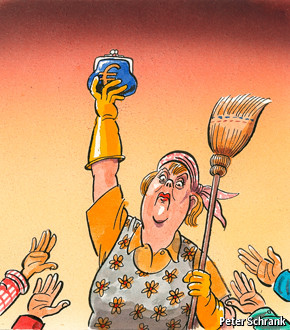
THE Swabian housewife made her debut on the world stage in 2008, when Angela Merkel, neither Swabian nor a housewife but the chancellor of Germany, mentioned her at an event in (Swabian) Stuttgart. The American banks which were failing, she said, should have consulted a Swabian housewife because she could have told them how to deal with money.
“Yes, she’s a cliché, but much more than a cliché,” says Winfried Kretschmann with some pride, because “the Swabian housewife represents the starting point” in German thinking on the euro and fiscal management. As the (Green) premier of the rich south-western state of Baden-Württemberg, Mr Kretschmann should know.
Württemberg, as distinct from the former grand duchy of Baden with which it has now merged, is where most Swabians live (though as one of Germany’s traditional “tribes”, their turf stretches from Augsburg to Switzerland). They are known for their quaint dialect, which adds the diminutive “le” to almost any noun to make it sound cute, as well as for such delicacies asMaultaschen, pockets of dough filled with meat and vegetables. But above all they are famous for being frugal, hating debt and getting the best deal. “Buy British,zahl schwäbisch” (ie, pay Swabian), a British electronics vendor once advertised in a Baden-Württemberg newspaper.
“We used to be dirt-poor,” says Gerhard Raff, a historian of Swabia whose books in Swabian dialect are barely comprehensible to other Germans. Viel Steine gibts und wenig Brot (“We have many stones and little bread”), runs one old saying. Swabians in the 19th century responded by emigrating to America or Russia, or by becoming master innovators. Swabians revere their inventors—men such as Gottlieb Daimler and Robert Bosch, who spawned world-class firms—and poets and philosophers, including Schiller and Hegel.
That tinkering creativity is the flip side of Swabian frugality, says Mr Kretschmann, because “scarcity makes innovation”. Maultaschen came about when Swabian housewives wanted to reuse every last morsel and adapted Italian ravioli. Their heirs are Baden-Württemberg’s “hidden champions”, according to Mr Kretschmann, the mainly family-owned firms that excel in tiny and often obscure products—ventilators, say, or ball bearings. To their owners, reusing every morsel means reinvesting the profits.
These traits stem from Pietism, thinks Andrea Lindlohr, a Green member of the state parliament. Pietism, which is to Lutheranism as Puritanism is to Anglicanism, dominates the psychological landscape of Swabia. (“We’re the Piet Cong,” jokes a real housewife.) It crops up in some surprising contexts, such as a minor controversy attacking Harry Potter novels for their embrace of superstition. But its main effect is to prize hard-working lives, with debt (Schulden in German) frowned upon as akin to guilt (Schuld).
This Swabian cultural cocktail is seen as so successful that it colours German attitudes to the euro crisis. Germany’s prescription of austerity is most associated with Mrs Merkel. The daughter of a Lutheran pastor, she even gave a speech to the Pietists of Swabia last year. Her finance minister, Wolfgang Schäuble, is a native of Baden-Württemberg. Though technically from Baden, whose people consider themselves bons vivants beside Württemberg’s Swabians, he still preaches to southern Europeans a good Pietist gospel of saving, hard work and self-improvement.
If the Swabian contribution to these attitudes is obvious, the emphasis on its female and domestic sides is also appropriate, Ursula Knupfer thinks. She is the spokeswoman for the Württemberg chapter of the German Association of Housewives. For a century her outfit has trained women in good housekeeping, from cooking good Maultaschen to watching the family purse. It is still going strong, with the only concession to a changing Zeitgeist being a rebranding in 2011 that put more emphasis on housekeeping than on wives (there are a few male members, says Mrs Knupfer).
Such frugal values are not just for southern Europe to learn from. “We Swabians look to Berlin and think: my, how loosely they’re spending money up there, while we here think so hard about it,” says Mrs Knupfer. Baden-Württemberg is one of three German states (with Bavaria and Hesse) that send money to the other 13. Just as Germany doesn’t want a “transfer union” in Europe, so Swabians dislike the notion in Germany itself.
 About bambooinnovator

