Private-Equity Investors Join China’s Environmental Cleanup
February 14, 2014 Leave a comment
Private-Equity Investors Join China’s Environmental Cleanup
CHAO DENG
Feb. 11, 2014 7:49 a.m. ET
Private-equity firms are again betting on China’s environmental sector as the government adopts a new sense of urgency in cleaning up the nation’s filthy air and water.
After a decline in 2012, the firms’ investments in environment-related businesses in China last year totaled $1.2 billion, a record-high 7.1% of all private-equity investment in the country, according to the Hong Kong-based Centre for Asia Private Equity Research. That’s up from 2.3% in 2012 and 6% in 2011, according to the center. The media, construction and consumer goods sectors were among those that were more popular.
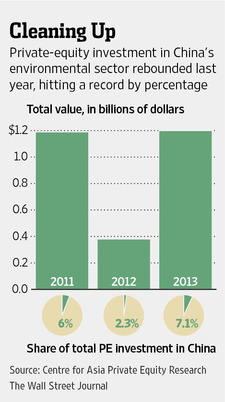
The jump in investment came as Beijing, under rising public pressure and fearing social unrest, issued two major policy statements regarding the environment. In August, the State Council, or cabinet, said it would support the expansion of theenvironmental industry to 4.5 trillion yuan ($730.5 billion) by 2015, with annual growth of more than 15%. In November, the Communist Party endorsed a “decisive role” for markets in allocation of natural resources, as a way to limit pollution, while saying that polluters would be penalized more harshly.
The largest deals last year involved management of water and waste. The biggest was RRJ Capital Co.’s $350 million investment in a 7.9% stake in Hong Kong-listed waste-management and energy company China Everbright International Ltd.0257.HK +0.58% in December.
Earlier, Beijing-based Hony Capital invested 1.8 billion yuan ($297 million) in a 10% stake in Shanghai-listed Shanghai Chengtou Holding Co., 600649.SH +1.95% a property developerand wastewater-management company. The deal, announced last April, was approved by regulators last month.
Still, as important as they are, the deals have generated little buzz. That’s because most of them involve relatively basic technology intended to merely clean up China’s severely degraded environment—in short, bringing the country up to speed with Western nations. More-innovative technologies have yet to catch on.
For the most part, private-equity investors in China’s environmental sector are investing in technologies that were adopted long ago in the U.S. and Europe, said Michel Brekelmans, co-head of the China practice at L.E.K. Consulting, a global management-consulting firm. He noted that the government only began encouraging state-owned companies to install energy-saving technology around five years ago.
For now, companies don’t need “rocket science” to be successful in China’s environmental sector—they need to be good at adapting and offering customized solutions, said Yong Zhang, Shanghai-based partner at venture capital firm Qiming Venture Partners. One upside of this, he said, is that investors don’t need to make the same types of riskier bets that are being seen in the general technology sector.
Beijing-based CSD Water Service, in which Qiming last year added to its original stake, is one company taking advantage of the relatively late adoption of cleantech in some regions of China. CSD Water Service helps manage wastewater treatment plants in third- and fourth-tier Chinese cities that have been overlooked by state-owned cleantech companies, which focus on bigger cities, Mr. Zhang said. Qiming plans to help CSD Water Service apply to list on the ChiNext board, China’s market for start-up companies, before the end of this year, he said.
Some companies, though, are bringing cutting-edge technology to the sector, said Elaine Wong, co-founder of Hao Capital, a China-focused private-equity firm with a stake in LP Amina, which helps utility companies reduce emissions. She pointed to Durham, North Carolina-based Phononic Devices, which makes energy-efficient cooling systems and received an investment from Beijing-based venture capital firm Tsing Capital in December.
“In addition to bringing proven clean-energy technologies to China, a growing number of U.S. companies are coming to China with new technologies to collaborate with early adopters looking to have an impact,” she said.
Some investors are already seeing big returns after companies completed initial public offerings, a primary way for private-equity firms to exit their stakes. Shares in Shenzhen-listed Beijing Originwater Technology Co. 300070.SZ +5.58% , for example, gained 42% over the past 12 months, while those in power-supply equipment manufacturer Sungrow Power Supply
Co. 300274.SZ +1.90% rose 324%. The benchmark index gained 17% during the same period.
Shanghai-based Tripod Capital International Ltd. invested 40 million yuan in a 15% stake in Originwater in 2006 and started selling in 2010, generating returns of more than 20 times its original investment, according to Shanghai-based industry tracker ChinaVenture. Several Chinese venture capital firms invested a total of 33 million yuan in Sungrow Power Supply starting in 2007, and began selling their stakes in 2010. One of them, Chengwei Capital, also enjoyed a return of more than 20 times its original investment, according to ChinaVenture.
 About bambooinnovator
 Bamboo Innovator