China pollution: Trouble in the air; Roused by public protests and air-quality tweets from the US embassy, China has vowed to challenge its growth model
March 3, 2014 Leave a comment
February 26, 2014 7:27 pm
China pollution: Trouble in the air
By Lucy Hornby
Roused by public protests and air-quality tweets from the US embassy, China has vowed to challenge its growth model
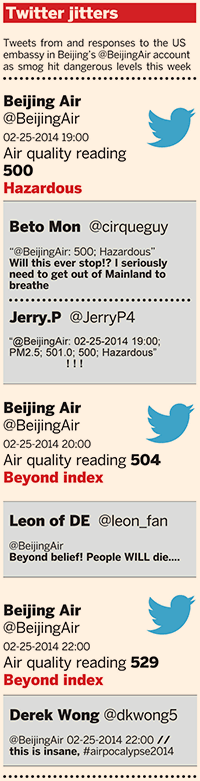
“440. Hazardous. Health alert: everyone may experience more serious health effects, please avoid physical exertion and outdoor activities.”
Tweet from US embassy air pollution monitor, Beijing, Tuesday Feb 25 2014
Before they even look out the window in the morning, many Beijingers have checked a smartphone app to see the pollution index for the day. Any reading below 100 offers a dose of reassurance – even though it is still well above ideal levels – but above that and pollution is the main topic of the day.
For the past week, the index has been close to the top of the charts. Smog over Beijing makes the sun a thin orange disk and adds a mysterious aura to the city as pedestrians and buildings fade into the gloom. On the worst days, people keep children indoors and scuttle about in masks with only their eyes showing. This week, the World Health Organisation’s representative described the pollution as a “crisis”.
Less tech-savvy Beijingers, such as 64-year-old Niu Zuoxuan, rely on the day’s pollution readings on state radio or television but long stretches of grey skies have made him sceptical. “I feel that the government has not done enough with regards to information disclosure,” says Mr Niu, sporting a blue mask for his daily walk.
Spurred on by public pressure – as well as a $30,000, live-Tweeting air quality monitor installed on the roof of the US embassy in Beijing in 2008 – China has rolled out air quality monitors to big cities and publishes the data. This year it began direct monitoring of 15,000 heavy polluters. The Beijing city government holds press conferences to explain contingency measures – and is criticised by state media when it fails to implement them.
By taking these steps, China is opening itself up to an unusual degree of public criticism. Over time, the scrutiny could help it contain pollution where top-down measures have made only a dent.
On paper at least, China has strict laws to regulate the environment. The latest efforts, which include mandates to cut capacity in polluting industries, subsidies for emissions mitigation and even the seizure of outdoor kebab stalls, are not the first to control pollution by fiat. So far, neither the laws nor the periodic campaigns against industrial overcapacity and heavy polluters have been effective.
The increased public monitoring this time around could strengthen the hand of reformers who worry about the effect of the growth-at-any-cost model pursued by powerful ministries and industrial interests.
Public pressure over air pollution helps the Ministry of Environmental Protection, which in the past has had difficulty implementing regulations that hurt powerful interest groups. It now has the wind at its back as it expands monitoring and reporting networks nationwide only a year after the first air quality measurements were publicly released.
“It helped them that the public is getting outraged. Local governments take it more seriously when they know there is pressure,” says Deborah Seligsohn, a researcher at the University of California San Diego who has worked extensively on pollution issues in China.
The latest step is direct state monitoring of power plants, steel mills and other industrial facilities nationwide. Environmentalists are disappointed that the real-time data gathered will only be released to government bodies, while the public gets an annual report. But even that level of scrutiny is new for many power plants and heavy industry bosses, who are used to answering only to close allies in the local government.
The “airpocalypse” of January 2013, when thick smog blanketing the north China plain sent the air quality index far beyond the measured limit, galvanised public concern. That year, delegates to the national legislature’s annual meeting submitted almost 400 proposals on environmental topics.
Smog, caused mainly by industrial pollution, coal burning and a fog bank, has become a public obsession. Sales of air filters and masks are soaring. School principals check the daily air quality alert level before deciding whether to allow children out for break. Military commentators claim on TV that smog will at least confuse US weapons sensors and deter any attacks.
One popular witticism has changed Chairman Mao’s slogan of “Serve the People” into “Serve the People Smog”.
“Environmental problems used to be like pandas, distant, remote and cute. But now the challenges are at our doorsteps. Everyone realises that,” says Li Bo from Friends of Nature, a Chinese environmental NGO.
People are fixated on PM2.5 – tiny particles 2.5 micrometres in diameter that can penetrate deep into the lungs and contribute to asthma, cancer and heart trouble – thanks to the newfound ability to track local and national air quality conditions via Weibo, the local equivalent of Twitter.
Last year’s airpocalypse, which lingered for less time but was more severe than 2014, gave the battle over pollution a much broader base among the urban middle classes. With smartphone apps, they were able to map Chinese government data or compare them with levels recorded at the US embassy and consulates. Citizens’ collective online venting has continued in spite of a government crackdown on so-called Big Vs, or influential online voices with millions of followers.
The intense awareness of air quality comes after a series of safety scandals over the past decade, including adulterated milk powder, exploding storm sewers, rivers full of dead pigs and toxic spills that cut off drinking water supply to entire cities.
Environmental activism used to be limited to a fairly small educated elite in China. They have scored some victories, notably persuading the government to scale back plans to dam the beautiful and remote Nu River. But activists who are too outspoken, particularly in rural areas, run the risk of being beaten, harassed or jailed, since polluters often enjoy close ties to local governments.
Although the government fears street protests, they have had little effect in curbing China’s pollution. Urban, middle-class Chinese held noisy street protests against chemicals plants, particularly those making the compound paraxylene, used to make polyester. Despite official promises made to defuse the protests, some of the PX plants are still operating.
Violent protests by rural Chinese against chemicals and waste spills that have killed livestock, poisoned water or sickened children, have been even less effective. Toxic emissions, soil pollution and heavy metals poisoning plague swaths of rural China.
With air, “they feel the mass protest is just outside their door if they don’t do anything. It’s there, in everyone’s eyes”, says Mr Li. He argues that air pollution has played an important role in raising concern about China’s environmental problems and the fact that they can be fixed. He warns, though, that the elite focus on air pollution could lead to underplaying serious soil and water problems.
Ms Seligsohn agrees: “Air is constant and intensely visible not only to the public but also to the leadership. They may not be in the countryside every day but they are looking out the window at the air.”
Air pollution is not easy to solve because of the complex mix of chemistry and economics that creates the problem. For years, the central government has had a series of targets for reducing sulphur dioxide and nitrogen oxide emissions, and improving water quality.
It installed emissions controls in big power plants and industrial complexes but monitoring and enforcement have tended to fall short of standards.
Past pollution control efforts were mostly technocratic targets, allocated behind the bureaucratic curtain with little effort to inform or involve the public. When the US embassy began broadcasting the air quality data collected from its roof, the Beijing government asked it to stop and then denounced the data as unscientific.
Local governments under pressure to do something are in a bind because the sources of pollution are not that easy to contain. For instance, 70 per cent of the pollutants in Beijing blow in from the surrounding industrial province of Hebei.
For its part, Hebei has committed to reducing the amount of steel it produces and used the anti-pollution campaign to shut smaller mills that had resisted closure for years. The unintended consequence was that mills in the southern province of Jiangsu stepped up output, producing unprecedented levels of smog in Shanghai this winter.
The central government pledged in September to freeze new coal projects in the prosperous east, while encouraging new coal projects in the west of the country, where water supplies are even more limited. It has allocated funds to reward polluters that reduce emissions, in a tacit recognition that heavy industry is the biggest taxpayer and employer in many provincial cities.
Beijing, which does not have the worst air in China but does host the most foreign journalists and central government officials, hastened to declare in October that schools would be shut and traffic restricted if pollution exceeded certain levels for three days running. That happened during a smoggy stretch this month but the measures were not implemented – prompting rare and biting criticism from powerful state media.
The national consensus that air pollution is a problem could mark a turning point, just like the 80km slick of benzene along the Songhua river in the winter of 2005, which cut off drinking water to tens of millions of people in northeast China and Russia. After the Songhua disaster, China began a more concerted effort to address water quality.
Yet the ruling Communist party is not about to let citizens take on too much of a role. The campaign to rein in outspoken critics on Weibo has been in full force for more than a year. And the party’s anti-corruption purges have been accompanied by jail sentences for activists such as Xu Zhiyong, who called for government officials to disclose assets.
Ma Jun, a leading Chinese environmentalist, uses a database of government pollution data to pressurise companies and build awareness. He has more experience than anyone in China in harnessing public information to fight pollution. Mr Ma says vested interests will hinder the government’s pollution efforts unless the government enlists the citizenry’s help by regularly publishing data on the industrial pollution sources.
“The policies nowadays are very much set in a top-down fashion. In the future, we want it to be transformed into real environmental governance where people can be a part.”
Government policy: A fitful journey towards ‘blue-sky days’
Passed around on Chinese social media this month was a screenshot of a headline from the state-owned China Daily in the early 1990s, pledging to clean up pollution.
In the years since that headline was printed, the Chinese economy has grown to become the second-largest in the world. Emissions have grown even faster.
Periodic campaigns have not managed to solve the problem, with growth at any cost the mantra for many officials.
There have been some successes, such as a late 1990s mandate to stop using polystyrene boxes (known as “white pollution”) for takeout food that littered roadsides, train tracks and urban waterways. A decade ago China phased out an extremely polluting aluminium smelting process. There have also been big failures, such as the extinction of the Yangtze river dolphin.
But overall, it has been one step forward, one step back. Drives to promote transparency alternate with punishment of activists; efforts to “clean up” wealthy city centres result in pollution being moved to the poorer hinterland.
Beijing pledged to clean up its air as part of its bid to host the 2008 Olympic Games, moving some factories out of the city, restricting traffic and setting a quota for “blue sky days”. Residents of the capital enjoyed several more months of clear blue skies when the global financial crisis kept many regional industrial plants shuttered far longer than planned.
Beijing originally only released data for PM10 – particulate matter of 10 micrometres in diameter – to the public, although it collected PM2.5 data as well. Initial efforts drew more scorn than praise, as measurements often diverged widely from the competing monitor atop the US embassy. The data were massaged to meet the government’s target of blue-sky days.
A WikiLeaks cable documents the “heated” meeting with embassy officials and a Chinese diplomat in 2009 after the embassy pollution monitor attracted a growing following on Twitter and on Chinese media. The diplomat claimed that the tweets caused “confusion” and undesirable “social consequences” among the Chinese public.
The daily drip of US data had an effect. In January 2012, Beijing finally made its PM2.5 readings public.
 About bambooinnovator

