Stalking trolls: Intellectual property: After being blamed for stymying innovation in America, vague and overly broad patents on software and business processes could get the chop

Stalking trolls: Intellectual property: After being blamed for stymying innovation in America, vague and overly broad patents on software and business processes could get the chop

Mar 8th 2014 | From the print edition

image001-2

AT LAST, it seems, something is to be done about the dysfunctional way America’s patent system operates. Two recent developments suggest calls for patent reform are finally being heard at the highest levels. First, in 2013, defying expectations, the House of Representatives passed (by an overwhelming majority) the Innovation Act, a bill aimed squarely at neutralising so-called patent trolls. These are individuals or companies who buy up lots of patents and then use them to extract payments from unsuspecting victims. Second, the US Supreme Court agreed to rule on what is the most contentious issue of all: which inventions are actually eligible for patent protection. Read more of this post


Woven electronics: An uncommon thread; Conductive fibres: From lighter aircraft to electric knickers, flexible filaments raise a wide range of interesting possibilities

Woven electronics: An uncommon thread; Conductive fibres: From lighter aircraft to electric knickers, flexible filaments raise a wide range of interesting possibilities

Mar 8th 2014 | From the print edition

image001-1

LAS VEGAS in January is the place to spot the latest trends in consumer electronics. The one that grabbed the attention of most people at the 2014 CES show were the wearables. These are gadgets that you put on, from all sorts of spectacles with built-in cameras and screens, like Google Glass, to wrist bands and watches that can monitor your heart rate or relay text messages. There is even jewellery that can warn you of too much exposure to the desert sun. Read more of this post

Molecular communications: Researchers are looking at ways to broadcast messages using chemical rather than electrical signals

Molecular communications: Researchers are looking at ways to broadcast messages using chemical rather than electrical signals

Mar 8th 2014 | From the print edition

HUMANS have long experimented with how best to communicate at a distance. Smoke signals and drums date back to prehistoric times. The Romans used carrier pigeons as messengers to support their conquests. Since the early 1830s, however, communication has been dominated by electrical or electromagnetic signals, from the first telegraph to the carrier waves in fibre-optic cables and the wireless networks of cellular telephones. But now a new contender is signalling its presence: molecular communication. Read more of this post

Caves found in Patagonia may unlock secrets of how continents formed

Caves found in Patagonia may unlock secrets of how continents formed

Fri, Mar 7 2014

SANTIAGO (Reuters) – Chilean and French scientists have discovered a network of underground caves on a remote island in Patagonia that could provide valuable clues as to how continents were formed. Read more of this post

Mexico telecoms regulator reins in Slim and his empire

Mexico telecoms regulator reins in Slim and his empire

Sat, Mar 8 2014

By Tomas Sarmiento and Christine Murray

MEXICO CITY (Reuters) – Mexico’s telecommunications watchdog unveiled a slew of regulations on Friday to claw back the massive telephone business of billionaire Carlos Slim, but said it would not order a break-up of his companies for now. Read more of this post

IBM factory strike shows shifting China labor landscape

IBM factory strike shows shifting China labor landscape

1:23am EST

By John Ruwitch

SHANGHAI (Reuters) – A wildcat strike at an IBM factory in southern China illustrates how tectonic shifts under way in the country’s labor market are emboldening workers to take matters into their own hands, raising risks for multinationals. Read more of this post

Korea’s quirky messaging apps go on offensive in text-happy Indonesia

Korea’s quirky messaging apps go on offensive in text-happy Indonesia

5:41pm EDT

By Miyoung Kim and Andjarsari Paramaditha

SEOUL/JAKARTA (Reuters) – South Korea’s pioneering mobile messaging apps have taken their oversized emoticons to Indonesia, intent on breaking the dominance of BlackBerry Ltd’s BBM messaging service in one of the world’s most active social media markets. Read more of this post

Stock caution urged as margin debt levels hit new highs; P/E valuations, record highs flash warnings; stock pickers look for quality, value

March 9, 2014, 3:00 p.m. EDT

Stock caution urged as margin debt levels hit new highs

P/E valuations, record highs flash warnings; stock pickers look for quality, value

By Wallace Witkowski, MarketWatch

image001

SAN FRANCISCO (MarketWatch) — A number of warning signals are flashing in the stock market, and while not indicative of an imminent crash, they’re telling investors to exercise caution, say market strategists. Read more of this post

Strikes in China may lead to heavy costs for MNCs

Strikes in China may lead to heavy costs for MNCs

SHANGHAI — A wildcat strike at an IBM factory in southern China illustrates how tectonic shifts under way in the country’s labour market are emboldening workers to take matters into their own hands, raising risks for multinational companies. Read more of this post

C.E.O. Libraries Reveal Keys to Success

July 21, 2007

C.E.O. Libraries Reveal Keys to Success

By HARRIET RUBIN

Michael Moritz, the venture capitalist who built a personal $1.5 billion fortune discovering the likes of Google, YouTube, Yahoo and PayPal, and taking them public, may seem preternaturally in tune with new media. But it is the imprint of old media — books by the thousands sprawling through his Bay Area house — that occupies his mind. Read more of this post

Richard Feynman: The Universe in a Glass of Wine; all life is fermentation

Richard Feynman: The Universe in a Glass of Wine

March 7, 2014 by Shane Parrish

A poet once said, “The whole universe is in a glass of wine.” We will probably never know in what sense he meant that, for poets do not write to be understood. But it is true that if we look at a glass of wine closely enough we see the entire universe. There are the things of physics: the twisting liquid which evaporates depending on the wind and weather, the reflections in the glass, and our imagination adds the atoms. The glass is a distillation of the earth’s rocks, and in its composition we see the secrets of the universe’s age, and the evolution of stars. Read more of this post

What Makes Art Popular? Science Says It’s Luck, and the Opinion of Others

WHAT MAKES ART POPULAR? SCIENCE SAYS IT’S LUCK, AND THE OPINION OF OTHERS

BY JENNIFER MILLER

You’d like to think that artistic merit drives commercial success. Unsurprisingly, a Princeton study says that artworks gain popularity based on social influence, and chance. Read more of this post

SingPost celebrates Hello Kitty’s 40th anniversary with limited edition stamps

SingPost celebrates Hello Kitty’s 40th anniversary with limited edition stamps

image001

Sunday, March 9, 2014 – 12:44

AsiaOne

SINGAPORE – In conjunction with Hello Kitty’s 40th Anniversary, SingPost will issue five limited edition MyStamp sets progressively in 2014 showcasing the evolution of Hello Kitty. Read more of this post

HK triads hide behind veil of respectability

HK triads hide behind veil of respectability

Sunday, March 9, 2014 – 16:48

Li Xueying

The Statesmen/Asia News Network

HONG KONG – On May 15, 1996, publisher Leung Tin Wai was in his office in Quarry Bay, working on his new magazine, Surprise Weekly. Two men entered, saying they had photographs for publication. What they whipped out instead were choppers. Read more of this post

The Cookie Monster Knows More About Willpower Than You; I had no idea how much thought actually went into the programming of Sesame Street before reading Focus: The Hidden Driver of Excellence.

The Cookie Monster Knows More About Willpower Than You

March 4, 2014 by Shane Parrish

image001-32

I had no idea how much thought actually went into the programming of Sesame Street before reading Focus: The Hidden Driver of Excellence. Read more of this post

A washing machine factory tests Italy’s industrial future

A washing machine factory tests Italy’s industrial future

Electrolux factory workers join the union-led protest outside a factory in Porcia, northern Italy

5:22am EDT

By Danilo Masoni and Francesca Piscioneri

PORCIA, Italy (Reuters) – The boxy white and grey factory of this rainy northern town makes fewer than half the washing machines it did when Italy joined the euro. It is one of the many symbols of Southern Europe’s industrial decline. Read more of this post

China will toughen its environmental protection laws to target polluters, paving the way for possibly unlimited penalties for polluting and the suspension or shutdown of pollut

China to toughen environment law, hold polluters accountable

12:56am EST

BEIJING (Reuters) – China will toughen its environmental protection laws to target polluters, according to a high-level policy report released on Sunday, paving the way for possibly unlimited penalties for polluting and the suspension or shutdown of polluters. Read more of this post

Smart labels: The 40-year-old barcode has a new, more intelligent rival that can store information, display and transmit it

Smart labels: The 40-year-old barcode has a new, more intelligent rival that can store information, display and transmit it

Mar 8th 2014 | From the print edition

IN JUNE 1974 history was made at a supermarket in Troy, Ohio, with a ten-pack of Wrigley’s Juicy Fruit chewing gum. It was the first time a commercial item bearing a Universal Product Code (UPC) was scanned by a cashier at the checkout. Forty years on, what became known as a barcode has transformed the world of commerce by providing reliable product identification, tracking and pricing. Nearly everything now comes with a barcode. Read more of this post

Aerial jellyfish: Ornithopters: Flying like a bird has long captured the imagination. The latest way to do so is copied from the ocean, not the atmosphere

Aerial jellyfish: Ornithopters: Flying like a bird has long captured the imagination. The latest way to do so is copied from the ocean, not the atmosphere

Mar 8th 2014 | From the print edition

image001

ENGINEERS often look to the natural world for inspiration—and flight engineers, doubly so. Mankind’s desire to soar like the birds directly inspired the Wright brothers’ solution to the problem of controlling a heavier-than-air flying machine, by suggesting the way to do so was to warp the shape of the craft’s wings. More recently, designers of ornithopters (tiny, robotic flying machines lifted by flapping wings) have looked to insects for inspiration, and built systems of sensory feedback that can keep aloft designs which are essentially unstable. Read more of this post

Truffle farming: How mapping technology is being used to discover new places to grow savoury and expensive fungi

Truffle farming: How mapping technology is being used to discover new places to grow savoury and expensive fungi

Mar 8th 2014 | From the print edition

PIGS, dogs and rakes can all be useful in the quest to discover wild truffles, but each has its drawbacks. Pigs like to gobble up the fancy fungi as much as their owners do. Dogs are costly to train. Rakes wreak havoc on the duff (leaf litter) that often covers truffle-rich soil, thus damaging the fungi’s environment. Truffles are, nevertheless, successfully being unearthed in areas not traditionally associated with their growth. Read more of this post

Can parallel lines meet: Power transmission: How to build a real supergrid by making existing electricity lines more efficient at transmitting power

Can parallel lines meet: Power transmission: How to build a real supergrid by making existing electricity lines more efficient at transmitting power

Mar 8th 2014 | From the print edition

GERMANY has a problem. The decision, taken in 2011, to close down the country’s nuclear-power stations risks leaving parts of the country with insufficient supplies of electricity. This means power will have to be brought in from elsewhere. But to do that seems, on the face of things, to require the building of new transmission lines, which will be unpopular with those they pass by. Read more of this post

Giant batteries: The missing piece of the renewable-power jigsaw may now have been found in the form of a new type of flow battery

Going with the flow

Giant batteries: The missing piece of the renewable-power jigsaw may now have been found in the form of a new type of flow battery

Mar 8th 2014 | From the print edition

image001-30

THERE is nothing so expensive, some cynics suspect, as free fuel. It is not that turning wind and sunlight into electricity is itself that costly, provided you pick the right places to do it. But it is not reliable. The wind does not always blow, and even in the most cloud-free desert night falls with monotonous regularity. Political commitments to use large quantities of renewables, such as several European countries have made (see article), thus risk the lights going out. The search therefore has been on for a cheap way to store energy transduced from sun and wind when it is plentiful, so that it can be used when it is not. Read more of this post

Let the sun shine: The future is bright for solar power, even as subsidies are withdrawn

Let the sun shine: The future is bright for solar power, even as subsidies are withdrawn

Mar 8th 2014 | IVANPAH VALLEY, CALIFORNIA, AND LEXINGTON, NORTH CAROLINA | From the print edition

FORTY-FIVE minutes west of Las Vegas, dejected sinners may encounter a sight to lift their sunken hearts: a sea of 347,000 mirrors, reflecting the rays of the desert sun on to boilers mounted on three 460-foot towers. The Ivanpah solar-thermal plant (pictured), which opened in mid-February, is the largest of its kind in the world. Fully ramped up, it will deliver around 377 megawatts (MW) of power to 140,000 homes in southern California. Its backers compare it to the nearby Hoover Dam; an astronaut claims to have spotted it from the international space station. It is a striking sight, even if the heat from its heliostats has roasted dozens of unfortunate birds alive. Read more of this post

Angela Belcher is a materials scientist who makes things with viruses. She is now using them to attack cancer

Brain scan: The DNA of materials

Angela Belcher is a materials scientist who makes things with viruses. She is now using them to attack cancer

Mar 8th 2014 | From the print edition

“IT’S getting a little challenging,” says Angela Belcher. “I feel I am having to make choices now, which I never really wanted to.” But there are only so many hours in the day and she already combines multiple academic disciplines into a repertoire of research that spans an ambition to drive an electric car powered by a virus battery to building better touch-screens for digital devices and lately to giving surgeons new tools to detect and potentially treat minute traces of cancer. Read more of this post

China’s restless West: The burden of empire; After a brutal attack in China, the Communist Party needs to change its policies towards minorities

China’s restless West: The burden of empire; After a brutal attack in China, the Communist Party needs to change its policies towards minorities

Mar 8th 2014 | From the print edition

image001-10

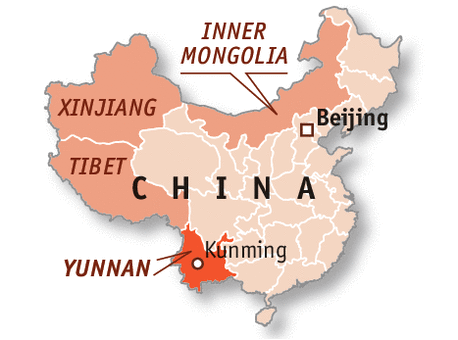
A GROUP of knife-wielding assailants, apparently Muslims from western China, caused mayhem and murder on March 1st in the south-western Chinese city of Kunming, stabbing 29 people to death at the railway station and injuring 140 others. The attack has shocked China. The crime against innocents is monstrous and unjustifiable, and has been rightly condemned by the Chinese government and by America. But as well as rounding up the culprits, the Communist Party must face up to an uncomfortable truth. Its policy for integrating the country’s restless western regions—a policy that mixes repression, development and Han-Chinese migration—is failing to persuade non-Han groups of the merits of Chinese rule. Read more of this post

Business in emerging markets: Submerging hopes; The boom in emerging-market investment by rich-world firms has led to plenty of disappointment

Business in emerging markets: Submerging hopes; The boom in emerging-market investment by rich-world firms has led to plenty of disappointment

Mar 8th 2014 | From the print edition

image001-29

IN 2007 UniCredit, an Italian bank, fought off ferocious competition from other Western lenders to buy Ukraine’s fourth-largest bank from an oligarch for a queasy $2 billion. This week, amid talk of war and default, UniCredit limited withdrawals from its ATMs in Ukraine. At the same time, the shares of firms that are big in Russia, such as Carlsberg and Renault, fell. Read more of this post

Autism: Women have fewer cognitive disorders than men do because their bodies are better at ignoring the mutations which cause them

Autism: Women have fewer cognitive disorders than men do because their bodies are better at ignoring the mutations which cause them

Mar 1st 2014 | From the print edition

AUTISM is a strange condition. Sometimes its symptoms of “social blindness” (an inability to read or comprehend the emotions of others) occur alone. This is dubbed high-functioning autism, or Asperger’s syndrome. Though their fellow men and women may regard them as a bit odd, high-functioning autists are often successful (sometimes very successful) members of society. On other occasions, though, autism manifests as part of a range of cognitive problems. Then, the condition is debilitating. What is common to those on all parts of the so-called autistic spectrum is that they are more often men than women—so much more often that one school of thought suggests autism is an extreme manifestation of what it means, mentally, to be male. Boys are four times more likely to be diagnosed with autism than girls are. For high-functioning autism, the ratio is seven to one. Read more of this post

The search for a cure for AIDS: If it ain’t broke.then break it

The search for a cure for AIDS: If it ain’t broke…then break it

Mar 8th 2014 | From the print edition

GENE therapy usually works by repairing a broken gene or creating a new one where none previously existed. Breaking a working gene to effect a cure is a novel approach. That, though, is what Carl June of the University of Pennsylvania and his colleagues are trying to do. As they explain in the New England Journal of Medicine, by damaging a gene called CCR5 they hope to treat—and possibly cure—infection with HIV, the virus that causes AIDS. Read more of this post

Global warming: Who pressed the pause button? The slowdown in rising temperatures over the past 15 years goes from being unexplained to overexplained

Global warming: Who pressed the pause button? The slowdown in rising temperatures over the past 15 years goes from being unexplained to overexplained

Mar 8th 2014 | From the print edition

image001-28 image002-10 ]

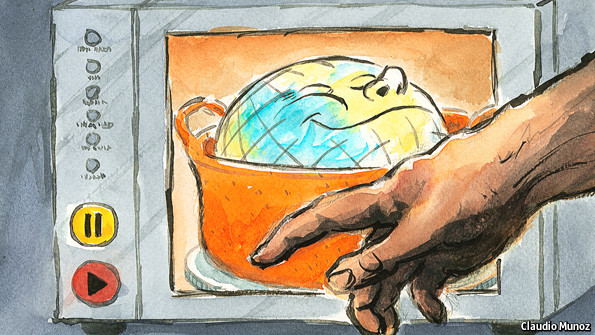
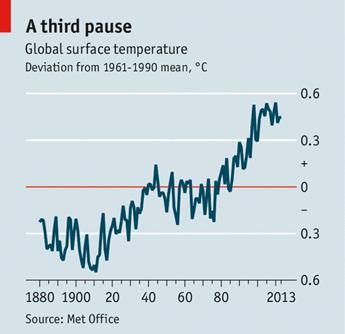
BETWEEN 1998 and 2013, the Earth’s surface temperature rose at a rate of 0.04°C a decade, far slower than the 0.18°C increase in the 1990s. Meanwhile, emissions of carbon dioxide (which would be expected to push temperatures up) rose uninterruptedly. This pause in warming has raised doubts in the public mind about climate change. A few sceptics say flatly that global warming has stopped. Others argue that scientists’ understanding of the climate is so flawed that their judgments about it cannot be accepted with any confidence. A convincing explanation of the pause therefore matters both to a proper understanding of the climate and to the credibility of climate science—and papers published over the past few weeks do their best to provide one. Indeed, they do almost too good a job. If all were correct, the pause would now be explained twice over. Read more of this post

Religion and advertising: Competing to be the real thing

Religion and advertising: Competing to be the real thing

Mar 8th 2014, 12:01 by B.C.

image001-26

TWO recent bits of news will be of interest to people who worry about the offence which advertising and other marketing tools can cause to religious believers. As it happens, both items concern Christians in Britain, but one could find many similar stories from other countries and faiths. The Advertising Standards Authority (ASA), a self-regulatory body,rejected a complaint from 30 people who said they were upset by a Christmas commercial for KFC, a fast-food chain. The ad poked lightish fun at some secular aspects of the winter-holiday celebration (like shoppers squabbling over an item they both wanted) and showed carol singers trying to soften the heart of a Scrooge-like figure with what they self-mockingly called “stupid songs”. It was the latter two words which offended some; but as the ASA noted, the singers were just making a point about their grumpy listener’s state of mind. Read more of this post