HK’s US$160m milk powder market to face severe clamp down

HK’s US$160m milk powder market to face severe clamp down

Staff Reporter

2013-02-27

Hong Kong will no longer be a safe haven for the baby formula buying craze of mainland Chinese customers. Starting as early as March 1, Hong Kong will limit the amount of baby formula taken from the island city to two tins per person or 1.8kg, following a string of measures proposed in early February to ease milk powder shortages, Guangzhou-based 21st Century Business Herald reports. Read more of this post

Korean chaebol face structural overhaul; Large firms urged to decentralize management control

2013-02-26 18:31

Chaebol face structural overhaul

Large firms urged to decentralize management control
By Kim Tae-jong

President Park Geun-hye Monday reaffirmed her will to facilitate “economic democratization” during Monday’s inauguration speech. To some corporate owners, this is obviously a warning sign, as she is expected to take a hardline stance on unfair business practices among the nation’s family-controlled conglomerates or chaebol.

Experts say that the chaebol need to reform their management structure in accordance with the new government in order to survive.

“Things have changed, and conglomerates should also adapt to such changes,” said Hansung University professor Kim Sang-jo. “They can’t go against this new trend.”

He suggested that conglomerates should decentralize their management by reducing their dependency on the owner or his or her family members.

“Since 1997, a number of companies have faced owner risks, as their chairmen were found to be engaged in irregularities. But those that successfully overcame them and reformed their traditional management structure have prospered,” he said. Read more of this post

Deflating shadow credit in China

Deflating shadow credit in China

Kate Mackenzie

| Feb 27 08:59 | 6 comments | Share

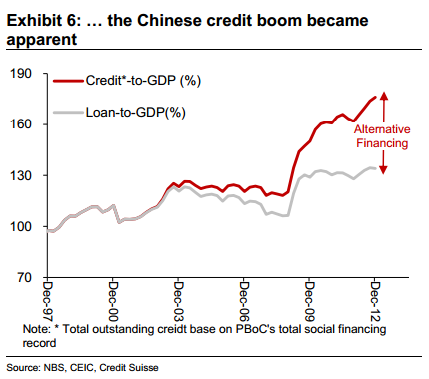
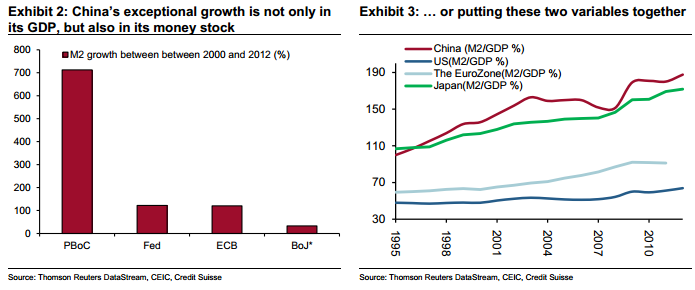
First, a reminder of the degree to which China’s growth has been increasingly fuelled by credit over the past few years:

China-credit-to-GDP-inc-shadow-creditsuissePBoC-money-growth-to-GDP-intl-comparison-CS

The chart above doesn’t quite show it, but non-bank credit growth outpaced bank loans last year. The rise of China’s shadow banking scene has happened very rapidly — much of the growth only happened since 2009.

Shadow banking in China is not all necessarily shadowy; in fact some of it, such as trusts, are legal and regulated at least to a degree. A chunk of shadow loans are also originated by banks (Anne Stevenson-Yang of J Capital Research reckons about 30 per cent).

But it does also include a number of ever more complex and opaque products such as wealth management products. The underlying assets are hard to determine and usually turn out to be property or financial in nature. Investors often assume banks and the state are guaranteeing the principle because of the way they are marketed. Read more of this post

The Starbucks Index – Coffee Price Parity

The Starbucks Index – Coffee Price Parity

Tyler Durden on 02/27/2013 09:44 -0500

20130227_WSJ

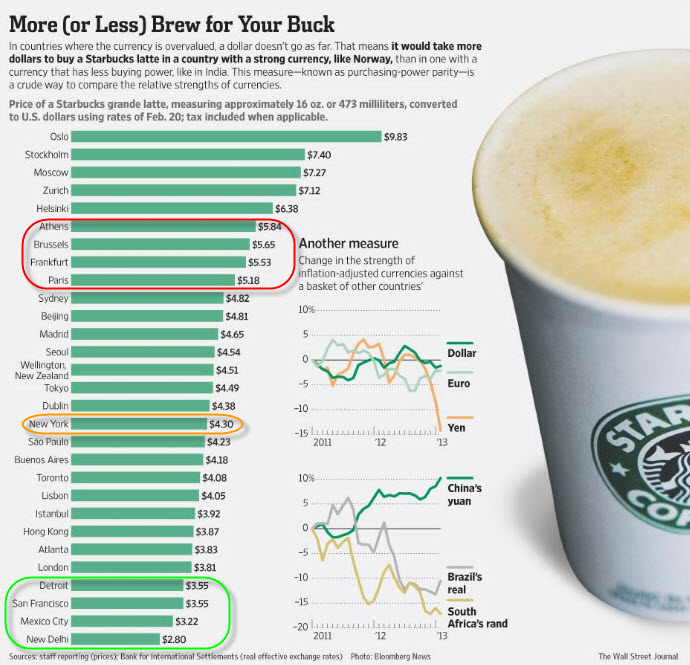
Despite Abe’s protestations, it would appear – from WSJ’s index of Starbucks coffee prices around the world – that Japan’s currency ‘value’ is similar to the US while it is Mr. Hollande (in France) that has more reason to hope for a currency devaluation in his country. With India and Mexico showing the lowest price for a grande latte (suggesting undervalued currencies), it appears Europeans (from Madrid to Paris to Athens) pay significantly more for a latte than even the New Yorkers. Forget the Big Mac Index, forget Purchasing Power Parity – the Scandinavians are suffering from over-priced currencies and significant divergence from Coffee Price Parity.

February 21, 2013, 4:49 p.m. ET

On Currencies, What’s Fair Is Hard to Say

Countries’ Heated Rhetoric Points Out Lack of a Universal Measuring Stick

By IRA IOSEBASHVILI

What’s the fair value of a euro? That depends on whether the answer comes from Berlin or Paris. Read more of this post

Doubts Over Returns Hit Fundraising in China

February 26, 2013, 5:36 PM

Doubts Over Returns Hit Fundraising in China

By Chao Deng

AM-AX364_ASIADE_NS_20130226213311

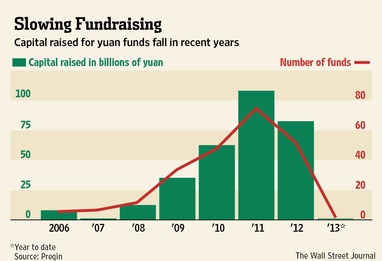
Investors are growing skeptical that private equity in China can keep giving them high returns, and local funds are bearing the brunt of their reluctance to pump in more cash.

The reasons: China’s market for initial public offerings has stalled, making it harder for private-equity firms to cash out of investments, and investors are growing disillusioned with the idea that China’s economy is in line for continued spectacular growth. Growth has already slowed slightly from previous years. Read more of this post

Mao’s $300 Red Army Liquor Suffers Before China Congress: Retail

Mao’s $300 Red Army Liquor Suffers Before China Congress: Retail

By Bloomberg News – Feb 26, 2013

Kong Guoqing hasn’t seen a quieter Chinese New Year in the 12 years his family has been running their small liquor and tobacco shop in downtown Shanghai.

They didn’t sell a single bottle of the high-end spirit made by Kweichow Moutai Co. (600519) that has become synonymous with banquets and gift-giving during China’s national holiday. Kong blames the vanished sales on incoming President Xi Jinping’s crackdown on extravagant spending by officials: Moutai’s sorghum spirit can fetch $300 a bottle — about a third of an average weekly wage in China’s financial hub.

“Demand for the most expensive liquors and cigarettes this New Year seemed to have just dried up,” said Kong, pointing to red boxes of cigarettes costing about $10 a pack, or more than six times the price of regular brands. “People are afraid to accept gifts.” Read more of this post

CBC Raises Deposit Rates, First Among Big State Lenders; significant move reflects building pressures even on the powerful state-owned banks as they scramble for deposits to meet regulatory requirement following a lending spurt at the beginning of the year

CBC Raises Deposit Rates, First Among Big State Lenders

02-26 19:25 Caijing

The significant move reflects building pressures even on the powerful state-owned banks as they scramble for deposits to meet regulatory requirement following a lending spurt at the beginning of the year.

Read more of this post

Leaked conversation reveals insiders’ secret A-share pessimism; “China no longer has any resilience as it has become a heavily indebted economy”

Leaked conversation reveals insiders’ secret A-share pessimism

The recording of two financial professionals sharing a bearish outlook during a private chat is made public.

By Lillian Liu | 27 February 2013

The leak of two industry experts’ private conversation about the outlook for A-shares has spooked the market, with retail investors waking up to the fact that domestic stocks may not be as attractive as many Chinese professionals would publicly claim.

The supposedly off-the-record chat between Cheng Dinghua, a well respected strategist at Essence Securities, and Xu Xiang, an influential fund manager at Zexi Investment, was recorded by a third party and released on the internet last week.

The conversation offers a rare opportunity into the true sentiment of Chinese industry professionals towards a market where only those with the right connections are able to make big profits, while the majority of retail investors are at the mercy of market conditions. Read more of this post

China turns to all-boys classes as girls progress

China turns to all-boys classes as girls progress
By Bill Savadove | Posted: 26 February 2013 1242 hrs

SHANGHAI: Teenage boys in a Shanghai school are on the front line of teaching reform after the world’s top-scoring education system introduced male-only classes over worries they are lagging girls.

Rows of white-shirted boys are put through their paces as they are called up individually to complete a chemical formula by teacher Shen Huimin, who hopes that a switch to male-only classes will help them overcome their reticence.

“We give boys a chance to change,” she said.

The Shanghai school system topped the Organisation for Economic Co-Operation and Development’s (OECD) worldwide assessment tests of 15-year-olds in 2009, the most recent available, ahead of Korea, Finland, Hong Kong and Singapore. Read more of this post

India: Government borrowing generates inflation, widens the external deficit and crowds out much-needed investment. Can India now overcome its debt addiction?

India’s public finances

A walk on the wild side

Government borrowing generates inflation, widens the external deficit and crowds out much-needed investment. Can India now overcome its debt addiction?

Feb 23rd 2013 | MUMBAI |From the print edition

20130223_ASC110 20130223_ASD001_0

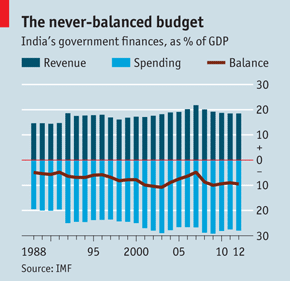
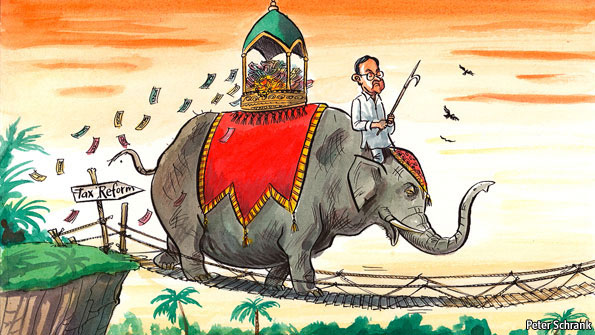
INDIA has grappled with its public finances for long enough. When presenting its first budget after independence in 1947, the finance minister of the day insisted that the country was not living beyond its means. Yet every budget since has failed to produce a surplus. India borrows more heavily than typical big emerging economies and faces more periodic crises. Palaniappan Chidambaram is the latest to try to tame the fiscal beast. He became finance minister, for the third time, last July. On February 28th he will present his budget, possibly the last one before the ruling Congress Party goes to the polls, which must take place by mid-2014.

India’s economy is a concern. Growth is running at about 5%, nearly half what it once was. The external deficit is at a record, while inflation remains stubbornly high. Last year India faced the threat of a downgrade of its credit rating to “junk” status. Thankfully, Mr Chidambaram has shaken Congress from its stupor. The party is to blame for the present budget mess, having launched a pre-election spending spree in 2008 that continued. Subsidies, mainly of fuel, almost doubled, to 2.4% of GDP. The central government’s deficit has been 5-6.5% of GDP. Add in spending by the states, and India’s overall budget deficit has been running at a wild 8-10% of GDP. Read more of this post

Indonesia: Gloomy politics, so how long can the bright economics last?

Indonesia’s economy

Gloomy politics, so how long can the bright economics last?

Feb 23rd 2013 | JAKARTA |From the print edition

20130223_ASC106

ITS public life is dismal, but Indonesia’s economy is, for now, among the brighter performers in Asia. The corruption scandals engulfing the ruling Democratic Party underscore the disappointment of Susilo Bambang Yudhoyono’s second and final term. The president exercises only a weak grip on the helm, and conservatives in government have manoeuvred economic modernisers to the sidelines. Yet the economy zips along. It grew by 6.2% last year, and the government now aims for growth of 6.8% in 2013.

After a decade of painful restructuring for banks and companies, Indonesian businesses are ramping up spending on new factories and infrastructure. Investment now accounts for nearly a third of GDP. Annual imports of things like machinery and mechanical equipment are growing at double-digit rates.

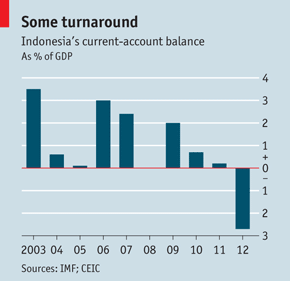
Yet Indonesia’s investment-led boom is now posing problems. Exports are weak, because of depressed global demand and lower prices for many of the natural resources that the country sells to the world. Merchandise imports are growing strongly. The result is a collapse in the trade balance. After a surplus of almost $26 billion in 2011, Indonesia posted a trade deficit last year—its first annual deficit since the late 1960s. The current account, too, swung into deficit in 2012, ending a 14-year run of surpluses (see chart). It has all put pressure on the rupiah, recently one of Asia’s worst-performing currencies. Read more of this post

Fast Retailing to Asahi Named to Women-Empowering Firms List; The exchange labeled the women-empowering companies selection the “Nadeshiko” list

Fast Retailing to Asahi Named to Women-Empowering Firms List

Fast Retailing Co. (9983), Asia’s largest apparel seller, and Nissan Motor Co. are among the Japanese companies that do the most to empower female employees, according to the Tokyo Stock Exchange.

The world’s largest bourse outside the U.S. selected those companies and 15 others for its list of firms that provide child care services and career advancement opportunities for female employees, the bourse said in a statement today.

“Expectations are increasing that women will help revive the Japanese economy,” said Hiroki Kawai, an official at Japan Exchange Group Inc. (8697), which operates the Tokyo Stock Exchange.

The list was compiled with the help of the Ministry of Economy, Trade and Industry and is the exchange’s third specialty selection. The exchange has said it expects the lists to encourage trading, which plunged 58 percent on the first section to 307 trillion yen ($3.34 trillion) in the six years ended Dec. 31.

“We started by picking a theme that would make investors want to cheer companies on by investing,” Kawai told reporters today in Tokyo. He said it can be difficult for individual investors to carefully select from the more than 2,000 companies on the Tokyo bourse.

The exchange initially chose as many as two top companies from each of 33 industry sub-sectors, then narrowed the selection based on two criteria: Promoting women to management positions and offering support allowing a balance of work and family needs. Read more of this post

Bernanke’s efforts to rescue the economy could result in more than a half trillion dollars of paper losses on the central bank’s books if interest rates rise abruptly from recent levels

Fed Faces Explaining Billion-Dollar Losses in Stress of QE3 Exit

Federal Reserve Chairman Ben S. Bernanke’s efforts to rescue the economy could result in more than a half trillion dollars of paper losses on the central bank’s books if interest rates rise abruptly from recent levels.

That sum is the difference between the value of securities in the Fed’s portfolio on Dec. 31 and what they may fetch in three years, according to data compiled by MSCI Inc. of New York for Bloomberg News. MSCI applied scenarios devised by the Fed itself for stress-testing the nation’s 19 largest banks.

MSCI sees the market value of Fed holdings shrinking by $547 billion over three years under an adverse scenario that includes an economic contraction and rising inflation. MSCI puts the Fed’s mark-to-market loss at less than half that, or $216 billion, if the economy performs in line with consensus forecasts of gradually rising growth, inflation and interest rates.

The potential losses are unprecedented in the Fed’s 100- year history, and Bernanke has never used congressional testimony to give a detailed explanation of the consequences of shifting hundreds of billions in interest-rate risk from private portfolios onto the Fed’s balance sheet. Today, Bernanke appears before senators who oversee the Fed and may face questions on how the $3.1 trillion balance sheet will affect an exit from the stimulus program, remittances to taxpayers, and its ability to stabilize inflation expectations. Read more of this post

Abenomics Risks Deepening Global Financial Turmoil, HSBC Says

Abenomics Risks Deepening Global Financial Turmoil, HSBC Says

Japanese Prime Minister Shinzo Abe’s policies aimed at ending deflation could distort trade, drive up asset prices in other nations and lead to global financial instability, according to HSBC Holdings Plc.

“The world seemingly has yet to find a way of coping with periods during which the Japanese have attempted to kick-start their economy,” Stephen King, the London-based chief economist at HSBC, wrote in a research report today. “The big risk for the years ahead lies in a mix of rapidly widening current account deficits, hot money inflows and a proliferation of capital controls.”

Moves by Japan to revive growth have raised concern over a so-called currency war as central bankers from New Zealand to Norway signal they’re ready to stem exchange rate swings. Group of 20 finance chiefs this month signaled Abe has scope to keep stimulating the economy as long as officials stop endorsing the yen’s more than 10 percent slide in the past three months.

“If Mr. Abe’s policies work primarily through a weaker yen, Japan’s main export competitors will find themselves in the firing line,” King wrote. “The most vulnerable include Germany, South Korea and China.” Read more of this post

Singapore Trading Hub May Reduce World’s Costliest LNG, IEA Says

Singapore Trading Hub May Reduce World’s Costliest LNG, IEA Says

Singapore is the most likely hub for trading liquefied natural gas and reducing the government interference that keeps Asia’s prices higher than anywhere else in the world, according to the International Energy Agency.

A new LNG terminal in Singapore, set to receive its initial cargo from Qatar in the first quarter, will serve a wide array of tankers and boost import capacity “far beyond” domestic consumption, the IEA said today in a report. The city-state, Asia’s oil-trading center, is also creating an example for Asia by unbundling transmission from other gas and power infrastructure and taking a “hands off” approach, according the IEA, an adviser to 28 nations.

“Singapore is establishing itself as an LNG trading hub even before the physical infrastructure to import LNG is in place,” the IEA said. “Natural gas companies have begun to set up trading desks in Singapore. The presence of various international oil companies secures the availability of financial services to cater to natural gas trading.”

Gas buyers in Asia now pay about five times as much as U.S. consumers. They will be stuck with higher costs and insufficient facilities for receiving, processing and transporting LNG as long as governments promote state-owned companies and try to restrict imports, the IEA said. Lower prices in the U.S. and Europe reflect competitive and deregulated markets as much as better access to low-cost supplies, the group said. Read more of this post

Lee Kuan Yew’s China

Graham Allison, Robert D. Blackwill, Ali Wyne

Lee Kuan Yew’s China

25 February 2013

CAMBRIDGE – On the question of how the evolving relationship between the United States and China will influence the international order, there are few individuals whose observations receive equal attention on both sides of the Pacific. Henry Kissinger is one; Singapore’s founding father, Lee Kuan Yew, is another. In profiling Lee for Time magazine’s 2010 list of the world’s 100 most influential people,Kissinger observed: “There is no better strategic thinker.” Read more of this post

China’s ‘House sister’ case exposes flaws in underground financial market

‘House sister’ case exposes flaws in underground financial market

Staff Reporter

2013-02-26

On the eve of Chinese New Year, Gong Aiai, the vice president of an agricultural and commercial bank in Shenmu county in northwestern China’s Shaanxi province, was taken into custody for forging public documents and government seals following the disclosure on the internet that she illegally owns dozens of properties worth a total of 1 billion yuan (US$160 million) in Beijing and making her known nationally as the infamous “house sister.” Read more of this post

Korea’s New President Can’t Be Daddy’s Girl; The education system must be less about exams, cram schools and striving for a job at one of the chaebol and more about critical thinking, questioning authority and fostering an entrepreneurial spirit

Korea’s New President Can’t Be Daddy’s Girl

The life of Park Geun Hye, South Korea’s just-inaugurated first female president, has so far been bookended by two larger-than-life men of debatable success.

The first is her father, Park Chung Hee, the dictator who ruled the nation for 18 years until his assassination in 1979. The second is Lee Myung Bak, her predecessor who spent the last five years in the Blue House, Korea’s presidential residence, and a fellow member of her New Frontier Party.

Park must deal with their shortcomings in reverse. The immediate challenge is to be truer to her party’s name than Lee ever was. Lee left office this week with an approval rating in the 20s, an economy burdened by record household debt, a widening income gap, a strong currency that is hurting export competitiveness, relations with Japan frayed and North Korea raising hell around the globe.

Park also must eventually reckon with the legacy of her father’s era. The rapid growth of his time was fueled by cheap exports, easy credit, protection from foreign markets and the family-led conglomerates that still dominate. Today’s voters are clamoring for a more balanced and egalitarian economy and an exit strategy from the past. They literally want a new frontier. Read more of this post

Singapore’s Darwinian Budget Sparks Employer Ire: Southeast Asia; Singapore to Raise Property Tax Rates for Luxury Homeowners

Singapore’s Darwinian Budget Sparks Employer Ire: Southeast Asia

Singapore tightened curbs on foreign labor for a fourth straight year and unveiled measures that will raise wage costs for companies through 2015, as the government steps up efforts to increase productivity among businesses.

Companies must pay higher levies for lower-skilled foreign employees over the next two years and cut the proportion of overseas workers in some industries, Finance Minister Tharman Shanmugaratnam said in his budget speech yesterday.

“This is really killing a lot of businesses, many companies are dying,” said Max Lee, managing director of Plasma Precision Technology Pte., which makes and repairs equipment used by offshore marine companies. His wage costs have risen 15 percent in the past year. “We are losing competitiveness and productivity.”

After years of letting firms bring in thousands to work at hotels, shipyards and restaurants, the push by Prime Minister Lee Hsien Loong’s government to reduce dependence on imported labor has forced some companies to delay expansion plans. The clampdown, in part because of voter unhappiness over the influx of foreigners, has led the government to warn that such curbs will hurt growth in Southeast Asia’s only advanced economy.

“This is a Darwinian budget for businesses in Singapore,” said Adrian Ball, head of tax services at Ernst & Young Solutions LLP. “Survival of the fittest!” Read more of this post

China Has Its Own Debt Bomb; Not unlike the U.S. in 2008, China is at the end of a credit binge that won’t end well

February 25, 2013, 7:04 p.m. ET

China Has Its Own Debt Bomb

Not unlike the U.S. in 2008, China is at the end of a credit binge that won’t end well.

By RUCHIR SHARMA

Six years ago, Chinese Premier Wen Jiabao cautioned that China’s economy is “unstable, unbalanced, uncoordinated and unsustainable.” China has since doubled down on the economic model that prompted his concern.

Mr. Wen spoke out in an attempt to change the course of an economy dangerously dependent on one lever to generate growth: heavy investment in the roads, factories and other infrastructure that have helped make China a manufacturing superpower. Then along came the 2008 global financial crisis. To keep China’s economy growing, panicked officials launched a half-trillion-dollar stimulus and ordered banks to fund a new wave of investment. Investment has risen as a share of gross domestic product to 48%—a record for any large country—from 43%.

Even more staggering is the amount of credit that China unleashed to finance this investment boom. Since 2007, the amount of new credit generated annually has more than quadrupled to $2.75 trillion in the 12 months through January this year. Last year, roughly half of the new loans came from the “shadow banking system,” private lenders and credit suppliers outside formal lending channels. These outfits lend to borrowers—often local governments pushing increasingly low-quality infrastructure projects—who have run into trouble paying their bank loans. Read more of this post

China Austerity Drive Becomes a Joke

February 25, 2013, 8:38 PM

China Austerity Drive Becomes a Joke

China’s leaders have been talking tough about graft, greed and gross extravagance again. One sign they’re serious this time: Their willingness to have a little fun with it.

Up until recently, the austerity campaign was suitably severe. There was tough talk from Communist Party chief Xi Jinping, who told a gathering of party heavyweights in November that corruption threatened their grip on power. He called for less pomp and ceremony for officials touring the countryside and urged comrades to make do with a little less banqueting. They should stick to four dishes and a soup and finish their food or else, he said.

Similar refrains have regularly appeared in the party mouthpiece, the People’s Daily. A recent commentary (in Chinese) said cadres need to avoid waste, hold only meetings that have a real purpose and observe the New Year holiday in a simple and modest fashion. “The people are looking forward to this – and they will be watching critically,” it warned.

But to help spread the party gospel even further, Beijing recently decided to take a more populist approach — making these themes part of the entertainment on CCTV’s widely watched Lunar New Year’s Eve gala – or the “Chun Wan Hui.”

In one of the CCTV New Year skits, comic Guo Degang took a swipe at the ex-Shaanxi work safety official Yang Dacai, dubbed the “Brother Watch” after photos of him appeared on the Internet sporting an array of expensive watches that normally would exceed a government salary. Mr Guo, who didn’t mention the sacked official by name, bragged he wore a hefty gold watch on his right wrist and a dozen more all the way up his left arm. Asked if it wasn’t risky wearing them he said: “I’m not afraid of wearing them and I’m not afraid of letting people see them,” he said, adding he had shortened his left suit sleeve so he could show them all off (in Chinese).

Still in character, he bragged of splashing out on a wedding banquet, inviting enough guests to fill 100 tables. He feigned outrage at apparently being upstaged by a banquet next door with 200 tables. On closer inspection, that banquet was paid for with public money, so it wasn’t a fair contest, he insisted. Read more of this post

China’s riskiest property market just collapsed. Is this how it starts?

China’s riskiest property market just collapsed. Is this how it starts?

By Max Fisher , Updated: February 25, 2013

The real estate market in Phoenix Island, a development project in the Chinese island province of Hainan, was so inflated, so outrageously expensive and unsustainable, that it became known as the Dubai of China. With its palm tree-lined streets, glimmering high-rises and ostentatious sports cars, it even looked a little like Dubai. And now, also like Dubai but maybe more in the vein of south Florida, the Phoenix Island real estate market that drove so much local economic growth has imploded.

Phoenix Island is an extreme case, but it’s in many ways symptomatic of China’s skyrocketing real estate market, which is both a blessing and a curse for China. A blessing because it helps to drive economic growth and domestic consumption, which the country’s economy needs more of to be healthy. It’s a curse because, as Americans are well aware, it can burst, pulling down much of the national economy with it.

If the national real estate market collapses in China, it would be disastrous not just for China but for the entire world economy, risking a third wave of the global crisis that began with the U.S. financial collapse and worsened with the Euro crisis. Is Phoenix Island an outlier, a crazy market so extreme that it tells us little about China? Is it the start of a major but recoverable setback? Or, in the worst-case scenario, is it the beginning of the end for China’s astounding 20 years of miraculous economic growth? Read more of this post

President Park: The Republic of Korea as we know it today has been built on the blood, toil, and sweat of the people. I have faith in the Korean people. I believe in their resilience and the potential of our dynamic nation.

2013-02-25 11:25

“Opening a New Era of Hope”

My fellow Koreans and seven million fellow compatriots overseas,

As I take office as the 18th-term President of the Republic of Korea, I stand before you today determined to open a new era of hope.

I am profoundly grateful to the Korean people for entrusting this historic mission to me. I also thank President Lee Myung-bak, former Presidents, dignitaries who have come from abroad to celebrate this occasion, and other distinguished guests for their presence.

As President of the Republic of Korea, I will live up to the will of the people by achieving economic rejuvenation, the happiness of the people, and the flourishing of our culture.

I will do my utmost to building a Republic of Korea that is prosperous and where happiness is felt by all Koreans.

Fellow citizens,

The Republic of Korea as we know it today has been built on the blood, toil, and sweat of the people. Read more of this post

Selloff Rattles Asia’s Bond Market; Plunge in Riskier Corporate Debt Has Left Many Investors with Large Losses, and Stoked Broad Fears

February 20, 2013, 6:47 p.m. ET

Selloff Rattles Asia’s Bond Market

Plunge in Riskier Corporate Debt Has Left Many Investors with Large Losses, and Stoked Broad Fears

By FIONA LAW

Fund managers worried about the end of an extended bull market in bonds might look to Asia, where a sudden selloff in a certain class of risky bonds has left many investors with large losses.

The plunge in so-called perpetual bonds is viewed as a cautionary example of an asset that had gotten too frothy and, some skeptics say, could be a sign of things to come in other corners of the bond market. Read more of this post

China will never match US in innovation: Lee Kuan Yew; “America’s creativity, resilience and innovative spirit will allow it to confront its core problems, overcome them, and regain competitiveness,”

China will never match US in innovation: Lee Kuan Yew

Staff Reporter

2013-02-21

In a new book about the relationship between China and the United States, Singapore’s former prime minister Lee Kuan Yew says China will never be able to compete with the United States in terms of creativity, reports the Australian.

In The Grand Master’s Insights on China, the United States and the World written by Graham Allison, Robert Blackwill and Ali Wyne, Lee says Beijing is trying to restore China’s historical position as the Middle Kingdom while the United States is also trying its best to maintain its superiority. Countries in Southeast Asia are still wary of what China may be like if the country becomes the dominant power in the Western Pacific.

“They are uneasy that China may want to resume the imperial status it had in earlier centuries, and have misgivings as being treated as vassal states.” While Beijing tells its neighbors that countries big or small are equal, Lee points out that China also tells them that they have made 1.3 billion people unhappy when they do things it doesn’t like. For this reason, Lee pointed out that a rising China is likewise concerned and insecure about the actions of small Asian nations.

Lee said it would be extremely unwise for China to enter an arms race with the United States. “The Chinese must avoid the mistakes made by Germany and Japan. Their competition for power, influence and resources led in the last century to two terrible wars.” Beijing must likewise avoid the fate of the Soviet Union. “The Russian mistake was that they put so much into military expenditure and so little into civilian technology that their economy collapsed.” For this reason, Lee says he believes China will keep its head down for at least another 40 or 50 years rather than risk asserting dominance too soon.

Conceding that China is set to replace the United States to become world’s largest economy, Lee said however that China will never overtake the United States in innovation. “America’s creativity, resilience and innovative spirit will allow it to confront its core problems, overcome them, and regain competitiveness,” he said, while suggesting on the other hand that China’s creative development will be stifled by a traditional culture which does not permit a free exchange and contest of ideas.

China is also unlikely to become a liberal democracy, Singapore’s founding father suggested. “To achieve modernization, China’s Communist leaders are prepared to try every method except for democracy with one person and one vote in a multi-party system.” The party needs a monopoly on power to maintain the stability of the nation. If it launched liberal democratic reforms, the central government may lose its power over different provinces. “If it did, it would collapse,” said Lee, “If you believe there is going to be a revolution of some sort in China for democracy, you are wrong.”

U.S. Banks Bigger Than GDP as Accounting Rift Masks Risk

U.S. Banks Bigger Than GDP as Accounting Rift Masks Risk

Warning: Banks in the U.S. are bigger than they appear.

That label, like a similar one on automobile side-view mirrors, might be required of the four largest U.S. lenders if Thomas Hoenig, vice chairman of the Federal Deposit Insurance Corp., has his way. Applying stricter accounting standards for derivatives and off-balance-sheet assets would make the banks twice as big as they say they are — or about the size of the U.S. economy — according to data compiled by Bloomberg.

“Derivatives, like loans, carry risk,” Hoenig said in an interview. “To recognize those bets on the balance sheet would give a better picture of the risk exposures that are there.”

U.S. accounting rules allow banks to record a smaller portion of their derivatives than European peers and keep most mortgage-linked bonds off their books. That can underestimate the risks firms face and affect how much capital they need.

Using international standards for derivatives and consolidating mortgage securitizations, JPMorgan Chase & Co., Bank of America Corp. and Wells Fargo & Co. would double in assets, while Citigroup Inc. would jump 60 percent, third- quarter data show. JPMorgan would swell to $4.5 trillion from $2.3 trillion, leapfrogging London-based HSBC Holdings Plc and Deutsche Bank AG, each with about $2.7 trillion. Read more of this post

CITI: There’s A Crisis Lurking In The Bond Market And No One Is Talking About It

CITI: There’s A Crisis Lurking In The Bond Market And No One Is Talking About It

Matthew Boesler | Feb. 20, 2013, 1:24 PM | 6,214 | 10

The Federal Reserve has revealed that it is considering scaling down and possibly even completely halting quantitative easing by the end of this year.

Whether or not the central bank will actually be in a position to do that in 2013 is one of the hottest debates in the market right now – but the 10-year U.S. Treasury yield has risen from an all-time low below 1.5 percent in July to its current levels, slightly above 2 percent, and that has people talking.

“It’s the $64,000 question: What ends up bringing this down?” Citi strategist Michael H. Anderson told Business Insider.

As several members of the Federal Reserve ramp up the public dialogue surrounding financial stability, Anderson thinks they’re looking in the wrong place.

In a recent note to clients, he wrote, “It’s more likely the excess that ultimately brings this cycle to an end is one that few are mentioning.”

In aggregate, investors have poured a staggering amount of money – hundreds of billions of dollars – into bond funds over the past five years. They have been largely deterred from stocks as memories of the crash in 2008 continue to haunt the market.

That may all be changing as investors in mutual funds begin to open up their monthly statements and realize that their bond investments are starting to lose money.

What happens when investors start pulling money from these mutual funds, and the fund managers have to turn around and get rid of their holdings of corporate bonds? Read more of this post

The Coming Atlantic Century; the pervasive narrative of western decline and Asia rising is quickly reversing itself

Anne-Marie Slaughter

Anne-Marie Slaughter, a former director of policy planning in the US State Department (2009-2011) and a former dean of the Woodrow Wilson School of Public and International Affairs, is Professor of Politics and International Affairs at Princeton University. She is the author of The Idea That Is America: Keeping Faith with Our Values in a Dangerous World.

The Coming Atlantic Century

21 February 2013

PRINCETON – The United States is rising; Europe is stabilizing; and both are moving closer together. That was the principal message earlier this month at the annual Munich Security Conference (MSC), a high-powered gathering of defense ministers, foreign ministers, senior military officials, parliamentarians, journalists, and national-security experts of every variety. The participants come primarily from Europe and the US; indeed, when the conference began in 1963, it was focused entirely on NATO members. This year, however, senior government officials from Brazil, China, India, Nigeria, Singapore, Qatar, and Saudi Arabia also joined, an important sign of the times. John McCain, the US senator and 2008 presidential candidate, always leads a large congressional delegation to Munich. The US administration also typically sends the Secretary of Defense or the Secretary of State to deliver a ritual speech reassuring the Europeans of the strength of the transatlantic alliance. This year, Vice President Joe Biden did the honors, bumping the US representation up a notch.

The conference also featured a panel on an unusual subject – “The American Oil and Gas Bonanza: The Changing Geopolitics of Energy.” Read more of this post

Andy Kessler: When Interest Rates Rise, Watch Out; The Fed’s inevitable Sword of Damocles could be brutal for bonds and stocks. Some of us recall the massacre of 1994

February 21, 2013, 7:09 p.m. ET

Andy Kessler: When Interest Rates Rise, Watch Out

The Fed’s inevitable Sword of Damocles could be brutal for bonds and stocks. Some of us recall the massacre of 1994.

By ANDY KESSLER

Can Ben Bernanke fly us through a needle’s eye? Minutes released this week from the last Federal Reserve policy meeting suggest evaluations are taking place that “might well lead the Committee to taper or end its purchases before it judged that a substantial improvement in the outlook for the labor market had occurred.” It’s about time. The experiment to kick-start the economy with near-zero interest rates has failed. Maybe our central bankers have figured out that low rates are what is holding back lending and hiring and growth.

Meanwhile, even as the stock market hits highs not seen since 2007, everyone on Wall Street knows interest rates will go up—although no one except Mr. Bernanke knows when. Investors are playing a game of chicken with rates, enjoying the ride but bracing for a downturn when the rates turn up. When rates go up, bonds become more attractive than stocks because you get returns with less risk.

Those of us on Wall Street in 1994 witnessed something very similar. After several years of essentially flat short-term rates, the Fed raised rates by 25 basis points (or 0.25%) on Feb. 4, 1994. The Fed raised short-term rates a total of six times and 2.5% over the next 10 months.

In what became known as a bond-market massacre, the price of long bonds dropped almost 9%. The stock market dropped 9% in three months, killing a then-vibrant market for initial public offerings.

Today we are at the bitter end of a three-decade-long interest rate cycle, culminating in Mr. Bernanke’s near-zero rates. You can’t fall off the floor. And the prospect of higher interest rates is like the Sword of Damocles hanging over the stock market. Read more of this post

Why the Euro Crisis Isn’t Over; The economist who dared to predict Europe’s mess, and was fired for it, says there is much more pain to come

Updated February 22, 2013, 6:27 p.m. ET

Why the Euro Crisis Isn’t Over

The economist who dared to predict Europe’s mess, and was fired for it, says there is much more pain to come

By BRIAN M. CARNEY

London

Seventeen years ago, Bernard Connolly foretold the misery that awaited the European Union. Given that he was an instrumental figure in the EU bureaucracy and publicly expressed his doubts in a book called “The Rotten Heart of Europe,” he was promptly fired. Mr. Connolly takes no pleasure now in having seen his prediction come true. And he takes no comfort in the view, prevalent in many quarters, that the EU has passed through the worst of its crisis and is on the cusp of revival.

As far as Mr. Connolly is concerned, Europe’s heart is still rotting away.

The European political class, he says, believes that the crisis “hit its high point” last summer, “because that was when there was an imminent danger, from their point of view, that their wonderful dream would disappear.” But from the perspective “of real live people, and families and firms and economies,” he says, the situation “is just getting worse and worse.” Last week, the EU reported that the euro-zone economy shrank by 0.9% in the fourth quarter of 2012. For the full year, gross domestic product fell 0.5% in the euro zone.

Two immediate solutions present themselves, Mr. Connolly says, neither appetizing. Either Germany pays “something like 10% of German GDP a year, every year, forever” to the crisis-hit countries to keep them in the euro. Or the economy gets so bad in Greece or Spain or elsewhere that voters finally say, ” ‘Well, we’ll chuck the whole lot of you out.’ Now, that’s not a very pleasant prospect.” He’s thinking specifically, in the chuck-’em-out scenario, about the rise of neo-fascists like the Golden Dawn faction in Greece.

Mr. Connolly isn’t just any Cassandra. When he predicted disaster, he was running the European Commission’s Monetary Affairs Committee, the Brussels bureaucracy charged with ushering the euro into being. His public confession of fear that the monetary union would inevitably produce an economic crisis not only cost him his job, he says, it also cost him his pension, and he was barred from his office even before his dismissal was official. In the introduction to the paperback edition of “The Rotten Heart of Europe,” Mr. Connolly describes how his photograph was posted at entrances to the commission’s offices, as if he were a wanted criminal. Read more of this post