Pakistan’s Army of Overseas Workers Keeps Economy From Collapse; Almost 10 million Pakistanis work overseas and the sum they’ve sent home has doubled in the four years through June, to a record $13 billion.

Pakistan’s Army of Overseas Workers Keeps Economy From Collapse

Living in poverty in a mud shack in Pakistan, Mazhar Ali dropped out of school, sold the family’s two buffalo and bought a visa to work in Dubai. The money he sends home is paying for a new house.

“We’re going to build three rooms with bricks and cement, plus a courtyard and a washroom,” said his younger brother Azhar in Larkana, home town of the ruling People’s Party about 300 kilometers north of Karachi. “We will then start marrying one by one, starting with Mazhar sometime this year.”

The family’s change in fortunes reflects a rising trend of rich nations with aging workers tapping poorer ones for labor — total remittances to developing economies will rise 7.9 percent this year, and reach $534 billion by 2015, the World Bank says. For Pakistan, the income offers a source of stability, with the country poised for its first civilian handover of government in May even amid power shortages, bombings and a Taliban insurgency.

“This is our savior for keeping Pakistan out of the oxygen tent,” Farooq Sattar, former Minister for Overseas Pakistanis said in an interview in Karachi last month before his party quit the government alliance. “It has kept us from a complete economic collapse.”

Almost 10 million Pakistanis work overseas and the sum they’ve sent home has doubled in the four years through June, to a record $13 billion. Read more of this post
Your Survival Instinct Is Killing You: Retrain Your Brain to Conquer Fear, Make Better Decisions and Thrive in the 21st Century

Updated March 25, 2013, 7:23 p.m. ET

Healthy Reader

By LAURA LANDRO

Your Survival Instinct Is Killing You: Retrain Your Brain to Conquer Fear, Make Better Decisions and Thrive in the 21st Century

Marc Schoen
Hudson Street Press, $25.95

From primitive times, the survival instinct has enabled mankind to handle major threats to existence. In the modern world, we have become such creatures of comfort that even the slightest annoyance—such as facing a long line at airport security—sends our self-preservation programming into overdrive, resulting in dangerous levels of stress.

‘Discomfort may very well be the most powerful change agent we have in our arsenal for becoming all that we can be.’

Think Differently

Dr. Schoen’s tips for quelling uncomfortable ‘inner survivalist’ feelings

Expand your comfort zone: Drive to a less-familiar location without GPS or a map.

Embrace discomfort: Delay or refrain from use of medications to fall asleep or cope with pain (if medically safe to do so).

Commit to the present: Fully engage with people without responding to texts or emails.

Delay gratification: Sit with hunger before reaching for food; forgo that drink after work sometimes. Read more of this post

Computing Looks to the Eyes; Eyeballs are poised to emerge in coming years as a legitimate tool for controlling everything from handsets to games

Updated March 25, 2013, 11:38 p.m. ET

Computing Looks to the Eyes

Technology That Tracks Eye Movement Could Cut Down on Mouse Use

By SVEN GRUNDBERG

MK-CB895A_EYETR_G_20130325183604

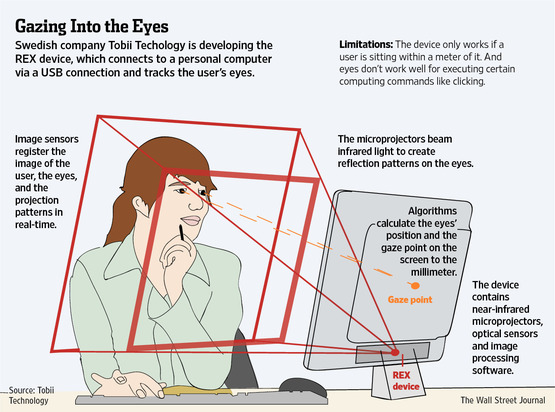
Touch screens have removed some of the need for clunky hardware extras long associated with personal computing. But the biggest technical challenge to wean computers off the age-old keyboard and mouse may rest on the two sockets in our heads.

Eyes are poised to emerge in coming years as a legitimate pointing tool for computers and mobile devices to accompany other methods of interacting with personal gadgets.

State-of-the-art eye tracking is mostly found in the health-care industry, as aids for disabled people with impaired mobility. Now the race is on to incorporate the technology into mass-market consumer electronics for games and everyday applications. Read more of this post

Science Fiction Comes Alive as Researchers Grow Organs in Lab

March 22, 2013, 10:36 p.m. ET

Science Fiction Comes Alive as Researchers Grow Organs in Lab

By GAUTAM NAIK

OB-WU659_BODYPA_DV_20130322173513P1-BK796_BODYPA_OR_20130322192503P1-BK794_bodypa_DV_20130322191355

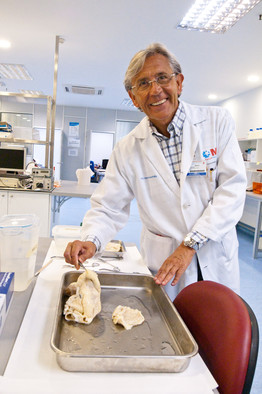
Francisco Fernandez-Aviles with a human heart that is devoid of its cells.

Building a complex human organ in the lab is no longer a dream of science fiction. At London’s Royal Free Hospital, a team of 30 scientists is manufacturing a variety of body parts, including windpipes, noses and ears. WSJ’s Gautam Naik reports. Photo: Gareth Phillips

MADRID—Reaching into a stainless steel tray, Francisco Fernandez-Aviles lifted up a gray, rubbery mass the size of a fat fist.

It was a human cadaver heart that had been bathed in industrial detergents until its original cells had been washed away and all that was left was what scientists call the scaffold.

Next, said Dr. Aviles, “We need to make the heart come alive.”

P1-BK792_BODYPA_G_20130322221602 Read more of this post

Progress Fighting Parkinson’s Drug Side Effects; “I’m basically going to be incapacitated by the drug that’s helping me, and that’s terrifying,”

March 25, 2013, 6:38 p.m. ET

Progress Fighting Parkinson’s Drug Side Effects

By SHIRLEY S. WANG

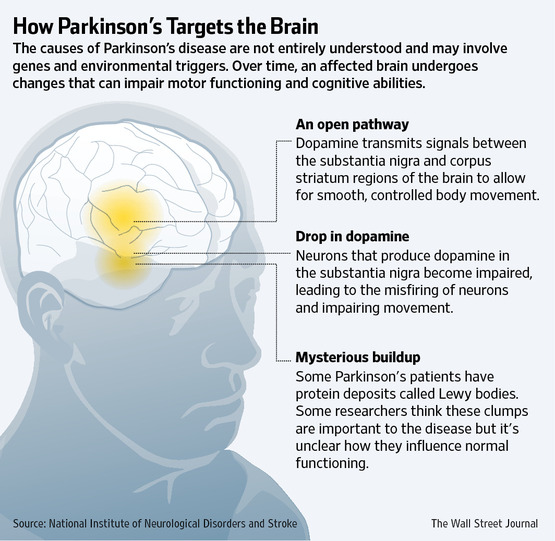
As they continue to wait for a cure, patients with Parkinson’s disease may soon see more consistent relief from side effects of the drugs that treat it.

One of the most pressing problems facing patients today is that the most effective treatment available wears off over time and may induce often severe involuntary movements. A number of new treatments are being developed to address the wearing-off effect or attenuate the movement side effects, called dyskinesia, that come with the drug, levodopa.

PJ-BN319A_LAB_G_20130325175416 Read more of this post

Mortimer Zuckerman: The Great Recession Has Been Followed by the Grand Illusion; Don’t be fooled by the latest jobs numbers. The unemployment situation in the U.S. is still dire

March 25, 2013, 7:07 p.m. ET

Mortimer Zuckerman: The Great Recession Has Been Followed by the Grand Illusion

Don’t be fooled by the latest jobs numbers. The unemployment situation in the U.S. is still dire.

By MORTIMER ZUCKERMAN

The Great Recession is an apt name for America’s current stagnation, but the present phase might also be called the Grand Illusion—because the happy talk and statistics that go with it, especially regarding jobs, give a rosier picture than the facts justify.

The country isn’t really advancing. By comparison with earlier recessions, it is going backward. Despite the most stimulative fiscal policy in American history and a trillion-dollar expansion to the money supply, the economy over the last three years has been declining. After 2.4% annual growth rates in gross domestic product in 2010 and 2011, the economy slowed to 1.5% growth in 2012. Cumulative growth for the past 12 quarters was just 6.3%, the slowest of all 11 recessions since World War II. Read more of this post

For One Chinese Student, a Tough Job Hunt; Grateful son and “Iron Chicken” Gao Yueqing is set to graduate this June with a degree in accounting, the most practical major he and his father could agree upon. But the younger Mr. Gao, like many Chinese college students, is finding it hard to nail a job

March 25, 2013, 10:33 p.m. ET

For One Chinese Student, a Tough Job Hunt

By BOB DAVIS

SHIJIAONAO, China—Four years ago, Gao Shangming was convinced that his son Yueqing needed to remain in the family’s one-room apartment and help harvest corn rather than go to college. “Our financial situation wasn’t good,” the 50-year-old peasant farmer says.

But Gao Yueqing was determined to escape the dusty north China mountain village of 200 households where nearly all young people either become farmers or migrate to nearby cities to work in restaurants. His father’s relatives talked up young Gao’s case, as did a respected high-school teacher who told the elder Gao how hardworking his son was.

The clincher: “He told me, ‘If I let him get a college degree, he’d make more money,'” the elder Gao recalls.

So the father put in extra hours in nearby coal mines to pay his son’s 10,000 yuan ($1,600) annual tuition and expenses at Shanxi University’s business school in Taiyuan, in the heart of China’s coal country. His grateful son was so frugal that his roommates nicknamed him “Iron Chicken,” because it was as hard to separate him from a yuan as it would be to pluck a feather from an iron fowl.

Gao Yueqing is set to graduate this June with a degree in accounting, the most practical major he and his father could agree upon. But the younger Mr. Gao, like many Chinese college students, is finding it hard to nail a job, especially one that pays decently. Read more of this post

Chinese College Graduates Play It Safe and Lose Out; Chinese college graduates say they want to work for the government or big state-owned firms, which are seen as recession-proof, rather than the private companies that have powered China’s economic climb

March 25, 2013, 10:32 p.m. ET

Chinese College Graduates Play It Safe and Lose Out

By BOB DAVIS

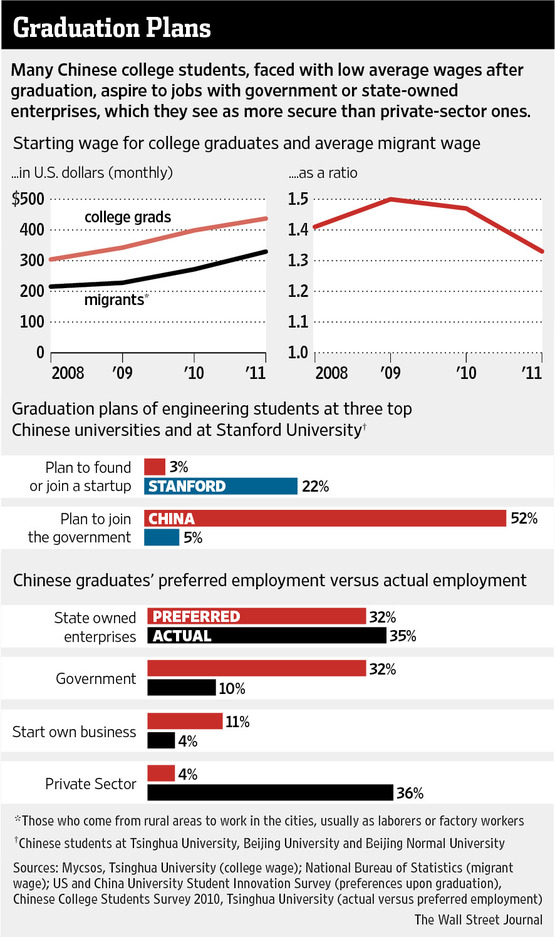
BEIJING—Xie Chaobo figures he has the credentials to land a job at one of China’s big state-owned firms. He is a graduate student at Tsinghua University, one of China’s best. His field of study is environmental engineering, one of China’s priorities. And he is experimenting with new techniques for identifying water pollutants, which should make him a valuable catch. But he has applied to 30 companies so far and scored just four interviews, none of which has led to a job. Although Mr. Xie’s parents are entrepreneurs who have built companies that make glasses, shoes and now water pumps, he has no interest in working at a private startup. Chinese students “have been told since we were children to focus on stability instead of risk,” the 24-year-old engineering student says.

Over the past decade, the number of new graduates from Chinese universities has increased sixfold to more than six million a year, creating an epic glut that is depressing wages, leaving many recent college graduates without jobs and making students fearful about their future. Two-thirds of Chinese graduates say they want to work either in the government or big state-owned firms, which are seen as recession-proof, rather than at the private companies that have powered China’s remarkable economic climb, surveys indicate. Few college students today, according to the surveys, are ready to leave the safe shores of government work and “jump into the sea,” as the Chinese expression goes, to join startups or go into business for themselves, although many of their parents did just that in the 1990s.

Chinese economists worry that waning entrepreneurial zeal could hobble China’s ability to remake its economy and reach the ranks of wealthy nations. “The current education system does not produce people who are innovative,” says Li Hongbin, a Tsinghua University economist who specializes in education and conducted some of the surveys. “That makes it harder for the country to reach its long-term goal of building an innovative society.”

P1-BK828_CCOLLE_NS_20130325175703

P1-BK829_CCOLLE_G_20130325183608 Read more of this post

Teenager, who just made US$30mil, tells other teenagers ‘if you have a tech idea just do it’; At 17, App Builder Rockets to Riches From Yahoo Deal

Updated: Tuesday March 26, 2013 MYT 12:35:40 PM

Teenager, who just made US$30mil, tells other teenagers ‘if you have a tech idea just do it’

LONDON: Got a tech idea and want to make a fortune before you’re out of your teens? Just do it, is the advice of the London schoolboy who’s just sold his smartphone news app to Yahoo for a reported US$30 million.

The money is there, just waiting for clever new moves, said 17-year-old Nick D’Aloisio, who can point to a roster of early backers for his Summly app that includes Yoko Ono and Rupert Murdoch.

“If you have a good idea, or you think there’s a gap in the market, just go out and launch it because there are investors across the world right now looking for companies to invest in,” he told Reuters in a telephone interview late on Monday. Read more of this post

Wall Street worries about PayPal’s real-world expansion as it launched a push in 2011 to become a payment option in brick-and-mortar stores. The move increases PayPal’s potential market by a factor of at least 10

Published: Tuesday March 26, 2013 MYT 8:09:00 AM

Wall Street worries about PayPal’s real-world expansion

SAN FRANCISCO: Wall Street is having second thoughts about following PayPal from its online roots into the physical world.

PayPal, a leader online, launched a push in 2011 to become a payment option in brick-and-mortar stores. The move increases PayPal’s potential market by a factor of at least 10, and has been a big driver of the shares of owner eBay Inc, which surged 68 percent in 2012.

But ahead of an investor day meeting at eBay‘s Silicon Valley headquarters on Thursday, some investors and analysts are beginning to worry that the initiative will sacrifice profit margins for growth.

“Profitability of on-site payment will be dramatically lower than it is online,” said Bill Smead of Smead Capital Management, an eBay shareholder who has been bullish on the company for several years. Smead’s Seattle-based firm has trimmed its eBay position twice in the past year. Read more of this post

‘Tall white foreigner from Wales singing songs about communism’ is hit in China

‘Tall white foreigner from Wales singing songs about communism’ is hit in China

A British singer has become an overnight celebrity in China after entering the TV talent show China’s Got Talent.

Iain-Inglis_2519637b

Iain Inglis sings communist revolutionary songs while dressed in a Red Army uniform Photo: WALES NEWS

Wales News Service

9:14PM GMT 25 Mar 2013

Iain Inglis, 30, shot to fame after singing traditional communist revolutionary songs while dressed in a Red Army uniform.

The university lecturer made it to the semi-finals of the show and now performs for up to £5,000 a night.

“I’m a tall, white foreigner from Wales singing songs about communism in Chinese,” Mr Inglis, from Cardiff, said. “It was a bit of fun to start off with but the more performances I did, the more I was hooked. For some reason the Chinese people seem to find it quite hilarious.” Read more of this post

Warhol’s Mao Works Censored in China

March 25, 2013, 2:35 PM

Warhol’s Mao Works Censored in China

By Doug Meigs

OB-WU807_mao_G_20130324222426

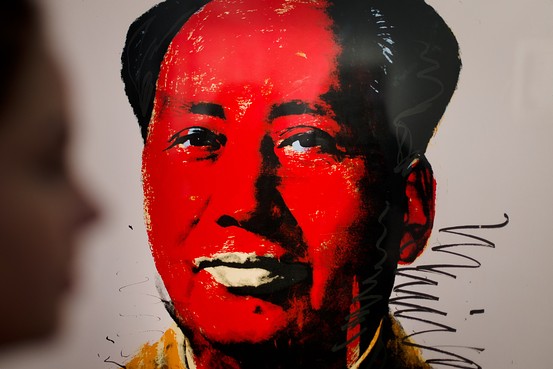
Andy Warhol’s ‘Mao’ pieces are some of his best-known works.

Mao Zedong’s face has long graced trinkets and kitsch sold at tourist markets across China. But in the country’s top art museums, his most famous portrayal by a Westerner isn’t welcome.

Sorry, Andy Warhol.

Although the scion of Pop Art passed away in 1987, Warhol is still generating controversy. A vast traveling retrospective of his work, “Andy Warhol: 15 Minutes Eternal,” has already made stops in Singapore and Hong Kong as part of a two-year Asia tour, but when it moves to mainland China next month, the artist’s Mao paintings won’t be coming along. Read more of this post

The internet remains the “single root” in China today to kick-start a career as a wordsmith. “There are no authors under the age of 35 who were not discovered on the internet”

Chinese online literature

Voices in the wilderness

Mar 24th 2013, 21:28 by C.S.-M. | BEIJING

FOR THE country that invented paper it is no small irony that China’s most innovative writing happens off the page. A number of authors, stifled by state censorship and a conservative publishing industry, are finding freedom online.

In the late 1990s aspiring literati began to share works online. One of these, Li Jie, started to write internet stories for no other reason than to kill time. Bored with her job serving customers in a bank, she signed up under the pen name Anni Baobei. Her depiction of a damaged, disillusioned youth hit a nerve. Aged just 25, to the horror of her parents, Ms Li gave up a secure income to write full time. The gamble paid off. She made the transition to print and is still one of China’s bestselling authors.

Internet writing has been nothing short of a revolution for Chinese literature. It has allowed myriad voices to be heard. The digital landscape and technology have changed since the first wave of authors began to write; readers in China now access novels through smartphones and tablets rather than desktops. Yet the internet remains the “single root” in China today to kick-start a career as a wordsmith, says Jo Lusby, managing director of Penguin China, a publishing house. “There are no authors under the age of 35 who were not discovered on the internet,” she adds. Read more of this post

YY Growth Fueled by Virtual Teddy Bears Lures Tiger Funds; Ni Linlin has made a career out of convincing men to send her virtual teddy bears, necklaces and blue roses

YY Growth Fueled by Virtual Teddy Bears Lures Tiger Funds: Tech

By Lulu Yilun Chen  Mar 25, 2013

Ni Linlin has made a career out of convincing men to send her virtual teddy bears, necklaces and blue roses.

Using a laptop in her 10-square-meter (110-square-foot) room in Qingdao, China, the 25-year-old entertains as many as 2,000 fans a day as a DJ and singer on YY Inc. (YY), a Chinese entertainment website with nearly half a billion users. She earns five times more than two years ago when she quit her job as an office secretary.

Part American Idol, part online hostess club, the platform allows freelance entertainers to charge fans a fee for playing games with them or earn a revenue cut from virtual gifts sold online. Racy jokes and low-slung tops are allowed, nudity is not. Guangzhou-based YY has surged 50 percent since its November listing on the Nasdaq and counts Temasek Holdings Pte. and Tiger Global Management LLC as investors.

“Very often in second- and third-tier cities and rural areas their only places for entertainment are Internet bars,” said Jenny Lee, a partner atMenlo Park, California-based GGV Capital, which has invested $17 million in the startup. Read more of this post

With Market Share Shrinking, Microsoft Bing’s China Dream is in Serious Danger

With Market Share Shrinking, Bing’s China Dream is in Serious Danger

Mar 26, 2013 at 09:00 AM by C. Custer, in BusinessWeb

Microsoft’s Bing search engine has never been a major player in China. The company itself conceded that last fall when it all but abandoned Chinese language search, opting instead to focus on what it then said was the 5 percent of searches in China that use English rather than Chinese. But six months later, it appears Bing’s strategy hasn’t worked. In an interview with Sina Tech, Microsoft VP Shen Xiangyang said that the company’s shrinking China market share — now barely above half of one percent, according to research firm CNZZ — put it in a seriously tough spot:

If you can’t see users’ search questions and choices, if you don’t have enough data to work with, then there is no way to make improvements [to the search engine]. Read more of this post

Chinese E-commerce Giant 360Buy Employees Abusing Power Over Merchants for Bribes, Free Gifts with the promise of helping them build traffic

360Buy Employees Abusing Power Over Merchants for Bribes, Free Gifts

Mar 26, 2013 at 09:30 AM by C. Custer, in E-commerceWeb

China’s e-commerce market may be gigantic and hugely profitable, but it’s also still a little bit like the wild west, as regulators are still trying to figure out the best way to oversee the industry without smothering its growth. That means that even at respectable sites, things sometimes go awry, and that’s exactly what happened at 360Buy recently according to the IT Times, which has the story of a 360Buy employee who extorted thousands of dollars and valuable goods out of merchants with the promise of helping them build traffic. Read more of this post

Apple pursuit lures 20,000 students into high-interest loans with annual interest rates of up to 47%

Apple pursuit lures 20,000 students into high-interest loans

By Xinhua in Wuhan (China Daily), 2013-03-22

More than 20,000 college students have taken high-interest loans to buy fancy electronic products, mostly Apple devices, in Wuhan, the capital of Hubei province.

From the start of January 2012 to the end of February 2013, the students applied for loans with a total value of 160 million yuan ($25.7 million) from Home Credit China (HC China), a subsidiary of international investment business PPF Group.

“We have lost touch with about 100 of them, getting no response to calls or letters reminding them about delayed payments,” said Liu Mingwei, Wuhan regional manager of HC China.

With around 1 million students in Wuhan, it means about one in 50 of them is shouldering HC China’s heavy annual interest rates of up to 47.12 percent on a 12-month-term loan. Read more of this post

Chinese officials earned almost US$5 trillion (30 trillion yuan) reselling land, says economist

Chinese officials earned 30 trillion yuan reselling land, says economist

Monday, 25 March, 2013, 2:49pm

News›China

Agence France-Presse in Beijing

Chinese authorities have earned almost US$5 trillion (HK$38.8 trillion) in profit by selling land obtained from farmers to developers over the years, a top economist said according to state media.

As the country undergoes a huge urbanisation process rural land confiscations have led to numerous protests, worrying the ruling Communist Party, which sees corruption and social unrest as threats to its power.

By law, officials may provide compensation worth up to 30 times the value of the land’s output, but in practice they have skimped on payments or foregone them altogether – then sold the land to developers at much higher rates. Read more of this post

Exclusive: ‘Princeling’ firm holds secret stake in giant fund house Cinda, including a private equity fund co-founded by the grandson of China’s former state head Jiang Zemin

Exclusive: ‘Princeling’ firm holds secret stake in giant fund house Cinda

Tuesday, 26 March, 2013, 12:00am

Business›Companies

George Chen george.chen@scmp.com

As jostling starts over the stock market float of Cinda Asset Management, details have come to light of two previously unknown stakeholders

With the giant state-owned fund house Cinda Asset Management planning to go public in Hong Kong this year, two behind-the-scenes investors in the company, including a private equity fund co-founded by the grandson of China’s former state head Jiang Zemin, have been pushed into the spotlight. Read more of this post

Character is at the heart of global leadership

CHARACTER IS AT THE HEART OF GLOBAL LEADERSHIP

By Professors Stewart Black and Allen Morrison – March 2013

Ironically, most people think that the higher you go, the more authority and control you have.But our research finds that in today’s complex, global environment, the higher you go, the more you get things done because of the goodwill and trust you develop, not because of your formal authority.As one C-suite executive put it to us, “I can make proclamations all day long but the world is just too big.There are too many places to hide.By the time I find out that they are not following through in Russia or wherever, it’s too late.It takes goodwill and trust–it takes personal relationships–to really make things happen on a global scale.

Our research identified two primary aspects of personal character that lead to the trust and goodwill needed to get things done in a global business today.

Emotional connections

Global leaders need to establish personal, empathetic relationships with people from all backgrounds inside their company, and in the broader community. Doing this requires three distinct abilities: sincere interest in other people, a heightened ability to listen, and a strong capacity for understanding different viewpoints. Read more of this post

Analysis: Sitting on too much money, Norway risks going off course

Analysis: Sitting on too much money, Norway risks going off course

Sun, Mar 24 2013

By Balazs Koranyi and Victoria Klesty

OSLO (Reuters) – Middle East-style oil wealth combined with a generous Nordic welfare model is slowly throttling big chunks of Norway’s economy, threatening western Europe’s biggest success story.

On the surface, Norway is the envy of the world: growth is strong, per capita GDP has exceeded $100,000 and the nation sits on a $700 billion rainy day cash reserve, or $140,000 per man, woman and child.

But it may just be too much money as Norwegians, more keen on leisure and family life are working less and less.

Immigration is not filling the gap in the skilled part of the workforce, so productivity is stagnating, wages are surging and firms are pricing themselves out of their own market.

“Oil is a metaphor for winning the lottery,” said Ivar Froeness, a sociology professor at the University of Oslo. “Affluence has slowly crept into society… people just don’t really notice it because it’s been so gradual.”

“These days more people leave Oslo on Thursday afternoon than on Friday, taking long weekends,” he said. “We may take for granted that we have a house and a cabin in the mountain, and maybe another house on the beach.” Read more of this post

Taiwanese-Canadian designer Jason Wu who created fashion for Michelle Obama: From sewing toy clothes to running a $24 million fashion business

From sewing toy clothes to running a $24 million fashion business

First+Lady+Michelle+Obama+Donates+Inaugural+6pRPIWe5ZSQl

New York – For a man who is small in build, Jason Wu certainly has big dreams and he has taken calculated steps to make sure they are being realised.

In the past year alone, the slim, 1.7m-tall Taiwanese-Canadian designer has already collaborated with Brazilian plastic footwear label Melissa to launch a collection (priced from $100 for a pair of sandals); designed a one-off collection for American mass-market retailer Target (prices start from US$129 or S$160 for a blouse); and released his own contemporary diffusion line called Miss Wu (from US$195 for a silk crepe blouse to US$865 for a leather shift dress).

This September, he has announced, he is slated to launch his own make-up range with beauty giant Lancome.

And need we even mention the ruby red inauguration ball gown he created for Michelle Obama?

Having the global spotlight trained on him with that dress since January may mean extra pressure to do more, but he feels otherwise.

“Inauguration or not, there is always pressure to give something better than the last,” says the 30-year-old. “I need to constantly keep moving. You’re only as good as your last project, you know?” Read more of this post

Psy shares the pain of creation; the Korean superstar released a photo of himself apparently struggling to get some writing done, with one hand clutching his forehead

Psy shares the pain of creation
Posted: 25 March 2013 1449 hrs

SEOUL: Millions of people around the world have seen Korean singer Psy dance, thanks to his ultra-popular “Gangnam Style” music video, which currently holds the title of most-watched YouTube video of all time. But what does he look like when he’s working? Fans finally got a peek into Psy’s life away from the glitz and glamour of the stage, when the Korean superstar released a photo of himself apparently struggling to get some writing done, with one hand clutching his forehead, over Twitter on Thursday. Psy even posted the photo under the hashtag #PAINofCREATION. With his new single due to drop in April, it’s no wonder the 35-year-old singer is hard at work. While he has carved a niche for himself in the Korean entertainment industry prior to “Gangnam Style”, it’s still the song that put him on the international music map, and it will be his new single that decides whether he will be able to further develop his music career outside of Korea, when “Gangnam Style” loses its shine.

display_image


Risk Management: History, Definition and Critique

Risk Management: History, Definition and Critique

Georges Dionne HEC Montreal – Department of Finance

March 11, 2013

Abstract: 
La version française de ce document est disponible à http://ssrn.com/abstract=2198583
The study of risk management began after World War II. Risk management has long been associated with the use of market insurance to protect individuals and companies from various losses associated with accidents. Other forms of risk management, alternatives to market insurance, surfaced during the 1950s when market insurance was perceived as very costly and incomplete for protection against pure risk. The use of derivatives as risk management instruments arose during the 1970s, and expanded rapidly during the 1980s, as companies intensified their financial risk management. International risk regulation began in the 1990s, and financial firms developed internal risk management models and capital calculation formulas to hedge against unanticipated risks and reduce regulatory capital. Concomitantly, governance of risk management became essential, integrated risk management was introduced and the first corporate risk officer positions were created. Nonetheless, these regulations, governance rules and risk management methods failed to prevent the financial crisis that began in 2007.

In Strange Company: The Puzzle of Private Investment in State-Controlled Firms

In Strange Company: The Puzzle of Private Investment in State-Controlled Firms

Mariana Pargendler Fundação Getulio Vargas School of Law at São Paulo

Aldo Musacchio Harvard Business School – Business, Government and the International Economy Unit; National Bureau of Economic Research

Sergio G. Lazzarini Insper Institute of Education and Research

February 14, 2013
Harvard Business School BGIE Unit Working Paper No. 13-071 

Abstract: 
A large legal and economic literature describes how state-owned enterprises (SOEs) suffer from a variety of agency and political problems. Less theory and evidence, however, have been generated about the reasons why state-owned enterprises listed in stock markets manage to attract investors to buy their shares (and bonds). In this Article, we examine this apparent puzzle and develop a theory of how legal and extralegal constraints allow mixed enterprises to solve some of these problems. We then use three detailed case studies of state-owned oil companies – Brazil’s Petrobras, Norway’s Statoil, and Mexico’s Pemex – to examine how our theory fares in practice. Overall, we show how mixed enterprises have made progress to solve some of their agency problems, even as government intervention persists as the biggest threat to private minority shareholders in these firms.

Hole in the Wall: A Study of Short Selling and Private Placements

Hole in the Wall: A Study of Short Selling and Private Placements

Henk Berkman University of Auckland – Faculty of Business & Economics

Michael D. McKenzie University of Sydney – Discipline of Finance; University of Cambridge – Cambridge Endowment for Research in Finance (CERF); Financial Research Network (FIRN)

Patrick Verwijmeren Erasmus University Rotterdam (EUR) – Erasmus School of Economics (ESE)

March 23, 2013

Abstract: 
Companies planning a private placement typically gauge the interest of institutional buyers before the offering is publicly announced. Regulators are concerned with this practice, called wall-crossing, as it might invite insider trading, especially when the potential investors are hedge funds. We examine privately placed common stock and convertible offerings and find widespread evidence of pre-announcement short selling. We show that pre-announcement short sellers are able to predict announcement day returns. The effects are especially strong when hedge funds are involved and when the number of buyers is high.

‘Hidden Recommendations’: A Re-Classification of Stock Recommendations

‘Hidden Recommendations’: A Re-Classification of Stock Recommendations

Ronald Espinosa University of California, Berkeley – Accounting Group

December 14, 2012

Abstract: 
Using a large database of analysts’ target prices and recommendations issued over the period 1999-2011, this paper documents the presence of inconsistencies between recommendation and implied return in the sell-side analysts’ target prices, and analyzes its impact on market prices. In particular, it analyzes if these inconsistencies are identified by investors at the announcement and if they are related to incentives to manipulate the recommendations. The paper finds that investors are capable to identify these inconsistent signals among the rest of recommendations. This study also shows that the inconsistencies between recommendation and implied return would be explained by analysts’ incentives to bias the stock recommendation upward (downward), against the direction suggested by the implied return, when the stock presents higher (lower) recent past performance, higher (lower) “glamour” characteristics and higher (lower) brokerage fee potential.

The next billion internet users are not going to be English-speaking, so the next big batch of new domain names will be in Arabic, Chinese or Cyrillic; Australian firm ARI Registry Services is the technology provider for four of the TLDs in the first batch to pass ICANN evaluation

First new top domains Arabic, Chinese

March 25, 2013 – 8:04PM

Trevor Chappell, AAP

The next billion internet users are not going to be English-speaking, so the next big batch of new domain names will be in Arabic, Chinese or Cyrillic.

The global governing body for domain names, the Internet Corporation for Assigned Names and Numbers (ICANN), has completed its evaluation of the first 27 of 1,898 new Top Level Domains (TLDs).

All 27 are in scripts other than Roman script, which is used for the English language.

The new TLDs are expected to join .com, .net and .au on the internet once they get approval from government advisory bodies, the applicants sign the ICANN registry contract, and the TLDs undergo technical testing.

Australian firm ARI Registry Services is the technology provider for four of the TLDs in the first batch to pass ICANN evaluation. Read more of this post

Steve Blank: An Epitaph for Entrepreneurs

March 25, 2013, 12:27 PM

Steve Blank: An Epitaph for Entrepreneurs

STEVE BLANK: Raising our kids and being an entrepreneur wasn’t easy. Being in a startup and having a successful relationship and family was very hard work. But entrepreneurs can be great spouses and parents.

This post is not advice, nor is it recommendation of what you should do. It’s simply what my wife and I did to raise our kids in the middle of starting multiple companies. Our circumstances were unique and your mileage will vary.
Biological Clocks

I met my wife on a blind date and we discovered that not only did we share the same interests, but we were both ready for kids. My wife knew a bit about startups. Out of Stanford Business School she went to work for Apple as an evangelist and then joined a startup of a Mac-database.

Our first daughter was born about four months after I started at my fourth startup. We ended up sleeping in the hospital lounge for five days as she ended up in intensive care. Our second daughter followed 14½ months later.

Family Rules

My wife and I agreed to a few rules upfront and made up the rest as went along. We agreed I was still going to do startups, and she knew what that meant –probably more than most spouses. To her credit, she also understood that meant that child-raising wasn’t going to be a 50/50 split. I simply wasn’t going to be home at 5 p.m. every night.

In hindsight, this list looks pretty organized, but in reality we made it up as we went along, accompanied with all the husband and wife struggles of being married and trying to raise a family in Silicon Valley. Here are the some of the rules that evolved that seemed to work for our family.

We would have a family dinner at home most nights of the week. Regardless of what I was doing I had to be home by 7 p.m. (My kids still remember mom secretly feeding them when they were hungry at 5 p.m., but eating again with dad at 7 p.m.) But we would use dinner time to talk about what they did at school, have family meetings, etc. Read more of this post

Saving Cyprus Means Nobody Safe as Europe Breaks More Taboos

Saving Cyprus Means Nobody Safe as Europe Breaks More Taboos

By Simon Kennedy  Mar 25, 2013

The devil lies in the detail of Cyprus’s salvation.

The island nation’s rescue sets precedents for the euro zone that may stick in the memory of depositors and bondholders alike as investors debate who will next fall victim to the debt crisis. Under the terms of the agreement struck early this morning in Brussels, senior Cypriot bank bond holders will take losses and uninsured depositors will be largely wiped out.

The message that stakeholders of all stripes can be coerced into helping a cash-strapped nation may make investors more skittish they’ll be targeted should SloveniaItaly, Spain or even Greece again be next in line to need help. The risk is that bank runs and bond market selloffs become more likely the moment a country applies for a new rescue, said economists and academics from Nicosia to New York.

“We now have a new type of rule and everyone within the euro zone has to sit down and see what that implies for their own finances,” Nobel laureate Christopher Pissarides, an adviser to the Cypriot government, told “The Pulse” on Bloomberg Television. Read more of this post