Cash Cow: Of the 50 Largest US Companies, Who has the Cash? Who has the Debt? The concept of “sideline cash” as widely believed and highly touted by mainstream media is mathematically impossible

Cash Cow: Of the 50 Largest US Companies, Who has the Cash? Who has the Debt?

Posted: 01 Apr 2013 08:37 AM PDT

Mike “Mish” Shedlock

Here’s the question of the day: How much actual cash is on hand at corporations? Fed by glowing reports from sell-side analysts, most investors are unaware that except for a handful of companies, there is no cash, only debt. Even counting short-term investments there is surprisingly little cash on hand. Courtesy of Mike Klaczynski at Tableau Software please consider the latest update to my periodic “Cash Cow” interactive report.

Cash Read more of this post

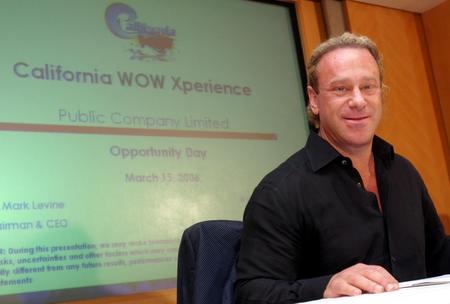
No progress in bankrupt Thai-listed California WOW fitness club case; “The proceedings have been slow and cannot catch up with fraud, deception and swindles of business operators.”

No progress in CAWOW case

Published: 1 Apr 2013 at 11.54

487484

A group of 639 members of the bankrupt California WOW (CAWOW) health club gathered on Sunday to decide on their next move, complaining that authorities have made no progress in helping settle their grievances. Read more of this post

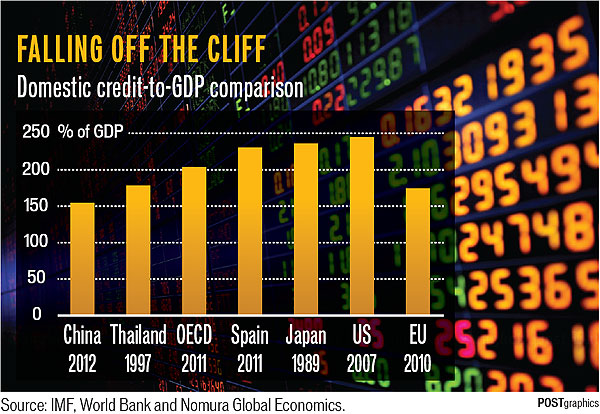
Cracks appear in China; Triple threat of high leverage, slow economic growth and soaring property prices could spell trouble for world’s second biggest economy; In short, investors should not allow the size of China’s balance sheet to blind them to concerns over the underlying structural risks, given that no economy is too big to fail.

Cracks appear in China

Triple threat of high leverage, slow economic growth and soaring property prices could spell trouble for world’s second biggest economy, some analysts warn.

Published: 1 Apr 2013 at 11.17

487464

Over the past three decades, China has undergone the greatest economic boom in world history, but now it faces a major challenge to sustain its rise. As the European crisis drags on and the US recovery remains slow, a new leadership team in China is struggling to arrest slowing growth.

Opinions vary about whether the world’s second largest economy can achieve a soft landing, or whether it faces a hard landing or even a financial crisis. In any case, some economists have warned that the remaining years of annual economic growth in the high single digits can now be counted on the fingers of one hand.

According to two economists from Nomura, the same three warning signs that preceded severe downturns in Japan, the United States and parts of Europe are now flashing over China. As a result, the government has limited time to contain the growing risks and keep the country out of trouble.

“Those signs include a rapid buildup of leverage, a decline in potential economic growth and skyrocketing property prices. The government needs to take urgent action to contain such risks,” wrote Nomura economists Zhiwei Zhang and Wendy Chen.

“We believe the true extent of financial risks in China is not fully appreciated by investors but tightening its monetary policy will be the way to avoid the crisis.” Read more of this post

China has become one of the largest producers of bibles in the world; Unofficial headcounts say that China has more Christians than members of the Communist Party (about 82m people)

Exporting bibles

In the beginning was the ideogram

China has become one of the largest producers of bibles in the world

Mar 30th 2013 | NANJING |From the print edition

LU GENGSHENG remembers growing up in rural Anhui province in the 1980s, where his father was pastor of a house church, an illegal congregation that refused to join with official churches it believed to be stooges of the Communist Party. His family owned the area’s only bible, and other believers would bring notebooks to copy passages of scripture to take home.

Today, Christians make up 5% of the population, some 67m people, according to the Pew Research Center, a think-tank. Unofficial headcounts say that China has more Christians than members of the Communist Party (about 82m people). Read more of this post

‘Airpocalypse’ drives expats out of Beijing

April 1, 2013 3:53 pm

‘Airpocalypse’ drives expats out of Beijing

By Jamil Anderlini in Beijing

Air pollution is driving expatriates out of Beijing and making it harder for companies to recruit international talent, according to anecdotal accounts from diplomats, senior executives and businesses.

No official figures are available on how many people are planning to leave after three months of the worst air pollution on record in the Chinese capital. But companies that mainly serve foreign residents are bracing for an exodus around the middle of the year when the school term ends.

“We’re anticipating this summer will be a very big season [of moves out of Beijing] for us,” said Chad Forrest, North China general manager for Santa Fe Relocations, a global service. “It seems a lot of people, particularly families with small children who have been here a few years, are reconsidering the cost-benefit equation and deciding to leave for health reasons.”

Doctors at private hospitals that mostly treat expat patients tell a similar story. Read more of this post

Hong Kong Businesses Vanish as Rents Soar: Real Estate

Hong Kong Businesses Vanish as Rents Soar: Real Estate

Over the past decade, car-repair shop owner Benny Chan has seen more than 70 percent of his small-business peers disappear as his Hong Kong neighborhood fills up with high-end Western bars and Japanese restaurants.

“Rents here are going up multiple times,” said Chan, who’s been in business since 1985 in the Tai Hang area, just east of the ritzy Causeway Bay shopping district. “We’ll all be out of here in the next four to five years.”

Rents are climbing in neighborhoods near Causeway Bay and Hong Kong’s other prime shopping districts, known for luxury stores that attract free-spending tourists from mainland China. That’s squeezing out mom-and-pop shops, congee and noodle vendors and other small businesses like Chan’s as developers and landlords seek to profit from the trend. Read more of this post

Five-Car Families Seen Deterring Thai Rate Cuts: Southeast Asia

Five-Car Families Seen Deterring Thai Rate Cuts: Southeast Asia

Chitwalai Srisaengchai bought a car last year to take advantage of a Thai tax rebate and now spends 70 percent of her salary on the loan. She’s also giving the central bank another reason to resist monetary easing.

Prime Minister Yingluck Shinawatra’s stimulus measures have stoked spending and contributed to rising household debt, prompting the Bank of Thailand to say it will monitor “persistently high” credit growth. About 1.25 million Thais have taken up the car-buying incentive the government introduced to boost domestic consumption after the 2011 floods, helping drive local car sales to a record last year.

“It was a very tempting offer,” said Chitwalai, a 27- year-old English teacher in Bangkok who will receive a 100,000- baht ($3,400) rebate on a black Mazda 2 sedan she bought for 705,000 baht, adding to her family’s four cars. “Something like this may not happen ever again, so I had to do it.”

Chitwalai’s purchase highlights why Thailand’s central bank may resist government pressure to cut interest rates tomorrow as Yingluck seeks to sustain growth. Lower borrowing costs may spur demand for personal loans that jumped 22 percent in 2012, the biggest increase in seven years, adding debt risks that threaten to heighten the economy’s vulnerability to a slowdown. Read more of this post

Are Floating Pigs Behind China’s Avian Flu? The immediate cause of floating pigs appears to be a government crackdown on the well-established, highly lucrative and totally disgusting underground trade in dead and diseased pigs for human consumption

Are Floating Pigs Behind China’s Avian Flu?

News that a new form of deadly bird flu recently killed two Shanghai residents arrived in the morning’s papers, along with some expert suggestions on how to avoid catching the unwelcome disease.

“Wash your hands, and cover your nose and mouth when coughing or sneezing,” was the advice published in the Oriental Morning Post, Shanghai’s most popular newspaper (and repeated in others). “And avoid eating or contact with dead and diseased livestock.”

That last directive might be a little tricky to fulfill. Since early March, Shanghai’s waterways have been clogged by dead pigs — officially at least 11,000 of them but likely a lot more. Many of those pigs have found their way into tributaries that feed directly into the municipal water supply. Thus, in theory, every Shanghai resident who comes into contact with the city’s water is potentially compromised.

Or are they? So far, at least, nobody from any level of government — local to national — has revealed what, precisely, may have caused a massive pork die-off so close to the city of Shanghai. Was it a virus? Or perhaps a play for livestock insurance? Both rumors (and others) have been floated in Chinese social and traditional media, but without official confirmation.

The reason for the mass water burial, however, is a different matter. According to numerous reports in Chinese and foreign media (though also without government confirmation), the immediate cause appears to be a government crackdown on the well-established, highly lucrative and totally disgusting underground trade in dead and diseased pigs for human consumption. Read more of this post

Vanguard’s founder JACK BOGLE WARNS: Prepare For Two Massive 50% Market Declines In The Next Decade

JACK BOGLE WARNS: Prepare For Two Massive Market Declines In The Next Decade

Matthew Boesler | Apr. 1, 2013, 5:38 PM | 5,977 | 17

Jack Bogle is the founder and chairman of mutual-fund giant Vanguard Group and is widely credited for popularizing index funds, a staple for buy-and-hold investors. Today, he was on CNBC, and he had a bit of a startling prediction. CNBC anchor Scott Wapner put the question to Bogle: You say, ‘prepare for at least two declines of 25-30 percent, maybe even 50 percent, in the coming decade.’ For a buy-and-hold guy, that’s a little concerning, don’t you think?”

Bogle replied: 

Not at all. They come and go. The market goes up, and the market goes down. It’s never failed to recover from one of those 50 percent declines. I went through one in 1973-1974, I went through one in 2001, 2002, 2003; I went through another one 2008-2009. They’re kind of scary – often terrifying – but it’s typical. Why it doesn’t bother me is if you hang on through the cycle, that’s the only way to invest. Trying to guess when it’s going to go way up or way down is simply not a productive way to put your money to work. Bogle’s comments don’t represent any sort of shift in his philosophy – he remains as big a proponent of buy-and-hold investing as ever. Of course, if Bogle is right about two 50-percent declines in the next decade, it’s going to be a trying experience for the buy-and-hold crowd.

Exuberant “Reach For Yield” In Spain Leaves Retail With Up To 96% Losses; All they saw were fail-safe investments with high returns. Clients infamously included Alzheimer’s sufferers and at least one customer who signed by dipping a finger in ink

Exuberant “Reach For Yield” In Spain Leaves Retail With Up To 96% Losses

Tyler Durden on 04/01/2013 11:46 -0400

The ‘relative’ innocence of the depositors in Cyprus who saw their savings crushed by the hammer-blow of Germany’s reality last week is, it seems, not the only hardship that the European people are suffering. In Spain, thanks to their FROB restructuring, shareholders and bondholders (includinghundreds of thousands of unsophisticated ‘retail’ investors who were sold ‘fail-safe’ and ‘high-return’ investments) face losses (haircuts) from 96% (equity) to 36% (subordinated debt) and 61% (preference shares) following the ‘bailout’ of Spain’s dodgiest cajas (or savings banks).

As The Economist notesclients infamously included Alzheimer’s sufferers and at least one customer who signed by dipping a finger in ink; shareholders should know the risks but the vast number of Spaniards who bought preference shares and complex subordinated debt from their cajas often did not. For example, a Madrid court is investigating whether Bankia misled investors: many of the 350,000 retail customers who bought Bankia shares in its €3.1 billion flotation in 2011 have already seen their money go up in smoke. Read more of this post

A publication designed to be an authoritative guide to financial planning hit bookstore shelves Monday; Kevin Keller, CFP Board president and chief executive, drew a parallel between the book and medical volumes that describe diseases and treatments for doctors and consumers; “I like to think of this as the Merck Manual of financial planning.”

CFP Board publishes ‘Merck manual’ of planning

735-page book targeted at students, profs and practitioners

By Mark Schoeff Jr.   |  April 1, 2013 – 4:28 pm EST

A publication designed to be an authoritative guide to financial planning hit bookstore shelves Monday.

The 735-page “Financial Planning Competency Handbook” is the first book published by the Certified Financial Planner Board of Standards Inc. Written for college students and professors, as well as financial planners, the book is the CFP Board’s attempt to build an academic foundation for financial planning and define the field’s body of knowledge.

Kevin Keller, CFP Board president and chief executive, drew a parallel between the book and medical volumes that describe diseases and treatments for doctors and consumers.

“We think it is a seminal work for the financial planning profession,” Mr. Keller said. “I like to think of this as the Merck Manual of financial planning.” Read more of this post

Save the Companion: Why Technological Leaders Share the Research Output with Competitors

Save the Companion: Why Technological Leaders Share the Research Output with Competitors

Yuri Jo KAIST Business School

Chang-Yang Lee Korea Advanced Institute of Science & Technology (KAIST)

March 1, 2013
KAIST Business School Working Paper Series No. 2013-005 

Abstract: 
This paper investigates the reasons why technological leaders voluntarily share their research outputs with competitors, especially those with lower research capability. Building a two-stage analytical model, we show that technological leaders have incentives to create cooperative knowledge partnership in order to induce competitors to commit more efforts to R&D. With weak knowledge spillovers, firms with low research capability are discouraged from doing R&D because they lack research capability to compete for innovation. Under some conditions, those discouraged competitors harm leading firms’ profitability because the leaders produce most knowledge for the industry. Hence, the leading firms have incentives to share their R&D outputs to encourage competitors to contribute more to the knowledge pool in the industry, which is beneficial to both of them. The leader’s incentive increases as unintended knowledge leakage is in low level, the leader’s research capability is moderate and capability gap between firms is small. Interestingly, a high level of capability gap also makes it possible for firms to form knowledge partnership if the lagging competitor is far inefficient. We found supportive empirical evidence for our model. Competing firms are more likely to cooperate in R&D as the level of unintended knowledge spillovers is lower and the asymmetry in their R&D productivities is larger. Our study sheds new light on firm cooperative behavior by providing theoretical foundation for knowledge partnering among asymmetric competitors.

Can Institutional Investors Cherry-Pick Hot IPOs?

Can Institutional Investors Cherry-Pick Hot IPOs?

Ufuk Gucbilmez University of Edinburgh – Business School

March 20, 2013

Abstract: 
Using a unique set of bookbuilding data, we provide comprehensive tests of Rock’s (1986) theory of IPO underpricing. In particular, we examine whether uninformed and informed investors coexist in the IPO market. We find that alongside uninformed institutional investors who regularly participate in the IPO market, there exist informed ones who can avoid cold issues and cherry-pick the hot ones to appropriate higher average initial returns. Finally, the results tie together competing explanations of positive IPO initial returns based on the winner’s curse and the investor sentiment.

Frank Sherman’s Horizon Coach Lines is one of the largest privately owned of its kind in North America. “You have to know how to handle 5,000 people an hour”; “We are changing the culture of Horizon from the ground up”; “We kept it asset-light”

Value Added: His bus business moves big crowds for big profits

By Thomas Heath, Monday, April 1, 6:05 AM

ValueAdded0401voisard081364673307

Frank Sherman runs his sprawling, Sandy Spring-based special-events bus business — with its 1,250 coaches and shuttles — with military precision.

He has to when dealing with the hordes who need to board his buses at events such as technology exhibitions, Republican conventions and Major League Baseball All-Star games.

If the buses aren’t present and the line doesn’t move, people lose faith. A docile crowd can turn unruly, ruining his reputation in an afternoon.

“You have to know how to handle 5,000 people an hour,” said the 52-year-old businessman, who has been riding the bus business since he was a kid, helping his father’s tour service whisk customers to weekend trips in New York and New England. Read more of this post

In China, anger grows over abuse of street vendors; “They are no different than bandits”, the fruit vendor whose detention along with her 2-year-old daughter this month sparked much outrage

In China, anger grows over abuse of street vendors

By William Wan, Monday, April 1, 3:38 AM

2013020713626168786591965605463

BEIJING — In a country infamous for heavy-handed officials, the government employees who harass and sometimes beat and extort money from street vendors are among the most despised.

Their official name is “chengguan,” which means city management, but the word has become slang for someone who uses excessive force to solve life’s problems.

In recent weeks, anger against the officials has reached a fever pitch as several cases of apparent abuse have been widely reported in Chinese microblogs, sparking a flood of online comments.

In a video posted online last week, witnesses say chengguan officers beat up a blind man, shown sitting in a pool of water, then took his cane, his begging cup and the change inside.

In another recent case, photos posted online show a swarm of officers roughing up and handcuffing a fruit vendor as her 2-year-old daughter cries inconsolably in the background. Read more of this post

The U.S. economy is in a bubble inflated by “phony money” from the Federal Reserve and will burst within a few years, warned David Stockman, who was budget director for President Ronald Reagan

Stockman Warns of Crash Of Fed-Fueled Bubble Economy

The U.S. economy is in a bubble inflated by “phony money” from the Federal Reserve and will burst within a few years, warned David Stockman, who was budget director for President Ronald Reagan.

In an essay published yesterday in the New York Times (NYT), Stockman wrote that the Fed’s quantitative easing policies in the aftermath of the credit crisis have flooded stock markets with cash even while the “Main Street economy” remains weak. The combination, he wrote, is “unsustainable.”

“When it bursts, there will be no new round of bailouts like the ones the banks got in 2008,” wrote Stockman, a former senior managing director at Blackstone Group LP (BX) and a former Republican congressman from Michigan. “Instead, America will descend into an era of zero-sum austerity and virulent political conflict, extinguishing even today’s feeble remnants of economic growth.”

Stockman, 66, is the author of “The Great Deformation: The Corruption of Capitalism in America,” which will be published April 2. Read more of this post

Softbank-Backed Startup SmarTots Builds Facebook for Kids

Softbank-Backed Startup SmarTots Builds Facebook for Kids

A former Nokia Oyj (NOK1V) engineer is building a private social network in China where children share art projects online with parents or grandparents. Japan’s phone and Internet giant Softbank Corp. (9984) is betting he’ll succeed.

SmarTots, Jesper Lodahl’s Beijing-based startup, began offering mobile education applications for kids from two to seven through Apple Inc. (AAPL)’s China iTunes store in June. Designed as a game center for app developers, this month it’s adding functions to allow parents to “like” or comment on projects in a layout similar to Facebook Inc. (FB)’s site, Lodahl said.

Softbank, which provided funding, and Lodahl expect growth in smartphones and tablets to drive demand for educational services. Parents’ desire to set children apart from peers is likely to drive strong demand for any service in China that can offer an edge, said Duncan Clark, Beijing-based chairman of BDA China, which advises technology companies.

“People will pay a lot for their kid’s educations,” said Clark, who doesn’t work with SmarTots. “There is a lot of spending power around educational betterment.” Read more of this post

Indonesia’s Yudhoyono Party Stumbles as Corruption Charges Undermine Support

Yudhoyono Party Stumbles as Corruption Charges Undermine Support

Indonesia’s ruling Democrat Party chose the country’s president, Susilo Bambang Yudhoyono, as chairman ahead of national elections next year amid jockeying among possible replacements that could stall spending on roads and ports. Yudhoyono was elected March 30 at an extraordinary congress in Bali to succeed Anas Urbaningrum, who resigned after becoming at least the third senior party official linked to corruption allegations in less than two years. Read more of this post

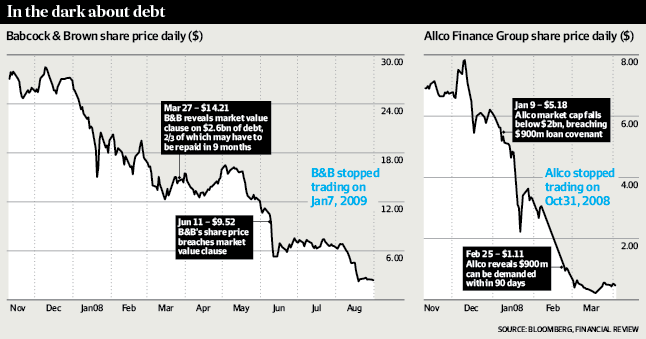
Keeping debt a dirty secret from investors

Keeping debt a dirty secret from investors

PUBLISHED: 28 MAR 2013 00:33:00 | UPDATED: 29 MAR 2013 00:31:10

CHRISTOPHER JOYE, The Australian Financial Review

4b98a466-969b-11e2-b272-865705c1a5bf_28p33joye

Ask yourself this question: is the amount of debt a company assumes, the rate of interest it pays, the events of default, the repayment date and all non-standard conditions (or “covenants”) vital to working out the value of that company’s equity? Any half-witted analyst or investor will emphatically answer “yes”.

Yet when I ask Damian Reichel, a partner at law firm Johnson, Winter & Slattery whether it is standard practice for companies listed on the Australian Stock Exchange to disclose all the terms and conditions of their debt arrangements, he responds: “No, it’s not standard at all. It is, however, normal to disclose the amount of debt outstanding in the company’s accounts and maturity dates so that people know when facilities expire.”

This is a problem that weighs heavily on the minds of sophisticated investors, analysts and even some regulators. While market convention is to disclose little information about a company’s leverage, it is vital to determining its equity value, even if lay retail investors tend to ignore it.

If a company’s capital structure is comprised of debt and equity, it is impossible to price one in isolation from the other. Debt directly subordinates equity in two ways: first, it has a prior-ranking entitlement to the company’s earnings for interest repayments; second, debt ranks ahead of equity if the business is wound up.

The introduction of debt into a capital structure exposes shareholders to new risks. And individuals and companies default on their obligations all the time. When they do, the lender has the right to force asset sales at prices often far below fair value, which inflicts losses on those standing last in the queue – shareholders. Read more of this post

James Altucher: The Only Good Idea is an Unoriginal Idea; “The Last Supper was totally unoriginal. Leonardo was a plagiarist”

The Only Good Idea is an Unoriginal Idea

Posted by James Altucher on March 31st, 2013 at 12:50 pm

ART161812

Here’s a painting from the 13th century: Ugh. BORING!

Giampietrino-Last-Supper-ca-1520 Read more of this post

What Are Foundations For?

What Are Foundations For?

Rob Reich

This article leads off our debate on philanthropy, with responses from Stanley Katz, Diane Ravitch, Larry Kramer, and others.

Graham Smith

Judge Richard Posner, one of the foremost American jurists outside the Supreme Court, once observed, “A perpetual charitable foundation . . . is a completely irresponsible institution, answerable to nobody. It competes neither in capital markets nor in product markets . . . and, unlike a hereditary monarch whom such a foundation otherwise resembles, it is subject to no political controls either.” Why, he wondered, don’t we think of these foundations as “total scandals”? If foundations are total scandals, then we have a massive problem on our hands. We are now living through the second golden age of American philanthropy. What Andrew Carnegie and John D. Rockefeller were to the early twentieth century, Bill Gates and Warren Buffett are to the early twenty-first century. Read more of this post

High-Tech Means of Production Belies the Nostalgic Image of Maple Syrup; Gathering sap to boil into maple syrup, long a tradition in places like Vermont, has become a more high-tech process, with miles of plastic tubing and powerful vacuums that draw the sap out of the trees using reverse osmosis machines

March 30, 2013

High-Tech Means of Production Belies the Nostalgic Image of Maple Syrup

By JULIA SCOTT

SYRUP-1-articleLarge

Gathering sap to boil into maple syrup, long a tradition in places like Vermont, has become a more high-tech process, with miles of plastic tubing and powerful vacuums that draw the sap out of the trees.

EAST MONTPELIER, Vt. — The rich, sweet tang of sap being boiled into maple syrup greeted tourists at Burr Morse’s sugar shack here this month — along with Mr. Morse, every inch the rural maple farmer in worn baseball cap and syrup-stained jacket, stirring the steaming evaporator with an old-fashioned dipper.

“People want to have a nostalgia trip,” said Mr. Morse, 65, a seventh-generation maple syrup farmer and the patriarch of Morse Farm Maple Sugarworks. “They want to see something natural, like taking sap from a tree.”

Forty years ago, Mr. Morse would snowshoe into the forest with his father to collect sap from galvanized buckets and load them onto a tractor. The farm has not changed much since then, but the winters have. So has the maple syrup ritual itself.

Scientists say the tapping season — the narrow window of freezing nights and daytime temperatures over 40 degrees needed to convert starch to sugar and get sap flowing — is on average five days shorter than it was 50 years ago. But technology developed over the past decade and improved in recent years offers maple farmers like Mr. Morse a way to offset the effects of climate change with high-tech tactics that are far from natural.

Today, five miles of pressurized blue tubing spider webs down the hillside at Morse Farm, pulling sap from thousands of trees and spitting it into tubs like an immense, inverse IV machine. Modern vacuum pumps are powerful enough to suck the air out of a stainless steel dairy tank and implode it, and they help producers pull in twice as much sap as before.

“You can make it run when nature wouldn’t have it run,” Mr. Morse said. His greatest secret weapon is a reverse-osmosis machine that concentrates the sap by pulling it through sensitive membranes, greatly increasing the sugar content before it even hits the boiler. The $8,000 instrument with buttons and dials looks like it belongs in a Jetsons-era laboratory more than in a Vermont sugarhouse. But it saves more fuel and money than every other innovation combined. With it Mr. Morse can process sap into syrup in 30 minutes, something that used to take two hours. Read more of this post

How to Be a Successful Luxury Brand; If You’ve Got a Story, Tell It

HOW TO BE A SUCCESSFUL LUXURY BRAND

ARTICLE | 26 MARCH, 2013 10:10 AM | BY JEREMY HAZLEHURST

The spread of luxury is the story of the early 21st century. Take this fact: Louis Vuitton, which started life as a trunk-making business in Paris in 1854, will soon open a swanky new store in Kazakhstan. This follows the opening of a massive new store in Shanghai, right at the heart of what was once a hardline Communist state. Luxury goods are the quintessentially modern products, charting the spread of wealth and aspiration to the most unlikely places. Campden looks at five things that luxury brands have to do if they are to flourish in this strange new world.

1: IF YOU’VE GOT A STORY, TELL IT
Human beings love stories, so brands that have good tales are wise to use them as much as possible. “Naturally, it is easier to sell your story if it starts with depuis 1833” says Anastasia Kourovskai of Millward Brown, a brand research agency. “Such brands as Chanel, Dior and Yves St Laurent have real stories behind the brand,” she says. Other newer ones, however, have created their brand stories.

Look at Tiffany’s, whose name is forever linked to Audrey Hepburn’s classic chic through the film Breakfast at Tiffany’s. Or Ralph Lauren, founded by a chap named Ralph Lifshitz from The Bronx, the son of immigrants from Belarus, but which has brilliantly used advertising and store design to link the brand with the WASPish pursuit of polo.

Mark Henderson, chairman of Savile Row tailor Gieves & Hawkes (founded in 1771) agrees that the stories matter. “I think that is why tradition and family heritage are such an important part of the brand,” he says. Read more of this post

Time is ripe for smartwatches; 2013 may be the year for the smartwatch because “the components have gotten small enough and cheap enough” and a large number of consumers now have smartphones that can connect to a wearable device

Time is ripe for smartwatches, analysts say

2013-03-31 07:44:30 GMT2013-03-31 15:44:30(Beijing Time)  SINA.com

Amid much speculation on the future of the “smartwatch,” the consensus is growing: the time is right.

In recent weeks, reports have surfaced about plans for smartwatches from tech giants Apple, Samsung and Google, with launches possible later this year.

“I think we have reached a tipping point,” said Avi Greengart, analyst on consumer devices at the research firm Current Analysis.

Greengart said 2013 may be the year for the smartwatch because “the components have gotten small enough and cheap enough” and a large number of consumers now have smartphones that can connect to a wearable device.

The idea of the connected watch has been around for at least a decade: Microsoft had one in 2003. And some devices are already on the market including from Sony, the crowdfunded maker Pebble and Italian-based firm i’m. Read more of this post

Insight: China’s losing battle against state-backed polluters

Insight: China’s losing battle against state-backed polluters

1:41am EDT

By David Stanway

SHANGHANG COUNTY, China (Reuters) – When Zijin Mining Group threatened to move its headquarters some 270 kms from its home county of Shanghang to Xiamen on China’s southeast coast, a local Communist Party boss rushed to confront the company’s chairman Chen Jinghe.

“If you want to move, you’ll have to move the Zijin Mountain to Xiamen as well,” the official told Chen, referring to a vast local mine that has helped transform the firm into China’s top gold producer and second-biggest copper miner. The exchange, recited with some pride by local residents, reflects the anxieties felt by regional governments as they consider the prospect of losing their biggest cash-cows. It also highlights the challenges facing Beijing as it tries to take on entrenched local bureaucracies and the powerful state-owned polluters they sponsor and protect, with the central government desperate to address decades of chronic environmental damage and force growth-addicted provinces to raise standards. Read more of this post

Angang Steel gets bourse warning following losses; China’s largest shipping conglomerate COSCO suspended after loss of 9.56b yuan; Three years of deficits could see the shipping firm removed from market

Angang gets bourse warning following losses

Updated: 2013-03-29 11:22

By Wang Ying in Shanghai ( China Daily) Read more of this post

Facilitating Successful Failures; Approximately 80,000 businesses fail each year in the United States

Facilitating Successful Failures

Michelle M. Harner University of Maryland Francis King Carey School of Law

Jamie Marincic Mathematica Policy Research, Inc.

2013
Florida Law Review, Vol. 65, 2013
U of Maryland Legal Studies Research Paper No. 2013-14 

Abstract: 
Approximately 80,000 businesses fail each year in the United States. This article presents an original empirical study of over 400 business restructuring professionals focused on a critical, arguably contributing factor to these failures – the conduct of boards of directors and management. Anecdotal evidence suggests that management of distressed companies often bury their heads in the sand until it is too late to remedy the companies’ problems, a phenomenon commonly called “ostrich syndrome.” The data confirm this behavior, show a prevalent use of loss framing, and suggest trends consistent with prospect theory. The article draws on these data and behavioral economics to examine the genesis and contours of this problem. It then discusses potential changes to applicable law and introduces a new “meet and confer” process for encouraging timely restructuring negotiations. The meet and confer process is designed to promote meaningful changes in management conduct and to facilitate more “successful failures.” Policymakers should adopt regulations fostering that mentality, rather than rewarding fear or ignorance in the face of failure.

Guangdong Publicly Says It Has “huge” Hidden Debts in Pension Fund; About half of China’s 31 provinces are unable to pay their retiree costs and rely instead on financial transfer from the central government

Guangdong Publicly Says It Has “huge” Hidden Debts in Pension Fund

03-29 15:15 Caijing

It says debts were cumulated for one critical reason: a large number of retirees who were entitled to a pension without contributions when China first launches its pension system.

The government of Guangdong has expressed concerns about its pension liabilities, saying the provincial government’s pension fund is running up “huge” hidden debts, opening a peephole into the patchy pension system in the world’s second-biggest economy. The government will seek to solve the many problems in the pension fund by raising financial subsidies and exploring ways to invest the money, government officials said in an official report on Thursday. About half of China’s 31 provinces are unable to pay their retiree costs and rely instead on financial transfer from the central government. Pension shortfalls could reach 18.3 trillion yuan in 2013, and 68.2 trillion by 2033, according to a recent report by economists at Deutsche Bank and the Bank of China. What makes things even worse is that China is facing a timebomb of aging population, with a sharp rise in those over age 65, the proportion of which stands at 8.2 percent now, and is expected to rise to 30 percent by 2064. The government report of Guangdong, a southern province topping total GDP rankings in among all provinces, did not reveal the amount of its deficit and reasons making the debts non-explicit. It says debts were cumulated for one critical reason: a large number of retirees who were entitled to a pension without contributions when China first launches its pension system. Without financial transfer from governments, the retirees are actually supported by young Chinese employees, it said. Pension revenue was close 250 billion yuan in Guangdong in 2012, compared with an expenditure of just below 150 billion. China’s pension system was designed as a combination of an inclusive welfare system supported by state subsidies and individual mandatory savings by both employees and employers whose contributions vary in regions. Budget expenditures in social network totaled 98.24 billion yuan in Guangdong in 2011, the report shows, tripling those in 2006. Its portion to general budget also hiked to 14.64 percent in 2011 from 12.53 percent five years ago. The government entrusted the country’s national security fund to “invest and manage” its pension fundin early 2012, as an alternative to state fiscal support to “retain and grow” value, the first and the single case in the country as local governments are loath to hand over their cash. Government officials did not disclose income of the investment in the report, but pledged the government will ensure the money is safe in following up management.

‘Medieval style’ in modern exams; Take, for example, the Cantonese word for accounting. It sounds like wui kai in everyday Cantonese. But, in the exam, it should be pronounced as kui kai

‘Medieval style’ in modern exams

Mary Ma

Thursday, March 28, 2013

The shift from the conventional secondary education to the new “3-3-4” system is supposed to keep our education system up to date. Understandably, there were bound to be hiccups in the transition, such as the confusion over liberal studies. Though liberal studies is designated as a compulsory subject alongside Chinese language, English and mathematics, a complaint that is most frequently heard is that it is a “subject at large” without a clear scope.

But that shortcoming is being overcome.

However, when it comes to Chinese, some so-called “mistakes” are laughable. Read more of this post

If a Fund Turns on a Dime, Watch Your Dollars; The demise of the Willow Fund offers two lessons in investment risk

March 30, 2013

If a Fund Turns on a Dime, Watch Your Dollars

By GRETCHEN MORGENSON

LAST October, shareholders in the Willow Fund, a closed-end investment fund sponsored and sold by UBS, received some disturbing news: the fund, which had assets of almost $500 million in 2006, was being liquidated.

With a portfolio that specialized in distressed debt instruments, the Willow Fund had suffered losses of almost 80 percent in the first three quarters of 2012 after its longtime manager switched gears: he had abandoned the corporate debt markets he was familiar with and piled into some colossally bad derivatives trades. The investors, some of whom hadn’t realized they were holding a portfolio filled with risky bets against the debt of European nations, were stunned.

What happened to the Willow Fund is a cautionary tale for any investor who entrusts his or her money to an investment fund. Its demise highlights the dangers when a portfolio manager makes a big change in investment strategy. It also raises questions about how assiduously this fund’s independent directors watched over the manager as he ramped up his portfolio’s risk levels. Both are problems that investors cannot be complacent about. Read more of this post