Power Grab Trumps Nanotechnology in Putin’s Russia

Power Grab Trumps Nanotechnology in Putin’s Russia

Russian President Vladimir Putin’s changing attitude toward two giant government-led high-tech projects sends a troubling message about his third term in office: Maintaining power is more important than modernizing the economy.

The projects, known as Rusnano and Skolkovo, were meant to propel Russia’s raw-material economy into the technology age. They involved multibillion-dollar government investments, the first in nanotechnology and the second in a new city that would become Russia’s answer to Silicon Valley. They were supposed to provide the infrastructure and stability required to attract large amounts of foreign investment.

Now, both have become targets in Putin’s campaign to demonstrate that he’s being tough on corruption and mismanagement of government funds. As a result, their chances of succeeding are looking increasingly remote. Read more of this post

China Small-Cap Bubble Seen Bursting by Chen After 43% Advance

China Small-Cap Bubble Seen Bursting by Chen After 43% Advance

Chen Li, the UBS AG (UBSN) strategist who predicted the tumble in China’s smallest shares two years ago, says the companies are poised to retreat again after valuations rose to the biggest premium over larger stocks since 2010. The ChiNext index of Shenzhen-listed companies with a median market value of $765 million has climbed 43 percent this year while the CSI 300 Index, which has a median capitalization of $3.5 billion, rose 2.7 percent. The smaller-company gauge trades for 4.6 times net assets versus 1.7 for the CSI index, the widest gap since June 2010, data compiled by Bloomberg show. Small-cap stocks have surged on speculation President Xi Jinping’s plan to boost the consumer, technology and alternative energy industries will benefit companies from Huayi Brothers Media Corp. (300027) to Leshi Internet Information & Technology Co. (300104) The rally may get derailed by tighter monetary policy, which helped spur the last slump, according to Chen.

“The bubble may burst” within two months, Chen said in a May 9 phone interview. The Shanghai-based strategist predicted in January 2011 that small-cap stocks would drop as much as 20 percent. The ChiNext gauge fell 21 percent in nine months. Investors will rotate out of smaller companies and into larger stocks as liquidity tightens, Chen said.

Read more of this post

Japan Biotech Ventures Surge as Abenomics Cash Spurs Speculation

Japan Biotech Ventures Surge as Abenomics Cash Spurs Speculation

Japanese biotech ventures promising to make jet fuel from algae and to produce synthetic cartilage are soaring in Tokyo trading as cash pumped into the economy by the central bank cascades into speculative investments.

Five of the 10 best-performing stocks this year traded on JASDAQ, which has lower minimum profit requirements than Japan’s main bourse, are biotech firms.

The companies have surged as the Bank of Japan last month voted to double debt-buying to more than 7 trillion yen ($68 billion) a month to achieve 2 percent inflation in two years. Prime Minister Shinzo Abe’s proposal this month to provide 110 billion yen in support to stem cell research over the next 10 years is also helping the shares.

“The market expects quantitative and qualitative easing to continue long term, boosting liquidity and drawing investors to speculative shares like biotech,” said Kazuyuki Terao, chief investment officer at Allianz Global Investors Japan, in an interview. “Abe raised health-care reform as a part of his growth plan and that’s also supporting the buy.”

Japan’s regenerative medicine market will probably increase by 62 times to 1.6 trillion yen by 2030 from 26 billion yen in 2012, the economy ministry estimates. Read more of this post

Oil prices are likely to fall over the next few years, the chief executive of Eni, one of Europe’s largest energy companies has said, suggesting a tough time ahead for oil producers

May 19, 2013 7:16 pm

Tough oil pricing ahead, says Eni chief

By Ed Crooks

Paolo Scaroni: ‘Where we can add most value is in countries that are complex and not easy to work in’

Oil prices are likely to fall over the next few years, the chief executive of one of Europe’s largest energy companies has said, suggesting a tough time ahead for oil producers.

Paolo Scaroni, chief executive of Eni, the Italian oil and gas group, said that unless there was another boom in the world economy, sluggish demand and new supply coming on to the market meant the price of crude was “more likely to go down than up” over the next two to five years. However, he suggested his company could survive at much lower prices, and identified Asia as the main target in its plans for future growth.

Mr Scaroni’s expectation of lower oil prices is based on his view that there are two glaring “anomalies” in world energy markets resulting from the US shale revolution, which has caused a surge in gas and oil production. Benchmark US gas at Henry Hub in Louisiana is about $4 per million British thermal units, which compares with about $15 per mBTU for liquefied natural gas imported to Asia, and about $16 per mBTU for the energy content of US crude oil. Over time, Mr Scaroni believes, market forces will narrow both of those gaps. Read more of this post

Enron No Lesson to Traders as EU Probes Oil-Price Manipulation

Enron No Lesson to Traders as EU Probes Oil-Price Manipulation

Enron Corp.’s 2001 collapse revealed the extent of its manipulation of spot gas prices. Twelve years later, European Union regulators may discover energy traders never learned the lessons of the scandal.

BP Plc (BP/), Royal Dutch Shell Plc (RDSA) and Platts were visited by EU inspectors last week over allegations they “colluded in reporting distorted prices” to manipulate the published prices of oil and biofuel products, the European Commission in Brussels said after the raids.

Shell, London-based BP and Statoil ASA (STL), three of Europe’s biggest oil explorers, are under investigation for potential manipulation of prices in the $3.4 trillion-a-year global crude market. The involvement of McGraw Hill Financial Inc. (MHFI)’s Platts, which publishes pricing data, hearkens back to other pricing scandals including Enron, and more recently, Libor.

“We’re making exactly the same mistakes we did with Enron, just with a different commodity,” Robert McCullough, an energy consultant, said by telephone from Portland, Oregon. “The same manipulation we saw in electricity and gas pricing is what we’re seeing in oil.”

The Enron scandal started in 2001 as traders used trading strategies called “Fat Boy” and “Get Shorty” to create phantom congestion in the California energy markets. Electricity prices rose 10-fold on average and California consumers endured days of rolling blackouts. Read more of this post

US shale gas may become export rival to Australia

US shale gas may become export rival to Australia

May 20, 2013, Peter Ker

Fears that the US could become a gas export rival to Australia are firming, after the Obama administration approved more liquefied natural gas exports at the weekend.

In a positive indicator for BHP Billiton’s petroleum business, the US Department of Energy gave conditional approval for the Freeport LNG project in Texas to export to nations that do not have a free trade agreement with the US.

The US has traditionally been reluctant to allow energy exports, given the nation has needed imports to meet its energy needs, but the recent shale boom has created a gas glut that has allowed the nation to consider more exports. Read more of this post

Toyota Pulls Bond Deal Due To Soaring Yields: The Japanese “VaR Shock” Feedback Loop Is Back

Toyota Pulls Bond Deal Due To Soaring Yields: The Japanese “VaR Shock” Feedback Loop Is Back

Tyler Durden on 05/19/2013 12:18 -0400

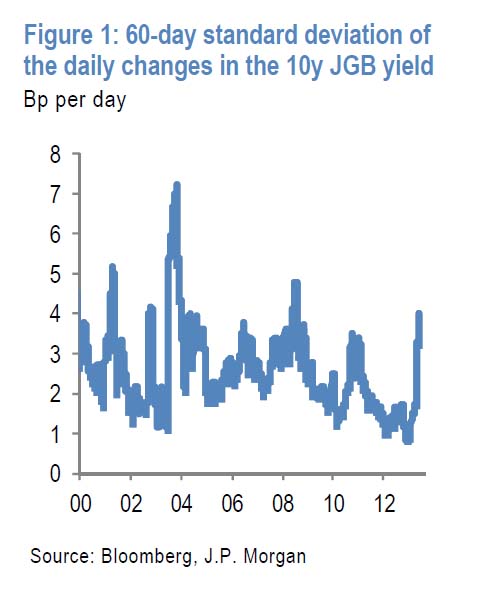
Despite the eagerness of Abenomics and the new BOJ head Kuroda to have their cake and eat it too, in this case manifesting in soaring stock prices, plunging Yen, rising GDP and exports, and most importantly, flat or declining bond yields, so far they have succeeded in carrying out three of the four (assuming Japanese economic data reporting is more accurate than that of its neighbor China), as it is physically impossible for any central planner to completely overrule the laws of math, economics and physics indefinitely. In this vein, we have described on numerous occasions in the past several days the shock to the system that the massive one-way transfer out of all asset classes and into equities has engendered, and resulted in several JGB futures trading halts in an attempt to normalize a market where bond volatility has suddenly exploded. Volatility aside (and it shouldn’t be as the below section from JPM explains), the recent surge in yields higher is finally starting to take its tool on domestic bond issuers. As Bloomberg reports, already two names have pulled deals from the jittery bond market due to “soaring” borrowing costs.The first is Toyota Industries which as NHK reported, canceled the sale of JPY20 billion debt. Toyota is among Japanese firms that put off selling debt as long-term yields on government debt have risen, increasing borrowing costs, public broadcaster NHK says without citing anyone. Last week JFE Holdings announced it would delay plans to sell bonds due to market volatility. Two names down… and the 10 Year is not even north of 1%.

Var Shock 1Var Shock 2_0 Read more of this post

Greying China taps rural elderly to care for those even older

Greying China taps rural elderly to care for those even older

1:08pm EDT

By Li Hui and Maxim Duncan

QIANTUN, China (Reuters) – Two years short of 70, Zhang Guosheng spends his days caring for an 81-year-old fellow villager – washing his clothes, bringing meals to his bed, and keeping him company – a routine he’ll keep up until he himself needs the type of care he is now giving.

“Living here is better than staying at home alone. We help each other and have a common language,” said the spritely Zhang, an enthusiastic dancer. “We are very happy here.”

With younger villagers who would traditionally have looked after their parents and grandparents flocking to the booming cities to seek work as part of Beijing’s urbanization drive, Qiantun village in northern China’s Hebei province has had to pioneer a new model – the old looking after the even older. Read more of this post

Burton Malkiel: Asset Management Fees and the Growth of Finance

Asset Management Fees and the Growth of Finance

Burton G. Malkiel

Journal of Economic Perspectives—Volume 27, Number 2—Spring 2013—Pages 97–108

From 1980 to 2006, the financial services sector of the United States economy grew from 4.9 percent to 8.3 percent of GDP. A substantial share of that increase was comprised of increases in the fees paid for asset management. This paper examines the significant increase in asset management fees charged to both individual and institutional investors. Despite the economies of scale that should be realizable in the asset management business, the asset-weighted expense ratios charged to both individual and institutional investors have actually risen over time. If we exclude index funds (an innovation that has made market returns available even to small investors at close to zero expense), fees have risen substantially as a percentage of assets managed. One could argue that the increase in fees charged by actively managed funds could prove to be socially useful, if it reflected increasing returns for investors from active management or if it was necessary to improve the efficiency of the market for investors who availed themselves of low-cost passive (index) funds. But neither of these arguments can be supported by the data. Actively managed funds of publicly traded securities have consistently underperformed index funds, and the amount of the underperformance is well approximated by the difference in the fees charged by the two types of funds. Moreover, it appears that there was no change in the efficiency of the market from 1980 to 2011. Arbitrage opportunities to obtain excess risk-adjusted returns do not appear to have been available at any time during the early part of the period. Passive portfolios that bought and held all the stocks in a broad-based market index substantially outperformed the average active manager throughout the entire period. Thus, the increase in fees is likely to represent a deadweight loss for investors. Indeed, perhaps the greatest inefficiency in the stock market is in “the market” for investment advice.

How Wall Street titan Leon Cooperman stays on top in investing and philanthropy

SATURDAY, MAY 18, 2013

Cues From Cooperman

By LAWRENCE C. STRAUSS | MORE ARTICLES BY AUTHOR

How Wall Street titan Leon Cooperman stays on top in investing and philanthropy.

Leon Cooperman has never been afraid to blow his stack. In fact, his volcanic tendencies are so well known on Wall Street that almost no one was fooled when the late Barton Biggs, Morgan Stanley’s longtime market strategist, introduced a character named Greg in Hedgehogging, a 2006 investment memoir. “Greg has a reputation of being difficult to work for and a screamer,” Biggs wrote, attempting to disguise Cooperman. “A screamer is a hedge-fund guy who yells at the people who work for him when they are wrong or careless.”

Asked about that description in a recent interview, Cooperman, 70, offered a warm, gentle smile. He is not a screamer, he said, but does take pride in being a “demanding” boss. Just look at it from his investors’ perspective, he said. “If you are paying somebody two and 20, as opposed to 1%, you basically have the right to expect more from that person,” he says. “And that’s what I tell my people: You’ve elected, for better or worse, to be in the two-and-20 game, so you have to be on the balls of your feet at all times.” Read more of this post

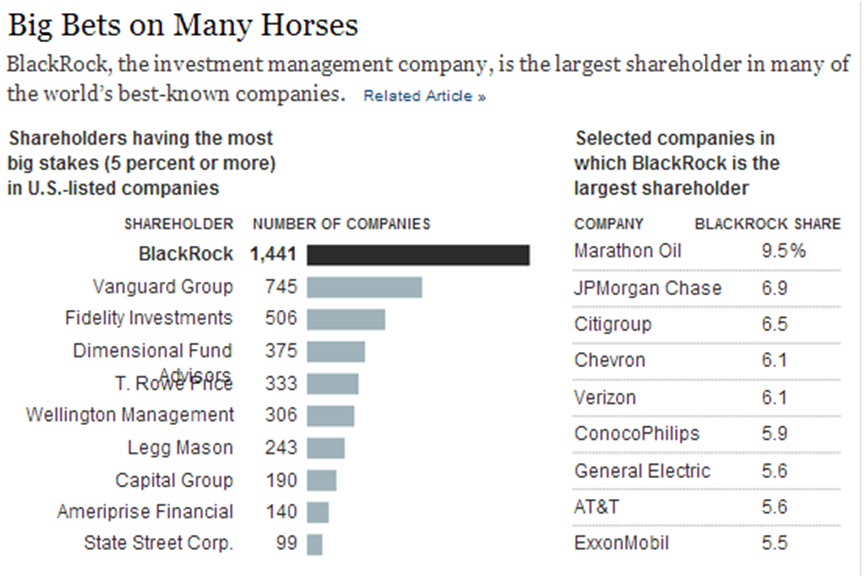
The Giant of Shareholders, Quietly Stirring; BlackRock, the world’s largest asset manager, is far from being an activist investor, but it is starting to ask more questions about companies in which it has stakes.

May 18, 2013

The Giant of Shareholders, Quietly Stirring

By SUSANNE CRAIG

Blackrock

AT 11 a.m. on a Wednesday earlier this month, Michelle Edkins and her team began wheeling extra chairs into a cramped conference room in a San Francisco office tower, preparing for the corporate-governance equivalent of speed dating. Once settled, Yumi Narita started describing the disappointing qualities of a big entertainment company she’d been checking out. “I’m inclined not to trust this compensation committee,” she told the group.  “Year-over-year, they pay their C.E.O. more, and the metrics are often questionable.” There were sympathetic nods around the room. Ms. Narita is one of about 20 analysts on the corporate governance team at BlackRock, the world’s largest asset manager. BlackRock’s size is mind-boggling. With almost $4 trillion under management, it is, according to a recent University of Michigan study, the single largest shareholder in one of every five United States companies. It manages money from pension funds and endowments as well as retail investors, controls large stakes in companies like JPMorgan Chase, Wal-Mart and Chevron and owns 5 percent or more of roughly 40 percent of all publicly traded companies in the country.

Read more of this post

Is This the Best Time for Investors? Don’t Bet On It.

Updated May 18, 2013, 8:34 p.m. ET

Is This the Best Time for Investors? Don’t Bet On It.

By BRETT ARENDS

SJ-AG481_LEDE_C_G_20130517163304

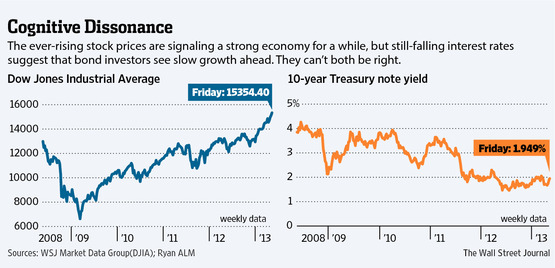
These have been good times—surprisingly good times—for investors. Stock prices have hit record highs. The Dow Jones Industrial Average has rocketed above 15000 for the first time, leaving even Wall Street bulls scrambling to raise their year-end forecasts to catch up. Meanwhile, even the normally staid bond market, as measured by the Barclays U.S. Aggregate Bond index, is up about 30% over the last five years. Interest rates on Treasury bonds are near historic lows. Corporate bonds, including those for blue-chip and riskier companies, are booming. Those who stuck with markets through the crisis of 2008, and especially those who held a balanced portfolio of stocks and bonds, are probably feeling very pleased with themselves, and well they might. But there’s a problem at the heart of financial markets. Psychologists would call it cognitive dissonance—the problem of trying to believe two incompatible things at the same time.

Read more of this post

China’s King of All Social Media: Tencent is China’s Facebook, Twitter, Zynga, and Tumblr all rolled into one, and it’s pushing hard into e-commerce. How it stays on top

SATURDAY, MAY 18, 2013

China’s King of All Social Media

By RESHMA KAPADIA | MORE ARTICLES BY AUTHOR

Tencent is China’s Facebook, Twitter, Zynga, and Tumblr all rolled into one, and it’s pushing hard into e-commerce. How it stays on top, and why the shares could climb 20%.

Chinese Internet companies are facing growing pains, as new competitors emerge and new trends like mobile Internet turn their business models upside down. Tencent Holdings (ticker: 700.Hong Kong) is coping better than most, aided by a diversified mix of businesses, among them: China’s dominant, youth-oriented gaming operations; one of the nation’s largest instant-messaging services, QQ; and the wildly popular WeChat, a free mobile social-networking and messaging software that allows users to send photos, videos, and voice messages to each other, walkie-talkie style.

Tencent’s individual businesses put it on par with Facebook (FB), Twitter, Zynga(ZNGA), and Tumblr, but it has more power than these firms because its users, advertisers, and application developers can access them all on a single platform. “Tencent is the winner-take-all social player in China,” says Ravi Sarathy, Citigroup’s head of Asia Pacific entertainment, media, and telecom research. Read more of this post

You Can Do Too Much Due Diligence: The Case of Feedburner

May 132013

You Can Do Too Much Due Diligence

It’s Monday, time for another lesson I’ve learned in the venture capital business. Today I will tell a story that I love telling. It has some of my favorite people in it. Back in 2004, early in my blogging career, I heard about a service that had just launched called Feedburner. It provided a number of useful services for a blog’s RSS feed. So I went and signed up and AVC became one of the first users of the service. I immediately liked the service and the idea. So I contacted the founder/CEO Dick Costolo, who has gone onto bigger and better things. I told Dick that I was interested in making an investment in Feedburner. My friend Brad Feld was also talking to Dick about the same thing so we decided to do the investment together. As part of our investment process, we do a bunch of fact gathering/checking work that is called Due Diligence in the vernacular of the VC business. So my partner Brad Burnham and I put together a list of leading blogs and online publishers who had popular RSS feeds at the time. I think there were a dozen or so publications on that list. It included Weblogs (Engadget), Gawker (Gawker), NY Times, and a bunch more. We know most everyone who ran those operations so we called them. What we heard was surprising. Not one of them was willing to hand over their RSS feed to a third party for analytics and monetization. We were very surprised to hear that and thought a bit about it. But, we decided, we could not invest in something that the big publishers would not support. So regrettably, I called Dick and told him we had to pass and why. Brad Feld went ahead with the investment and Feedburner closed their round without USV. About six months later I ran into Dick at an industry conference. We decided to grab lunch together and during lunch he said to me “you know those dozen publishers you called?” I said “yes, what about them?” He said “every single one of them is on Feedburner now.” I was pissed. How could that be? So I said to Dick, “Would you consider letting us into that last round we walked away from.” He said “No, but I will let you invest at a 50% increase in price”. We did that and became an investor in Feedburner. And that worked out well when Feedburner was sold to Google a few years later. So what did I learn from this lesson? First, trust your gut. I was using Feedburner and knew it was a very useful service. I felt that others would see that too. They did, but it took some time. Second, I learned that a service can get traction with the little guys and in time, the big guys will come along. I have seen that happen quite a bit since then. And finally, I learned that you can do too much due diligence. It’s important to talk to the market and hear what it is saying. But you have to balance that with other things; the quality of the team, the product, the user experience, etc. You cannot rely alone on due diligence, particularly early on in the development of a company and a market.

Adrian Cheng: updating the Hong Kong family empire of Chow Tai Fook/New World for a changing China

Saturday May 18, 2013 MYT 10:05:00 PM

Adrian Cheng: updating a Hong Kong family empire for a changing China

HONG KONG: He has trained on Broadway and been a Wall Street banker.

Now, Adrian Cheng, 33-year-old scion of the world’s largest jewellery retailer and one of Asia’s leading property developers is gearing up for his latest challenge – modernizing his family’s $25 billion empire for what he calls a “new era”.

The grandson of Hong Kong billionaire Cheng Yu-tung, who built up jeweler Chow Tai Fook (1929.HK) and real estate titan New World Development (0017.HK), Cheng is one of a new generation of business leaders in Asia who are taking over the corporate reins from their ageing rags-to-riches forebears. Read more of this post

Meet the man who is betting against China; Muddy Waters’ Carson Block believes that China’s banks hold more toxic assets than Western peers did ahead of the 2008 financial crash

Meet the man who is betting against China

Carson Block, the founder of Muddy Waters Research, believes that China’s banks hold more toxic assets than Western peers did ahead of the 2008 financial crash .

Earlier this month, Mr Block caused shares in Standard Chartered to fall and the cost of insuring its debt to spike after he warned the emerging market-focused lender had more risk on its balance sheet than the market commonly believed and suggested that betting against the bank was a good way to profit from any Chinese downturn. Photo: Bloomberg

By Harry Wilson

10:00PM BST 18 May 2013

He is listened to by institutional investors, regulators and politicians but he rarely speaks publicly. Last week, his analysis of Standard Chartered’s exposure to China caused a tremble in its share price and its backers to leap to the bank’s defence. Carson Block has broken his silence this weekend to reveal his fears for the global economy. The secretive fund manager said the risks within China’s banking system are more severe than those in Western financial institutions before the crisis. Mr Block, founder of Muddy Waters Research, which has gained a reputation over the past three years for its in-depth reports on financial irregularities in scores of Chinese companies, said the country’s banks hold more toxic assets than their peers in the West did ahead of the 2008 financial crash. “We believe that the domestic Chinese banking system is a mess, with an enormous amount of bad loans, or loans waiting to go bad,” he told theSunday Telegraph. Read more of this post

Chinese enterprises’ globalization ‘big in scale but weak’: Accenture

Chinese enterprises’ globalization ‘big in scale but weak’: Accenture

Staff Reporter

2013-05-19

The globalization of Chinese enterprises has been “big in scale but weak,” Claire Yang, head of Accenture’s Greater China talent and organization service line, was quoted May 14 in a report on the caixin.com Chinese business news website.

In terms of business scale, direct overseas investments made by Chinese enterprises touched US$77.2 billion in 2012, posting a growth rate of more than 20 times the levels seen less than a decade ago, the report said.

However, the global percentage of Chinese foreign investments remained at a low level compared with other countries. An Accenture report indicated that in 2011, capital flow involving Chinese direct foreign investment accounted for 16% of that of the United States and 57% of Japan, and was ranked the world’s ninth largest.

The ratio of Chinese enterprises overseas revenue was low. Using Standard and Poor’s 500 index, the average overseas revenue recorded for an enterprise accounted for 27% of the total the enterprise generated in a year. Read more of this post

Dongguan, one of China’s richest cities, suspends free services as debt crisis bites

Dongguan suspends free services as debt crisis bites

Saturday, 18 May, 2013, 12:00am

Charlotte So in Dongguan charlotte.so@scmp.com

In a telling sign of the mainland’s mounting local government debt crisis, some towns in Dongguan – one of the richest cities – are being forced to suspend free public services and infrastructure projects.

In February, Shipai town terminated the free bus services that it introduced with much fanfare about two years ago. Then in March, the township government said it was reviewing a policy of providing free education to all residents aged below 25 because the government’s coffers had dried up.

The town of Zhangmutou – dubbed little Hong Kong because of its popularity as an investment and holiday destination – has scrapped an ambitious plan to build a 100-million yuan (HK$126.4 million) recreational park, leaving a large chunk of empty land in the town centre.

Many local township authorities in Dongguan are struggling to pay the salaries of their employees.

Their problems underline the magnitude of local government debt issues on the mainland. Read more of this post

S&P warns it may lower India rating to junk status

S&P warns it may lower India rating to junk status

India faces at least “a one-in-three” chance of losing its prized sovereign grade rating. -AFP
Sat, May 18, 2013
AFP

NEW DELHI – India faces at least “a one-in-three” chance of losing its prized sovereign grade rating, global ratings agency Standard and Poor’s has warned, in another blow to the scandal-tainted Congress government. The announcement late on Friday comes after finance ministry officials have been arguing for a ratings upgrade, saying the government has been taking strong steps to curb India’s financial deficit and promote investment. India’s BBB-minus investment rating is already the lowest among its BRICS peers Brazil, Russia, China and South Africa, and cutting it to “junk status” would push up the country’s hefty borrowing costs as it would signal higher risk. Read more of this post

63 Brand-New Quotes From Warren Buffett; “More kids are ruined by the behavior of their parents than the size of their inheritance.”

63 Brand-New Quotes From Warren Buffett

By Matt Koppenheffer | More Articles | Save For Later
May 12, 2013 | Comments (8)

The tried and true “classic” Warren Buffett quotes are classics because they’re great, timeless bits of investing wisdom. But sometimes they can also feel a bit too well worn. Following are 63 brand-new quotes from Buffett, fresh from the May 4 Berkshire Hathaway (NYSE: BRK-A  ) (NYSE: BRK-B  ) shareholder meeting.

1. On playing table tennis with Ariel Hsing at Borsheims: “If you’re courageous you’ll show up with your paddle and you’ll look like an idiot.”

2. “If the market continues as it has in 2013, this will be the first five-year period that Berkshire has underperformed. … It won’t be a happy day, but it won’t totally discourage us.”

3. On what makes ISCAR great: “[They] never stop improving the product, never stop trying to make customers happy.”

4. Responding to a shareholder who thanked him for letting attendees in early from the cold and rain: “If we had a company that sold coats, we would have left you out there.”

5. On his successor: “It would be rejected like a foreign tissue if we got the wrong person in there.” Read more of this post

Why Low-Risk Innovation Is Costly

Why Low-Risk Innovation Is Costly

Companies are finding it hard to churn out “the next big thing”. Instead of the disruptive products, services and business models of yesteryears, innovations coming to market today are typically line extensions.

An Accenture survey of more than 500 executives has found that while one in five (18 percent) respondents rate innovation as their top strategic priority and two-thirds depend strongly on innovation for their long-term strategy success, and more than half feel they have a sluggish innovation process. Companies are seeking to innovate but are increasingly less satisfied with the results. The respondents also have an answer to why this is happening. They are aware that a cautious approach and reduced investment by companies to generate renovation or, at best, incremental innovation is a potentially perilous strategy. By putting formal systems in place to manage innovation, companies can protect themselves from such risks. Enterprises able to successfully innovate at a breakthrough level are far more likely to dominate and prosper in the new markets they create. They can also position themselves to master change.

Last updated: May 17, 2013 10:26 pm

Companies see innovation without results

By Paul Taylor

The vast bulk of corporate innovation initiatives are failing to deliver the results that senior executives expected. Despite increased investment in innovation, only 18 per cent of executives believe their company’s innovation efforts deliver a competitive advantage, according to a survey conducted by Accenture and published this week. Read more of this post

What Value Creation Will Look Like in the Future

What Value Creation Will Look Like in the Future

by Jack Hughes  |   9:00 AM May 17, 2013

Organizations have nearly perfected implementing the industrial model of managing work — the effort applied toward completing a task. For individuals, this model ensures that we know what we’re supposed to do each day. For organizations, it guarantees predictability and efficiency. The problem with the model is that work is becoming commoditized at an increasing rate, extending beyond manual tasks into knowledge work, as data entry, purchasing, billing, payroll, and similar responsibilities become automated. If your organization draws value from optimizing repetitive work, you’ll find that it will be increasingly difficult to extract that value.

The value of products and services today is based more and more on creativity — the innovative ways that they take advantage of new materials, technologies, and processes. Value creation in the past was a function of economies of industrial scale: mass production and the high efficiency of repeatable tasks. Value creation in the future will be based on economies of creativity: mass customization and the high value of bringing a new product or service improvement to market; the ability to find a solution to a vexing customer problem; or, the way a new product or service is sold and delivered. Read more of this post

The ‘Believe It or Not’ Life of Ripley: The godfather of reality shows and purveyor of freaks empathized with struggling people; he’d been there.

May 17, 2013, 9:17 p.m. ET

The ‘Believe It or Not’ Life of Ripley

The purveyor of freaks and godfather of reality TV empathized with people on the margins; he’d been there

OB-XM977_0517Ri_H_20130516182614

The man primarily responsible for mainstreaming our voyeuristic tendencies was Robert ‘Believe It or Not!’ Ripley. In his cartoons and books, on radio and TV, the globe-trotting Ripley tapped into Americans’ appetite for the oddly titillating, the unbelievable, the uncomfortable.

By NEAL THOMPSON

America’s TV and computer screens are crammed with people doing extreme, dangerous, exotic, bizarre or embarrassing things. They crab-fish or dive for gold in Alaska; they compete in little-girl beauty pageants or run moonshine in the South; they attempt outrageous feats, striving to set records and, above all, get noticed.

Our obsession with peculiar people is nothing new, though, nor did it originate with P.T. Barnum, whose genius was for sideshow spectacle. The man primarily responsible for mainstreaming our voyeuristic tendencies was Robert “Believe It or Not!” Ripley. In his cartoons and books, on radio and TV, the globe-trotting Ripley tapped into Americans’ appetite for the oddly titillating, the unbelievable, the uncomfortable.

Until his death in 1949, at age 59, Ripley was the unrivaled impresario of freaks of the natural world (compare today’s “River Monsters”), exposes of popular falsehoods (cue “Mythbusters”) and celebrations of charismatic underdogs (“Here Comes Honey Boo Boo”). He gave a platform to every sort of specialist in self-abuse and pseudo-torture: sword swallowers, glass-eaters, contortionists and self-mutilators, from the man who lifted weights with hooks in his eyelids to the one who took a shot in the gut with a cannonball to the one who ate an entire sack of portland cement. During the Depression, as Americans sought affordable means of escape and entertainment in a world before television, Ripley provided both in abundance. In his day, he possessed the combined cultural clout of YouTube, “American Idol” and Monday Night Football. Read more of this post
The Tyranny of the Micromanager: It is notoriously difficult to get rid of a micromanager once he or she holds power. They rule without mercy, turning the minute and the mundane into weapons of war.

May 17, 2013, 9:09 p.m. ET

The Tyranny of the Micromanager

It is notoriously difficult to get rid of a micromanager once he or she holds power.

RV-AK567_FOREMA_DV_20130517183658

By AMANDA FOREMAN

As anyone who has had the misfortune to work for a micromanager knows, success only makes the manager worse. Nor is this observation limited to CEOs of Fortune 500 companies.

Frederick the Great of Prussia was a notorious micromanager of his generals. During the battle of Zorndorf in 1758, he shunted around his battalions like a boy playing with tin soldiers. Finally, goaded to the point of exasperation by the king’s interference, his brilliant cavalry general Friedrich von Seydlitz had the following message relayed to headquarters: “After the battle the king can do what he likes with my head, but during the battle will he please allow me to use it?”

Frederick partially relented, once he made sure that their plans for battle were essentially the same, and Seydlitz went on to achieve a decisive victory against the Russians. But the following year at Kunersdorf, poor Seydlitz was not so lucky, and Frederick insisted on sending his beloved cavalry straight into the waiting guns of the Russian artillery.

It’s notoriously difficult to get rid of a micromanager once he or she holds the reins of power. They rule without mercy, turning the minute and the mundane into weapons of war. The trick is to recognize the danger signs early on and take the appropriate preventive measures. Read more of this post

The Book of Kings: A fast-paced, blood-soaked history of the dynasty that transformed England from a loosely-governed patchwork into a powerful nation

May 17, 2013, 3:30 p.m. ET

The Book of Kings

A fast-paced, blood-soaked history of the dynasty that transformed England from a loosely-governed patchwork into a powerful nation.

By STEPHEN BRUMWELL

In April 1349, as an epidemic of bubonic plague devastated his subjects, King Edward III of England staged a lavish tournament at Windsor Castle. This spectacular festival of jousting culminated in the creation of an exclusive club, the Order of the Garter. Edward was fascinated by stories of the legendary King Arthur. In founding a new order of chivalry, he sought to establish his own Knights of the Round Table, with an expanded Windsor standing in for Camelot.

Yet as Dan Jones amply demonstrates in “The Plantagenets: The Warrior Kings and Queens Who Made England,” such ostentatious display amid the horrors of the Black Death was justified by harsh personal experience: Edward’s father, Edward II, had been deposed and murdered in 1327 because of his failure to win the respect of his war-minded nobles. By inviting them to join his new fraternity, Edward III was not only rallying the military support he needed to pursue a claim to the crown of France—he had invaded the country in 1346 and warred there consistently through 1359—but taking steps to ensure that he would never share his father’s dismal fate. Read more of this post

Scientist who beat Nasa to the ozone hole: Joe Farman, physicist and environmental hero, 1930-2013

May 17, 2013 7:11 pm

Scientist who beat Nasa to the ozone hole

By Pilita Clark

Joe Farman was not long out of university when he nearly turned his back on the job that led him to make one of the most important discoveries in environmental science.

The young Cambridge physicist had spotted an advert in New Scientist magazine for a researcher to go to Antarctica. “I sort of blinked at it,” he later said, before eventually deciding: “Well if I don’t do it now I won’t ever do it.” That he applied was just as well. Farman, who has died aged 82, became the man who found the hole in the world’s ozone layer. Even so, it was not something that happened in the most straightforward way. By 1956 he had begun a life with what is now theBritish Antarctic Survey in Cambridge. “They were just doing curiosity-based research,” says Chris Rapley, a former BAS director. This included measuring the ozone in the stratosphere – the bluish-green gas that filters out ultraviolet solar rays, which hasten skin cancers, cataracts and other ills. Read more of this post

Financial Advice, Served Rare; A new wave of private firms that cater to clients’ every imaginable financial need are increasingly courting the merely wealthy

Financial Advice, Served Rare

A new wave of private firms that cater to clients’ every imaginable financial need are increasingly courting the merely wealthy. Here’s what they offer.

By Julie Steinberg, Kelly Greene

BF-AE961_WIOffi_G_20130517223802

You don’t have to be a Rockefeller to join a family office.

Family offices are private firms that manage just about everything for the wealthiest families: tax planning, investment management, estate planning, philanthropy, art and wine collections—even the family vacation compound.

Now many family offices are courting the merely rich.

The price of admission is still steep, and having your own personal chief financial officer doesn’t come cheap. But the help is worth considering.

Single-family offices gained popularity in the 1800s to manage the burgeoning fortunes of tycoons such as the Rockefellers. The offices offer many of the same services as top-tier private banks and wealth managers but are devoted to a single family. Read more of this post

Researchers at Princeton and Johns Hopkins universities used a 3-D printer to create bionic ears with auditory powers far beyond the natural human endowment. A look at the implications.

All Ears for a Revolution

By DANIEL AKST

The singularity may not be near, but it’s getting close enough that you might just hear it coming—if you had the kind of synthetic ears scientists recently developed.

The singularity is a term used by futurists for the merger of human and machine into an infinitely malleable, self-determining species with powers of intelligence that flesh-and-blood-mortals can only dream of. Although superhuman mental powers aren’t yet on the horizon, the new ears remind us that our future is very likely bionic.

Human ears are a problem for plastic surgeons. But writing in Nano Letters, researchers at Princeton and Johns Hopkins universities described how they used a standard 3-D printer to create bionic ears with auditory powers far beyond the natural human endowment. The technique lets scientists mimic the structural complexity of the ear while achieving a wider range of audible frequencies through the embedded electronics. They used the printed ear to culture genuine cartilage in vitro from calf cells. Read more of this post

Children’s Mental Illness Costs $247 Billion, U.S. Says

Children’s Mental Illness Costs $247 Billion, U.S. Says

Mental illness in children costs $247 billion annually, a figure increasing along with the number of kids hospitalized for mood disorders, substance abuse and other psychiatric disorders, according to a U.S. report.

As many as 1 in 5 children ages 3 to 17 years old has a mentally illness, with attention deficit hyperactivity disorder as the most prevalent diagnosis, according to the report from the Centers for Disease Control and Prevention. The rate of children hospitalized for mood disorders increased 80 percent from 1997 to 2010, the report said, citing a U.S. study from that year.

The CDC report released yesterday draws on a number of U.S. surveys that collect data on children’s mental health. The Atlanta-based agency uses the report to mark the prevalence of the disorders and promote public health initiatives to treat and prevent them. Researchers found that suicide, often stemming from mental illness, was the second-leading cause of death in 2010 among adolescents ages 12 to 17.

“Millions of children in the U.S. have mental disorders that affect their overall health and present challenges for their loved ones,” Thomas Frieden, the director of the CDC, said in a statement. “We are working to both increase our understanding of these disorders, and help scale up programs and strategies to promote children’s mental health so that our children grow to lead productive, healthy lives.” Read more of this post

How do you monetize a digital service?

Forget Ads! Here are the Money Making techniques every startup should know.

by Nick De Mey With 2 Comments

How do you monetize a digital service? Why would clients put their money on the table? In fact it doesn’t matter if you pick a freemium, subscription, license or any other model if you don’t understand the emotional context of your customers. You have to see what drives people to open up their wallet. Just look at other companies. The small nudges and psychological tricks they have in place can often be copied to your own product or service. In order to help you out we’ve selected 17 remarkable techniques documented with 36 cases.