Next Wal-Mart CEO Faces Challenges Sam Walton Never Saw

Next Wal-Mart CEO Faces Challenges Sam Walton Never Saw

As Wal-Mart Stores Inc. (WMT) prepares to anoint the fifth chief executive in its history, the world’s largest retailer is grappling with challenges founder Sam Walton never faced.

Wal-Mart’s board has identified international chief Doug McMillon, 46, and Bill Simon, 53, who runs the U.S. operations, as leading candidates to succeed Chief Executive Officer Mike Duke, according to a person familiar with the situation. While Duke, 63, isn’t expected to step down immediately, Wal-Mart may name his successor in the coming months, said the person, who asked not to be identified because the matter is private.

Wal-Mart is trying to goose slowing sales gains in the U.S. as such rivals as Amazon.com Inc. (AMZN) and the dollar stores lure its customers. Overseas, the company is struggling to ignite growth in China and other emerging markets even as it probes allegations of bribery in Mexico and possible violations of the Foreign Corrupt Practices Act.

The next CEO will face “tough decisions globally,” said David Strasser, a New York-based analyst for Janney Montgomery Scott LLC. “They have to pick and choose. China has been a big struggle. What do you do? Double down? Back out?” Read more of this post

Fed Council Warned of Credit Risk, Asset Price Bubble

Fed Council Warned of Credit Risk, Asset Price Bubble

A Federal Reserve (TREFTOTL) panel of bankers warned policy makers in February that record stimulus was pushing financial institutions to take on more credit risk and creating a “bubble” in the price of U.S. farmland.

“The margin pressures that the low-rate environment has put on financial institutions, coupled with dramatically increased compliance and other infrastructure costs, have caused many to seek higher returns by accepting greater interest-rate or credit risk,” the bankers said on Feb. 8, following a Federal Open Market Committee meeting on Jan. 29-30.

The minutes of the meeting by the Federal Advisory Council trace how the 12 bankers’ views evolved from opposition to the Fed’s announcement of new bond buying in September to support for Fed efforts in February to boost an economic expansion beset by a “drag” from fiscal tightening. Read more of this post

Aquino Hunts ‘Big Fish’ to Bury Philippines’ Sick-Man Tag

Aquino Hunts ‘Big Fish’ to Bury Philippines’ Sick-Man Tag

The Philippines, Asia’s fastest-growing economy after China, needs to do more to finally lose its decades-old tag as the “Sick Man of Asia,” according to the country’s president.

“We’ll have to be able to prove that this is not cyclical, or a temporary aberration,” President Benigno Aquino said in an interview yesterday of the country’s economic revival. “We’ll have to be able to do it year in, year out.” His point was illustrated when the lights went out during the 90-minute meeting at the presidential compound in Manila, as the capital suffered a major power failure. Aquino, 53, who is campaigning to expand his support in elections for the Senate on May 13, said more needs to be done to jail the “big fish” in his anti-corruption drive. Reducing the number of Filipinos who travel abroad to find work is also a key benchmark of success in the three years that remain in his single six-year term, he said. In the first half of his presidency, Aquino has overseen a resurgence in the economy, which expanded 6.6 percent last year. While the growth rate and a shrinking budget deficit helped earn the country a ratings upgrade, they mask an unemployment rate that is among the highest in Asia-Pacific and poverty levels unchanged since before he took office in 2010.  Read more of this post

SAT Scandal Shines Harsh Light on South Korean Academics

May 9, 2013, 4:28 a.m. ET

SAT Scandal Shines Harsh Light on South Korean Academics

By JEYUP S. KWAAK

AI-CA829_SKCHEA_NS_20130508035708

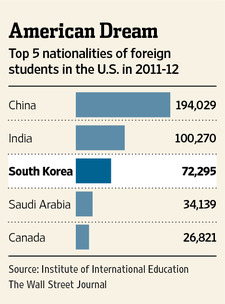
SEOUL—The recent cancellation of U.S. college entrance exams in South Korea—the first time SAT tests have been called off nationwide anywhere in the world for suspected cheating—is throwing the spotlight back on the country’s hyper-competitive academic environment. The May 4 sessions of the SAT, the most widely used standardized evaluation tool for high-school students applying to American universities, were scrapped three days before the test date across South Korea after the U.S.-based administrator discovered questions from the tests circulating in test-prep centers in the country.

The cancellation has thrown college-entrance preparations for thousands of students into disarray. Some students now plan to travel to other countries in the region to ensure they are able to take the next test in the summer. Read more of this post

Shale Boom a Bust for Europe’s Gas Plants; European utilities are forced to mothball modern gas-fired power plants that can’t compete with growing imports of cheap coal dislodged from the U.S.

May 8, 2013, 11:44 a.m. ET

Shale Boom a Bust for Europe’s Gas Plants

By JAN HROMADKO

EI-CA770_EUPOWE_G_20130508140906

FRANKFURT—The ripples of the North American shale boom continue to spread, as a growing number of European utilities are forced to mothball modern gas-fired power plants that can’t compete with growing imports of cheap coal dislodged from the U.S.

Norwegian state energy company Statkraft said Wednesday it has idled a gas-fired power station in Germany that couldn’t compete with its coal-fired rivals, while German utility E.ON EOAN.XE -0.60% SE said it is seriously considering mothballing more gas-fueled plants, including a state-of-the-art facility in Slovakia.

Other European utilities have taken similar action, presenting policy makers with a dilemma—cheaper coal-fired power could provide some relief for the region’s struggling economies, but might be incompatible with long-term goals for carbon emissions and renewable energy.

The closures across Europe are another example of the far-reaching effects of the North American energy-supply boom. Surging supplies of natural gas in North America, unlocked from shale rock by a new combination of technology known as hydraulic fracturing, have prompted many U.S. power generators to switch away from coal, pushing increasing amounts of the fuel into Europe as cheap imports.

In 2012, U.S. exports of coal to Europe rose 23% to 66.4 million short tons, according to data from the U.S. Energy Information Administration.

Much of this coal is displacing natural gas as a fuel for electricity generation in Europe. In the U.K., for example, the proportion of electricity generated from coal rose to its highest level in 17 years in 2012, while gas fell to a corresponding low.

“The economic situation of our legacy business in Europe, particularly in conventional power generation, remains difficult,” said E. ON Chief Executive Johannes Teyssen.

Gas-fired power plants are losing out to coal-fueled rivals, which are more competitive at present electricity and commodity prices. Additionally, the expansion of renewable energies is reducing the operating hours of gas power plants; wind and solar energy output is generally higher at peak demand hours, a market gas plants are designed to serve. “Companies are struggling to operate gas-fired power plants economically, even in case of modern, state-of-the-art facilities,” said IHS Energy analyst Kash Burchett. Read more of this post

Contemporary Accounting Research: Family Ownership and CEO Turnovers

Family Ownership and CEO Turnovers

Xia Chen Singapore Management University

Qiang Cheng Singapore Management University

Zhonglan Dai University of Texas at Dallas – School of Management

May 30, 2013
Contemporary Accounting Research, Forthcoming

Abstract: 
This paper investigates the impact of the founding family’s presence on CEO turnover decisions. We find that family firms managed by CEOs outside the founding family (i.e., professional CEO family firms) have higher CEO turnover-performance sensitivity than family firms managed by family members (i.e., family CEO firms) or non-family firms. These results are robust to alternative performance measures and CEO turnover definitions. Additional analyses indicate that higher family ownership leads to even higher (lower) turnover-performance sensitivity in professional CEO family firms (family CEO firms). These results indicate that, with regard to CEO turnover decisions, better monitoring of CEOs by family owners leads to the alleviation of agency conflicts, but the power of family CEOs leads to potential family entrenchment.

Are the Life and Death of a Young Start-Up Indeed in the Power of the Tongue? Lessons from Online Crowdfunding Pitches

Are the Life and Death of a Young Start-Up Indeed in the Power of the Tongue? Lessons from Online Crowdfunding Pitches

Dan Marom Hebrew University of Jerusalem – Jerusalem School of Business Administration; Hebrew University of Jerusalem

Orly Sade Hebrew University of Jerusalem – Department of Finance

April 23, 2013

Abstract: 
Securing seed funding is one of the biggest challenges for any entrepreneur. While presenting an initiative to potential investors, the entrepreneur can choose the extent to which she presents herself, versus presenting the project idea. This research investigates not only this decision, but also the effect of this decision on the success of the fundraising in a leading crowdfunding financing platform (Kickstarter). In our empirical analysis, we use a text mining quantification method validated by experiment and robustness tests. This methodology was implemented on a dataset that was collected by custom software, and which includes more than 20,000 online business pitches and their crowdfunding results. Our findings indicate clearly that in Kickstarter fundraising, entrepreneurs’ descriptions do matter – projects which highlighted their entrepreneurs enjoyed higher rates of success, controlling for other relevant variables.

Pre-Disclosure Accumulations by Activist Investors: Evidence and Policy

Pre-Disclosure Accumulations by Activist Investors: Evidence and Policy

Lucian A. Bebchuk Harvard Law School; National Bureau of Economic Research (NBER); European Corporate Governance Institute (ECGI)

Alon P. Brav Duke University – Fuqua School of Business

Robert J. Jackson Jr.Columbia Law School

Wei Jiang Columbia Business School – Finance and Economics

April 1, 2013
Journal of Corporation Law, Volume 39, Fall 2013, Forthcoming

Abstract: 
The SEC is currently considering a rulemaking petition requesting that the Commission shorten the ten-day window, established by Section 13(d) of the Williams Act, within which investors must publicly disclose purchases of a 5% or greater stake in public companies. In this Article, we provide the first systematic empirical evidence on these disclosures and find that several of the petition’s factual premises are not consistent with the evidence. Our analysis is based on about 2,000 filings by activist hedge funds during the period of 1994-2007. We find that the data are inconsistent with the petition’s key claim that changes in market practices and technologies have operated over time to increase the magnitude of pre-disclosure accumulations, making existing rules “obsolete” and therefore requiring the petition’s proposed “modernization.” The median stake that these investors disclose in their 13(d) filings has remained stable throughout the 17-year period that we study, and regression analysis does not identify a trend over time of changes in the stake disclosed by investors. We also find that:
* A substantial majority of 13(d) filings are actually made by investors other than activist hedge funds, and these investors often use a substantial amount of the 10-day window before disclosing their stake.
* A significant proportion of poison pills have low thresholds of 15% or less, so that management can use 13(d) disclosures to adopt low-trigger pills to prevent any further stock accumulations by activists — a fact that any tightening of the SEC’s rules in this area should take into account.
* Even when activists wait the full ten days to disclose their stakes, their purchases seem to be disproportionately concentrated on the day they cross the threshold and the following day; thus, the practical difference in pre-disclosure accumulations between the existing regime and the rules in jurisdictions with shorter disclosure windows is likely much smaller than the petition assumes.
* About 10% of 13(d) filings seem to be made after the 10-day window has expired; the SEC may therefore want to consider tightening the enforcement of existing rules before examining the proposed acceleration of the deadline.
Our analysis provides new empirical evidence that should inform the SEC’s consideration of this subject — and a foundation on which subsequent empirical and policy analysis can build.

The Signals in the Noise: The Role of Reputable Investors in a Crowdfunding Market

The Signals in the Noise: The Role of Reputable Investors in a Crowdfunding Market

Keongtae Kim University of Maryland – Robert H. Smith School of Business

Siva Viswanathan University of Maryland – Robert H. Smith School of Business

April 29, 2013

Abstract: 
This paper examines the role of reputable investors in a crowdfunding market. Using a novel data set on individual investments in a crowdfunding market for mobile applications, we investigate whether early investments serve as signals of quality for later investors and if the value of these signals differs depending on the identity of early reputable investors. We find that reputable investors – app developer investors and experienced investors – tend to invest early. Both are likely to affect later investors, although their expertise determines their influence. App developer investors tend to have a better knowledge of the product and are found to be more influential for “concept apps” (apps that are in development), whereas experienced investors – investors with a better knowledge of market performance are found to be more influential for “live apps” (apps that are already being sold in the market). Our findings show that investors in this market, although inexperienced, are rather sophisticated in their ability to identify and exploit nuanced differences between various signals within the same market. In examining the ex-post performance of apps, we find that successful funding in the market is positively associated with ex-post app sales, providing some indication of rational herding among investors. Our study offers new insights for theories of opinion leadership and signaling, and also has practical implications for the design of crowdfunding markets.

Giant Australian property trust GPT agreed to pay its shareholders $75 million for allegedly failing to disclose in 2008 that the company was financially underperforming its previous forecasts.

Davids win in giant fight with GPT

May 9, 2013

Elizabeth Knight

The final chapter in the legal brawl between giant property trust GPT and its shareholders drew to a close on Wednesday. The Davids won and the Goliath agreed to pay $75 million for allegedly failing to disclose in 2008 that the company was financially underperforming its previous forecasts. It was a two-year battle and it went to the wire. In class action cases, neither party wants the outcome to be determined by the courts and this was no exception. Allowing the courts to set precedents presents hazards for both sides. The corporate defendant would have to accept liability if it lost and the damages could be more onerous. For the shareholder plaintiffs, a poor outcome could be every bit as damaging if an unfavourable precedent was set.

Corporate continuous disclosure is an area in which the phrase ”the lawyers always win” is particularly apposite. This class action was mounted in 2011 by lawyers Slater & Gordon and bankrolled by a US litigation funder who, for its troubles, will probably get about 25 per cent of the proceeds. Thanks to the newly intense focus in this area, legal firms are raking in fees for ensuring companies adhere to legal disclosure responsibilities. For the legal fraternity, corporate disclosure is lucrative business. Read more of this post

Turn Bad Stress Into Good

May 7, 2013, 8:12 p.m. ET

Turn Bad Stress Into Good

The Right Type of Pressure Can Boost Daily Performance; Taking More Control

By SUE SHELLENBARGER

Kate Matheny isn’t exactly someone who shies away from stress. Throughout her career, the Aurora, Colo., certified public accountant has pursued a progression of high-pressure management jobs. “I’m hard core,” says the 44-year-old wife and mother of two. “I wanted to be on top of the food chain [at work], and I wanted to be a great mom”—one who could attend lacrosse games, drive carpool and help with homework even after an hour-long commute and workdays that started, more often than not, with a 5 a.m. marathon-training run.

That is, until she hit the proverbial wall.

After months of losing sleep, dropping weight and “feeling pushed to the brink of losing my mind” by her juggling act, Ms. Matheny decided she had to address her stress—and turn it to her advantage. The new job she recently switched to still has its share of pressure, but with more support from her boss and more flexibility in her schedule, she says she feels great.

Contrary to popular belief, stress doesn’t have to be a soul-sucking, health-draining force. But few people know how to transform their stress into the positive kind that helps them reach their goals. Read more of this post

Latest China bailout reveals risk of local government’s hidden debts; A Chinese local government has apparently used public funds to repay the debt of a private firm

Latest China bailout reveals risk of local government’s hidden debts

Tue, May 7 2013

By Gabriel Wildau

SHANGHAI (Reuters) – A Chinese local government has apparently used public funds to repay the debt of a private firm, in a case that raises fresh questions about whether recent estimates of local government debt properly account for the full range of local liabilities. It is not the first time local officials have bailed out a private enterprise, but the fact that the municipal government had formally guaranteed the debt highlights the lack of visibility on the extent of localities’ hidden commitments. Read more of this post

When the CEO Burns Out: Job Fatigue Catches Up to Some Executives Amid Mounting Expectations; No More Forced Smiles

May 7, 2013, 6:47 p.m. ET

When the CEO Burns Out

Job Fatigue Catches Up to Some Executives Amid Mounting Expectations; No More Forced Smiles

By LESLIE KWOH

A few years ago, James Green began to dread work. He dragged himself out of bed every morning and trudged through New York’s Penn Station, trying to muster a “game face” for his office at Giant Realm, an online advertising network. But Mr. Green wasn’t just any manager at the company; he was the CEO. And he was burned out on the job. Companies and managers are equipped to handle job fatigue among employees, but what happens when burnout—described as persistent fatigue, detachment or resentment triggered by excessive work and stress—strikes the top boss? More companies might soon find out. An uncertain economy, shareholder discontent and mounting expectations to deliver results have made the lives of chief executives more stressful, management experts say. And while few executives publicly acknowledge burnout, researchers studying the issue say it is more common than previously thought. In one study conducted by Harvard Medical School faculty, 96% of senior leaders reported feeling burned out to some degree, with one-third describing their burnout as extreme. Read more of this post

Nat Rothschild Rues ‘Terrible Mistake’ in Deal Gone Sour

Nat Rothschild Rues ‘Terrible Mistake’ in Deal Gone Sour

Nat Rothschild, dressed in a hooded sweater, jeans and hiking boots, perches on a cowhide sofa in his relatively modest chalet-style apartment in the Swiss ski resort of Klosters.

He recalls the fateful day in October 2010 when, as he scanned the globe for business opportunities, he first heard the word Bumi, Bloomberg Markets will report in its June issue.

Ian Hannam, a well-known JPMorgan Chase & Co. (JPM) investment banker, had e-mailed Rothschild suggesting he look at two coal companies, including PT Bumi Resources (BUMI), linked to the Bakrie family, a powerful Indonesian business dynasty.

“He said it was the best deal he had ever seen in his life,” Rothschild says. Read more of this post

Tips from Wall St hedge fund gurus fail to reward faithful

May 7, 2013 7:27 pm

Tips from Wall St hedge fund gurus fail to reward faithful

By Dan McCrum and Arash Massoudi in New York

Advice from the gurus of Wall Street may be rather less valuable than their fans would like to believe. Investors who bought on the basis of top tips from one of New York’s most celebrated hedge fund conferences last year spectacularly failed to beat the market. The Ira Sohn Investment conference held at New York’s Lincoln Center brings together the leading lights of the hedge fund community to share market insights as a way of raising money for cancer research. But a Financial Times analysis of last year’s tips shows decidedly mixed results. An investor who followed every top idea from the 12 speakers last year would have made 19 per cent, less than the 22 per cent gain available from a passive index fund tracking the US stock market. Many of the ideas have proved woefully miscued, including some from the most high-profile managers who will return to the stage on Wednesday: David Einhorn of Greenlight Capital and Bill Ackman of Pershing Square. Read more of this post

Here’s Taco Bell’s Brand New ‘Low End’ $1 Menu

Here’s Taco Bell’s Brand New ‘Low End’ Menu

Ashley Lutz | May 7, 2013, 6:02 PM | 2,569 | 6

Taco Bell announced last week that it was rolling out a new “low-end” menu at select stores across the country. Now we finally get to see what’s on the $1 menu, which is being tested in Sacramento and Kansas City. Pending results, the menu could roll out nationwide in the near future, company reps told us. The menu includes new items, such as a spicy potato taco, spicy beef mini quesadilla, shredded chicken mini quesadilla, and a beefy cheesy burrito. Check it out:

screen shot 2013-05-07 at 5.33.58 pm


Bankers Warn Fed of Farm, Student Loan Bubbles Echoing Subprime

Bankers Warn Fed of Farm, Student Loan Bubbles Echoing Subprime

A group of bankers that advises the Federal Reserve’s Board of Governors has warned that farmland prices are inflating “a bubble” and growth in student-loan debt has “parallels to the housing crisis.” The concerns of the Federal Advisory Council, made up of 12 bankers who meet quarterly to advise the Fed, are outlined in meeting minutes obtained by Bloomberg through a Freedom of Information Act request. Their alarm adds to a debate on the Federal Open Market Committee about whether the benefits from their monthly purchases of $85 billion in bonds outweigh the risk of financial instability. While Chairman Ben S. Bernanke has argued the program is worth pursuing, Fed Governor Jeremy Stein and Kansas City Fed President Esther George are among those who have voiced concerns that an extended period of low interest rates is heightening the risk of asset bubbles. “Agricultural land prices are veering further from what makes sense,” according to minutes of the council’s Feb. 8 gathering. “Members believe the run-up in agriculture land prices is a bubble resulting from persistently low interest rates.” Read more of this post

Brazilian pension funds go global

May 7, 2013 7:11 pm

Brazilian pension funds go global

By Joseph Leahy in São Paulo

As little as a year ago, Brazil’s greatest concern was the currency war – a tsunami of international funds that it believed was threatening to inundate its financial markets and those of other emerging countries.

Now, Brazilian real interest rates have fallen so low that, in a dramatic reversal, the country’s own pension funds are looking abroad. While their initial offshore investments will not amount to anything like a tsunami, it marks the start of what may prove to be an important step in the maturing of Brazil’s financial industry. Read more of this post

Korean firms far behind in creativity

2013-05-07 16:25

Korean firms far behind in creativity

By Kim Rahn

The government is aiming to achieve a “creative economy” by adopting more creative and innovative ideas in all industries. In reality, however, employees think Korea’s working culture is far from creative. If the corporate cultures of global firms famous for creativity, such as Google or Facebook are graded at 100, the average score for Korean companies would be 59.2, mainly due to hierarchism, a survey showed Tuesday. The survey was conducted recently on 500 workers by the Korea Chamber of Commerce and Industry (KCCI). According to the study, the smaller the size of a company, the lower a score it obtained. Asked the reasons for such low grades, 61.8 percent of those surveyed cited the country’s hierarchical culture or rigid communication system in which juniors always have to obey superiors. When multiple responses were given, 45.3 percent said the corporate culture puts more value on the organization than on individuals. “Seniors give orders and juniors follow. That’s all. Some seniors even think that juniors who make suggestions about work are impertinent,” said a steel company worker who asked not to be named. Read more of this post

The liquidity crisis at the STX Group, Korea’s 13th largest conglomerate, is weighing heavily on creditor banks amid dismal earnings outlook for the banking sector

2013-05-07 18:12

STX crisis may spill into banking sector

Credit extended to cash-strapped group reaches W13 tril.

By Na Jeong-ju

The liquidity crisis at the STX Group, the country’s 13th largest conglomerate, is weighing heavily on creditor banks amid dismal earnings outlook for the banking sector.

Creditors of STX may suffer losses totaling 13.2 trillion won ($12.1 billion) if the group collapses, according to the Financial Supervisory Service (FSS). Read more of this post

China Export Gains Spur Renewed Skepticism of Figures

China Export Gains Spur Renewed Skepticism of Figures: Economy

By Bloomberg News  May 8, 2013

China’s export growth unexpectedly accelerated in April even as shipments to the U.S. and Europe fell, spurring Bank of America Corp. and Mizuho Securities Co. analysts to say the figures were inflated by fake reports. The 14.7 percent increase, reported by the General Administration of Customs in Beijing today, was led by a 57.2 percent jump in shipments to Hong Kong that highlighted suspicions of false transactions used to mask capital flows into China. A customs spokesman said last month that the agency would investigate the “extraordinary” gain in trade with Hong Kong. The report deepens skepticism on the reliability of trade data from the world’s largest exporting nation, with Royal Bank of Scotland Group Plc saying export gains may be overstated by 9 percentage points. Regulators announced a crackdown this week on companies using trade reports to disguise speculative money inflows chasing a yuan that’s already exceeded last year’s gains against the dollar. “Exports actually haven’t done all that well,” Louis Kuijs, the RBS chief China economist who previously worked for the World Bank, said on Bloomberg Television from Hong Kong. That reflects a “pretty weak global picture, weak demand for Chinese exports” and the impact from yuan appreciation on China’s shipments, he said. Today’s report showed a 0.1 percent drop in U.S. shipments and 6.4 percent decline in exports to the European Union. Previous figures showed China’s shipments to Hong Kong rose 92.9 percent in March, while Hong Kong said imports from China rose 13.8 percent.  Read more of this post

What keeps Israeli companies out of China? A survey by Globes Research and PwC Israel reveals the opportunities, and the difficulties in exploiting them.

What keeps Israeli companies out of China?

A survey by Globes Research and PwC Israel reveals the opportunities, and the difficulties in exploiting them.

6 May 13 18:06, Avi Temkin

“There is a real fear that Israeli companies will not be astute enough to exploit the huge opportunities that have been created by China’s economic growth, especially in the light of the government’s twelfth five-year plan, because of lack of knowledge or fear of failure. The companies need to understand however that those are the markets where the big growth will happen, and if the management doesn’t understand this, then the board of directors should take action,” says Gerry Seligman, an international tax partner in the New York office of PwC US residing in the Tel Aviv office of PwC Israel, following the publication of a broad survey of business models of Israeli companies in China. The survey, by Globes Research and PwC Israel, is based on dozens of interviews with company managers, government officials, and researchers.

Israel Export Institute director Ofer Sachs explains that exports to China are concentrated in three main sectors: electronic components; minerals; and chemicals. These account for 71% of total Israeli exports to China. In other industries, it seems that Israeli companies are finding it hard to expand exports to China, and in some cases they are actually declining. Read more of this post

China’s struggling automakers jump on SUV boom

China’s struggling automakers jump on SUV boom

2013-05-08 01:44:44 GMT2013-05-08 09:44:44(Beijing Time)  SINA.com

BYD is known for electric cars but this year’s flagship model is the S7, a gasoline-powered SUV. It comes with an interior air purifier, radar to help with backing and digital TV. An onboard hard drive can hold 1,000 films. This is China’s Year of the SUV. Whatever their specialties used to be, automakers ranging from global brands to China’s ambitious rookies are scrambling to cash in on the explosive popularity of sport utility vehicles. “We are selling vehicles that have extensive technologies,” said Isbrand Ho, BYD’s director of export sales. “These are all on … premium models for European marques but we are making it available to the everyday person.” Read more of this post

Tanning Beds Should Carry Skin Cancer Warnings, FDA Says

Tanning Beds Should Carry Skin Cancer Warnings, FDA Says

Tanning beds would be forced to warn young people of the dangers of skin cancer and face tighter oversight under a proposal from U.S. regulators.

The Food and Drug Administration proposed today that sunlamp products recommend against use by those younger than 18 years old and warn frequent users to regularly screen for cancer. The proposed order would also require sunlamp products seek FDA clearance before sale, the agency said in a statement.

The risk of melanoma, the deadliest type of skin cancer, rises 75 percent in those exposed to ultraviolet radiation from indoor tanning, the FDA said. The agency has been reviewing its oversight of tanning beds since 2010 and still could choose to propose banning the products for use by young people, said Jeffrey Shuren, director of the FDA’s Center for Devices and Radiological Health. Read more of this post

Scientists said Wednesday that flu infections were rising among pigs raised for slaughter on farms in south and southeastern China, also plagued by bird flu

Study shows flu infections rising among Chinese pigs

POSTED: 08 May 2013 9:24 AM
Scientists said Wednesday that flu infections were rising among pigs raised for slaughter on farms in south and southeastern China, also plagued by bird flu.

PARIS: Scientists said Wednesday that flu infections were rising among pigs raised for slaughter on farms in south and southeastern China, also plagued by bird flu.

And the risk of spillover to humans was “constant or growing”, according to one of the authors of a study published in Proceedings of the Royal Society B. Read more of this post

JOLTS Jolts Jobs Report Cheerleaders, Implies Worst Job Growth Since September 2010

JOLTS Jolts Jobs Report Cheerleaders, Implies Worst Job Growth Since September 2010

Tyler Durden on 05/07/2013 12:49 -0400

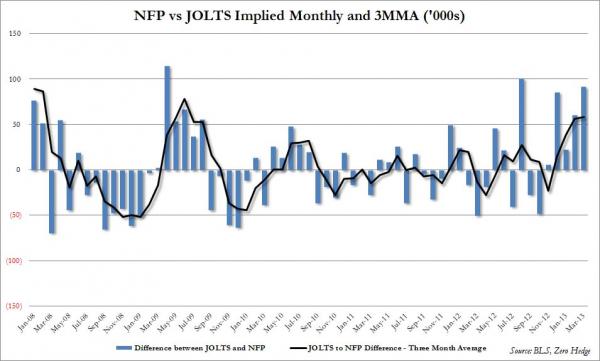
In the aftermath of last week’s decidedly weak unemployment report (pre-spun to appear strong while ignoring the major drop in average weekly hours worked, which would have resulted in a massive drop in payrolls had total demand for labor stayed constant from March), many were looking for some confirmation, or denial, from today’s Job Openings and Labor Turnover (JOLTS) survey which provides the labor breakdown by new job openings, hires, separations, quits and layoffs for the preceding month. On the surface, the March JOLTS survey was a disappointment – analysts look at the report to see how the Job Openings trend is doing as an indication of labor demand (a decline from 3.899MM to 3.844MM, and down from a year ago, or 3.848MM, as well). More importantly, New Hired tumbled to the lowest since December, printing at 4.259MM, down from 4.451MM in February, and down from 4.435MM a year earlier.  On the exit side, workers indicates less leverage as well, with voluntary Quits, or worker-initiated departures, down 126K from 2.286MM to 2.160MM, while involuntary discharges, or terminations, spiked by 121K from 1.572MM to 1.693MM. As Stone McCarthy explains, this “hints at a less favorable environment for the labor market, especially when the increase in the number of layoffs (+121,000) is taken into consideration.” However, the biggest surprise from the JOLTS report is not in any of the standalone series, but in the time progression of the Net Turnovers number, which is simply the total new hires less total separations. Historically, the Net Turnover number tracks the total monthly nonfarm payroll change (establishment survey) on a almost tick for tick basis. Not this time. In fact as the chart below showed, the upward revised March NFP number to 138K, which preceded the even more optimistic, and much cheered April print of 165K, which sent the S&P and the DJIA soaring to new all time highs on Friday, not only did not get a confirmation, but in fact the JOLTS survey for Net Turnovers  – which came at only 46K in March compared to a revised 138K jobs added per the establishment survey – implied that the real NFP number in March should have tumbled to a level last seen in September of 2010! Looking at only the difference between the monthly NFP change and the implied JOLTS monthly job change, we find only the third highest discrepancy since the Great financial crisis, as can be expected implying a far greater bullish upside bias reported by the BLS in the non-farm payroll data. In fact, on a three monthly moving average, the “bullish bias” difference to NFP reported data is now only as big as it was just after the Lehman failure!  Of course, this data only looks back through March. It is quite possible that the April JOLTS data will be so strong, that it overwhelms the time series on both a monthly, and a moving average basis, promptly catches up to where it should be… Somewhere 150K higher than what the April payroll print of +165K suggested. Somehow, we doubt it.

NFP to Jolts Difference_0 NFP to Jolts_1_0 Read more of this post

Australia: Rising debt weighs heavily on any future boom

Rising debt weighs heavily on any future boom

May 8, 2013

Clancy Yeates

When confidence is building in the property market, as it has been lately, it can be easy to get swept up in the hype. Many of us know people who have made small fortunes on property. After all, house prices rose 6 per cent each year in the boom years between 1995 and 2005. Might this happen again?

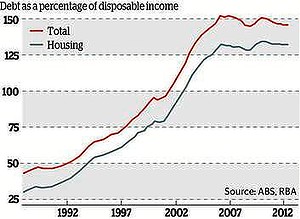
Household indebtedness

There are entire industries – from real estate agents to mortgage brokers – that like to believe so. Some of the less scrupulous operators even like to mention this boom era in their sales pitch, implying it may soon return. While there are signs the housing market could be strengthening at the moment – prices are up 2.7 per cent nationally in the past year – a long-term view suggests we won’t see a return to the boom days of old. Why not? Perhaps the biggest reason is household debt. There were several reasons prices rose so quickly in the past, but the big one was that people bid them up by borrowing more. As this week’s graph shows, we went from borrowing about 50 per cent of disposable income in the early 1990s to 150 per cent – where it has settled. This increase occurred because we were taking out bigger home loans. Such a staggering rise was only possible because debt became a lot cheaper, thanks to a one-off drop in interest rates, and competition in banking.

But both these factors are highly unlikely to be repeated, and here’s why.

RH-353-clancy_20130507155153601145-300x0 Read more of this post

Indian economy: An unfinished project; New Delhi has introduced reforms to revitalise business. But many disillusioned investors are not convinced

May 7, 2013 6:58 pm

Indian economy: An unfinished project

By James Crabtree and Victor Mallet

New Delhi has introduced reforms to revitalise business. But many disillusioned investors are not convinced

At a private meeting in Mumbai’s seafront Taj Mahal hotel last month, finance minister Palaniappan Chid­ambaram made corporate India an unusual offer. Sitting in the hotel’s ballroom were most of the country’s leading industrialists, including billionaires Anil Ambani and Kumar Birla, who were gathered to discuss how to re-energise their nation’s flagging economy. “I’ve come here with one mission: to understand your problems and to fix them,” Mr Chidambaram said, according to one of those present. The finance minister then offered a bouquet of flowers to any participant able to report that none of their big investments was held up by bureaucratic obstacles linked to the government. As the conversation progressed round the table, and one tycoon after another complained of multibillion-dollar projects lying unfinished for the want of some official clearance or other, the flowers went unclaimed. Read more of this post

Malaysian Prime Minister Najib Razak’s election win without the bulk of ethnic Chinese voters is set to pose the biggest test yet

Najib Win Masks Biggest Test After Malaysian Chinese Exodus

Malaysian Prime Minister Najib Razak’s election win without the bulk of ethnic Chinese voters is set to pose the biggest test yet for the pro-Malay affirmative action policies instituted by his father more than three decades ago. The May 5 ballot left Najib’s United Malays Nasional Organisation with 109 parliamentary seats, almost enough to govern without any of its 12 allies in the Barisan Nasional coalition, Election Commission data showed. At the same time, the alliance as a whole took just 47 percent of the popular vote, the lowest since 1969, when Sino-Malay race riots flared. With opposition chief Anwar Ibrahim — ally of the mainly ethnic-Chinese Democratic Action Party that expanded its seats – – planning protests tonight over electoral fraud concerns, Najib, 59, is calling for national reconciliation. To get that, he may need to temper the same preferential-contract and job rules that helped secure his victory among rural Malays.

“UMNO is looking strong, but it’s a false dawn,” said Edmund Terence Gomez, a professor at the University of Malaya in Kuala Lumpur who edited a book on the race-based programs. “They know they need structural changes, and if they don’t do it they will face serious consequences in the next election.” Gomez said the biggest change needed is the removal of policies that restrict certain government contracts to Malays and indigenous groups together known as Bumiputera, or “sons of the soil.” They make up about 60 percent of Malaysia’s 29 million people. Abdul Razak, Najib’s father and Malaysia’s second prime minister, initiated the preferences in the wake of the 1969 riots that killed hundreds. Read more of this post

Bears Keep a Distance From Great White Short; Canada looks like a tempting target for short sellers

Updated May 7, 2013, 6:54 p.m. ET

Bears Keep a Distance From Great White Short

By GREGORY ZUCKERMAN and ALISTAIR MACDONALD

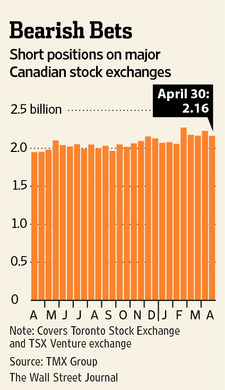
Canada looks like a tempting target for short sellers. The country’s commodity-and-debt-fueled boom has slowed, and consumer debt is at records. There are concerns about a housing bubble after residential-property prices surged nearly 90% over the past decade. And some analysts smell trouble from the economy’s reliance on natural resources, as commodities prices fall and the U.S., long an importer of Canadian crude, produces more of its own oil. Despite all that, some hedge funds and other big investors are agonizing over whether to make big bets against, or sell short, Canadian investments. “I want to [short Canada] very badly,” said Vishaal Bhuyan, who runs Nariman Point, a New York hedge fund that manages more than $20 million. “But their housing bust is more slow-moving than ours was and there are no” perfect ways to bet against the Canadian housing market. The fund has held off on betting against Canadian investments.

MI-BV815_CANADA_NS_20130507175411 Read more of this post