MillerCoors Sees Metal-Warehouse Delay Costing Buyers $3 Billion

MillerCoors Sees Metal-Warehouse Delay Costing Buyers $3 Billion

Global aluminum costs were inflated by $3 billion in the past year through unfair rules that allow Goldman Sachs (GS) Group Inc. and other warehouse owners to slow deliveries, said a risk executive at brewer MillerCoors LLC.

The practices of warehouse owners authorized to hold aluminum by the London Metal Exchange created artificial limits on available supply, leaving prices “inflated relative to the massive oversupply and record production,” Tim Weiner, a global risk manager at Chicago-based MillerCoors, said in written testimony before his appearance today at a U.S. Senate subcommittee hearing in Washington. Read more of this post

Mandela’s Wealth-Sharing Dream Fades in South Africa

Mandela’s Wealth-Sharing Dream Fades in South Africa

Prudence Moime looks up from stirring a pot of corn meal in front of her two-room shanty in northeastern South Africa and gazes across the surrounding rocky hillside. Just beyond her view lie some of the world’s best platinum deposits.

She says she waits in vain for some of the money promised to her village by African Rainbow Minerals Ltd. (ARI), part-owned by Patrice Motsepe, the richest black South African and a beneficiary of the country’s policy to spread the wealth to blacks after the end of apartheid. Read more of this post

Corporate fraud specialists say using travel agencies, and marketing or consulting firms, to launder money, embezzle or create slush funds to bribe officials is common in China, even at MNCs

July 21, 2013

Files Suggest a Graft Case in China May Expand

By DAVID BARBOZA

SHANGHAI — A few weeks ago, when Chinese investigators raided a small travel agency in this fast-growing city, they came upon something startling.

The agency appeared to be using fake contracts and travel invoices to help executives at the British pharmaceutical giant GlaxoSmithKline bribe doctors, hospitals, foundations and government officials, Chinese authorities said. Read more of this post

Alcoa chairman and chief executive Klaus Kleinfeld complained that China’s aluminium smelter sector is “living on a different universe”; record production despite 41% of all Chinese smelters may be financially “under water”.

Aluminium; parallel universe or the same one? Andy Home

10:11am EDT

By Andy Home

LONDON (Reuters) – China’s production of aluminium cranked up several gears last month to an annualized 22.42 million tonnes. It was the second-highest run-rate ever, eclipsed only by what may have been a holiday-distorted output figure in February.

The world’s largest producer churned out 10.54 million tonnes of the light metal in the first half of this year, according to figures from China’s Nonferrous Metals Industry Association published by the International Aluminium Institute (IAI). Read more of this post

Hotlines spring up for China VIPs to buy luxury goods amid anti-graft drive

Hotlines spring up for China VIPs to buy luxury goods amid anti-graft drive

Monday, 22 July, 2013, 12:00am

George Chen george.chen@scmp.com

Amid Xi Jinping’s anti-graft drive and the popularity of weibo, those who have something to hide prefer to do their shopping by telephone

President Xi Jinping’s anti-graft campaign may have created a new business on the mainland: serving “important people” in an extremely low-profile, or even secret, way.

I was back in Shanghai for a quick trip recently and dropped by several big shopping centres on Nanjing Road, one of the mainland’s busiest streets. Ironically, these shopping centres – and, in particular, the big luxury brand shops inside – didn’t look busy at all. They were almost empty. Read more of this post

A Reformist Chinese Leader? Stop Fooling Yourself

A Reformist Chinese Leader? Stop Fooling Yourself

By Jeffrey WasserstromJuly 22, 201313 Comments

Pedestrians walk past a billboard displaying, from left, Chinese Communist Party leaders Mao Zedong, Deng Xiaoping, Jiang Zemin and Hu Jintao at an event celebrating the 90th anniversary of the Chinese Communist Party in Beijing

For those of us who have tracked Chinese political trends since the late 1970s when Deng Xiaoping came to power, reading the news about China these days can prove strangely disorienting. One week, we’ll be struck by a slew of stories, on everything from fast trains to record growth rates, which underscore how different China is than it was when Deng first launched his reforms. The next week, though, we’ll be struck just as powerfully by a sense of eerie familiarity. Headline after headline — about the intractability of corruption, the death of a watermelon vendor or a petitioner’s desperate attempt to draw attention to this plight by detonating an explosive device at a Beijing airport — seem just like those we came across a few years or even a couple of decades ago. Read more of this post

Systemic risk over China’s mid-tier banks

Updated: Tuesday July 23, 2013 MYT 8:01:46 AM

Systemic risk over China’s mid-tier banks

BY KARIM RASLAN

Analysts have been warning on the risks of China’s “shadow banking” system – a sector estimated to have as much as RM4.15tril in assets.

RAMADAN is always a good time for reflection. This year, I’ve been researching a new TV documentary series, Ceritalah Indonesia, that I’m hoping to shoot by September. I want to tell the story of how Indonesia, having endured the Asian Financial Crisis in 1997/1998, ousted President Suharto and then launched into the tumultuous “Reformasi Era” before finding some degree of stability under President Susilo Bambang Yudhoyono. As a result, I’ve been going over recent history – including the roots of the crisis itself. Now even though I’m not an economist, it’s been a very interesting journey, especially reading about the various bank failures that sparked off and then deepened the crisis. Back then, banks seemed to be falling like dominoes: Thailand’s Finance One collapsed spectacularly. This was followed only a few months later by Bank Indonesia’s surprise decision to close sixteen banks. As the momentum gathered in intensity, one of Japan’s most important brokerage houses – Sanyo Securities was also shuttered. Read more of this post

EBay Eyes China as Global Commerce Seen at $307 Billion

EBay Eyes China as Global Commerce Seen at $307 Billion

Online sales of goods between countries will almost triple over the next five years as more people shop on the Web and merchants seek consumers across globe, a study commissioned by EBay Inc. (EBAY)’s PayPal found.

Cross-border Internet commerce between Australia, Brazil, China, Germany, U.K. and U.S. will jump to $307 billion in 2018 from $105 billion this year, according to a Nielsen study published today. The top categories of goods that will be traded includes clothing, shoes and accessories, followed by health and beauty products, and personal electronics, the report said. Read more of this post

Google to Acquire 6.3% Stake in Taiwan’s Himax Display Division to push Google Glass

Google to fund Taiwanese display maker to push Google Glass

Tue Jul 23 00:42:33 UTC 2013

Sruthi Ramakrishnan

Google has taken another step towards a commercial version of Google Glass by acquiring a small stake in a unit of Taiwanese chipmaker Himax Technologies, which develops tiny displays. Google will take a 6.3 per cent stake in Himax Display and has an option to raise its stake to 14.8 per cent within a year, Himax said in a statement without disclosing the financial details. Read more of this post

How big data can result in bad data; ‘A fool with a tool is still a fool.”

How big data can result in bad data

July 23, 2013 – 8:13AM

Drew Turney

Stacks of information is just yada yada yada until it’s analysed properly. A couple of years ago, ratings agency Standard & Poor’s downgraded US debt. Not because of the state of the economy, but because of an error in its original calculations – a mere $US2.1 trillion. Nate Silver, the poster child for analytic predictions, told a recent conference that the financial crisis was as much about bad modelling as greed. The ratings agencies, he said, based assumptions on past mortgages, not the number of people who would default. Welcome to the world of bad data, something that’s caught on in Australia, too. GS1, the agency responsible for barcoding and product identification systems, recently released a report that found bad data will cost Australian grocery retailers $675 million in lost sales over the next five years, and that 65 per cent of ”data misalignment” problems led to lost sales. Read more of this post

Hasbro Games Show Signs of Life in iPad World; Hasbro has remade classic products, such as turning “Twister” into “Twister Dance” and incorporating pop music into the game, to lure a younger set accustomed to digital elements in their play

Hasbro Games Show Signs of Life in iPad World

Hasbro Inc. (HAS), the world’s second-largest toymaker, is showing signs that its games business just may thrive in an iPad world.

Sales of games such as “Monopoly” and “Magic: The Gathering” rose 19 percent to $255.4 million in the second quarter, Pawtucket, Rhode Island-based Hasbro said today in a statement. That was the unit’s third straight sales gain and reverses a 7.6 percent drop in the same period a year earlier.

Hasbro has remade classic products, such as turning “Twister” into “Twister Dance” and incorporating pop music into the game, to lure a younger set accustomed to digital elements in their play. After years of playing catch-up to Zynga Inc. (ZNGA) and others in the market for games played on Apple Inc.’s best-selling tablet, Hasbro two weeks ago acquired a stake in Backflip Studios, maker of titles such as “DragonVale” and “Paper Toss.” Read more of this post

Wall Street Commodity Trading in Jeopardy Amid Fed Review

Wall Street Commodity Trading in Jeopardy Amid Fed Review

JPMorgan Chase & Co. (JPM), Morgan Stanley (MS) and Goldman Sachs Group Inc. (GS) are among lenders whose commodity-trading is in jeopardy as the Federal Reserve reconsiders letting banks ship oil and store metal.

The central bank, ahead of a Senate subcommittee hearing on the issue tomorrow, says it’s reviewing a decade-old ruling to let deposit-taking banks trade physical commodities. A reversal would be the Fed’s biggest exclusion of banks from a market since Congress lifted the Depression-era law against them joining with securities firms in 1999. Read more of this post

BRIC Bust Seen in Emerging Market Discontent With Growth

BRIC Bust Seen in Emerging Market Discontent With Growth

Stretched budgets and sluggish growth are putting emerging-market governments on a collision course with rising pressures from recently empowered middle classes for more spending and better services.

From Jakarta to Brasilia, policy makers face the end to an era of abundant global liquidity that helped fuel the fastest expansion in three decades. In the eight weeks through July 17, investors pulled $40.3 billion from emerging-market bond and equity funds amid signs the Federal Reserve may begin reducing stimulus later this year. In 2012, $111 billion poured into these asset classes, according to EPFR Global in Cambridge, Massachusetts, which tracks money flows. Read more of this post

SEC Warns: Prepare For Repo Defaults

SEC Warns: Prepare For Repo Defaults

Tyler Durden on 07/22/2013 21:28 -0400

As we warned here most recently, the shadow-banking system remains the most crisis-catalyzing part of the markets currently as collateral shortages (and capital inadequacy) continue to grow as concerns. In recent weeks, between The Fed, Basel III, and the FDIC, regulators have signalled the possible intent to change risk, netting, and capital rules that could have dramatic implications on the repo markets and now, it seems, the SEC has begun to recognize just how big a concern that could be. As Reuters reports, the SEC urged funds and advisers last week to review master repurchase agreement documentation to see if there are any procedures to handle defaults, and if necessary, prepare draft templates in advance. A retrenchment in repo markets is unwelcome news for the liquidity of the underlying securities. Most repos, around 80%-90%, are against government-related collateral and it is the repo market which makes government securities relatively more liquid by allowing fast and efficient financing and short covering. It is not accidental that trading volumes in bond markets are so closely related to the outstanding amount of repos. Read more of this post

A Beer Tale: Pilsner Urquell’s formula for success; How the iconic brand won back U.S. fans by making the product more exclusive — and better tasting.

A Beer Tale: Pilsner Urquell’s formula for success

July 22, 2013: 8:28 AM ET

How the iconic brand won back U.S. fans by making the product more exclusive — and better tasting.

By Beth Kowitt, writer

10

FORTUNE — The Pilsner Urquell brewery in the Czech Republic is a regular stop for beer aficionados. Visitors make their way down to the cellars to drink beer out of wooden barrels. It’s a place where people fall in love with the beer, says Pilsner Urquell brand manager, Chad Wodskow. The problem for SABMiller (SBMRF), which owns the brand, is that people would come back to the U.S., buy a Pilsner at their local bar, and accuse the company of bringing over a different brew. SABMiller is one of the parent companies of MillerCoors, which imports the beer into the U.S. Read more of this post

Amazon versus your public library; Will consumers buy as many e-books when they can borrow them?

Amazon versus your public library

July 22, 2013: 10:13 AM ET

Will consumers buy as many e-books when they can borrow them?

By Verne Kopytoff, contributor

FORTUNE — Amazon’s dominance in digital books is under perpetual attack by Google and Apple. Now you can add another threat to the list: the public library. That’s what an analyst from Barclays suggested in a recent research report. Consumers will likely avoid buying e-books if they can borrow them from the library for free. “As e-reader users become more familiar with the library’s system’s free alternative, and as libraries reduce the friction associated with borrowing e-books, we believe digital content revenue growth at Amazon may soften,” said Anthony DiClemente, a Barclays analyst. Read more of this post

The Sinodependency index: Is exposure to China still a good thing?

The Sinodependency index

Declaration of Chindependence

For an American multinational, is exposure to China still a good thing?

Jul 20th 2013 | SYDNEY |From the print edition

20130720_FNC092

BEFORE the global financial crisis, emerging economies like China aspired to “decouple” themselves from the rich world, hoping that local demand and regional trade would sustain them even if Western markets faltered. After the crisis, rich economies aspired to couple themselves with China, one of the few sources of growth in a moribund world. Carmakers in Germany, iron-ore miners in Australia and milk-powder makers in New Zealand all benefited enormously from exports to the Middle Kingdom. Every company needed a China story to tell. But as China slows and America gradually recovers, those stories are becoming less compelling. Some of them are turning into cautionary tales. Exposure to China does not always endear a firm to investors, as GlaxoSmithKline, a British pharmaceutical giant embroiled in a corruption scandal in the country, is now discovering. As a rough gauge of multinational exposure to China, The Economist in 2010 introduced the Sinodependency index, a stockmarket index that weights American multinationals according to their China revenues. The latest version of the index includes all of the members of the S&P 500 index that provide a usable geographical breakdown of their revenues. The weight of each of these 133 firms in the index reflects their market capitalisation multiplied by China’s share of their revenues. A company worth $100 billion that derives 10% of its revenues from China has the same weight as one worth $20 billion deriving half of its revenues from China. Where firms report their revenues for Asia-Pacific but not for China, the index assumes that China’s share of regional revenues matches its share of regional GDP. The biggest members of the index are Apple, with an 11% weight in 2013, followed by Qualcomm (8.3%) and Intel (7%). Most of the firms in the index are more dependent on China now than they were. China accounted for 11.2% of their revenues on average in 2012, compared with 9.8% in 2009. Read more of this post

Banks big and small are embracing cloud computing

Banks big and small are embracing cloud computing

Jul 20th 2013 |From the print edition

“I’VE only got one IT guy,” says Segun Akintemi, the chief executive of Renaissance Credit, a Nigerian moneylender that opened for business in October 2012 and signed up about 3,000 customers in its first six months. “Whenever I walk past his desk he is surfing the web.” That the firm has just one bored computer specialist is not a sign of backwardness. On the contrary, Renaissance Credit is ahead of its time when it comes to technology. Its information processing takes place in the “cloud”, the term for software and services delivered over the internet. The emergence of cloud-based banking promises to affect banks big and small. Banks are expected to spend almost $180 billion on IT this year, according to Celent, a consultancy. For the moment cloud-based services make up a tiny fraction of this amount, but by some estimates spending by financial-services firms on the cloud will total $26 billion in 2015. This increase should lower barriers to entry for newcomers, which can rent modern IT infrastructure at monthly fees of less than $10,000 rather than having to invest tens of millions of dollars upfront to build their own secure data centres. And it should also enable big banks to become much more cost-efficient. Read more of this post

Investors Struggle With Cash Conundrum: Respected investment pros are scouring the world for cheap stocks and bonds, and coming up empty. They are left holding cash, preferring to dilute returns rather than risk buying near the top

Jul 21, 2013

Investors Struggle With Cash Conundrum

By E.S. Browning

Charles de Vaulx has an investment idea: cash.

That may seem an odd choice, since cash earns less than inflation, making it a money-losing proposition. But Mr. de Vaulx, who oversees $17.8 billion as chief investment officer at International Value Advisers in New York, has been boosting his cash position. He is having trouble finding stocks he considers cheap and won’t buy overvalued stocks. He considers bonds even more overvalued than stocks, leaving him perched on a lumpy cash pillow. Other value-oriented investors have made similar choices, led by Berkshire Hathaway Inc. BRKB +0.29% chief executive Warren Buffett. Mr. Buffett is sitting on $49 billion, his biggest cash hoard ever, according to Berkshire’s latest quarterly report. It is an odd spectacle. Teams of respected investment pros are scouring the world for stocks and bonds they can buy on the cheap, and coming up empty. They are left holding some cash, telling their investors and shareholders they prefer to dilute their returns now rather than risk losing a lot by buying near the top. Read more of this post

Ctrl Alt Delete: Reboot Your Business. Reboot Your Life. Your Future Depends On It

Your Career Won’t Be Predictable, And That’s A Good Thing

WRITTEN BY: MITCH JOEL

There is no gold watch in your future. Careers just aren’t as predictable as they once were. Here’s how you can manage.

1682611-inline-mitch-joel-cover

This is an excerpt from Mitch Joel’s Ctrl Alt Delete: Reboot Your Business. Reboot Your Life. Your Future Depends On It. © 2013 by Mitch Joel. Reprinted by permission of Business Plus. All rights reserved

To be an effective business leader (and this is, without question, the goal for those of us who want to still be employable moving forward) requires you to not only personally embrace a digital-first posture but to also look microscopically at your career to date and where it is headed.

I’m fascinated by successful people and their career paths. Do you know what I never hear when I listen to a successful businessperson speak or when I read a biography of someone I respect? I never hear a story that goes like this: “I always knew that I wanted to be in marketing. There was never any doubt in my mind. All through elementary school, all I could do was daydream about marketing campaigns and working on a company’s overall strategic vision. While other kids were outside playing, I was busy drawing up logos for imaginary companies. In high school, I started the marketing club and could not wait until our economics teacher touched–ever so slightly–on the topic of marketing. Right after high school graduation, I interned at an advertising agency and could not wait to pursue my MBA with a focus on marketing.” Read more of this post

Hong Kong Brokers Drive Cabs as Competition Forces Locals Out

Hong Kong Brokers Drive Cabs as Competition Forces Locals Out

Hong Kong, Asia’s second-biggest stock market, may see 25 percent of its local brokerages close as trading and fees plunge, and competition from banks intensifies, a securities association said.

The number of local broking firms may decline to 300 from about 400 in the next five years, Mofiz Chan, a spokesman of the Hong Kong Securities & Futures Professionals Association, said in a telephone interview. Read more of this post

Foreign Capital Outflows Hit China in June; Net Outflow Was First Since November, Contributing to Credit Crunch

Updated July 22, 2013, 7:27 a.m. ET

Foreign Capital Outflows Hit China in June

Net Outflow Was First Since November, Contributing to Credit Crunch

BEIJING—Foreign capital flowed out of China in June as economic growth slowed and a rise in the Chinese currency stalled, contributing to a credit crunch that briefly strained the nation’s banking system. The credit crunch has eased considerably since last month as the central bank injected liquidity in the interbank market, where banks lend funds to each other, but the squeeze raised doubts about the strength of China’s banking and financial system. The net outflow of foreign capital in June was the first since November. The People’s Bank of China and financial institutions sold a net 41.2 billion yuan ($6.71 billion) worth of foreign currency in June compared with net purchases of 66.86 billion yuan in May, according to Wall Street Journal calculations based on central bank data released Monday. Read more of this post

Beijing Lending Shift May Force Banks to Raise Capital; China’s banks will need up to $100 billion in new funding over the next two years following Beijing’s move to shake up lending

July 21, 2013, 12:06 p.m. ET

Beijing Lending Shift May Force Banks to Raise Capital

Removal of Floor on Loan Rates Is Seen Hitting Smaller Lenders Hardest

LINGLING WEI

MI-BX327_CLEND_D_20130721171804

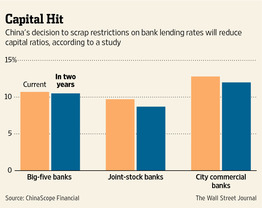
BEIJING—China’s banks will need up to $100 billion in new funding over the next two years following Beijing’s move to shake up lending, according to an analysis by a research firm, and that could spur banks to tap investors for capital even amid growing worries over the strength of their balance sheets. China’s central bank on Saturday removed a government floor on the interest rates banks can charge their clients for credit, allowing financial institutions to price loans at whatever level they want. Authorities hope the action will foster competition among banks and result in easier access to loans for businesses and individual borrowers, especially small and private manufacturers long shunned by big state-owned lenders.  Read more of this post

China’s rate reform adds to concerns for bank investors as eventual industry overhaul will deprive the banks of virtually risk-free profits

China’s rate reform adds to concerns for bank investors

12:16am EDT

By Pete Sweeney and Gabriel Wildau

SHANGHAI (Reuters) – Beijing’s move to scrap the floor on lending rates is not yet a game-changer for Chinese banks, but it may have just started the countdown to an eventual industry overhaul which will deprive the banks of virtually risk-free profits.

China bank stocks mostly fell on Monday, the first trading session following the rate reform announced late on Friday. An index of banks listed in Shanghai was down 1.7 percent in late morning trading, compared with a decline of 0.4 percent for the broader Shanghai Composite Index .SSEC.SS. Read more of this post

Senior provincial officials seek financial help from China’s finance ministry, even from provinces considered economically sound such as Guangdong

Senior provincial officials seek help from China’s finance ministry

Staff Reporter

2013-07-18

Several senior provincial-level officials have personally sought financial support from China’s Ministry of Finance, with officials from provinces considered economically sound such as Guangdong, also voicing similar demands, reports Shanghai’s National Business Daily. Amid an economic slowdown, provincial officials have made visits to the Ministry of Finance with the aim of receiving central government benefits to bolster their regions. The list includes Guo Gengmao, secretary of the CPC Henan Provincial Committee, Xie Fuzhan, the governor of Henan, Zhou Benshen, secretary of the CPC Hebei Provincial Committee, and the governor of Guangdong Zhu Xiaodan. Read more of this post

The path of bankruptcy which crippled the once booming industrial city of Detroit is now being followed by certain cities in China

Detroit clones cropping up around China

Staff Reporter

2013-07-21

The path of bankruptcy which crippled the once booming industrial city of Detroit is now being followed by certain cities in China. These cities, such as Ordos and Wenzhou, develop rapidly without considering market demand and become “ghost towns,” according to the China Securities Journal.

The difference between Detroit and ghost towns in China, said Yang Shaofong, chairman of Chinese property developer Conworld, is that the latter will never go bankrupt because Beijing will always bail them out through policy support. Many of the ghost towns are actually already bankrupt. Read more of this post

As luck would have it: Historian, China scholar and bestselling author Jonathan Spence retraces a career driven by serendipity

As luck would have it

Sunday, 21 July, 2013, 12:00am

Kate Whitehead

Historian, China scholar and bestselling author Jonathan Spence retraces a career driven by serendipity, writes Kate Whitehead.

Jonathan Spence – historian, intellectual and eminent China scholar – is not one for a snappy answer. He’s not slow to reply; just very thorough. Unhurriedly he paints a picture, sketching in plenty of detail and planting his response somewhere in the middle. Ask him when he first became interested in China and he won’t give you a hard and fast answer. He’ll talk about his childhood, about his first conscious memory, and then go on to ponder whether we can even be certain that a memory is genuine. He’ll want you to understand the context behind what he’s saying – and it will always be interesting. Perhaps that’s what sets him apart from other historians – this knack of spinning his web and drawing you in. Read more of this post

Madness and the delicate art of exercising power in negotiating

Madness and the delicate art of exercising power in negotiating

INSEAD | Business | Sat, July 20 2013, 3:46 PM

Unpredictability can be an asset in making people do what you want as a leader and a negotiator. In October, 1969, the Nixon White House indicated to the Soviets that the “madman was loose” as the US military ostentatiously flew bombers packed with thermonuclear weapons near the Soviet border for three consecutive days. It was part of the then-president’s “Madman” strategy, designed to make the leaders of other countries, especially the Soviet Union, think that the American president was quite literally emotionally unstable and disjointed. Senior U.S. officials, such as Secretary of State Henry Kissinger, not only portrayed Nixon as irrational and volatile to his Soviet counterparts, but made them think that Nixon was totally unpredictable. The sudden decision to bring the bombers home reinforced the “madman’s” unpredictable nature and baffled the Soviets. Read more of this post

Beware your heroes and heed the lesson of stargazer Galileo Galilei

Beware your heroes and heed the lesson of stargazer Galileo Galilei

BY NORIKO HAMA

SPECIAL TO THE JAPAN TIMES

JUL 21, 2013

A scene from “The Life of Galilei” seems to encapsulate the dilemma Japan faces as it gropes for new leadership. “Woe betide a nation without heroes.” “Not so. Woe betide a nation in need of heroes.” This exchange from the play by anti-establishment German playwright Bertolt Brecht is a traumatic one in which Galileo Galilei returns from his encounter with the Grand Inquisitor. (The production I saw was in Japanese. The translations are my own.) The latter has managed to convince the scientist to rescind his views on celestial dynamics and shut up about the earth moving round the sun. It turns out that even the great Galileo is susceptible to threats when they are accompanied by a display of the latest advances in torture tools. The above lament over the lack of heroes is an utterance of Master Galileo’s foremost student, who did not believe even for a moment that his great tutor would capitulate. Read more of this post

How Companies Can Get Smart About Raising Prices; Marketers too often do precisely the wrong things, alienating customers and getting little return. Here’s how they can do it right.

Updated July 21, 2013, 4:01 p.m. ET

How Companies Can Get Smart About Raising Prices

Marketers too often do precisely the wrong things, alienating customers and getting little return. Here’s how they can do it right.

KUSUM L. AILAWADI and PAUL W. FARRIS

LE-AA274B_PRICE_G_20130719125704

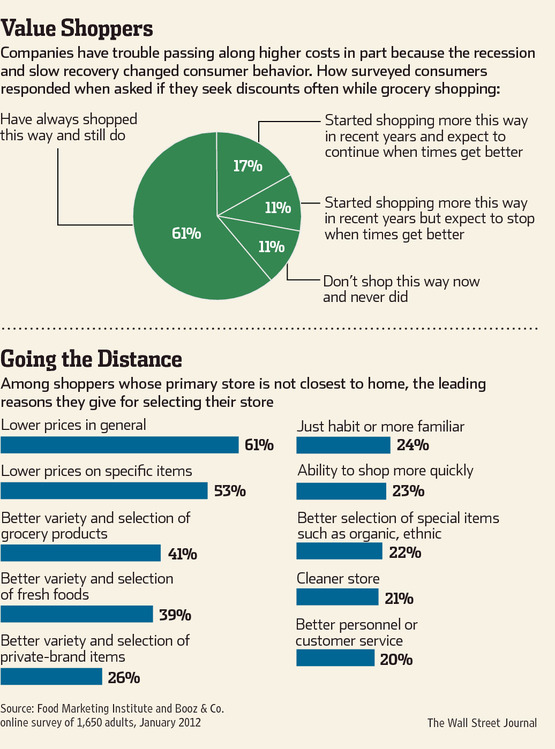
How do you get Customers to pay more for your products? It’s a question no company wants to face. Raise prices in the middle of a sluggish economy, and they risk alienating customers they can’t afford to lose and leave themselves vulnerable to competitors. Yet they have little choice but to ratchet up. The cost of making consumer goods and getting them to stores has been rising for some time. And a lot of the old strategies for shaving overhead, such as outsourcing, are getting less effective in economic terms and more unpopular in humanitarian terms. Read more of this post