Weibo to introduce e-commerce platform

Weibo to introduce e-commerce platform

Staff Reporter

2013-07-10

After the launch of an online shopping service in cooperation with Alibaba’s Taobao — one of China’s leading e-commerce websites — Sina Weibo, the country’s most popular microblogging service, has enabled online shoppers to check the status of their parcels, representing another major step towards its commercialization, reports the Beijing-based China Entrepreneur magazine. Online shoppers can now use Weibo to check the payment and shipment status for orders placed within a three month period. They can also use dedicated mobile phones in partnership with Weibo to check and receive information on orders, thereby closely monitoring the latest handling status of their items, the report said. Read more of this post

China Seen Widening Car-Purchase Limit to Fight Pollution; “More cities will introduce purchase restrictions. This is just the beginning of a long-term trend.”

China Seen Widening Car-Purchase Limit to Fight Pollution

China, the biggest emitter of greenhouse gases, plans to widen the number of cities curbing auto purchases to fight pollution and congestion, threatening vehicle sales, the government-backed car association said. Eight cities — Chengdu, Chongqing, Hangzhou, Qingdao, Shenzhen, Shijiazhuang, Tianjin and Wuhan — will probably introduce measures limiting auto purchases, Shi Jianhua, deputy secretary general of the China Association of Automobile Manufacturers, said in a briefing in Beijing today, without being more specific about the timing. Such limitations could cut vehicle deliveries by 400,000 units, or 2 percent of nationwide sales, and undermine economic growth, Shi said. If introduced, the measures may triple the number of Chinese cities — Beijing and Shanghai have vehicle quotas — imposing curbs on automobiles as public anger grows over worsening congestion and air pollution.

Read more of this post

Warren Buffett, the Human Big Data Engine

Warren Buffett, the Human Big Data Engine

Posted May 3, 2013 by Chanu Darmarla in Big DataThought Leadership

Warren Buffett is one of the world’s most successful investors. By combining a sound investment philosophy with a bullet-proof decision-making process, Buffet has been able to outperform the stock market by roughly 13% over a 35-year period. Buffett spends countless hours researching each of his equities. Before making a decision, he reads annual reports, news publications and any other information he can get his hands on. His decisions are informed by research, and based on the strict fundamentals that work best for his style of investing. The way Buffett operates is not unlike the best use cases for big data. Among other things, his success lies in his ability to make good decisions in accordance with quality benchmarks. This is the key to using big data well, and to business success in general. Big data users can learn from Warren Buffett. His brain, in effect, is a kind of big data engine. Here are three lessons that Buffett provides for big data users:

1. Know What You’re Looking For

By analyzing large amounts of data from diverse sources, we can gain context and correlations that wouldn’t have otherwise occurred to us. Buffett pulls from actuary reports and bond publications; big data can suck information out of nearly everything, from social media to expense reports. But it is all for nothing if you don’t know what you’re looking for. You need structure around your queries. Buffett has a few rules of thumb. He looks for low-volatility stocks with a low price-to-book ratio. They should be profitable and growing, among other considerations. Similarly, if you ask your data analytics platform the right questions, you’ll know the best answers when you see them. Perhaps you’re looking for a Scotch-drinking customer base that prefers premium product and prioritizes convenience over shopping around. If you know that before you ask your data engine to generate their social media preferences, you’ll get a much better result than if you asked the same question about Scotch drinkers in general. Read more of this post

The only community you need to worry about are the people who buy your stuff; They’re the only ones who truly appreciate your value, and they’re the only ones who have any interest in seeing you succeed

The only community you need to worry about

BY FRANCISCO DAO 
ON JULY 9, 2013

Social media advocates will tell you it’s no longer enough for a business to just have customers or even fans. They have to have an active community of “influencers,” “brand advocates,” and a designated community manager to keep them all warm and happy. As usual, the smankers have it wrong. They think your community is who likes you on Facebook or who attends your launch party. Such people have no commitment to you and are basically just using you for whatever they can get for free. Stop worrying about managing this false community. The only group you need to worry about are the people who buy your stuff. Unless someone is an actual customer, they haven’t experienced your product or service, which means whatever they have to say about your brand is coming from a place of limited knowledge. Furthermore, it is highly unlikely that someone who is not a customer can legitimately identify with, or has any emotional attachment to, your product or service. There’s really no way for them to be a credible advocate for what you offer. Read more of this post

The most dangerous unforced errors: Major, self-inflicted mistakes can undermine a career – or an entire life

July 9, 2013 4:57 pm

The most dangerous unforced errors

By Luke Johnson

Major, self-inflicted mistakes can undermine a career – or an entire life

As Wimbledon has just ended, it feels appropriate to discuss the subject of unforced errors. I’m not referring to shots on a tennis court: I’m talking about big, self-inflicted mistakes that can undermine a commercial career – or indeed an entire life.

● One of the worst blunders is to be insufficiently optimistic when favourable circumstances present themselves. Great business and substantial market openings are rare. To cast them aside too swiftly is a frequent failing. After we took Topps Tiles public in 1997, the shares rose threefold, and it seemed to me that the stock market was overexcited – so I sold a big chunk of my holding. But the journey was only just beginning. The stock climbed at least 500 per cent more over the following years: I could only watch in irritation at the ascent. Gordon Moore, who went on to found Intel, said: “My biggest mistake at Fairchild [Semiconductor] was not appreciating how big the business for integrated circuits would be.” Read more of this post

7 Founders That Got Kicked Out By Their Own Company

7 Founders That Got Kicked Out By Their Own Company

INC STAFFINC. JUL. 9, 2013, 6:25 PM 12,431

Men’s Wearhouse made headlines recently when it decided to can its TV spokesman and founder George Zimmer. This type of thing happens all the time, says Noam Wasserman, a professor at Harvard Business School. Sometimes their passion detracts from their management skills and they aren’t suited to run the companies their start-ups grow into. Here are seven more founders who learned the hard way.

Martin Eberhard, Tesla

Tesla Motors might be synonymous with the name Elon Musk, but the company has two founders. In 2007, Tesla fired Martin Eberhard from his post as president, but apparently signing a”non-disparagement agreement” didn’t stop him from sounding off on the company. In 2009, Eberhard sued Musk for libel and breach of contract, as well as taking credit for developing Tesla’s Roadster. The suit also claimed Tesla had withheld his severance pay as a consequence of violating the non-disparagement clause. Read more of this post

Lessons from the first millionaire online teacher

Lessons from the first millionaire online teacher

BY SARAH LACY 
ON JULY 8, 2013

Software programming? Yeah it’s an okay way to  make a living. But the real money is in teaching.

Or at least that’s the recent experience of Scott Allen, a programmer and teacher the tech-y online education platform Pluralsight.com. Allen has earned more than $1.8 million through fees and royalties from Pluralsight over the last five years. He says each monthly royalty check has increased in size over that period — the smallest increase being 10 percent month-over-month. That far outdid his expectations when he started making educational videos for Pluralsight. “It’s amazing,” he says.

I got pitched this story this morning with the subject line “Online ed’s first millionaire teacher.” I was drawn to it, because I could imagine the same story being pitched about blogging or online journalism several years ago. There are a lot of parallels between what those two industries are going through, and how each are grappling with the Web’s potential for disruption. Read more of this post

The future is in creativity, not mere productivity

The future is in creativity, not mere productivity

Organisations have nearly perfected the industrial model of managing work. For individuals, this model ensures that we know what we are supposed to do each day. For organisations, it guarantees predictability and efficiency.

4 HOURS 31 MIN AGO

Organisations have nearly perfected the industrial model of managing work. For individuals, this model ensures that we know what we are supposed to do each day. For organisations, it guarantees predictability and efficiency. The problem with this model is that work is becoming commoditised at an increasing rate, extending beyond manual tasks into knowledge work, as data entry, purchasing, billing, payroll and similar responsibilities become automated. Organisations are finding that it is increasingly difficult to draw value from the optimisation of repetitive work. The value of products and services today is based more and more on creativity — the innovative ways that products take advantage of new materials, technologies and processes. Read more of this post

Loro Piana Brothers Become Billionaires Selling Cashmere

Loro Piana Brothers Become Billionaires Selling Cashmere

Sergio and Pier Luigi Loro Piana, the brothers who head Italian cashmere clothier Loro Piana SpA, have emerged as billionaires after agreeing to sell 80 percent of the family-owned company to LVMH Moet Hennessy Louis Vuitton SA (MC).

LVMH’s 2 billion euro ($2.57 billion) purchase is subject to approval by competition authorities, the Paris-based company said yesterday in a statement. The deal gives Quarona, Italy-based Loro Piana an enterprise value of 2.7 billion euros. Enterprise value is defined as market capitalization plus debt minus cash. The Loro Piana brothers will retain 20 percent of the business, LVMH said. Read more of this post

Spanish message in a bottle; Carlos Moro has nurtured a flourishing winery based on patents; sales at Matarromera, one of Spain’s top 20 wine groups by sales, have risen by 43 per cent, fuelled by a surge in exports, since the start of the crisis

July 9, 2013 5:32 pm

Spanish message in a bottle

By Tobias Buck

World view: Carlos Moro says Matarromera was based on globalisation ‘before people spoke about globalisation’

When Carlos Moro wants to show off the heart of his winery group, he takes visitors neither to the famous vineyards that dot the Spanish region of Ribera de Duero, nor to the dark cavernous halls that house hundreds of oak barrels filled with the latest vintages.

Instead, he opens the door to a brightly lit laboratory on the first floor of a bodega, or winery, just outside the village of Valbuena. Perched at computer screens and scientific instruments are more than a dozen researchers in white lab coats. The walls are covered with posters of molecules and technical diagrams explaining some of the seven patents awarded to the winery in recent years. There is not a corkscrew or wine bottle in sight. Read more of this post

Rare Mutation Ignites Race for Cholesterol Drug

July 9, 2013

Rare Mutation Ignites Race for Cholesterol Drug

By GINA KOLATA

jpHEART-1-articleLarge

LARGE SCALE Amgen is preparing three sites, including a 75-acre plant in Rhode Island, to make a cholesterol drug if production is approved.

She was a 32-year-old aerobics instructor from a Dallas suburb — healthy, college educated, with two young children. Nothing out of the ordinary, except one thing. Her cholesterol was astoundingly low. Her low-density lipoprotein, or LDL, the form that promotes heart disease, was 14, a level unheard-of in healthy adults whose normal level is over 100. The reason was a rare gene mutation she had inherited from both her mother and her father. Only one other person, a young, healthy Zimbabwean woman whose LDL cholesterol was 15, has ever been found with the same double dose of the mutation. The discovery of the mutation and of the two women with their dazzlingly low LDL levels has set off one of the greatest medical chases ever. It is a fevered race among three pharmaceutical companies, Amgen, Pfizer and Sanofi, to test and win approval for a drug that mimics the effects of the mutation, drives LDL levels to new lows and prevents heart attacks. All three companies have drugs in clinical trials and report that their results, so far, are exciting. Read more of this post

Investing for a rapidly changing world

July 5, 2013 6:51 pm

Investing for a rapidly changing world

By Norma Cohen, Demography Correspondent

The news on the population front often could not appear more grim – longer working lives, less spending and more saving, higher taxes, and a greater likelihood of chronic or degenerative diseases, such as Alzheimer’s. But there is a silver lining. There is a way to profit from the current unprecedented pace of population change and several large fund management groups are turning their collective hands to doing just that. Read more of this post

Seoul braces for a slowdown; S Korea is trying to find best balance between intervention and market forces at times of stress

July 9, 2013 5:46 pm

Inside Business: Seoul braces for a slowdown

By Henny Sender

S Korea is trying to find best balance between intervention and market forces at times of stress

Asia is bracing for harder times once again. “The oxygen is getting thinner,” noted Frederic Neumann, HSBC’s Asian regional economist, as he slashed growth projections for the region in a report this week. One early straw in the wind was the decision by South Korea’s new government of Park Geun-hye some weeks ago to quietly cancel the planned privatisation of Korea Development Bank, one of Seoul’s principal policy arms. The decision is understandable. As a relatively open economy that lacks the continental dimensions of its neighbour, South Korea is among the countries that are potentially most exposed to the harder economic times. About a quarter of its exports go to China. So when economic growth in its neighbour slows, South Korea also slows. Read more of this post

The send-a-box boom: A slew of young startups have embraced a subscription model wherein customers receive a box of items at their doorstep — but can the model have lasting success?

The send-a-box boom

July 9, 2013: 3:26 PM ET

A slew of young startups have embraced a subscription model wherein customers receive a box of items at their doorstep — but can the model have lasting success?

By Andres Vaamonde, reporter

FORTUNE — Maybe the best things do come in small packages. In an age when consumers can get nearly everything they want online, a number of small new companies are gaining traction not by sending consumers precisely what they’ve ordered, but by surprising them with curated boxes. Birchbox, Merchbox, NatureBox, and BarkBox all make use of the marvel of surprise. Even without “box” in the name, Quarterly.co and, to an extent, Dollar Shave Club, do the same. One part of the process is similar to how the big mainstream e-tailers function: People can place orders and see precisely what they’ll get and when. But in contrast to an Amazon (AMZN) or eBay (EBAY), with these companies — call them “send-a-box” services — signing up is, in most cases, the full extent of the customer’s participation in selecting products. Then they receive a package in the mail every month or few months (varying by company) filled with anything from little-known vinyl records (Merchbox) to makeup samples (Birchbox) to dog treats and toys (BarkBox). Read more of this post

Britain battles to build tech giant as home-grown talent goes West

Britain battles to build tech giant as home-grown talent goes West

7:08am EDT

By Paul SandleDasha Afanasieva and Tommy Wilkes

LONDON (Reuters) – East London’s technology hub is established well beyond start-up status: Thousands of new web firms now work in the offices around Old Street and on any given day the area’s coffee shops buzz with young hopefuls meeting advisers and investors.

Britain’s government has christened the area “Tech City” and makes no secret of its hope that the entrepreneurial ventures being dreamed up there can spearhead an economic boost to lift the country out of a long recession. Read more of this post

Since the first quarter of 2005, Microsoft’s online division has lost $10.9 billion.

Steve Ballmer’s Huge Reorg Of Microsoft Could Bury One Of The Company’s Biggest Embarrassments

JAY YAROW JUL. 9, 2013, 11:12 AM 15,119 14

Microsoft may be about to bury one of its biggest quarterly embarrassments.  Kara Swisher at All Things D reports CEO Steve Ballmer is going to announce a big reorganization of the company this Thursday. As part of the reorg, Microsoft’s earnings reports could be totally different. Swisher says Ballmer is considering mashing up the reporting of the company’s divisions. This would allow Microsoft to hide the atrocious performance of its Online Services Division, which is made up of Bing, MSN, and other pieces. Every quarter Microsoft reports earnings, we run a chart showing the giant losses from OSD. Last quarter, for instance, Microsoft’s online division had an operating income loss of $262 million. And that’s a big improvement!  Since the first quarter of 2005, Microsoft’s online division has lost $10.9 billion.  Read more of this post

Chinese Outsourcing Firms Bid Farewell to America after steep declines in growth and accounting scandals

Chinese Outsourcing Firms Bid Farewell to America – Economic Observer Online

By Shen Jianyuan (沈建缘)
Issue 626, July 1, 2013
On June 6, 2013 services firm iSoftStone (软通动力) announced it was delisting, the company is the last of the nine Chinese service outsourcing enterprises that listed in the U.S. over recent years to withdraw from the stock market. Prior to iSoftStone, Pactera Technology International Ltd. (文思海辉), the largest of China’s service outsourcing companies, was taken private through a management buyout, with acquisition of the remaining stock by private equity firm Blackstone Group in May 2013. Beijing-based Pactera, formed last year through a merger of HiSoft Technology International Ltd (海辉软件国际和) and VanceInfo Technologies Inc (文思信息技术公司), specialises in offering technology outsourcing and consulting services to blue-chip companies around the world. Read more of this post

It will take more than tech to solve traffic problems in Asian cities

It will take more than tech to solve traffic problems in Asian cities

J. Angelo Racoma 5, Jul 2013Featured 

Tripid co-founder Michael Ngo Dee says it will take much more than technology to fix “broken” transportation systems, a big cause of Asia’s traffic woes.

Mass transit in the Philippines is not as efficient as in cities like, say, Singapore, New York or Brazil. Just in Manila, for instance, you would usually need to line up for about an hour or so just to ride the jam-packed MRT during rush hour. Taking the bus or jeepney is just as inefficient, as these public utility vehicles would usually bunch up on select areas in their route while competing for passengers, thereby causing traffic jams. Private motorists are not helping at all — you can still see a lot of big cars with only one passenger plying the streets, which is such a waste. Read more of this post

China Leaves Sour Taste at Yum Brands; Dependency on the Country Has Come Home to Roost After Poultry Scandal There

July 9, 2013, 6:53 p.m. ET

China Leaves Sour Taste at Yum Brands

Dependency on the Country Has Come Home to Roost After Poultry Scandal There

SPENCER JAKAB

MI-BX068_YUMTAP_NS_20130709183304

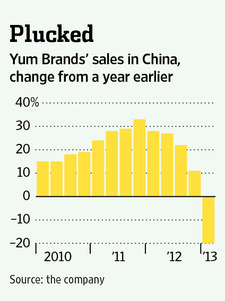
While not quite putting all its eggs in one basket, fast-food chain Yum Brands Inc.YUM +0.70% has leaned heavily on the popularity of fried chicken in China. That dependency has come home to roost in recent months as a poultry scandal in late 2012 and then an avian-flu outbreak this spring drove customers away. Although KFCs in China account for just over a 10th of Yum’s restaurant count globally, it owns all of them and they are the bulk of a Chinese business that contributed 42% of Yum’s “segment profit” in 2012. Restaurants elsewhere are largely franchised and have less earnings impact. Read more of this post

Why China will not buy the world; The Chinese economy is marked by its dependence on others

July 9, 2013 7:26 pm

Why China will not buy the world

By Martin Wolf

The Chinese economy is marked by its dependence on others

China frightens the west. Rarely, however, do westerners look at how the world looks to China. Yes, it has made enormous economic strides. But it still sees a world economy dominated by developed economies. Among the few westerners able to look at the world from the Chinese point of view is Peter Nolan, professor of Chinese development at Cambridge university. In a thought-provoking book published last year, he addressed one of the big fears about China – that it is buying the world. His answer is no: we are inside China but China is not inside us. To understand what Prof Nolan means by this, one must understand his view of what has happened during three decades of technology-driven global economic integration. The world economy has been transformed, he argues, by the emergence, through mergers, acquisition and foreign direct investment, of a limited number of dominant businesses, almost entirely rooted in advanced countries. Read more of this post

China’s credit crunch buffets Berlin; 15 per cent to 20 per cent of German Dax companies’ earnings are China related

July 9, 2013 6:58 pm

China’s credit crunch buffets Berlin

By Ralph Atkins

Germany was the rock of stability during the eurozone crisis but it is being seriously buffeted by the economic slowdown in China. German shares have dropped much more than the European average since June 19. That was when the US Federal Reserve confirmed it wanted to scale back its asset purchases – but also when China’s credit crunch sprang to global attention, heightening worries about how Beijing was applying the economic brakes. There was more bad news yesterday when the International Monetary Fund revised down forecastsfor Chinese growth this year and next. Deutsche Bank estimates the fall in German shipments to China in the first three months of this year compared with the same period in 2012 was already equivalent to 0.5 per cent of German gross domestic product. Read more of this post

Emerging Markets Hit by IMF Forecast; Lower Growth Prospects Further Rattle Developing Nations

Updated July 9, 2013, 9:00 p.m. ET

Emerging Markets Hit by IMF Forecast

Lower Growth Prospects Further Rattle Developing Nations

ERIN MCCARTHY, CHARLES FORELLE and IAN TALLEY

MI-BX090_Emergi_G_20130709190307

Investor fears that the end of easy money is at hand are ricocheting around the globe, slamming financial markets and squeezing economic growth prospects from Brazil to Turkey. In the latest fallout, the International Monetary Fund on Tuesday trimmed its global-growth forecast, reducing its projections for emerging markets such as China and Russia. The report highlights the difficulties facing nations that recently were flooded with investor cash amid a global search for yield, but now face outflows as interest rates rise in the U.S. The IMF’s move underscores the ripple effects as markets brace for the withdrawal of central-bank stimulus policies. Scores of riskier markets have been whipsawed since Federal Reserve Chairman Ben Bernanke signaled this spring that the central bank’s monthly bond purchases, currently $85 billion, eventually will be curtailed. Many investors expect the sharp moves to continue as participants grapple with Fed policy and economic uncertainty. Read more of this post

The political nightmare of a slowing China

The political nightmare of a slowing China

The recent financial turmoil in China, with interbank loan rates spiking to double digits within days, provides further confirmation that the world’s second-largest economy is headed for a hard landing.

4 HOURS 40 MIN AGO

The recent financial turmoil in China, with interbank loan rates spiking to double digits within days, provides further confirmation that the world’s second-largest economy is headed for a hard landing. Fuelled by massive credit growth, the economy has taken on a level of financial leverage that is the highest among emerging markets. This will not end well. Indeed, a recent study by Nomura Securities finds that China’s financial-risk profile today uncannily resembles those of Thailand, Japan, Spain and the United States on the eve of their financial crises. Read more of this post

More Taiwanese firms in China heading home

More Taiwanese firms in China heading home

A growing wave of Taiwanese companies that rode the tide of cheap manufacturing in China are returning home. But they play it safe by relocating partially as costs rise in China. -ST
Lee Seok Hwai
Wed, Jul 10, 2013
The Straits Times

TAIPEI – A growing wave of Taiwanese companies that rode the tide of cheap manufacturing in China over the last three decades are returning home as costs on the mainland creep up. But they are hedging their bets by keeping most of their existing operations in China and relocating only partially or investing in new facilities – focused on research and development (R&D) or more sophisticated manufacturing – back in Taiwan, where wages have remained stagnant for the past decade because of an underperforming economy. Read more of this post

Japan’s Bullet Trains Face Challenge From Low-Fare Airlines

Japan’s Bullet Trains Face Challenge From Low-Fare Airlines

The battle between three new budget airlines in Japan is benefiting businessmen as well as tourists, as operators of the bullet trains that have dominated long-distance travel since 1964 cut prices to defend market share.

West Japan Railway Co. (9021) and Kyushu Railway Co. started reducing advance ticket prices this month by as much as 34 percent to 14,000 yen ($140) between the central city of Osaka and the southern city of Kagoshima over the next three months. Read more of this post

Bible holds lessons for future of energy; The Genesis message about preparing for harsh times should be applied to fuel production

July 9, 2013 7:11 pm

Bible holds lessons for future of energy

The Genesis message about preparing for harsh times should be applied to fuel production

The writers of Genesis understood the commodity cycle very well. When the pharaoh dreamt of seven fat cows being eaten by seven lean ones, it was a warning to prepare in the good times for harsher days to come. It is a Biblical lesson that energy policy makers would do well to relearn.

In the global oil market, we are in the fat years. Not only is the US enjoying a fully fledged oil boom, but production is set to grow in Canada and Kazakhstan, Iraq and Brazil. It is tempting to think that we are entering an “age of abundance”, in which concerns about oil security are behind us. Read more of this post

‘Abenomics’ Brings an IPO Flood

Jul 9, 2013

‘Abenomics’ Brings an IPO Flood

By Kana Inagaki

AM-AZ347_AMONEY_NS_20130709041208

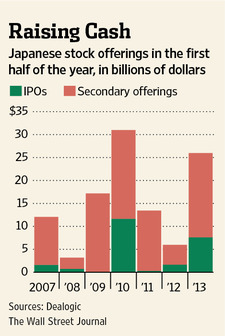
As equity fundraising slows in other Asian markets, Japanese companies such as Suntory Beverage & Food Ltd. 2587.TO +2.37% are raising billions of dollars by issuing shares, pushing capital raising in Japan during the first half of 2013 to a three-year high. Olympus Corp. 7733.TO +2.36% said Monday that it would seek to raise as much as $1.2 billion through a new share offering. Last week, advertising company Dentsu Inc. 4324.TO -0.31%and home builder Daiwa House Industry Co. 1925.TO +0.22% said they would look to raise $1.2 billion and $1.4 billion, respectively. And Suntory Beverage & Food Ltd. listed in Tokyo last week after raising $3.9 billion in Asia’s biggest initial public offering this year. Read more of this post

Japanese Fans Mourn Demise of 25-Year-Old ‘Potato Snack’; The weak yen may be a boon for exporters like Toyota but it was the last straw for Potato Snack

July 9, 2013, 10:32 p.m. ET

Japanese Fans Mourn Demise of ‘Potato Snack’

Crisp Once Came in Salami, Pudding, Octopus Flavors; Memorials, Hoarding

ELEANOR WARNOCK

2.JPG

A hostess at a pachinko parlor in Koshu, Japan, posed with Potato Snack. Players can select sweets and snacks as prizes for playing pachinko, or Japanese pinball.

The weak yen may be a boon for exporters like Toyota Motor Corp., 7203.TO 0.00%but it was the last straw for Potato Snack. The 25-year-old Japanese cracker, sold four in a 30-cent bag, had already been pummeled by years of stagnant demand. With the prospect of a weakening currency pushing higher costs of imported ingredients, maker Izumi Seika Co. pulled the plug on the unit that makes Potato Snack last month, to the dismay of die-hard fans. Heartbroken consumers have poured out their grief over the Internet, sending more than 100,000 tweets and uploading a score of video eulogies to YouTube. Devotees have staged farewell parties for the snack, which had a texture like deep-fried wonton and came in flavors from fried chicken to salami.

Read more of this post

Malaysian Stocks First From Worst on Lowest Volatility

Malaysian Stocks First From Worst on Lowest Volatility

At a time when slowing economic growth and political protests from Brazil to Turkey are spurring capital flight from emerging markets, Malaysia has turned into a refuge for equity investors.

The FTSE Bursa Malaysia KLCI Index was the biggest loser in Asia just four months ago as the closest elections in 55 years threatened the ruling coalition’s plans to spend $444 billion on infrastructure. Now the $478 billion stock market is the region’s best performer, after Prime Minister Najib Razak’s May 5 poll victory sparked a 4.2 percent rally in the KLCI index. Read more of this post

Mega-Bridge Tests Yudhoyono With Legacy in Focus; “He wants to leave these tangible, physical legacies, and the bridge is clearly one of them. The real worry is that this bridge would become a white eelephant. It would not just be costly, but it would actually blow up Indonesia’s well deserved achievement of macroeconomic stability.”

Mega-Bridge Tests Yudhoyono With Legacy in Focus: Southeast Asia

For Aat Djunaidi, a 12-hour wait to catch a ferry linking Indonesia’s most-populous islands isn’t so bad. On some trips the 41-year-old waits for two days before his truck can cross the Sunda Strait from Java into Sumatra. “If they build a bridge, it would take just 20 minutes to cross,” Djunaidi, who makes the journey three times a week to transport Suzuki motorcycles, said while waiting at the back of a four-kilometer (2.4-mile) queue. “I’d be happy if I get to use the bridge in my lifetime.” Indonesia will soon decide whether to proceed with what would be the world’s largest suspension bridge, according to Luky Eko Wuryanto, a deputy minister overseeing infrastructure projects. First conceived half a century ago, the planned 29-kilometer link that would cost an estimated $15 billion has spawned a debate over the best way to reduce logistics costs in a country with more than 17,000 islands and 250 million people. Read more of this post