A baby boy born in Pennsylvania in June is the first birth following embryo screening using the latest gene sequencing technology designed to increase the success rate of in-vitro fertilization and reduce miscarriages

First Baby Born After Embryo Gene Sequencing to Cut Miscarriages

A baby boy born in Pennsylvania in June is the first birth following embryo screening using the latest gene sequencing technology designed to increase the success rate of in-vitro fertilization and reduce miscarriages.

Gene sequencing of embryos can identify chromosomal defects that can result in the failure of embryos to adhere to the lining of the mother’s womb, which is necessary for the fetus to receive oxygen and nutrients. Researchers at Oxford University used the technology to select healthy embryos about five days after fertilization by two couples undergoing IVF, which resulted in successful pregnancies. The study will be presented today at the European Society of Human Reproduction and Embryology’s annual meeting in London. Read more of this post

Herbal stroke medicine NeuroAid marketed by Singapore-based Moleac no better than dummy pill in a large, three-month clinical trial

Herbal stroke remedy no better than dummy pill

Fri, Jul 5 2013

By Kerry Grens

NEW YORK (Reuters Health) – A Chinese herbal remedy marketed to improve stroke recovery failed to exceed the benefits of a placebo in a large, three-month clinical trial. “There’s no evidence of efficacy,” said Dr. James Brorson, medical director of the University of Chicago Stroke Center, who was not involved in the study. Still, the researchers are not completely discouraged by the results. “Yes, we had hoped for a larger effect, but the results of the trial suggest that this may be the case for certain groups of patients,” said Dr. Christopher Chen, the report’s lead author and a professor at the National University of Singapore. Chen’s research was supported in part by Moleac, the company that markets the herbal medicine, called NeuroAiD. NeuroAiD is a blend of extracts from plants, leeches, beetles, scorpions and antelope horn. Read more of this post

India’s poor ‘duped’ into clinical drug trials; Many desperate and poor people are unwittingly taking part in clinical trials for drugs by pharmaceutical companies that outsource the work to unregulated research organizations

India’s poor ‘duped’ into clinical drug trials

Many desperate and poor people are unwittingly taking part in clinical trials for drugs by Indian and multinational pharmaceutical companies that outsource the work to unregulated research organisations. -Reuters
Abhaya Srivastava
Sun, Jul 07, 2013
Reuters

NEW DELHI – Niranjan Lal Pathak couldn’t believe his luck initially. When a doctor at a hospital in central India offered the factory watchman free treatment for a heart complaint, he jumped at the chance. It was five years ago and the family of the 72-year-old says he didn’t realise that the Maharaja Yashwantrao Hospital in the city of Indore was about to enroll him in a trial of an untested drug. “We were told that our uncle will be treated under a special project,” his nephew Alok Pathak told AFP over the phone from Indore, the largest city of Madhya Pradesh state. “The doctor said we wouldn’t have to spend a penny. There was only one condition placed before us – that we should not approach local chemists if we ever ran out of his medicines but go straight to the doctor,” he said. Read more of this post

Emerging Markets: A Career-Killing Sequel?

SATURDAY, JULY 6, 2013

A Career-Killing Sequel?

By BEN LEVISOHN | MORE ARTICLES BY AUTHOR

Emerging markets stocks were on a tear—until they stopped. This year has been the Hudson Hawk to what had been akin to the Die Hard franchise. The good news is that stocks are looking cheap; the bad is that they could still get cheaper.

After the blockbuster success of the Die Hard franchise, moviegoers thought they knew what they were getting from a new Bruce Willis flick: action, adventure and a wisecracking hero. In 1991, however, they got Hudson Hawk, a movie about a show-tune singing cat burglar robbing the Vatican. The film bombed. Investors in the emerging markets can relate. For years, they’ve bought into the narrative that the developing world’s faster economic growth, improving credit quality, and increased stability would lead to supersized returns. And for a while, they did. Emerging markets stocks rose 12% annually for the ten years ended Dec. 31, 2012. Read more of this post

One Born Every Minute; As exchange-traded funds pour into the market, more of them are of dubious value. Consider the Bitcoin ETF

| SATURDAY, JULY 6, 2013

One Born Every Minute

By RANDALL W. FORSYTH | MORE ARTICLES BY AUTHOR

As exchange-traded funds pour into the market, more of them are of dubious value. Consider the Bitcoin ETF. “There’s an app for that” is the mantra behind the boom in smartphones, turning them from things used just to make calls and send texts, to devices that put mobile computing in the palm of your hand or your pocket (well, almost, as screens steadily expand in size). Financial markets have seen a parallel phenomenon: “There’s an ETF for that,” for all manner of things. And, as with smartphone apps, a few exchange-traded funds dominate the market, alongside thousands of dubious offerings. Read more of this post

Proposed EU financial transaction tax will hit FX users hard

EU financial transaction tax will hit FX users hard: report

7:03pm EDT

By Sebastian Sadr-Salek

LONDON (Reuters) – A proposed EU financial transaction tax (FTT) could discourage use of the foreign exchange (FX) market by typically raising costs of doing business by up to 700 percent, a report said on Monday. The report by the Global Financial Markets Association (GFMA) said that due to the double-sided nature of the proposed tax, transaction costs for pension funds would increase by around 1,500 percent. And they could reach as high as 4,700 percent for some FX products such as those that involve short-dated swaps with a very low transaction cost. Read more of this post

Crowded ETF Exit Proving Costly as Bonds Trail

Crowded ETF Exit Proving Costly as Bonds Trail: Credit Markets

Investors who sought exchange-traded funds as a faster way to trade corporate bonds are finding that they can be as expensive to trade as the underlying debt.

As trading in the three-biggest credit ETFs surged to unprecedented levels last month amid the market’s biggest losses since 2008, the funds’ shares dropped as much as 1.1 percentage points more than the net value of the less-traded securities they hold. The two largest high-yield bond ETFs have lost about 6 percent since reaching a five-year high May 8. That’s about 2 percentage points more than the loss for the Bank of America Merrill Lynch U.S. High Yield Index. Read more of this post

Losing $317 Billion Makes Treasuries Safer for Mizuho to HSBC

Losing $317 Billion Makes Treasuries Safer for Mizuho to HSBC

The biggest investors in Asia and Europe are keeping their money in Treasuries even after the steepest two-month loss for the securities erased $317 billion of market value.

Mizuho Asset Management Co., which oversees $32 billion, added Treasuries due in 10 years or longer to its holdings in the past month. HSBC Private Bank, with $480 billion in assets, bought U.S. notes when 10-year yields rose to 2.5 percent. Deutsche Asset & Wealth Management, which manages about $1.3 trillion, is holding debt maturing in less than four years, betting American interest rates will remain subdued. Read more of this post

For Europe’s Debt Collectors, More Work Isn’t Paying Off

July 7, 2013, 6:52 p.m. ET

For Europe’s Debt Collectors, More Work Isn’t Paying Off

MANUELA MESCO

MK-CE530A_BADDE_D_20130707181813

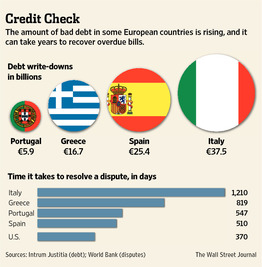
MILAN—In Europe, bad debts are soaring, the economy is contracting and business owners are flocking to debt-collection agencies to chase down deadbeat clients. Yet the boom in bad debt is bringing surprisingly little joy to the Continent’s repo men. Clogged courts, tough debt-collection rules and tapped-out debtors are making their jobs harder—and less profitable. Consider Marco Alborghetti, a Rome-based debt collector. He recently resolved a case involving a €10,000 ($12,825) debt owed to a client, the owner of a leasing company. It took 10 years to pursue the debtor through Italian courts. While the client recovered the entire amount, Mr. Alborghetti says the hassle, as well as the cost of hiring lawyers to pursue the case, hardly made the job worth it. “It’s just uneconomical for everyone involved,” he said. Read more of this post

Record numbers of exchange traded funds have closed so far this year, underscoring the difficulty many of the investment vehicles face in gaining traction among investors, despite the industry’s overall boom in popularity in recent years

July 7, 2013 2:11 pm

ETFs close in record numbers despite industry boom

By Arash Massoudi and Tracy Alloway in New York

Record numbers of exchange traded funds have closed so far this year, underscoring the difficulty many of the investment vehicles face in gaining traction among investors, despite the industry’s overall boom in popularity in recent years. About 117 ETFs have shuttered in the first half of this year, according to data collected by independent research firm ETFGI, easily outpacing closures in the same period in previous years. Out of 4,849 exchange traded products on the market, more than 60 per cent have less than $100m in assets, suggesting that more closures could take place in the coming months. Read more of this post

Billionaires and their supercars add to Singapore inequality concerns

July 7, 2013 3:10 pm

Billionaires and their supercars add to Singapore inequality concerns

By Jeremy Grant in Singapore

At a showroom in Singapore, a small crowd of McLaren enthusiasts were gathering for the unveiling of the latest “supercar” made by the British carmaker, a petrol-electric hybrid with a top speed of 350km an hour. Never mind that the vehicle only comes in left-hand drive, so can not legally be driven on Singapore’s crowded right-hand drive roads. Anyone interested in buying would be looking at the P1 as an investment, even if they could get their hands on one – for a cool S$1.5m ($1.2m). McLaren has only made 375 of the cars and has yet to allocate what few are left unsold to the Singapore market. None of this has put off Chor King Ang, senior executive at Kwang Sia, a Singapore-based fashion retailer that sells luxury labels such as Hugo Boss and DSquared2 in stores across southeast Asia. “I’ve long been a fan of their Formula One racing team,” he said, adding that he is already an owner of an earlier McLaren model. In the past year, the trappings of wealth have been increasingly visible in Singapore as the number of sports cars roaring down its streets has increased. Last month saw the first sale in the island-nation of a Koenigsegg “hypercar” for $5.3m. Read more of this post

Rising rates to spur litany of capital losses

July 7, 2013 5:54 pm

Rising rates to spur litany of capital losses

By Tracy Alloway and Tom Braithwaite in New York

US banks have watched billions of dollars of paper profits on their securities portfolios wiped out by rising market interest rates, erasing huge gains made during the prolonged run of increasing bond prices since the financial crisis and ensuring that erosions of capital will be a feature of the coming bank earnings season.

Data released by the Federal Reserve on Friday showed unrealised gains in these portfolios had plummeted from more than $40bn at the beginning of the year to about $6bn, with the most precipitous falls over the past few weeks amid mounting market concern about the “tapering” of the central bank’s bond-buying programme. Read more of this post

A Different Deal Mania Grips TV; As companies like Tribune and Gannett buy up local television stations, the goal is not transformation, but leverage, using size to cut better deals with distributors and suppliers

July 7, 2013

A Different Deal Mania Grips TV

By DAVID CARR

Suddenly, being big is a big deal. Again. And we’re not just talking about the resurgence in the sales of pickup trucks. After years of small-bore shifting and tweaking by media companies in an effort to stay in front of consumers, big deals are back on the table. Using relatively cheap capital, companies in dire need of diversification away from wounded businesses like print are going shopping. Last Monday, the Tribune Company, fresh out of bankruptcy, spent $2.7 billion to buy 19 stations from Local TV Holdings. Several weeks earlier, the Gannett Company made its own bet on going bigger, buying the Belo Corporation, with its 20 television stations, for $1.5 billion. “It’s time to gobble or get gobbled,” a media analyst told The New York Times last Monday. Read more of this post

Mexico’s freight business has transformed into a principal artery for the top export industries of Latin America’s second-largest economy

Trains, planes and automobiles: Mexico rail freight comes of age

Fri, Jul 5 2013

By Gabriel Stargardter

MEXICO CITY (Reuters) – Slowly, like the trains that crawl past towering avenues of containers here at the country’s largest rail hub, Mexico’s freight business has transformed into a principal artery for the top export industries of Latin America’s second-largest economy. A rail network that once shunted Mexico’s mustachioed revolutionaries to battles across the country was gasping for air by the late 1990s as grinding inefficiency and rising costs forced the government into privatization. Read more of this post

Quebec rail disaster shines critical light on oil-by-rail boom

Quebec rail disaster shines critical light on oil-by-rail boom

6:59pm EDT

By Scott HaggettDave Sherwood and Cezary Podkul

20130707.121437_reuters_trainderail

(Reuters) – The deadly train derailment in Quebec this weekend is set to bring intense scrutiny to the dramatic growth in North America of shipping crude oil by rail, a century-old practice unexpectedly revived by the surge in shale oil production. At least five people were killed, and another 40 are missing, after a train carrying 73 tank cars of North Dakota crude rolled driverless down a hill into the heart of Lac-Megantic, Quebec, where it derailed and exploded, leveling the town center. It was the latest and most deadly in a series of high-profile accidents involving crude oil shipments on North America’s rail network. Oil by rail – at least until now – has widely been expected to continue growing as shale oil output races ahead far faster than new pipelines can be built. Read more of this post

Rice Stocks Reach 12-Year High as Food Costs Drop

Rice Stocks Reach 12-Year High as Food Costs Drop: Commodities

Rice stockpiles are expanding to the highest level in 12 years as production increases to a record, adding to a worldwide surge in agricultural output that is poised to diminish the $1.1 trillion global food-import bill.

Reserves will gain for a seventh year, rising 2.7 percent to 108.6 million metric tons in 2013-2014, the U.S. Department of Agriculture estimates. Output will climb 1.9 percent to 479.2 million tons, exceeding demand by 2.8 million tons. Prices for 5-percent broken Thai white rice, an Asian benchmark, will drop 13 percent to $455 a ton by December, according to the median of eight trader and analyst estimates compiled by Bloomberg. Read more of this post

Mobile gaming taking China by storm

Mobile gaming taking China by storm

Staff Reporter

2013-07-08

Backed by huge numbers of mobile phone subscribers, the gaming industry in China has been growing by leaps and bounds to develop into a major industry. According to figures released on July 3 by Tencent, China’s largest internet company by value, the number of registered game software developers in the country topped 80,000 as of April, with the number of registered game applications exceeding 40,000. The number of games racking up over 100,000 yuan (US$16,300) in monthly revenue also jumped by 65% year-on-year. While a game created by Tencent called Plants vs Zombies, launched in May last year, accumulated over 80 million yuan (US$13 million) in revenue as of June this year. Read more of this post

How Netflix Is Shaking Up Hollywood; Streaming Site Becomes Aggressive Programming Buyer; Serialized Dramas Benefit

July 7, 2013, 8:47 p.m. ET

How Netflix Is Shaking Up Hollywood; Streaming Site Becomes Aggressive Programming Buyer; Serialized Dramas Benefit

AMOL SHARMA

MK-CE527A_NETFL_G_20130707193609

When AMC Networks AMCX +1.27% canceled its TV crime drama “The Killing” last year after two seasons, the show’s creators made a push to get it back on the air, believing they could correct the missteps that had caused an ardent fan base to lose interest. They got some help from an unlikely source: Netflix Inc. NFLX +1.90% The show’s producer, Fox Television Studios, signed a deal with the streaming-video service that made a third season financially viable. The revenue from Netflix allowed the studio to charge AMC a lower license fee. In return, Netflix got exclusive streaming rights in the U.S. and Canada beginning three months after the season finale—shorter than the typical delay of as much as a year. It also got the rights to premiere the show in several foreign markets where its previous seasons had been a big hit for the company. Read more of this post

Modesty is a source of pride at Arm, the UK’s largest tech company by market cap, whose microprocessor designs are used in nearly all smartphones. Simon Segars joined Arm in 1991 when it was based in a Cambridgeshire barn

July 7, 2013 2:28 pm

Simon Segars, Arm Holdings chief

By Henry Mance

Whatever attracted Simon Segars to his new job, it can’t have been his windowless office. Even his prize decoration – a map of the Arm7 processor that he helped design, complete with “72,000 beautiful transistors” – lies unframed on a chair. “The least glamorous company in the FTSE,” he jokes. Modesty is a source of pride at Arm, the UK’s largest technology company by market capitalisation, whose microprocessor designs are used in nearly all smartphones. “It’s inbuilt in the culture. We’re not glitzy and flashy, and we’re not about to shout about our success from the rooftops,” says Mr Segars, who took over as chief executive of the Cambridge-based group last week. That ethos is one sign of continuity with his predecessor Warren East, whose belongings are still in boxes in the next-door office. Read more of this post

The CEO of IMAX on How It Became a Hollywood Powerhouse

The CEO of IMAX on How It Became a Hollywood Powerhouse

by Richard Gelfond

R1307A_A

The Idea: The company experimented with business models to grow from its modest roots in nature documentaries into a major player in multiplexes around the world.

When I came to IMAX, in 1994, I had been an entrepreneur, a lawyer, and an investment banker. I didn’t know much about the movie business, but I recognized that the moviegoing experience IMAX offered had great potential if we could find the right way to grow.

A partner and I had acquired the company through a leveraged buyout, and we took it public a few months later. On paper the transaction was a success, and the company’s market cap grew rapidly. But at the time, most IMAX movies were nature documentaries shown in the theaters of science museums, and figuring out how to move into mainstream markets proved much more difficult than we’d expected. That was due in part to the technology constraints of the predigital era; it took years to find ways to make it easy and cost-effective to show IMAX movies in a large number of multiplexes. We also faced cultural challenges. The Hollywood movie industry is an interconnected system of studios, directors, and theaters that has evolved over 100 years, and it has a traditional way of doing things. As newcomers we spent years trying and failing to persuade the industry to adapt to our model. Even after we began adapting our strategy to fit the Hollywood way of doing business, it took a while to find a model that benefited us and our partners. Read more of this post

Israel’s Mobileye, whose collision-avoidance technology has been adopted in BMWs, says investors value it at $1.5 billion

Mobileye says investors value it at $1.5 billion

7:23pm EDT

(Reuters) – Mobileye N.V., whose collision-avoidance technology has been adopted in cars made by the likes of BMW AG (BMWG.DE: QuoteProfileResearchStock Buzz) and General Motors Co (GM.N: QuoteProfile,ResearchStock Buzz), said on Sunday it had raised money from five investors that valued its equity at $1.5 billion, highlighting the market potential for driver-assistance systems. Founded in 1999 by an Israeli businessman and a professor of computer science at the Hebrew University of Jerusalem, Mobileye sold its 1 millionth driver assistance system last year. It has said it expects to sell 2 million more in 2013. Read more of this post

As Software Takes Over, Network Gear Could Be in Jeopardy; Software-defined networking threatens hardware makers, including Cisco Systems, F5 Networks

SATURDAY, JULY 6, 2013

As Software Takes Over, Network Gear Could Be in Jeopardy

By TIERNAN RAY | MORE ARTICLES BY AUTHOR

Software-defined networking threatens hardware makers, including Cisco Systems, F5 Networks, and Juniper Networks. VMware could be a winner. How Cisco is striking back.

ago, I asked a venture capitalist in computer networking if dedicated network gear would ever be replaced by software running on a standard computer. My hypothesis was that as general-purpose computers became more powerful, they could absorb functions that previously required specialized computer hardware, the way many functions can be performed on PCs today that once required mainframes. The venture capitalist assured me it would never happen, for a variety of reasons, even if it became technologically possible. Read more of this post

How Google Flu Trends Is Getting to the Bottom of Messy Data

How Google Flu Trends Is Getting to the Bottom of Messy Data

by Nicholas Diakopoulos  |  11:00 AM July 5, 2013

Churning through, tabulating, and modeling millions of search queries every day, Google Flu Trendscan measure, a full two weeks before the CDC, the incidence of influenza-like illnesses (ILI) across the U.S. Any official response to a flu pandemic, such as vaccine distribution and timing, could be greatly enhanced with such an early warning. And while not billed as an ersatz measure, Google Flu has had an uncannily high correlation with the CDC’s own slower, yet more assiduously produced estimate of ILIs. Read more of this post

Do CEOs and Directors Get Sick of Attending Meetings?

Do CEOs and Directors Get Sick of Attending Meetings?

Stephen Gray University of Queensland – Business School; Duke University – Fuqua School of Business; Financial Research Network (FIRN)

John Nowland City University of Hong Kong

June 26, 2013

Abstract: 
This study examines whether CEO and director attendance is affected by additional board and committee meetings. Using a hand-collected Australian dataset of 21,691 observations of the number of board and committee meetings held and attended by directors from 2004 to 2007, we find that attendance rates for both outside and inside directors decrease (non-random absences increase) when they are required to attend more board meetings. The marginal effect is that the average outside (inside) director has a 14% (12%) likelihood of missing an additional board meeting. Further analysis shows that the negative relationship between board meetings and attendance rates is consistent across directorships in a range of firms, including when more meetings are associated with poor performance, M&A activity and CEO turnover. The results for committee meetings are mixed, indicating that director attendance is not consistent across different types of meetings. In summary, our analysis indicates that any benefits firms obtain from holding additional meetings are being eroded by lower director attendance, a result that should be of particular interest to shareholders and policymakers.

The Real Reason You Learn A Lesson Better When You Teach It: Nachas, pride and satisfaction that is derived from someone else’s accomplishment

The Real Reason You Learn A Lesson Better When You Teach It

ANNIE MURPHY PAULTHE BRILLIANT BLOG JUL. 6, 2013, 8:11 AM 1,508 

Learning, and thinking, are deeply social activities. 

This is not the traditional view (Rodin’s iconic sculpture, “The Thinker,” is conspicuously alone in his chin-on-fist musings), but it’s the view that is emerging out of several decades of social science research. Our minds often work best in interaction with other people’s minds, and there are particular kinds of relationships that are especially good at evoking our intelligence. One is the master-apprentice relationship, which I wrote about here. Another, of course, is the teacher-student relationship—but today I want to talk about the benefits of this relationship for the teacher. For thousands of years, people have known that the best way to understand a concept is to explain it to someone else. “While we teach, we learn,” said the Roman philosopher Seneca. Now scientists are bringing this ancient wisdom up to date, documenting exactly why teaching is such a fruitful way to learn — and designing innovative ways for young people to engage in instruction. Read more of this post

Jim Rogers Correctly Predicted Gold Would Fall To $1200, And Now He Thinks It Could Go As Low As $900

Jim Rogers Correctly Predicted Gold Would Fall To $1200, And Now He Thinks It Could Go As Low As $900

MAMTA BADKAR JUL. 6, 2013, 6:44 AM 8,375 33

The price of gold peaked at just over $1,900 per ounce in the fall of 2011. And it was right around that time that commodities guru Jim Rogers began warning investors that the yellow metal could hit a low of $1,200 before the sell-off was over. He was right. Gold prices entered a bear market (down 20% from its high) in April. And on June 27, they touched $1,200. In a phone interview this week, Rogers explained to us how he arrived at the $1,200 figure. He also offers his outlook for gold as it continues its complicated bottoming process. Read more of this post

Global Yellow Pages CEO Stanley Tan loses $25.4m in 2 days in financial products, sues UBS

Yellow Pages CEO loses $25.4m in 2 days, sues UBS

Saturday, Jul 06, 2013, AsiaOne

acc430

SINGAPORE – Global Yellow Pages CEO Chen Bao Neng (Stanley Tan) is taking UBS to court after he suffered losses amounting to $25.4 million in just two days. According to Lianhe Zaobao, the 55-year-old executive director had invested in 16 financial products through UBS from October 2007 to August the following year. He then lost $25.4 million in the 2008 financial crisis.  Read more of this post

Amazon.com: the Hidden Empire

LinkedIn, the Serious Network

Twitter Study