FX Concepts Closing Asset-Management Business; Firm Was Once World’s Largest Currency-Focused Fund Manager
October 10, 2013 Leave a comment
Updated October 9, 2013, 7:14 p.m. ET
FX Concepts Closing Asset-Management Business
Firm Was Once World’s Largest Currency-Focused Fund Manager
GREGORY ZUCKERMAN, IRA IOSEBASHVILI And NICOLE HONG
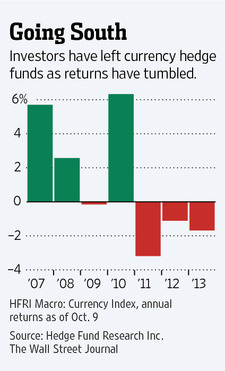
The investor retreat from the once-lucrative currency-trading arena passed a milestone Wednesday with the closure of a firm that once was the largest of its sort, FX Concepts. The New York firm, whose assets under management shriveled to $660 million last month, from $14 billion at the dawn of the financial crisis, will close its asset-management business over the next few weeks and return money to investors, the company said in a statement.The developments at FX Concepts underscore the difficulties traders are having in currency, futures and commodities markets, even as stocks enjoy another boffo year. Currency funds are down 1.68% this year, after losing 1.1% last year and dropping 3.2% in 2011, according to data-tracker HFR. Assets in hedge-fund strategies dedicated to currency trading have fallen to $21.6 billion, down nearly 50% from a peak of $40.4 billion in 2007, HFR says.
High-profile investors including Boston Red Sox owner John Henry already have hung up their currency-trading cleats, and the disappointing results have many investors shying away from the area.
“Currency-fund returns are historically inconsistent and volatile,” says Greg Brousseau, who helps run Central Park Group, which invests in hedge funds and private-equity firms.
“There is a lack of faith in foreign exchange as an asset class when equities are going up,” said Robert Savage, chief strategist at FX Concepts. “Investors are reallocating their money to where they can get better returns.”
The company was founded in 1981 by John Taylor, a pioneer in the foreign-exchange world who paid for part of his Princeton University tuition with money he invested in the stock market after his father gave him $7,000. He began as a bank analyst in the 1970s, advising multinationals on how to hedge their currency positions. Mr. Taylor launched FX Concepts as a foreign-exchange consulting firm with clients such as Eastman Kodak. A few years later, he persuaded Kodak to let his firm manage some of its money by buying and selling currencies.
As the firm grew in size, FX Concepts attracted global attention for its big currency bets. The firm was so active in yen that, in 2005, a Japanese film crew made a documentary about Mr. Taylor and FX Concepts. Mr. Taylor told The Wall Street Journal in January that he had taken a 98% pay cut in order to keep the fund running.
In recent decades, numerous hedge-fund managers have made fortunes betting on global currency gyrations. George Soros made $1 billion wagering against the British pound in the early 1990s. More recently, investors including David Einhorn of Greenlight Capital Inc. and Kyle Bass of Hayman Capital Management LP racked up gains betting against the Japanese yen.
But hefty currency-trading profits have become increasingly rare amid relatively placid markets. Investors have been souring on the area amid the limp currency returns and better results elsewhere, adding pressure to currency traders.
So-called systematic currency funds, which trade based on quantitative models that tend to do well when trends are relatively easy to spot, have fared the worst. Such funds tracked by HFR saw the amount of assets they manage decline by 13.3% in the first six months of 2013, to $13.8 billion, less than half the $34.4 billion under management at the peak in 2007.
FX Concepts’ Global Currency Program, one of its most-popular trading strategies, was down 13.9% this year as of late August. Last year, it rose less than 1%, after dropping 19.4% in 2011.
“Assets at the firm have dropped to levels that can no longer sustain the business, so the board has concluded that it is in the best interest of the investors for an orderly wind down of open positions, close its funds, and hand back any remaining mandates to clients,” the statement from FX Concepts said.
About 180 hedge funds focus on currency trading, but many more, including so-called macro funds and managed-futures funds, bet on currencies along with other investments.
Other high-profile funds that did a lot of currency trading also have closed in recent years, such as John W. Henry & Co.., which last year told clients it will stop managing their money amid dwindling assets and slumping returns.
Many currency funds, including FX Concepts, also have been managing money for clients looking to hedge their own currency risks rather than score big profits.
U.K. asset manager Record Currency Management Ltd. says it has survived by primarily serving pensions that want to hedge against exchange-rate fluctuations, as opposed to clients who want to generate actual returns in currency markets. Still, the firm’s assets under management have dropped approximately 27%, to $36.3 billion, in the past six years. Some clients of currency funds have less need for this hedging amid placid foreign-exchange markets.
Still, some contrarian investors remain fans of currency trading, figuring the best returns come when a sector is most out of favor.
The Florida Retirement System Pension Fund, for example, which manages $137 billion, says it is currently conducting a search for currency-hedge-fund managers, seeking gains that aren’t correlated to overall markets. A representative said it isn’t clear how much Florida will invest in these funds.
But several pension clients pulled out from FX Concepts this year, including the Pennsylvania Public School Employees’ Retirement System in January and the Montgomery County, Md., Employee Retirement Plans in March. Ohio Police & Fire Pension Fund also withdrew $52.7 million from FX Concepts in June.
FX Concepts’ Mr. Savage says stimulus programs by the world’s most-influential central banks, led by the U.S. Federal Reserve, have reduced the volatility necessary for currency-fund managers to realize profits. This year, uncertainty on when the Fed would begin winding down its asset purchases has made currency markets precariously unpredictable, Mr. Savage says.
Political standoffs in the U.S. and euro zone, including the current fiscal impasse in Washington, have also driven investors away from currencies, drying up volume in the markets.
“You have situations where the outcome is so hard to predict that people just don’t trade,” Mr. Savage says.
FX Concepts to shutter investment management business
4:20pm EDT
By Gertrude Chavez-Dreyfuss
NEW YORK, Oct 9 (Reuters) – FX Concepts, once the largest currency hedge fund in the world, said on Wednesday it is winding down its investment management operations given a flood of withdrawals and poor performance.
Assets at the firm “have dropped to levels that can no longer sustain the business,” FX Concepts Vice Chairman Jonathan Clark said in an emailed statement.
On Monday, FX Concepts chief strategist Bob Savage said the firm’s assets under management had dropped to $621 million from a high of $14 billion in 2007.
Clark said FX Concepts, which uses computer models for 90 percent of its trading, will wind down open positions and close all of its funds. It will, however, keep its newsletter and currency overlay businesses, which manage the foreign exchange risk of equity and bond portfolios for asset managers.
Savage told Reuters on Wednesday that the decision by FX Concept’s board of directors to wind down was made late on Tuesday afternoon. He said the company will have closed all its hedge funds by the end of November.
“There isn’t enough assets under management to sustain this business. In order to do the mandates that we were getting, you need at least a billion dollars,” said Savage. “We need to regroup and rethink our strategy and come up with a way to re-create ourselves.”
FX Concepts will also lay off an additional nine employees. The company currently has 20 employees.
Its suite of hedge funds include the FX Concepts Protection fund, with assets of $9.02 million, according to a Sept. 26 filing with the Securities and Exchange Commission; the Global Currency Program, with assets of $28.9 million; the Multi-Strategy Fund, with assets of $68.7 million; and the Global Financial Markets Fund, with assets of $11.5 million.
In the September filing, FX Concepts reported that its assets under management were $661.2 million from 20 accounts and it had 32 employees. In two weeks, it lost at least $40 million and laid off 12 more people.
At its peak, FX Concepts had 55 to 60 employees globally.
In a conversation with Reuters on Monday and Tuesday, Savage blamed the company’s woes on the underperformance of its systematic trading business.
Brad Bechtel, managing director at Faros Trading in Stamford, Connecticut, said he was not surprised by the news.
“From an industry perspective this is another example of how the model fund community has had a hard time since the Federal Reserve introduced quantitative easing,” said Bechtel.
“They (FX Concepts) are high profile because they were in the market so long. Winding down and ramping up of hedge funds happens all the time, however. They are another victim.”
Savage earlier told Reuters the company was examining all options to stay afloat, including closing its flagship GCP fund, which has lost 10 percent so far this year. Its Multi-Strategy Fund has lost 8.9 percent.
Savage on Tuesday floated the idea of the company being bought by other hedge funds with no FX business, or private equity firms, noting that FX Concepts was in talks with specific entities for such a deal.
He also said the company was shuttering its London and Singapore offices.
FX Concepts was founded in 1981 by chairman and chief executive officer John Taylor, who declined to be interviewed.
The company has been besieged this year with the withdrawal of big investors, including the Pennsylvania Public School Employees’ Retirement System and the Bayerische Versorgungskammer pension fund.
The last straw was the withdrawal of the San Francisco Employees’ Retirement System, which voted to redeem its money from FX Concepts on Sept. 11, CNBC reported on Monday. Savage said reports by CNBC of clients leaving the fund “are on track.”
 About bambooinnovator

