Najib’s Fiscal Pledge Faces Test in 2014 Budget: Southeast Asia

Najib’s Fiscal Pledge Faces Test in 2014 Budget: Southeast Asia

Malaysian Prime Minister Najib Razak’s promise of measures to curb the budget gap and avert a credit rating downgrade helped send three-year government bond yields to a four-month low. His resolve is about to be tested. Najib, also finance minister, will deliver his 2014 budget speech to parliament on Oct. 25 after cementing his leadership in a May general election. Having given handouts to the poor and pay increases for civil servants to woo voters earlier, he may now introduce a potentially unpopular consumption tax, delay projects and raise the levy on property gains, according to United Overseas Bank Ltd. (UOB) and DBS Group Holdings Ltd. Read more of this post

U.S. Steel to Take $1.8 Billion Writedown amid excess global production capacity and higher imports

U.S. Steel to Take $1.8 Billion Writedown Amid Higher Imports

U.S. Steel Corp., the country’s largest steelmaker by volume, said it will take a writedown of about $1.8 billion on North American assets amid excess global production capacity and higher imports.  The non-cash goodwill impairment charge will be taken in the third quarter, Pittsburgh-based U.S. Steel said today in a statement. The writedown won’t have a tax benefit or affect liquidity and compliance with debt covenants, the company said. U.S. Steel said its North American flat-rolled steel unit and its Texas operations carry almost all of its goodwill. The writedown at the flat-rolled business is largely attributable to the “protracted” economic recovery and surplus global capacity, the company said. The writedown in Texas was driven by a drop in prices for welded tubular steel following “high” import levels and plans for additional domestic capacity. Steelmakers in the U.S. have struggled to be profitable amid low prices and competition from imports since the global financial crisis began in 2008. U.S. Steel has posted net losses for the past four years, according to data compiled by Bloomberg, and is expected to lose $226.6 million this year, according to the average of nine analysts’ estimates.

To contact the reporter on this story: Simon Casey in New York at scasey4@bloomberg.net

Quebec Train Fire Prompts New Oil Railway-Shipping Costs

Quebec Train Fire Prompts New Oil Railway-Shipping Costs

New rules will boost costs to transport crude by rail in North America as trains are forecast to carry as much as 2 million barrels a day, about equal to daily output from Norway. “You’re going to see a massive flood of spending to get ahead of these government regulations,” Jerry Swank, managing partner at Dallas-based Swank Capital, said yesterday during the Bloomberg Link Oil & Gas Conference in Houston. Read more of this post

Japanese Fund Managers Look Beyond Yen-Driven Export Stocks

Japanese Fund Managers Look Beyond Yen-Driven Export Stocks

Lesser-Known Small and Midsize Companies Are Gaining Favor

YUMI OTAGAKI

Oct. 20, 2013 11:39 a.m. ET

TOKYO—Forget Toyota Motor Corp. 7203.TO -0.16% or Sony Corp. 6758.TO -0.83%When fund manager Hideo Shiozumi looks for Japanese stocks to buy these days, he shuns the big-name exporters that saw sharp gains earlier this year as the yen’s sudden drop made their goods more competitive on global markets. Instead he seeks lesser-known small and midsize companies he thinks will benefit from deeper structural changes that many economists say need to happen for Japan to enjoy a deeper recovery beyond the quick fix of a cheaper currency. Specifically, the manager of U.K.-based Legg Mason’s Japan Equity Fund is weighted toward e-commerce companies that can gain from shifts in consumer behavior, and health-care firms that can profit from the country’s aging population. Read more of this post

Abe Invokes Thatcherism in Reform Push Raising Disparity Risks

Abe Invokes Thatcherism in Reform Push Raising Disparity Risks

Japan’s Prime Minister Shinzo Abe evokes the late Margaret Thatcher as he repeats “there is no alternative” to his platform of economic change. One of the byproducts: prospects for a Thatcherite division of wealth. Tomoko Kawamura, 33, a pharmaceutical-company worker in Tokyo, bought a Louis Garneau bicycle costing about 50,000 yen ($510) and a MacBook Air laptop with proceeds from stock investments this year. She owns a one-bedroom apartment in Tokyo’s well-heeled Meguro district. Eight hundred kilometers (500 miles) to the southwest in Ehime prefecture, Miyoko Yamazaki, 81, is struggling to cover the rising cost of gasoline for her regular hospital trips. Read more of this post

Monsoon Bonanza Makes India’s Farmers New Target for Tata; “This year is a good year for us farmers. Prices of tomatoes, onions, grapes and vegetables have been good. Everybody’s had a good harvest.”

Monsoon Bonanza Makes India’s Farmers New Target for Tata: Cars

For Dayanand Sakharam Kute, it seems money is finally growing on trees.

Well, not trees exactly. But it’s sprouting from the ground. This year’s crop of tomatoes and ivy gourd on his 4 acre farm in the village of Pimpri Pendar is looking so bountiful that the 58-year-old farmer is thinking of buying his first car. That’s manna from heaven to Eknath Pardeshi, a salesman for Tata Motors Ltd. (TTMT), who’s been coming over every few days since September to pester Kute, riding his motorbike about 30 kilometers each way along potholed roads east of Mumbai. Read more of this post

Securitisations resurface in Singapore; Courts, Southeast Asia’s largest electrical and furniture retailer has launched the region’s first-ever multi-jurisdiction, multi-currency and multi-seller securitisation

Securitisations resurface in Singapore

Fri, Oct 18 2013

* Two asset-backed bonds priced this week

* Local investors again warming up to the structure

* Banks prompting issuers to diversify loan funding

By Neha d’Silva

HONG KONG, Oct 18 (IFR) – Two Singapore firms completed private placements of asset-backed securities this week in a level of activity for structured bonds not seen since the 2008 financial crisis. “People are finally warming up again to securitisation, and we expect the market-opening trades to have follow-on trades,” said Peeyush Pallav, vice president, structured debt solutions at DBS Bank. Read more of this post

Sacks of Cash in Myanmar Hard to Displace for MasterCard, Visa

Sacks of Cash in Myanmar Hard to Displace for MasterCard, Visa

A year ago, Myanmar had no automated teller machines and not a single hotel or restaurant able to swipe the credit cards proffered by throngs of foreigners arriving in the newly opened country, who instead had to bring crisp U.S. dollars to pay for everything in cash. It has come a long way since: 2,500 credit- and debit-card machines, known as point-of-sale terminals, and 450 ATMs including at least three at the gates of Yangon’s Shwedagon Pagoda, according to Kanbawza Bank Ltd., known as KBZ, the country’s largest privately owned bank. Read more of this post

Party Vote Leaves Malaysian Leader a Weakened Winner

October 20, 2013, 5:48 PM

Party Vote Leaves Malaysian Leader a Weakened Winner

ABHRAJIT GANGOPADHYAY

KUALA LUMPUR, Malaysia — Allies of Prime Minister Najib Razak fought off challenges from conservatives in high-stakes party elections on Saturday night, leaving Mr. Najib in firm control — at least for now — over the United Malays National Organization. Prime Minister Najib Razak, who wasn’t contested in Saturday’s party elections, has made a series of moves to the right after a weak showing in national elections in May. Read more of this post

The Yale University endowment is lowering the percentage of assets dedicated to private-equity investments for the first time since 2005

Yale Endowment Shuffles Portfolio’s Allocations

Private Equity, Real Estate Will Play a Smaller Role

LAURA KREUTZER

Updated Oct. 20, 2013 6:52 p.m. ET

The Yale University endowment is lowering the percentage of assets dedicated to private-equity investments for the first time since 2005. The New Haven, Conn., college’s endowment totaled $20.8 billion as of June 30 and is closely watched for changes in its holdings of stocks, bonds, hedge funds, private equity and other investments. Yale Investments Office, which manages the endowment, said last month that it cut the endowment’s target exposure to private equity to 31% of assets for the fiscal year that began July 1. Read more of this post

Sun Life’s Mecca Pilgrims Drive Growth; Sun Life offers Islamic-compliant savings and insurance plan for the Mecca trip; “It’s the top 80 million today that can afford the kind of products we offer but the true Shariah market is the next 80 million — the middle to lower-middle income classes.”

Sun Life’s Mecca Pilgrims Drive Growth: Corporate Canada

Dyah Apsari, a 55-year-old Indonesian woman in Saudi Arabia this month for Hajj, is the kind of customer Sun Life Financial Inc. (SLF) is betting on for the insurer’s expansion in Asia. Hajj, the religious pilgrimage required of all Muslims, cost Apsari about $8,000, half of what she and her husband earn in a year. Sun Life, the only North American life insurer in Indonesia to offer an Islamic-compliant savings and insurance plan for the trip, is targeting the nation’s Muslim population of 216 million, the highest in the world. Read more of this post

Hedge Funds Seek to Trade in Comfort as Bankruptcy Insiders

Hedge Funds Seek to Trade in Comfort as Bankruptcy Insiders

Hedge funds that invest in bankrupt companies are demanding protection from insider-trading lawsuits before agreeing to take part in restructuring talks — a reaction by the industry’s top performers to an obscure court decision involving the 2008 collapse of Washington Mutual Inc. The ruling by a Delaware federal judge let shareholders pursue allegations that four hedge funds involved in the bankruptcy traded on inside information about talks between WaMu, JPMorgan Chase & Co. and the Federal Deposit Insurance Corp. Read more of this post

Hard work, long hours: French find Chinese recipe sour

Hard work, long hours: French find Chinese recipe sour

7:12am EDT

By Alexandria Sage and Nicholas Vinocur

PARIS (Reuters) – A newspaper open on the bar of this Paris cafe tells of a row over France’s Sunday trading rules. But the bar owner, Zhang Chang, says he has little time to follow such debates. He’s too busy working. While French workers worry the country’s long economic downturn could mean the end of laws banning Sunday trading and enforcing a 35-hour week, Zhang and Chinese immigrants like him are quietly getting ahead the old-fashioned way – 11 hours a day, six days a week. Read more of this post

ECB Men-Only Club Threatened as Draghi Sifts Bank Chief Resumes

ECB Men-Only Club Threatened as Draghi Sifts Bank Chief Resumes

Last-minute resumes sent to Mario Draghi for the European Central Bank’s new financial supervisor job are unlikely to feature many men. Ten months after Yves Mersch joined the ECB’s board in the wake of an outcry that its top management would become an all-male club, the next senior appointment needs to be a woman, said four euro-zone central bank officials. The leading candidate is Daniele Nouy of the Bank of France, they said on condition of anonymity because the hiring process is ongoing. Read more of this post

David Rosenberg, one of Wall Street’s leading bears has turned more bullish, riling some longtime clients. “Cancel my account, and tell Dave I don’t recognize his work. He used to be the straightest shooter out there…it is too much for me to have another cheerleader.”

Top Bear’s Bullish Tilt Has Followers Growling

GREGORY ZUCKERMAN 

Oct. 20, 2013 9:07 p.m. ET

One of Wall Street’s leading bears has turned more bullish, riling some longtime clients. David Rosenberg, a former chief economist at Merrill Lynch & Co. who since 2009 has been chief economist and market strategist at Toronto money manager Gluskin Sheff & Associates Inc., GS.T +2.86% spent a decade warning about the fragile health of the U.S. economy, urging caution about stocks and recommending safe U.S. bonds. Read more of this post

Saudi Heartland Dictates Pace of Modernization for King Abdullah

Saudi Heartland Dictates Pace of Modernization for King Abdullah

Abdulrahman al-Moshaigeh remembers leaving his mud-brick house and walking on unpaved roads to what was then the only elementary school serving Buraidah. “There’s no comparison,” said the former member of King Abdullah’s advisory Shoura Council, born in 1945, as he contemplates the changes that have swept his hometown, the capital of Qassim province in Saudi Arabia’s conservative heartland. “Now we have more than 150 elementary schools for boys, and it’s difficult to find a girl not in school,” al-Moshaigeh said as he sat at a banquet where two roasted lambs were served with local dishes in a villa in the city. Read more of this post

Eyes Wide Open: How to Make Smart Decisions in a Confusing World

Eyes Wide Open: How to Make Smart Decisions in a Confusing World Hardcover

by Noreena Hertz  (Author)

Eyes Wide Open

Eyes Wide Open: How to Make Smart Decisions in a Confusing World is Noreen Hertz’s practical, cutting-edge guide to help you cut through the data deluge and make smarter and better choices, based on her highly popular TED talk. In this eye-opening handbook, the internationally noted speaker, economics expert, and bestselling author of IOU: The Debt Threat and Silent Takeover reveals the extent to which the biggest decisions in our lives are often made on the basis of flawed information, weak assumptions, corrupted data, insufficient scrutiny of others, and a lack of self-knowledge. To avert such disasters, Hertz persuasively argues, we need to become empowered decision-makers, capable of making high-stakes choices and holding accountable those who advise us. In Eyes Wide Open, she weaves together scientific research with real-world examples from Hollywood to Harry Potter, NASA to World War Two spies, to construct a path to more astute and empowered decision-making in ten clear steps. With a razor-sharp intellect and an instinct for popular storytelling, she offers counter-intuitive, actionable guidance for making better choices—whether you are a business-person, a professional, a patient, or a parent.

Read more of this post

Why We Make Bad Decisions: We listen to the information we want to hear and ignore the rest

Why We Make Bad Decisions

By NOREENA HERTZ

OCT. 19, 2013

20HERTZ-articleLarge

LONDON — SIX years ago I was struck down with a mystery illness. My weight dropped by 30 pounds in three months. I experienced searing stomach pain, felt utterly exhausted and no matter how much I ate, I couldn’t gain an ounce. I went from slim to thin to emaciated. The pain got worse, a white heat in my belly that made me double up unexpectedly in public and in private. Delivering on my academic and professional commitments became increasingly challenging. It was terrifying. I did not know whether I had an illness that would kill me or stay with me for the rest of my life or whether what was wrong with me was something that could be cured if I could just find out what on earth it was. Trying to find the answer, I saw doctors in London, New York, Minnesota and Chicago. I was offered a vast range of potential diagnoses. Cancer was quickly and thankfully ruled out. But many other possibilities remained on the table, from autoimmune diseases to rare viruses to spinal conditions to debilitating neural illnesses. Treatments suggested ranged from a five-hour, high-risk surgery to remove a portion of my stomach, to lumbar spine injections to numb nerve paths, to a prescription of antidepressants. Faced with all these confusing and conflicting opinions, I had to work out which expert to trust, whom to believe and whose advice to follow. As an economist specializing in the global economy, international trade and debt, I have spent most of my career helping others make big decisions — prime ministers, presidents and chief executives — and so I’m all too aware of the risks and dangers of poor choices in the public as well as the private sphere. But up until then I hadn’t thought much about the process of decision making. So in between M.R.I.’s, CT scans and spinal taps, I dove into the academic literature on decision making. Not just in my field but also in neuroscience, psychology, sociology, information science, political science and history. Read more of this post

The Not-So-Hidden Cause Behind the A.D.H.D. Epidemic

The Not-So-Hidden Cause Behind the A.D.H.D. Epidemic

By MAGGIE KOERTH-BAKER

OCT. 15, 2013

Between the fall of 2011 and the spring of 2012, people across the United States suddenly found themselves unable to get their hands on A.D.H.D. medication. Low-dose generics were particularly in short supply. There were several factors contributing to the shortage, but the main cause was that supply was suddenly being outpaced by demand. The number of diagnoses of Attention Deficit Hyperactivity Disorder has ballooned over the past few decades. Before the early 1990s, fewer than 5 percent of school-age kids were thought to have A.D.H.D. Earlier this year, data from the Centers for Disease Control and Prevention showed that 11 percent of children ages 4 to 17 had at some point received the diagnosis — and that doesn’t even include first-time diagnoses in adults. (Full disclosure: I’m one of them.) Read more of this post

The New Science Behind Medical Investing: Big pharma companies increasingly are relying on venture capitalists who generate their own ideas and then build companies around them

SATURDAY, OCTOBER 19, 2013

The New Science Behind Medical Investing

By JACK WILLOUGHBY | MORE ARTICLES BY AUTHOR

Big pharma companies increasingly are relying on venture capitalists who generate their own ideas and then build companies around them.

The senior management of Third Rock Ventures knows something about making money from biotechnology. Back in 2008, co-founder Kevin Starr and his partners, Mark Levin and Bob Tepper, raked in $8.8 billion for themselves and investors by selling Millennium Pharmaceuticals, a global drug giant, to a Japanese drug maker. After a celebratory weekend in Las Vegas, the three decided they wanted to try their hand at medical start-ups in a new kind of venture firm that would address what they thought was a broken model for funding biotech and drug introductions. In six years, they’ve raised $1.3 billion in three funds, backed three successful initial public offerings, and had a couple of their fledgling companies acquired. The IPOs include gene-therapy maker Bluebird Bio(ticker: BLUE), up more than 48% from its June pricing, cellular-metabolism specialistAgios Pharmaceuticals (AGIO), which has gained more than 52% following its July pricing, and Foundation Medicine (FMI), which provides molecular information about cancer patients and has seen its stock rise 91% since its September pricing. In light of their success in a revved-up market for biopharmaceutical IPOs and the debate about the state of American health care, we thought it a good time to chat with Starr at the firm’s offices on Newbury Street in Boston. Read more of this post

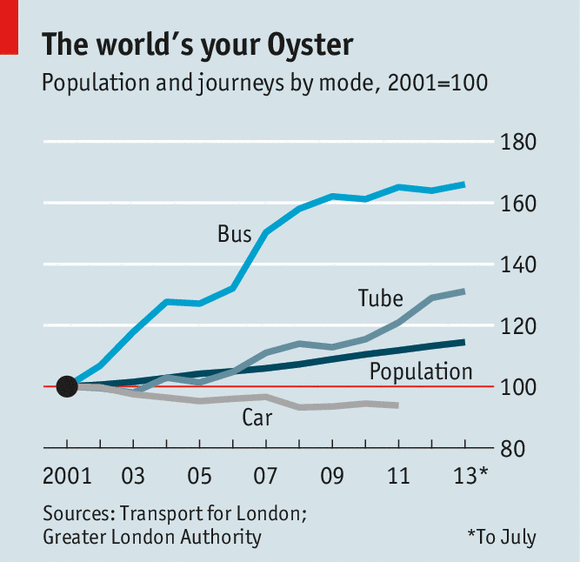
Underground, overground: London has built about as good a transport network as it could, given its constraints. Time to remove the constraints

Underground, overground: London has built about as good a transport network as it could, given its constraints. Time to remove the constraints

Oct 19th 2013 |From the print edition

20131019_BRC594 20131019_BRM993

FROM his offices high above Victoria station, Glenn Keelan, an engineer, looks down on a hive of activity. Huge diggers chew up and spit out earth just outside the 19th-century façade of the original station. Nearby, workers are lowered in boxy metal cages to work on an emergency entrance. By the time the extension is finished in 2018, the Tube station will be three times bigger. It needs to be: Victoria now has more people going through it than Heathrow airport, and its traffic has increased more quickly over the past four years. Read more of this post

How Jeff Bezos Makes Decisions

How Jeff Bezos Makes Decisions

by Dan McGinn  |   1:00 PM October 18, 2013

Over the last 19 years, Amazon.com has revolutionized the way we shop—and for much of that time, journalist Brad Stone has been watching closely. This week Stone, a senior writer at Bloomberg Businessweek, published The Everything Store: Jeff Bezos and the Age of Amazon. I talked with Stone about the evolution of Bezos as a decision-maker. Some excerpts from our conversation:

In the course of your reporting, what did you observe about Bezos’s decision-making style?

Two factors come to mind. The first is an observation made by Rick Dalzell, his right hand guy. He says that Jeff does two things better than anyone else. One is that he tries to find the best truth at the time. That may sound obvious, but Rick says that while a lot of people know what the truth is, they don’t engage their thinking about how the truth may change. Second, Rick says that Jeff refuses to accept the conventional wisdom about the way things are typically done. He thinks about reinventing everything—even small things. Two weeks ago, for instance, Amazon introduced the new Kindle Fire tablets. Ordinarily when tech companies do this, they hold a big press conference. Instead, Jeff brought about two dozen reporters in to see him in small groups. He did all the product demos himself. Everyone left feeling like they had a special session with this dynamic CEO, and Amazon received great press coverage. It’s a small example of how he tries to reinvent how things are done. Read more of this post

Since its debut in August, the “Chinese Characters Dictation Competition” has exploded in popularity. The show has touched a nerve in China, where purists complain that smartphones are eroding language skills

Chinese TV’s Latest Hit Features a Character-Driven Plot

Show Aimed at Reviving the Country’s Written Language Explodes

ISABELLA STEGER

Updated Oct. 19, 2013 12:32 a.m. ET

101913bee_640x360

A hit Chinese game show is revealing a startling fact: Chinese youth are losing their writing skills. Photo: CCTV

The word “toad” would be a snap in an English-language spelling bee, but not in a nationally televised contest in China. In Chinese, toad has three characters that are made up of 46 individual strokes. Yu Shuang, a 14-year-old contestant, came close in an early round. As her teammates squealed and drew out the word in the air, Miss Yu quickly wrote the characters on a screen that projected her effort on a big display above her head. When she finished, one of three judges hit the buzzer signaling a correct answer, bringing cheers. But the other two didn’t agree, pointing out that the young girl had missed a single dot in the third character. “You were obviously very nervous just now,” said the judge, as Miss Yu’s teammates groaned in disappointment backstage. Miss Yu wasn’t alone. The show tested a group of adults in the audience, and just 30% of them could write toad correctly, state media lamented after the broadcast. “It’s a word that everyone knows,” said the Xinhua News Agency. Read more of this post

Nobel winner Robert Shiller talks about the forces that made him a questioning, data-driven economist

Robert Shiller: A Skeptic and a Nobel Winner

By JEFF SOMMER

OCT. 19, 2013

Robert J. Shiller, a professor at Yale, learned on Monday that he had wonthe Nobel Memorial Prize in Economic Science, along with Lars Peter Hansen and Eugene F. Fama of the University of Chicago. The Nobel committee described Professor Shiller as a founder of the field of behavioral finance, an innovator in incorporating psychology into economics and a pioneering analyst of speculative bubbles in the stock and real estate markets. He is also one of a group of eminent economists who write the Economic View column for Sunday Business, and has contributed 60 of those columns since August 2007. As the editor of that column, I have talked to him often about his work, and on Wednesday, he called me from the airport en route to a lecture at the Dutch central bank in Amsterdam. Here is an edited, condensed version of that conversation.  Read more of this post

Leslie Moonves turned CBS into the country’s No. 1 network and revolutionized the way broadcasters get paid for content. Why he believes the future of TV is still bright

SATURDAY, OCTOBER 19, 2013

The Hit Maker

By ROBIN GOLDWYN BLUMENTHAL | MORE ARTICLES BY AUTHOR

Leslie Moonves turned CBS into the country’s No. 1 network and revolutionized the way broadcasters get paid for content. Why he believes the future of TV is still bright.

BA-BD182_CEO_F1_G_20131018133308ON-BC461_SPOTLI_G_20131019023448

“The guy relaxes by working,” says superagent Ari Emanuel of Moonves.

There’s no business like show business, as the Irving Berlin song goes. Trouble is, too few in the trade understand the business as well as the show. Leslie Moonves, who has run CBS since its spinoff from Viacom in early 2006, is a notable exception, having restored the so-called Tiffany network to glory and profits with programming hits and savvy deal-making. Today, CBS is No. 1 among television networks, and a strong fall lineup of new shows, including The Crazy Ones with Robin Williams, seems likely to secure its coveted status.

Read more of this post

India’s MCX says CEO submits resignation

India’s MCX says CEO submits resignation

4:07am EDT

MUMBAI (Reuters) – The Multi Commodity Exchange of India Ltd (MCEI.BO: QuoteProfileResearchStock Buzz) said on Saturday its managing director and chief executive officer, Shreekant Javalgekar, had submitted his resignation from the company, in which Financial Technologies (FITE.NS: Quote,ProfileResearchStock Buzz) holds a 26 percent stake. It did not specify a reason for the resignation in a statement. Financial Technologies also owns National Spot Exchange Ltd (NSEL). The NSEL has been under investigation by local police since last month after India’s commodities regulator ordered it to suspend trading over suspected violations of rules on contract duration. The MCX board will meet on Tuesday to discuss the appointment of a new CEO, its spokesman said.


To Catch Up, Walmart Moves to Amazon Turf

To Catch Up, Walmart Moves to Amazon Turf

By CLAIRE CAIN MILLER and STEPHANIE CLIFFORD

OCT. 19, 2013

SAN BRUNO, Calif. — A plucky Silicon Valley company, forced to compete for talented engineers, is trying it all — recruiting billboards on Highway 101; workplace perks like treadmill workstations and foosball tables; and conference rooms named after celebrities like Rihanna and Justin Bieber.

The name of that arriviste company?

Walmart.

The country’s largest retailer, which for years didn’t blink at would-be competitors, is now under such a threat from Amazon that it is frantically playing catch-up by learning the technology business, including starting @WalmartLabs, its dot-com headquarters. The two retail behemoths, one the king of the physical store and the other the conqueror of the online world, are battling over e-commerce — competing for the most talented engineers, trying to gain the upper hand in the new frontier of same-day delivery and warring over online pricing. Read more of this post

It’s Time for Amazon to Open Its Black Box; Amazon.com’s Kindle business is big and growing bigger. How big, and how fast? No one knows. A risk for investors

SATURDAY, OCTOBER 19, 2013

It’s Time for Amazon to Open Its Black Box

By ALEXANDER EULE | MORE ARTICLES BY AUTHOR

Amazon.com’s Kindle business is big and growing bigger. How big, and how fast? No one knows. A risk for investors.

In the coming days, Amazon.com will turn up its marketing muscle to promote its latest tablet, known as the Kindle Fire HDX. The device went on sale last Friday, and it has received hefty praise from gadget reviewers. At $229, the tablet undercuts Apple‘siPad mini by $100. If recent history is any guide, the new Fire will jump to the top of sales charts at Amazon, and the company will tout its success with a rather vague set of pronouncements. And then the news flow will come to a halt. Read more of this post

Jakarta Governor Joko Fires City Employee, But Not Agency Head, for Playing Video Games; “It’s actually alright to play games, but they should be able to process [permit applications] in five minutes”; Jokowi to wield axe in effort to slim down city’s bureaucracy

Joko Fires City Employee for Playing Video Games: Report

By SP/Deti Mega Purnamasari on 5:16 pm October 18, 2013.
Jakarta Governor Joko Widodo did not say a word to the employee caught playing video games during a surprise visit to the offices of the city’s small-and-medium enterprises agency. But on his way out of the building, Joko told his assistant to take down the employee’s name so that he could be fired. “It’s actually alright to play games, but they should be able to process [permit applications] in five minutes,” Joko said later, according to Indonesian news portal Merdeka.com. “But if they need two weeks to process [permits], how can they play games?” He visited the East Jakarta offices unannounced on Friday — the second time he has done so. Accompanied by East Jakarta Mayor H.R. Krisdianto and integrated services (PTSP) head Husnul Chotimah, Joko proceeded directly to the PTSP offices.

“How does one get a SIUP [business permit]?” he asked an employee. “How many days does it take? Where should I go after this?”

“Three days, sir,” the official reportedly replied,

But an applicant named Rofi Nata who was in line for a permit told the governor that the process takes two weeks. Joko went to the third floor, bringing with him a list of the companies and business that had registered for permits. He asked office staff there to teach him how to input the information so that he could do it himself.

“How do I input this?” he asked. “What’s the password?”

Office staff told him that agency head Johan Afandithe was the only one who knew the password, but he was nowhere to be found and no one knew where he was. At this point, Joko reportedly saw an employee trying to covertly close down a computer game he had been playing. The governor threw the papers he had been holding onto a table, asked for the names of all third floor staff, and while two officials tried to explain the situation, he walked to his car without speaking and slammed the door. PTSP is still a pilot project in Jakarta. The governor made his first unannounced visit there on July 16. Back at City Hall, Joko said the agency needed to become more efficient. “The speed should be faster,” he said. “Just type some sentences, input the information, fill in the form, type it, enter, sign it and issue it. It’s not difficult.” Read more of this post


A New Map of How We Think: Top Brain/Bottom Brain: Forget dated ideas about the left and right hemispheres. New research provides a more nuanced view of how we plan our lives and experience the world. Which cognitive mode best describes you?

A New Map of How We Think: Top Brain/Bottom Brain

Forget dated ideas about the left and right hemispheres. New research provides a more nuanced view of the brain

STEPHEN M. KOSSLYN and G. WAYNE MILLER

Oct. 18, 2013 7:57 p.m. ET

Who hasn’t heard that people are either left-brained or right-brained—either analytical and logical or artistic and intuitive, based on the relative “strengths” of the brain’s two hemispheres? How often do we hear someone remark about thinking with one side or the other? A flourishing industry of books, videos and self-help programs has been built on this dichotomy. You can purportedly “diagnose” your brain, “motivate” one or both sides, indulge in “essence therapy” to “restore balance” and much more. Everyone from babies to elders supposedly can benefit. The left brain/right brain difference seems to be a natural law. Read more of this post