Buddhism in South Korea: Monkey business; It is not all sweetness and light at the biggest Buddhist order

Buddhism in South Korea: Monkey business; It is not all sweetness and light at the biggest Buddhist order

Oct 5th 2013 | SEOUL |From the print edition

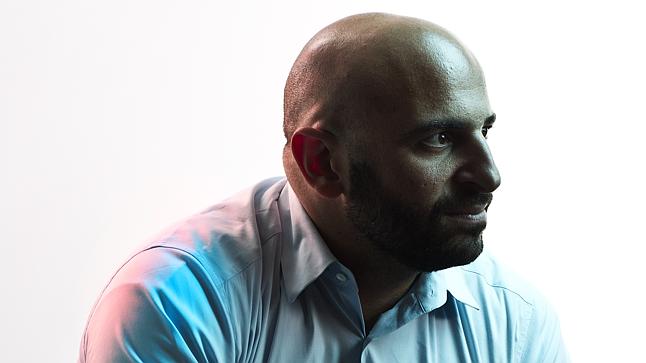
THE Venerable Jaseung has, of late, become good at saying sorry. When eight senior monks were caught smoking and boozing over a game of high-stakes poker in a hotel room last year, the leader (pictured) of the Jogye order, South Korea’s biggest Buddhist sect, led the 108-bow repentance. Many thought he should resign. He assured them he would not run for election again. But on September 16th, he belatedly entered the race—and swiftly apologised for doing so. Read more of this post


The Story Of The Creation Of The iPhone Explains Why Apple Can’t Just ‘Innovate’ A New Product Every Other Year

The Story Of The Creation Of The iPhone Explains Why Apple Can’t Just ‘Innovate’ A New Product Every Other Year

JAY YAROW OCT. 5, 2013, 10:02 AM 7,876 10

One of the strangest criticisms to dog Apple in the two years since Steve Jobs died is that the company is no longer innovative.  Innovation is one of those fickle words that’s relatively loaded.  Microsoft, for instance, is often blasted for lacking innovation despite the fact that it has labs filled with amazing inventions and home-built first-of-its-kind technology. Google and Facebook are often lauded for their innovation, despite the fact that they often release me-too products that are essentially iterations of what already exists.  We’re not trying to knock Google and Facebook. They often release innovative products.  But, every major technology company is innovative. Without innovation these companies die.  Still, some people say innovation is dead at Apple.  The reason the innovation tag hangs over Apple is that the company’s success is perceived to depend upon the release of ground-breaking new products since it is not a monopoly in its product markets. The iPhone has less than 20% of the smartphone market. The Mac has less than 10% of the PC market. The iPad is at 32% of the tablet market, and falling. The iPod is dominant, but largely irrelevant today. Read more of this post

How Twitter’s IPO affects Sina Weibo; Twitter’s 218 million monthly active users is valued at $15 each; Sina Weibo has 54 million daily active users valued at $7 each

How Twitter’s IPO affects Sina Weibo

October 4, 2013

by Paul Bischoff

twitter-sina-eye

Sina (NASDAQ:SINA) investors are keeping a watchful eye on the news about Twitter‘s IPO. Despite the Chinese web giant’s more diverse portfolio of products and services, many market analysts believe the majority of Sina’s market cap lies in its Twitter-like Sina Weibo social network. Thinking that the clone will mirror the original, Twitter’s value is inherently tied to Sina’s. Read more of this post

The economics of cow ownership: If the average return on a cow is -64% once you factor in the cost of labour, why do households buy them?

The economics of cow ownership

Udder people’s money

Cattle may be a terrible investment but a decent savings vehicle

Oct 5th 2013 |From the print edition

IN INDIA there are about 280m cows. They produce valuable things—milk, dung and calves. But cattle are expensive to keep. The biggest outlay is food—the average cow consumes fodder worth about 10,000 rupees ($160) a year. Veterinary costs also add up. These expenses are so high that cows are often a poor investment. According to a new and splendidly titled NBER paper, which looks at cow and buffalo ownership in rural areas of northern India, the average return on a cow is -64% once you factor in the cost of labour. If returns on cattle are so bad, why do households buy them? People may not be thinking about economics, of course. Hindus may derive spiritual fulfilment from cow ownership. Households may prefer to produce high-quality milk at home, even if doing so costs more. Read more of this post

Hot air: Are models that show the economic effects of climate change useless?

Hot air: Are models that show the economic effects of climate change useless?

Oct 5th 2013 |From the print edition

20131005_FND000_1

MODELS simplify. They are supposed to. It is a feature, not a bug. Their formulae may be complex but models deliberately omit some things in order to focus on others. They also leave out factors that cannot be modelled satisfactorily. That is understandable, but what if the factors that cannot be modelled make a huge difference to the outcome? And what if the things that are excluded tend to produce a systematic bias in the results? Read more of this post

Duke to NYU Missteps Abroad Lead Colleges to Reassess Expansion

Duke to NYU Missteps Abroad Lead Colleges to Reassess Expansion

For two decades, U.S. universities have raced to build campuses abroad to burnish their reputation and attract foreign students. Now, controversies and stumbles at high-profile projects have led some to reconsider expansion. Among the setbacks: faculty dissent at New York University and Yale University, construction delays at Duke University’s campus in China and lackluster enrollment at Persian Gulf outposts. Politics in Russia are jeopardizing the success of Massachusetts Institute of Technology’s project in Moscow. Read more of this post

Why Lots Of Grass-Fed Beef Sold In U.S. Comes From Down Under

Why Lots Of Grass-Fed Beef Sold In U.S. Comes From Down Under

by DAN CHARLES

October 03, 2013 2:49 PM

Beef from cattle that have grazed only on pasture is in high demand — much to the surprise of many meat retailers, who didn’t traditionally think of grass-fed beef as top-quality. George Siemon, a founder of Organic Valley, the big organic food supplier, says the push for grass-fed beef started with activists who wanted to challenge a beef industry dominated by factory-scale feedlots. In those feedlots, cattle are fed a corn-heavy diet designed to make the animals gain weight as quickly as possible. Read more of this post

Don’t be misled by this chart Twitter used in its IPO filing

Don’t be misled by this chart Twitter used in its IPO filing

By David Yanofsky @YAN0 October 3, 2013

Twitter included in its IPO filing a chart of monthly active users—MAUs as it calls them. These numbers are significant for investors trying to assess how fast Twitter will grow in the future—and it’s clearly in the company’s interest to make the growth rate look as impressive as possible. Twitter’s chart looks like this:

g564001g90u15

If you were just looking at the bars you might make the assumption that from March 2012 to June 2013 monthly active users tripled—the June 2013 bar is three times the size of the March 2012 bar. But if you look carefully you’ll see that the chart’s y-axis starts at 100 million, and if you look at the numbers on top of the bars you’ll see that over this time period user growth was only 58%. Here’s a more accurate chart of the same data, with the y-axis set at zero:

twitter-monthly-active-users-mau_chartbuilder-1

The flawed Twitter chart appears at the beginning of the filing. But in fairness, Twitter does provide bar charts of its user growth with y-axes that start at zero later in the document. See page 61.

A cluster of start-ups in east London is thriving. All they need now is a big success

A cluster of start-ups in east London is thriving. All they need now is a big success

Oct 5th 2013 |From the print edition

TO SPAWN the next Facebook or Twitter, first launch a start-up contest. Promise the winner a sizeable equity investment, say £1m ($1.6m), and let firms from all over the world compete. Among the entries there will surely be a hit. This is the idea behind the Million Pound Start-Up competition put together by Digital Shoreditch, an event organiser. More than 1,000 hopefuls from 77 countries have signed up. Read more of this post

What newspapers can learn from television

What newspapers can learn from television

Oct 5th 2013 |From the print edition

LAST November Mike Darcey, then a top executive at BSkyB, a British satellite-television company, received a phone call from Rupert Murdoch, the boss of News Corporation. Mr Murdoch wanted him to run News UK (formerly News International), his scandal-plagued British newspaper unit, even though Mr Darcey had never worked in publishing. “Don’t worry about it,” Mr Murdoch said. “It’s exactly the same” as television. Read more of this post

Regional Control Eludes Indonesian Firms

Regional Control Eludes Indonesian Firms

By Tito Summa Siahaan on 1:30 pm October 5, 2013.
Semen Indonesia may be one of the the biggest companies in Southeast Asia’s biggest economy, but its rival, SCG of Thailand, has a larger regional presence. (JG Photo/Dhana Kencana)

Telekomunikasi Indonesia, Bank Mandiri, Bank Rakyat Indonesia, Bank Central Asia, Indofood Sukses Makmur, Gudang Garam, Bumi Resources and Adaro Energy. These Indonesian firms are part of the top 50 listed companies in Southeast Asia by revenue, according to the Asean Investment Report, published by the Asean Secretariat in July. The largest of them all, state-controlled telecommunication firm Telekomunikasi Indonesia, ranked 13th in the list that was dominated by companies from Thailand, Singapore and Malaysia. More strikingly, in the same report, of the 10 largest banks in the region by assets, none hailed from Indonesia. Household names like Mandiri and BRI are well known within Indonesia, but outside, they lack cache and are minnows compared to regional champions such as DBS Group Holdings, OCBC and United Overseas Bank — all from Singapore. Even with the list based on financial reports of 2011, the data show that Indonesian corporations are still trying to catch up with their regional counterparts. Read more of this post

Policy Missteps Seen As Hurting Indonesia’s Appeal to Investors

Policy Missteps Seen As Hurting Indonesia’s Appeal to Investors

By Francezka Nangoy on 12:30 pm October 5, 2013.
DBS Group Holdings’ decision to bail out of its planned acquisition of Bank Danamon Indonesia this year may be one example of why investors are concerned about nationalism and protectionism issues in Indonesia. DBS’s deal was the most anticipated acquisition in Indonesia’s financial sector, highlighting the interest of foreign investors in Indonesia’s growing economy. Read more of this post

Bicycles and rickshaws in India: Some say Kolkata should back-pedal on its bicycle ban

Bicycles and rickshaws in India: Some say Kolkata should back-pedal on its bicycle ban

Oct 5th 2013 |From the print edition

20131005_ASP003_0

TRAVEL within any Indian city is usually crowded and slow. But Kolkata (formerly Calcutta), capital of West Bengal, has certain advantages. Its underground rail network, which was the first to open in India in 1984, is being extended. Uniquely in the country, electric trams clatter along its streets. Public transport may look dilapidated but it functions reasonably well: urban ferries, suburban trains, smoky buses and motorised rickshaws shunt around the city’s 14m residents. Read more of this post

What Deng Taught Xi Jinping: Pragmatism Trumps Ideology

What Deng Taught Xi Jinping: Pragmatism Trumps Ideology

By Christopher Johnston on 12:40 pm October 4, 2013.
When Xi Jinping became leader of the Chinese Communist Party he chose the location of his first official visit carefully. He did not pay tribute at Mao’s tomb, or tour the rural heartland of Hu Jintao. Instead, the new General Secretary traveled to Shenzhen, a prosperous special economic zone once overseen by his father. There he laid flowers at a bronze statue of Deng Xiaoping. Read more of this post

‘Property tours’ in China: Free travel, no commitment required

‘Property tours’ in China: Free travel, no commitment required

Staff Reporter

2013-10-05

“Excellent shops available, with down payment of 100,000 yuan (US$16,300) and a guaranteed lease period of 15 years at an annual return rate of between 8%-18%. Free transportation and accommodation will be provided to those who wish to see the shops over the National Day holiday.” The above advertisement has proved attractive for potential buyers keen to take advantage of getting a free trip with no commitment to buy anything required. Read more of this post

China gambles on theme park, whale sharks to lure punters from Macau casinos

China gambles on theme park, whale sharks to lure punters from Macau casinos

By Farah Master

HENGQIN ISLAND, China (Reuters) – It’s being touted as China’s answer to Orlando, a $5 billion resort and theme park complete with a mega rollercoaster and a whale shark tank situated on a sleepy southern island next to the world’s biggest gambling hub Macau. Chimelong, which is set to partially open next month, is the linchpin of China’s ambitious plans to expand Hengqin into a leisure hub similar to the coastal U.S. city globally renowned for its natural attractions and theme-park resorts by Walt Disney Co (DIS.N: QuoteProfileResearchStock Buzz) and Universal Studios. Read more of this post

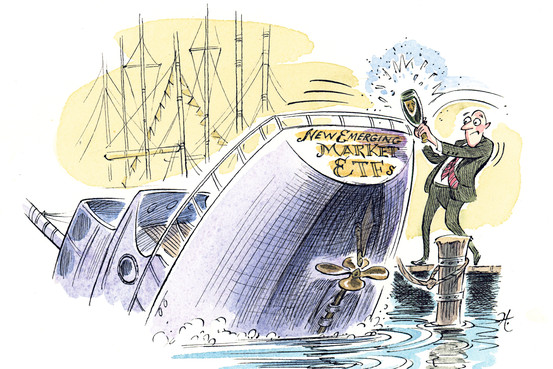
The latest trend in emerging-market exchange-traded funds is to leave out the biggest countries. But the focus should be on companies, not countries

SATURDAY, OCTOBER 5, 2013

New ETFs: Christening a Sinking Ship

By BEN LEVISOHN | MORE ARTICLES BY AUTHOR

The latest trend in emerging-market exchange-traded funds is to leave out the biggest countries. But the focus should be on companies, not countries.

BA-BD075_mfq_et_G_20131005000300

What was once a brilliant marketing concept has collapsed like a ton of bricks. That would be the BRICs, of course, the term for Brazil, Russia, India, and China coined by Goldman Sachs’ Jim O’Neill in 2001. Once a favorite of investors, it’s now so far out of favor that the latest trend seems to be excluding them from new emerging-market exchange-traded funds. But that ship has already sailed. Read more of this post

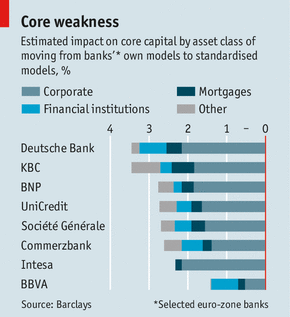
The asset-quality review: Close scrutiny of Europe’s banks may turn up unexpected shortfalls

The asset-quality review: Close scrutiny of Europe’s banks may turn up unexpected shortfalls

Oct 5th 2013 |From the print edition

20131005_FNC509

THE ink on the agreements that will hand supervision of the euro area’s biggest banks to the European Central Bank (ECB) is barely dry. Yet the ECB is already enmeshed in squabbles with national banking supervisors over the extent of its powers and the rigour with which it will undertake its first big task, a warts-and-all review of the balance-sheets of the banks it will take charge of in a year’s time. Read more of this post

Riding the wave: Corporate dealmakers should heed the lessons of past merger waves

Riding the wave: Corporate dealmakers should heed the lessons of past merger waves

Oct 5th 2013 |From the print edition

20131005_WBD000_0

WHY mergers and acquisitions (M&A) come in waves is not fully understood. Companies’ fortunes are affected by the economy’s ebb and flow, but this does not seem enough to explain why merger activity crests and breaks so dramatically. Yet crest and break it does. In America there have been at least five merger waves, in which the number of deals swelled, peaked then tumbled. The first, in the 1920s, ended with the onset of the Great Depression. It was less obvious why the following ones—in the 1960s and then in each decade since 1980—were so strong. Now, say some experts, a powerful sixth wave is forming. Read more of this post

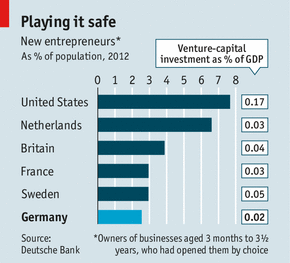
Business creation in Germany: A vigorous start-up scene has yet to produce its first big breakthrough; “All of the entrepreneurial spirits left here 200, 300 years ago,” jokes Maxim Nohroudi in his Berlin office

Business creation in Germany: A vigorous start-up scene has yet to produce its first big breakthrough

Oct 5th 2013 | BERLIN |From the print edition

20131005_WBC503

“ALL of the entrepreneurial spirits left here 200, 300 years ago,” jokes Maxim Nohroudi in his Berlin office. That is obviously not quite true. He met his business partner at Düsseldorf airport in 2010, their flight grounded by the eruption of Iceland’s Eyjafjallajökull volcano. If only there were an app to compare their options to get back to Berlin by schedule, price and time required, they thought. Now there is: Waymate, which quickly compares both inter-city and intra-city means of travel. To make money, Waymate plans to sell adverts aimed at people based on their location. Eventually the app will allow data to travel two ways, so that users can tell each other when a bus is stuck in traffic. Read more of this post

Work on Stuff that Matters: First Principles – Work on something that matters to you more than money.

Work on Stuff that Matters: First Principles

by Tim O’Reilly | @timoreilly | +Tim O’Reilly | Comments: 91 | January 11, 2009

I spent a lot of last year urging people to work on stuff that matters. This led to many questions about what that “stuff” might be. I’ve been a bit reluctant to answer those questions, because the list is different for everyone. I thought I’d do better to start the new year with some ideas about how to think about this for yourself. First off, though, I want to make clear that “work on stuff that matters” does not mean focusing on non-profit work, “causes, or any other form of “do-goodism.” Non-profit projects often do matter a great deal, and people with tech skills can make important contributions, but it’s essential to get beyond that narrow box. I’m a strong believer in the social value of business done right. We need to build an economy in which the important things are paid for in self-sustaining ways rather than as charities to be funded out of the goodness of our hearts. There are a number of half-unconscious litmus tests I use in my own life. I’m going to try to tease them out here, and hope that you can help me think this through in the comments.

Work on something that matters to you more than money. Read more of this post

David and Goliath: Underdogs, Misfits and the Art of Battling Giants: Malcolm Gladwell’s study of unlikely victors is his most enjoyable book yet, writes Lucy Kellaway

October 4, 2013 7:04 pm

Lucy Kellaway on ‘David and Goliath’ by Malcolm Gladwell

Review by Lucy Kellaway

Malcolm Gladwell’s study of unlikely victors is his most enjoyable book yet, writes Lucy Kellaway

David and Goliath: Underdogs, Misfits and the Art of Battling Giants, by Malcolm Gladwell, Allen Lane, RRP£16.99/Little, Brown, RRP$29, 320 pages

David and Goliath is an ill-assorted collection of anecdotes that demonstrates various things we already know. It tells us that having nothing to lose can make you bolder. That if you deploy power indiscriminately, it may backfire. And that losing a parent early on can give you a leg up if you plan on becoming a genius. Malcolm Gladwell’s new book comes without the single, catchy idea that made his earlier ones such stonking successes. The Tipping Point (2000) introduced us to the instant at which a trend became a trend. Blink (2005) told us how we make decisions without thinking. And Outliers (2008) warned that if you want to get good at something, you’ll need to spend 10,000 hours practising. Yet David and Goliath is Gladwell’s most enjoyable book so far. It is a feel-good extravaganza, nourishing both heart and mind. Each of its stories – set in Northern Ireland, Alabama, California, Vichy France and ancient Palestine – has an ending that is both happy and surprising. Gladwell is a master at marching us off in one direction, only to end up taking us somewhere else instead – somewhere better. Read more of this post

Pull closet indexing out of the closet; Fund manager practice is a tax on millions of investors

October 4, 2013 2:15 pm

Pull closet indexing out of the closet

John Authers

Fund manager practice is a tax on millions of investors

In the UK, people are trying to pull closet indexing out of the closet. It is a fight that could have global implications. This is one issue on which there is no need to sit on the fence. The debate betweenactive managers, who try to beat their benchmark, and passive managers, who merely track it, will go on and on. But everyone can agree that there is no case for closet indexing – the practice of running an “active” fund, charging active management fees but, in practice, offering an investment that merely hugs the index. Read more of this post

Tongyang Group Chairman Hyun Jae-hyun’s risky bets have led the mid-tier conglomerate to head toward a tragic end, producing innocent victims

2013-10-04 17:46

Tongyang investors to take fall

Financial regulator launches taskforce to help victims
By Kim Tae-jong

K2013100400118-200(1)

Aletter to Tongyang Group Chairman Hyun Jae-hyun was found in the car where a female employee at a Jeju branch of Tongyang Securities committed suicide on Oct. 2, feeling guilty about customers’ losses

Tongyang Group Chairman Hyun Jae-hyun’s risky bets have led the mid-tier conglomerate to head toward a tragic end, producing innocent victims.
The group’s five affiliates including Tongyang Cement & Energy and Tongyang Networks have been placed under court receivership, and its previous efforts to keep afloat through bond issuance have also harmed tens of thousands of retail investors.
Pressured by the guilt over customer losses, a female employee from a Jeju branch of Tongyang Securities took her own life on Oct. 2. The brokerage affiliate sold more than half of corporate bills and bonds issued by the group.
Identified only by her surname Ko, she was found dead in her car in an apparent suicide with a suicide note and letter to chairman Hyun found in the scene.
“Chairman Hyun, you can’t do this to your employees and customers,” she wrote in her letter to Hyun. “I recommended to customers (to buy our corporate bonds and bills) to offer them high interests. I really trusted Tongynag Group.”
She also expressed her deep regret over the financial damage caused to customers, demanding the group take measures to make full compensation for them.
The police stated she made a tragic decision, and that she suffered from complaints from customers who were subject to huge losses from their investment, after the group’s five affiliates sought court receivership. Read more of this post

Capturing the Innovation Mindset at Bally Technologies

Capturing the Innovation Mindset at Bally Technologies

by Vijay Govindarajan and Srikanth Srinivas  |   9:00 AM October 4, 2013

Bally Technologies, a leading provider of gaming systems for casinos, has earned more than 60 awards for innovation in just the last four years. It increased R&D spending from 7-8% of revenue before 2009 to 11-12% of revenue starting in 2010, and maximized the return on that increased investment. The result: Its return on assets tripled, from an industry-lagging position below 4% to an industry-leading position above 12%. How did Bally Technologies do it? Through an innovation excellence framework. This framework is not new; we introduced a similar mindset in an earlier post with 3M. But while the foundational elements are the same, Bally Technologies uses them in a distinct way. It has a more rigorous organization structure that divides responsibilities between the innovation team and development team, and strengthens management around the opportunity pipeline. The company combines this with an intense focus on execution and weekly course correction — but also uses innovation as a means to get the employees energized. Bally Technologies has achieved great success, but only after making this framework its own. Using the five tenets we introduced before, here’s a breakdown of how the company does just that. Read more of this post

Tips for entrepreneurs from Yammer co-founder Adam Pisoni

Caitlin Fitzsimmons Online editor

Tips for entrepreneurs from Yammer co-founder Adam Pisoni

Published 04 October 2013 12:02, Updated 04 October 2013 14:36

fad219d8-2c98-11e3-ba24-c68aeb341ab8_764483237--646x363

Adam Pisoni co-founded a software company and sold it to Microsoft for $US1.2 billion five years later.

The product, Yammer, is a social networking tool to foster collaboration inside companies and is being integrated into the Microsoft Office suite. Pisoni is still running the business, based in downtown San Francisco with about 350 staff. A year after the acquisition, Pisoni claims to want to stay at Microsoft to see Yammer “change every company on the planet” – although he would be bucking a trend if he did so. (Statistics show the majority of start-up founders leave within two years of an acquisition). BRW caught up with Pisoni last month at Microsoft Australia’s TechEd conference on the Gold Coast and he shared his tips for aspiring entrepreneurs. Read more of this post

On today’s campuses, the Socratic ideal of genuine intellectual encounters has largely disappeared

October 4, 2013, 3:51 p.m. ET

Book Review: ‘Why Teach?’ by Mark Edmundson

On today’s campuses, the Socratic ideal of genuine intellectual encounters has largely disappeared.

HARRY GRAVER

Picture a day in the life of an ambitious American undergrad. Morning starts with a pre-law course that does little to nourish his soul but that has been commended to him by an adviser. After an internship interview with an investment firm, he’ll spend the afternoon on elective courses with titles like “GaGa for Gaga: Sex, Gender, and Identity” (actually taught at the University of Virginia) or “Invented Languages: Klingon and Beyond” (University of Texas at Austin). The evening is reserved for drunken revelry. Read more of this post

Earth’s Oxygen: A Mystery Easy to Take for Granted

October 3, 2013

Earth’s Oxygen: A Mystery Easy to Take for Granted

By CARL ZIMMER

To Donald E. Canfield, there’s something astonishing in every breath we take. “People take oxygen for granted because it’s just there and we breathe it all the time,” said Dr. Canfield, a geochemist at the University of Southern Denmark. “But we have the only planet we know of anywhere that has oxygen on it.” What’s even more astonishing is that Earth started out with an oxygen-free atmosphere. It took billions of years before there was enough of the element to keep animals like us alive. Although scientists have been struggling for decades to reconstruct the rise of oxygen, they’re still making fundamental discoveries. In just the past two weeks, for example, Dr. Canfield and his colleagues have published a pair of studies that provide significant clues about some of the most important chapters in oxygen’s history. They’re finding that our weirdly oxygen-rich atmosphere is the result of a complicated dance of geology and biology. Read more of this post

Chinese e-cigarette inventor fights for royalties

Chinese e-cigarette inventor fights for royalties

BY TOM HANCOCK

AFP-JIJI

OCT 4, 2013

nb20131005a5a-870x580

Smokin’ clean: Hon Lik, widely acknowledged as the first person to develop a commercially viable electronic cigarette, smokes a pipe version on Sept. 23 at his office in Beijing. | AFP-JIJI

BEIJING – The Chinese inventor who dreamed up the electronic cigarette in a nicotine-induced vision says that despite its global popularity, copycat versions and legal disputes mean he has battled to cash in on his creation. “Smoking is the most unhealthy thing in people’s everyday lives. . . . I’ve made a big contribution to society,” said Hon Lik, 57, in a cramped office in Beijing, sending tobacco-scented smoke into the air as he puffed on a battery-powered pipe. “But I don’t live like a rich person, because of all the troubles our company has faced.” Read more of this post

Funding startups ‘a bit of a lottery’: How one angel investor has perfected choosing which companies he invests in

Funding startups ‘a bit of a lottery’: How one angel investor has perfected choosing which companies he invests in

Armina Ligaya | 30/09/13 9:30 AM ET
Colin Wyatt calls his first foray into the world of angel investing “a wipeout.”

The National Angel Capital Organization (NACO) serves Canada’s angel investor community, with a mission to scale up its size and scope. To that end, it is set to release a report on the state of angel investing in Canada. While I don’t know what this report will say, I can guess it will argue investing levels are not even close to where they need to be to allow Canada to advance its early stage entrepreneurial investment opportunities. It was the late 1990s, and the Canadian technology executive decided to invest $150,000 in a U.K.-based startup called Imagine. Their model was to put kiosks in retail stores which would recognize customers by their mobile phones and print out physical coupons based on their shopping preferences, he said. Read more of this post