Disney’s Mouse Has Room to Roar; Shares of big media companies have been on a tear the past year as the market power of content owners seems increasingly difficult to dispute
November 1, 2013 Leave a comment
Disney’s Mouse Has Room to Roar
Investment in Its Business Should Start to Pay Off
MIRIAM GOTTFRIED
Oct. 31, 2013 4:02 p.m. ET
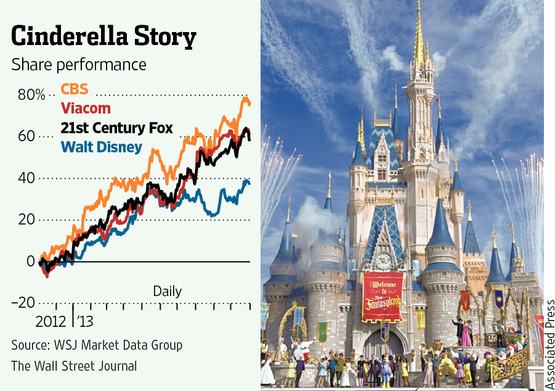
Walt Disney‘s DIS +0.18% kingdom has seemed less than magical in recent months. Shares of big media companies have been on a tear the past year as the market power of content owners seems increasingly difficult to dispute. All trade at, or near, 52-week highs. In that, Disney is no exception. But its shares have underperformed peers, rising 40% over the past year, compared with 62% for 21st Century Fox, FOXA +0.43% 63% for ViacomVIAB -0.24% and 83% for CBS. CBS +0.89%Fears related to the August launch of Fox’s Fox Sports 1, a direct competitor to Disney’s ESPN, concerns about investment in its parks division and a relatively low rate of capital return all have kept investor enthusiasm in check. The announcement that fiscal fourth-quarter results, due Nov. 7, will include a write-down of as much as $190 million for “The Lone Ranger” didn’t help.
But Disney’s financial movie shouldn’t prove as scary as the preview.
For one, the moat around crown-jewel ESPN is deeper than it seems. ESPN has recently signed long-term renewal agreements with eight of its 10 largest distributors. Fees from pay-TV providers, which represent 70% of ESPN’s revenue and 20% of Disney’s revenue, are largely unaffected by Fox’s entrance, according to Sanford C. Bernstein.
Granted, Fox could cut into ESPN’s advertising sales. But, so far, Fox is using the sports channel to consolidate programming it already carried across a handful of networks. That isn’t hurting ESPN, whose ratings have actually risen slightly since the launch. (Until June, 21st Century Fox was part of the same company as Wall Street Journal owner News Corp. NWSA +1.41% )
And Fox will have to wait to outbid ESPN for big content deals. The vast majority of ESPN’s sports rights are locked in through the next decade, according to research firm MoffettNathanson. The only wild card is the National Basketball Association, up for renegotiation in 2016.
ESPN aside, heavy spending on the parks business, Disney’s second largest, seems to have made investors nervous the company won’t be able to recoup its investment. Domestic parks are nearing the end of their investment phase, including the completion of the Fantasy Land refurbishment and the beginning of construction of Avatar Land, both in Orlando, Fla. But Disney is still working on its Hong Kong park and is building one in Shanghai, set to open in late 2015.
So the full benefit of these investments is yet to be reflected in park margins. Indeed, thanks to the investments, Bernstein estimates park revenue will rise at a 9.1% compound annual growth rate through fiscal 2016, with operating income increasing at 16.1%. That compares with growth rates of 4.4% and 10.3%, respectively, without the recent initiatives.
Worries about investment tap into what has perhaps been a more fundamental issue for many: Disney’s capital returns. The company has historically chosen to avoid specific buyback targets like those embraced by peers.
That has allowed Disney to use its cash to invest in its business and given it more flexibility for such recent acquisitions as Marvel Entertainment and Lucasfilm. Yet investors haven’t given Disney full credit, a fact the company seemed to acknowledge in September. It said it planned to buy back between $6 billion and $8 billion of shares in fiscal 2014, up from $4 billion in 2013.
That is significantly more than in the past as a percentage of net income. But Disney should be able to fund the buybacks with strong free-cash-flow growth as investment slows, MoffettNathanson says. It forecasts free cash flow will rise 13%, to $6.5 billion, in fiscal 2014 and 15%, to $7.2 billion, in fiscal 2015.
If so, this could mean Disney ends up looking cheaper than it does on a multiple of enterprise value to earnings before interest, taxes, depreciation and amortization, or Ebitda. And it is already at a slight discount, trading at 10.1 times estimated 2014 Ebitda, versus 10.3 times for CBS and 10.5 times for Viacom, even though those companies aren’t expected to increase such earnings as quickly.
Disney has been building a better mouse house. As that starts to pay off, investors should be readying their traps.
 About bambooinnovator
 Bamboo Innovator