Perhaps half a million people live illegally in Britain. The government’s draconian new immigration bill will not change that much

Perhaps half a million people live illegally in Britain. The government’s draconian new immigration bill will not change that much

Oct 26th 2013 |From the print edition

MARY, a Zimbabwean woman, first came to Britain in 2003. She flew in on a South African passport and immediately claimed asylum. Her claim was rejected, as the Home Office believed she really was South African. But, like many asylum seekers, she did not leave. Several years—and appeals—later, she was almost deported, but avoided it by cutting herself with a blade she found in her cell. She has no right to be in Britain, let alone to work or claim benefits. But nor is she likely to be deported. “I don’t really know what happens now,” she says. Read more of this post
Pay and economic growth: A shrinking slice; Labour’s share of national income has fallen. The right remedy is to help workers, not punish firms

Pay and economic growth: A shrinking slice; Labour’s share of national income has fallen. The right remedy is to help workers, not punish firms

Nov 2nd 2013 |From the print edition

20131102_LDC685_020131102_FNC674_0

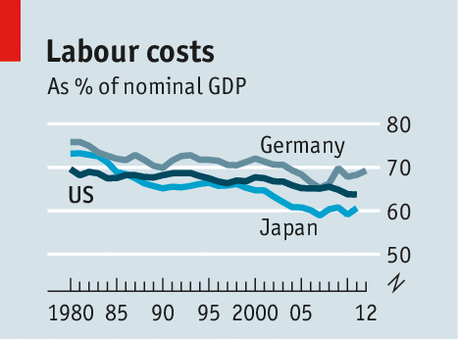
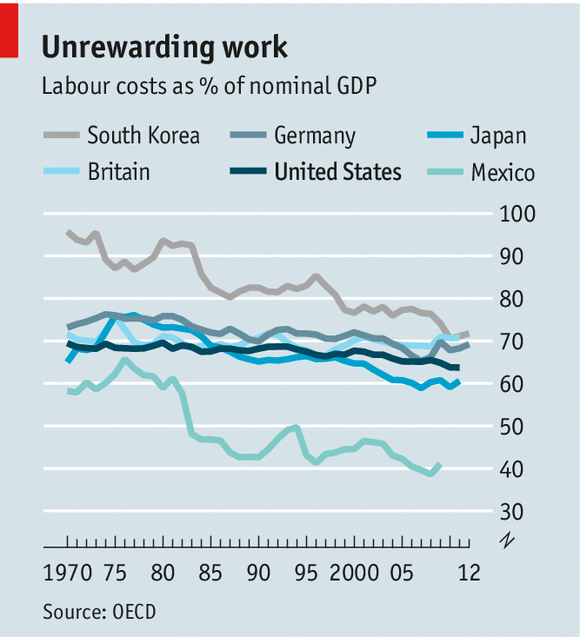
IMAGINE the proceeds of economic output as a pie, crudely divided between the wages earned by workers and the returns accrued to the owners of capital, whether as profits, rents or interest income. Until the early 1980s the relative sizes of those slices were so stable that their constancy became an economic rule of thumb. Much of modern macroeconomics simply assumes the shares remain the same. That stability provides the link between productivity and prosperity. If workers always get the same slice of the economic pie, then an improvement in their average productivity—which boosts growth—should translate into higher average earnings. Read more of this post

MSCI Puts ISS on Block amid Proxy Firm Headwinds

October 31, 2013, 6:09 PM ET

MSCI Puts ISS on Block amid Proxy Firm Headwinds

CFO Report Editor, WSJ Pro

This article was originally posted on our sister blog, Risk & Compliance Journal.

By Gregory J. Millman

MSCI Inc. announced in its third quarter earnings release that it was exploring strategic alternatives for its influential proxy advisor and governance-services provider ISS. The announcement comes as the proxy advisory business is facing regulatory scrutiny, market headwinds, and questions about the validity of its analytical models. The announcement quoted Henry A Fernandez, chairman and chief executive of MSCI, saying of ISS that,  “Over the past three years, MSCI has worked hard to return that business to a growth track.” Mr. Fernandez further said, “the Governance business reported organic revenue growth of 7% and Adjusted [earnings before interest, tax, depreciation and amortization] growth of 12%. We believe the time is right to explore our strategic alternatives.” A spokesman for ISS declined to comment beyond the release.


FedEx and UPS have turned Memphis and Louisville into “aerotropolises”

FedEx and UPS have turned Memphis and Louisville into “aerotropolises”

Nov 2nd 2013 | MEMPHIS |From the print edition

AFTER most Memphians have gone to bed and before they switch on their coffee-makers, around 150 jets land at Memphis International Airport and take off again. They have no passengers—just stuff. A Boeing 777 jet may feel cramped to those sardined in coach class, but with all the seats and compartments stripped out it is immense—able to carry 225,000 pounds (102 tonnes) of cargo non-stop from Tennessee to Shanghai. Read more of this post

Fed’s Bubble Alarm Stuck on Snooze

Fed’s Bubble Alarm Stuck on Snooze

By Jonathan Weil  Oct 31, 2013

The Federal Reserve’s policy of unrestrained quantitative easing has worked like rocket fuel for U.S. stocks this year. Case in point:Rocket Fuel Inc. It’s the sort of company that probably couldn’t have done an initial public offering absent a raging bull market. Rocket Fuel says its business is “big data” and “artificial intelligence” (as opposed to real intelligence). Mainly, it helps advertising agencies place orders for online ad campaigns. Read more of this post

Chinese investors sour on Brazil

Updated: Friday November 1, 2013 MYT 3:03:00 PM

Chinese investors sour on Brazil

SAO PAULO: For Chinese investors, Brazil is no longer the promised land. After making a big push into the South American giant in search of raw materials such as iron ore, as well as a promising market for their consumer goods, Chinese executives have grown frustrated with stagnant economic growth, heavy costs and what they see as a political and popular backlash against their presence. As a result, Chinese investment is falling. As much as two-thirds of the roughly US$70bil in projects announced since 2007 is either on hold or has been cancelled, according to interviews with Chinese and Brazilian officials.

Read more of this post

Britain’s plans for a high-speed railway are deeply flawed. Spend the money on boring stuff instead

Britain’s plans for a high-speed railway are deeply flawed. Spend the money on boring stuff instead

Nov 2nd 2013 |From the print edition

THE Victorians did Britain a favour by building such a terrific railway network. A map of the country’s lines resembles a dense tangle of blood vessels, clotted around London, the West Midlands and the urban north-west. France’s, by contrast, looks like a lazy spider’s web. But the Victorians also bequeathed to their successors a powerful sense of inferiority. Surely the nation ought to be able to build like that again? Read more of this post

Britain runs towards nuclear energy as other countries flee

Britain runs towards nuclear energy as other countries flee

Oct 26th 2013 |From the print edition

20131026_BRC618

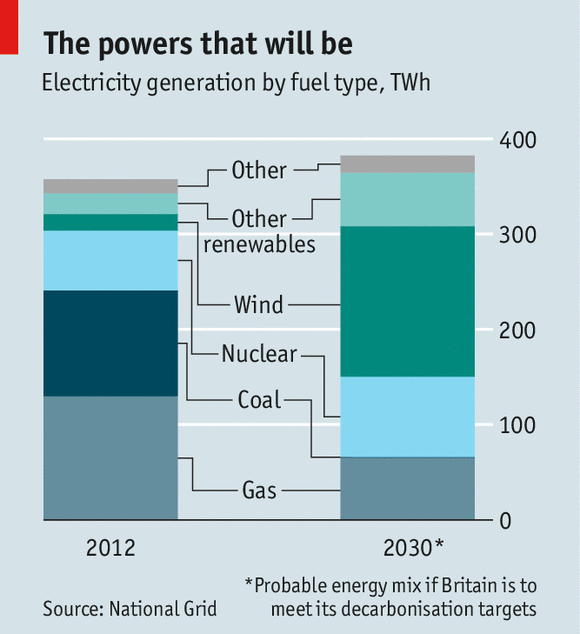
TOURING the muddy, unfinished site of Calder Hall, Britain’s first nuclear power station, in 1955, The Economist’s correspondent detected an “infectious, irresistible sense of excitement”. Some fear the flattened earth at Hinkley Point in Somerset, soon to host Britain’s first new reactors since 1995, will give way to a money pit. On October 21st the government said that a consortium led by EDF, a state-controlled French firm, has committed to building Hinkley C. To secure the £16 billion ($26 billion) construction costs, the government has promised EDF a price of £92.50 per megawatt hour for the power it generates—about twice the current wholesale price of electricity. Read more of this post

Hybrid corporate bonds: The rating game; The latest fashion in corporate borrowing has a familiar air

Hybrid corporate bonds: The rating game; The latest fashion in corporate borrowing has a familiar air

Nov 2nd 2013 |From the print edition

AS CORPORATE-BOND issuance has swelled in recent years, so have its more exotic offshoots. None is more exotic than “hybrid” bonds, of which €23 billion-worth ($32 billion) have been issued in Europe this year, according to Royal Bank of Scotland, more than doubling the size of the market. Banks have been issuing instruments called hybrid bonds for a while, most recently as part of the effort to strengthen their balance-sheets after the financial crisis. Investors in such issues will be “bailed in” (their debt converted into equity) if the bank gets into trouble. But corporate hybrid bonds are different—indeed they are rather odd creatures. Their main appeal is that they are treated by rating agencies as part-bond, part-equity; most recent issues have been classified as half-and-half. Read more of this post

Greek survivors of the crisis are those that move fast and think creatively

Survivors of the crisis are those that move fast and think creatively

Nov 2nd 2013 |From the print edition
APOSTOLOS KAISIDIS is thankful that in 2008, after nearly half a century dealing in cars, his family firm moved out of Thessaloniki, Greece’s second-largest city, to a cheaper place 50km away, and started repairing vehicles as well as selling them. If it hadn’t, “we would probably be bankrupt now,” he says. In crisis-ridden Greece, companies have had to adapt to survive. Read more of this post

Warren Buffett and Charlie Munger’s best advice: “The big secret is that we’re good at lifelong learning. If you keep learning all the time, you have a wonderful advantage.”

Warren Buffett and Charlie Munger’s best advice

By Patricia Sellers October 31, 2013: 11:50 AM ET

The world’s greatest investing duo talk about how they’ve helped each other exceed at investing–and life.

Warren Buffett and his lifelong investing partner Charlie Munger are rarely interviewed together except in front of 30,000-plus shareholders at the Berkshire Hathaway (BRKA) annual meeting in Omaha each spring. So, my recent sit-down with the two investing legends was a special event. The new issue of Fortune features Buffett, 83, and Munger, 89 and other super-successful duos who have thrived by sharing advice with one another over the years. Here’s an expanded piece of my interview that didn’t make it into the magazine. You don’t have to be a billionaire to understand that following  this advice can lead to a truly successful life. Read more of this post

Buffett’s $40 Billion Cash Pile Provides Acquisition Fuel

Buffett’s $40 Billion Cash Pile Provides Acquisition Fuel

Warren Buffett, who aims to have $20 billion in cash at his Berkshire Hathaway Inc. (BRK/A), isn’t investing fast enough to keep money from piling up. Berkshire will post a $4.3 billion third-quarter profit, according to an estimate from Barclays Plc, adding to a cash hoard of $35.7 billion at the end of June. Buffett also got back $4.4 billion this month that was lent to help Mars Inc. buy Wm. Wrigley Jr. Co. in 2008. Read more of this post

David Teoh: Untangling the start-up web of TPG’s reclusive billionaire and his family

Ben Hurley Reporter

David Teoh: Untangling the start-up web of TPG’s reclusive billionaire and his family

Published 30 October 2013 15:36, Updated 31 October 2013 01:27

4b5ed6e8-3d1f-11e3-ab36-6925a5387f6d_777013947--646x363

Evasive: David Teoh ducks the lens of BRW’s photographer. Photo: Nic Walker

He’s a self-made billionaire. He heads what could soon become the second-biggest privately-owned fixed line network in the country, and compete with the National Broadband Network. More recently his wife and four sons have pumped tens of millions of dollars into a vision to own disruptive start-up companies and incubators in every major capital city. And yet, hardly anybody in the start-up world seems to know Malaysian businessman David Teoh – the executive chairman of TPG Telecom – his Taiwan-born wife Vicky, and their four sons Shane, Jack, John and Bob. Read more of this post

GoPro Puts You Inside The Marines’ Most Terrifying Water Training Scenario

GoPro Puts You Inside The Marines’ Most Terrifying Water Training Scenario

GEOFFREY INGERSOLL OCT. 30, 2013, 8:30 PM 6,364 3

The helicopter dunk tank scenario is not a favorite of the Marines, but still, it saves lives. In it, Marines mount up into a modified helicopter hull and strap in. Then the hull dunks into the water and rolls over. The Marines have 30 seconds to clear the vehicle. The simulation is intended to simulate a belly landing in the water, which would result in a roll-over due to the top heavy nature of most helicopters. The troops undergo extensive training prior to this exercise, and qualified instructors remain onhand. Still, some Marines can’t help but freak out:

The Tacit-Knowledge Economy

The Tacit-Knowledge Economy

30 October 2013

Ricardo Hausmann, a former minister of planning of Venezuela and former Chief Economist of the Inter-American Development Bank, is a professor of economics at Harvard University, where he is also Director of the Center for International Development.

CAMBRIDGE – Almost all rich countries are rich because they exploit technological progress. They have moved the bulk of their labor force out of agriculture and into cities, where knowhow can be shared more easily. Their families have fewer children and educate them more intensively, thereby facilitating further technological progress. Poor countries need to go through a similar change in order to become rich: reduce farm employment, become more urban, have fewer children, and keep those children that they have in school longer. If they do, the doors to prosperity will open. And isn’t that already happening? Read more of this post

Money mirage exposes emerging markets; The real problem for EM assets is illusion of abundant liquidity

October 31, 2013 8:45 am

Money mirage exposes emerging markets

By Gillian Tett

The real problem for EM assets is illusion of abundant liquidity

If a shock was to hit Brazil, India, Indonesia – or any other emerging market country – tomorrow, how would investors react? Would asset values adjust smoothly, amid an explosion of trading flows? Or would markets instead freeze up, as liquidity evaporated? It is not an academic question. Earlier this year, when investors started to speculate about an American “taper” – or wind-down from quantitative easing – this mere conjecture was enough to spark a dramatic gyration in the value of some emerging market assets, such as Indian or Brazilian equities. Read more of this post

Asia’s Rising Debt Brings Back Memories of 2007

October 31, 2013, 3:17 AM

Asia’s Rising Debt Brings Back Memories of 2007

NATASHA BRERETON-FUKUI

With debt levels rising across Asia in an era of easy money, many observers have asked if the region is facing a repeat of the 1997 Asian financial crisis. Perhaps a more relevant question is whether it’s 2007 all over again. A report this week by Standard & Poor’s Ratings Services notes similarities between Asia’s rising household debt – fueled by waves of cash unleashed by quantitative easing in the developed world — and the excessive private-sector borrowing that helped trigger the U.S. subprime mortgage crisis and a global recession. Read more of this post

Are China’s Banks Next?

Are China’s Banks Next?

Simon Johnson, a former chief economist of the IMF, is a professor at MIT Sloan, a senior fellow at the Peterson Institute for International Economics, and co-founder of a leading economics blog, The Baseline Scenario. He is the co-author, with James Kwak, ofWhite House Burning: The Founding Fathers, Our National Debt, and Why It Matters to You.

30 October 2013

WASHINGTON, DC – America’s recent bout of dysfunctional politics and the eurozone’s on-again, off-again crisis should, on the face of it, present a golden opportunity to China. To be sure, the malaise in the United States and Europe is likely to hurt Chinese exports; but, over the long term, China wants to reorient its economy toward domestic consumption. With the Tea Party wing of America’s Republican Party scaring investors out of the dollar, interest in the Chinese renminbi’s potential as an international reserve currency can only increase. Read more of this post

China GDP figures wrong by US$610bil: report

Updated: Wednesday October 30, 2013 MYT 5:51:58 PM

China GDP figures wrong by US$610bil: report

BEIJING: China’s economy would be at least 3.7 trillion yuan (US$610bil) bigger than Beijing thinks if the country’s local government statistics were to be believed, state media reported Wednesday. The Economic Information Daily tallied up gross domestic product (GDP) data from 28 of mainland China’s 31 provincial-level authorities, and arrived at 42.4 trillion yuan for the first nine months of the year. But the figure for the whole country, already announced by Beijing, is 3.7 trillion yuan lower. The discrepancy – which has been in place for more than two decades – has been widening rapidly in recent years, the Economic Information Daily said. Read more of this post

A different approach in design and marketing in the past decades has catapulted Pernod Ricard to its current leading position in the world’s liquor market

2013-10-30 16:44

Pernod Ricard rises on unique marketing

By Choi Kyong-ae

A different approach in design and marketing in the past decades has catapulted Pernod Ricard to its current leading position in the world’s liquor market.
Back in the 1980s, most advertisements took a similar form as they were manufactured based on customers’ daily lives but the French liquor company decided not to join the mainstream to sell its products. Read more of this post

Lessons Learned at Australia’s Vast Outback Classroom

Lessons Learned at Australia’s Vast Outback Classroom

By Agence France-Presse on 11:54 am October 30, 2013.
Alice Springs. Like any Australian child, Cameron Smith attends school every weekday, but with his teacher and fellow pupils spread hundreds of kilometers across the vast Outback his “classroom” is considered the largest on earth. Children from Australia’s remote central desert regions have for decades been tutored by the ground-breaking Alice Springs School of the Air, which once provided instruction over radio and is considered a pioneer of distance education. Read more of this post

The trouble with investors’ “Jack & the Beanstalk” approach to Apple’s growth

The trouble with investors’ “Jack & the Beanstalk” approach to Apple’s growth

BY NATHANIEL MOTT 
ON OCTOBER 31, 2013

Apple decided long ago that its success would depend on increasing profits instead of market share. The company still considers its computers and tablets and smartphones as luxury goods instead of commodity products, and it prices them accordingly. This has allowed Apple’s competitors to reach more customers by offering cheaper devices. It has also made its retail stores the most popular — as measured by sales per square foot — in the US. Read more of this post

How To Find Great Business Ideas From All Over The World

How To Find Great Business Ideas From All Over The World

JULIE BORT OCT. 31, 2013, 10:55 AM 1,134

Do you want to start a company or come up with that genius idea for your current company?

Of course you do.

But if it was easy to come up with the Next Big Thing, we would all do it. So here’s a secret. There are two websites created by the same guy, Reinier Evers, that have some 17,000 thousand people worldwide scouring the world for the coolest, most creative business ideas and reporting on them for all to see and be inspired: Springwise and trendwatching.com. For instance: Former Grateful Dead drummer Mickey Hart is using a mind-reading EEG headset to create thought-controlled visuals and music for his Superorganism tour. A smart scale and Kickstarter project called the Prep Pad is a chopping board and weighing scale that can determine the exact nutritional content of the meal being prepared, and tracking users’ eating habits. Yahoo! Japan has created Hands On Search, a machine that allows users to search by voice and receive a result in 3D-printed form. A new 3D printer called LumiFold is designed to be folded, so it can fit in a backpack.

A clothing designer Elizabeth Fraguada, founder of the Jorge & Esther studio, has created a collection of clothing that embeds LED lights into the fabric (like color or cuff) and these lights can change color via a smartphone app. We recently caught up with Chris Kreinczes, managing director for the Springwise blog, to ask about the business of trend spotting. Read more of this post

Why you shouldn’t buy shares in Legoland owner Merlin Entertainment

Why you shouldn’t buy shares in Legoland owner Merlin Entertainment

Questor editor John Ficenec says investors should avoid buying shares in Merlin Entertainment when it floats

By John Ficenec, Questor editor

1:03PM GMT 30 Oct 2013

Merlin Entertainments, the owner of Alton Towers and Madame Tussauds, is launching its £3bn IPO. Will this be another Royal Mail and rocket on day one or will it fall as flat as Facebook? Will Merlin conjure up Royal Mail style gains? First up, the theme park owner is a very different animal from Royal Mail. Spending on trips to theme parks is discretionary and dependent on consumer confidence and therefore more cyclical. Questor thinks Merlin revenue and profitability is therefore exposed to a downturn. Read more of this post

Teenager Kieran Bailey takes on top UK economist in ‘Brexit’ battle

Teenager Kieran Bailey takes on top UK economist in ‘Brexit’ battle

A 15-year-old boy is taking on Nomura’s chief UK economist and politicians with his plan for a British exit from the European Union

By Szu Ping Chan

3:44PM GMT 31 Oct 2013

Fifteen-year-old Kieran Bailey’s plan for a British exit from the European Union has been shortlisted for a prestigious €100,000 prize, but his entry was only made possible because illness forced him to take a day off school. Kieran was among 149 candidates who submitted entries to win the six-figure “Brexit” prize, which asked entrants to devise a blueprint for Britain outside the EU. The competition was launched this summer by the Insititute of Economic Affairs, and a shortlist of 17 names was unveiled on Thursday. The teenager, who describes himself as a “eurosceptic”, only learned about the competition while watching a popular morning politics show one weekday while off from school in Bristol. Read more of this post

Protecting Children From Toxic Stress

OCTOBER 30, 2013, 11:55 AM

Protecting Children From Toxic Stress

By DAVID BORNSTEIN

Imagine if scientists discovered a toxic substance that increased the risks of cancer, diabetes and heart, lung and liver disease for millions of people. Something that also increased one’s risks for smoking, drug abuse, suicide, teen pregnancy, sexually transmitted disease, domestic violence and depression — and simultaneously reduced the chances of succeeding in school, performing well on a job and maintaining stable relationships? It would be comparable to hazards like lead paint, tobacco smoke and mercury. We would do everything in our power to contain it and keep it far away from children. Right? Read more of this post

Under Fire, Hedge-Fund Billionaire Steve Cohen to Sell Choice Art

October 30, 2013

Under Fire, Hedge-Fund Billionaire to Sell Choice Art

By CAROL VOGEL and PETER LATTMAN

In the two decades that the hedge fund billionaire Steven A. Cohen has collected art, he has been not only a high-profile buyer but also a high-profile seller, disposing of a painting one season, a sculpture the next. But Mr. Cohen is now parting with about $80 million worth of blue-chip art at the important auctions that begin next week at Sotheby’s and Christie’s. It is the largest single group of artworks he has sold at one time and includes top examples of paintings and sculptures by Brice Marden, Rudolf Stingel and Cy Twombly, along with previously reported Warhols and a Gerhard Richter. Read more of this post

Harvard: Great school, lousy investor

Harvard: Great school, lousy investor

By Dan Primack October 31, 2013: 12:13 PM ET

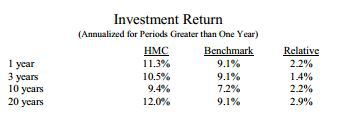
Harvard has America’s largest college or university endowment, but not nearly its best. FORTUNE — Harvard University has the nation’s largest college or university endowment, valued at $32.7 billion through the end of June. It also has worse investment returns than any of its peers over the past five years, according to a Fortune analysis. This may come as a surprise to Harvard employees and alums, who have been told that the endowment’s investment arm — Harvard Management Company — regularly beats its benchmarks. For example, HMC CEO Jane Mendillo wrote the following last month in a public letter:

capture14 Read more of this post

It Turns Out Google Co-founders Larry Page And Sergy Brin Are Actually Pretty Lousy Coders

It Turns Out Google Co-founders Larry Page And Sergy Brin Are Actually Pretty Lousy Coders

NICHOLAS CARLSON OCT. 30, 2013, 12:36 PM 6,981 11

If you’re like me, you’ve probably always assumed that Google co-founders Larry Page and Sergey Brin are pretty great at writing code. You may have even assumed that Page and Brin wrote the code that made Google.com so fast and powerful as long ago as the late 1990s. Wrong! I’ve been reading early Googler Douglas Edwards’ excellent book about the company’s startup days. It’s called “I’m Feeling Lucky: The Confessions of Google Employee Number 59. You should buy it if startups fascinate you. The book reveals that Page and Brin actually had little to do with making the code that powered Google back then. In the book, early Google engineering boss Craig Silverstein says “I didn’t trust Larry and Sergey as coders.” Read more of this post

A Lonely Passion: China’s Followers of Friedrich A. Hayek

OCTOBER 30, 2013, 5:55 PM

A Lonely Passion: China’s Followers of Friedrich A. Hayek

By DIDI KIRSTEN TATLOW

As quixotic causes go, working in China to spread the ideas of Friedrich A. Hayek, the Austrian-born liberal economist and philosopher of freedom, is up there. Hayek believed that economic planning by the state leads to a loss of individual liberty, and that a private economy run by people whose rights are protected and enlarged by good laws delivers the best life. ‘‘There is some distance between Hayek and the current realities’’ in China, Gao Quanxi, a prominent Chinese Hayekian and law professor at Beihang University in Beijing, said in an interview this week. Read more of this post