Sony’s Loss Is Black Eye for CEO
November 1, 2013 Leave a comment
Sony’s Loss Is Black Eye for CEO
Electronics Giant Cuts Full-Year Guidance After Second-Quarter Loss
JURO OSAWA and KANA INAGAKI
Updated Oct. 31, 2013 8:18 a.m. ET
TOKYO— Sony Corp.’s 6758.TO -1.73% turnaround strategy was thrown into doubt after the electronics giant unexpectedly reported weak results and slashed its full-year profit forecast by 40%. The poor numbers are a black eye for Kazuo Hirai, who came in as chief executive last year, vowing to finally push Sony out of a prolonged slump that began when its vaunted TV business started weakening. The results for the quarter ended Sept. 30 were particularly disappointing since signs of progress had been emerging with Sony’s TV division turning profitable in the previous quarter. Since last year, Sony has been cutting costs by slashing jobs and has been focusing on expanding its smartphone business under Mr. Hirai’s leadership.Sony’s setback could lend support to hedge-fund investor Daniel Loeb, who earlier this year called for a spinoff of Sony’s entertainment division through an initial public offering, based on the assertion that the film and music businesses were being poorly managed. In his letter to Mr. Hirai in May, Mr. Loeb also said that Sony’s entertainment operations were being undervalued because of the woes of its electronics operations.
In August, Sony formally rejected Mr. Loeb’s proposal. A spokeswoman at Mr. Loeb’s Third Point LLC declined to comment.
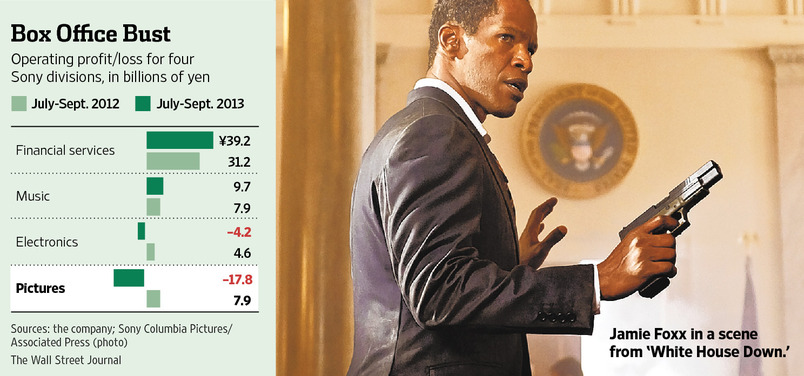
On Thursday, Sony cut its profit forecast for the fiscal year through March by about $200 million, after reporting a deeper loss for its fiscal second quarter ended Sept. 30. Sony blamed the quarterly loss mainly on its movie business, which swung to an operating loss due to box-office flops such as “White House Down” and “After Earth.” Sony’s mainstay electronics businesses also performed poorly, with the exception of the smartphone business, which contributed to an increase in group revenue. For the fiscal year, Sony cut its sales forecasts for four of its electronics products—TVs, PCs, digital cameras and video cameras.
“Conditions are harsher than what we had anticipated due to the negative impact from the slowdown in emerging markets and a fall in emerging economy currencies,” said Sony Chief Financial Officer Masaru Kato at a news conference. But Mr. Kato insisted that the company sees signs of progress in videogames, cameras as well as smartphones.
Under Mr. Hirai, Sony has designed a three-year road map for turning around its business. The company achieved the first step of squeezing out a group net profit in the last fiscal year that ended in March and is now trying to turn its core electronics operations profitable this fiscal year.
“In order for Sony to grow significantly over the medium term, we need revival in our core electronics business,” Shiro Kambe, Sony’s senior vice president, said. “We will turn the electronics division profitable for this year despite the downward revision.”
Sony said its net loss for the three months ended Sept. 30 widened to ¥19.3 billion ($196 million) from ¥15.5 billion a year earlier, even though analysts had predicted a modest profit. Sony’s operating profit for the quarter fell 51% to ¥14.8 billion even as revenue rose 11% to ¥1.78 trillion from ¥1.60 trillion due to an increase in smartphone sales.
Five of Sony’s eight business segments recorded losses in the quarter. The three profitable segments were devices—which include image sensors used in smartphone cameras—music and financial services.
Sony’s TV business, which briefly became profitable in the fiscal first quarter through June, had an operating loss of ¥9.3 billion in the second quarter. On an annual basis, the TV business has been unprofitable for nearly a decade. Mr. Kato said that the economic slowdown in emerging markets such as Latin America is affecting TV sales.
One bright spot for Sony in the second quarter was the strength of its smartphone business. Operating loss from the mobile products and communications segment, which includes smartphones and PCs, narrowed sharply to ¥900 million from ¥23.1 billion a year earlier, with revenue up 39% from a year earlier. Over the past year, Sony has poured more resources into the smartphone business to turn it into an engine for growth. In February, Sony launched the Xperia Z, a flagship smartphone that borrowed technological resources from the company’s camera and TV businesses, and followed it up with a successor model last month.
Still, the prospects for the smartphone business are far from guaranteed, given fierce competition from industry leaders Apple Inc. AAPL +0.42% and Samsung Electronics Co.005930.SE -1.53% Even though Sony’s smartphone sales are brisk in Japan and Europe, it has little presence in the U.S. and China, the world’s two biggest smartphone markets.
For the full fiscal year through March, Sony cut its net profit outlook to ¥30 billion from ¥50 billion it forecast in July. It also lowered its operating profit outlook to ¥170 billion from ¥230 billion, and revenue forecast to ¥7.7 trillion from ¥7.9 trillion, reflecting lower sales forecasts for most of its electronics products.
Separately, Panasonic Corp. 6752.TO +3.79% said it swung to a net profit in its fiscal second quarter and doubled its net-profit outlook, helped by a weaker yen and cost cuts as well as the absence of massive restructuring charges. The Japanese electronics maker best known for its Viera television sets posted a net profit of ¥61.5 billion for the three months through September, from a net loss of ¥698 billion a year earlier.
For the full fiscal year through March, Panasonic doubled its net profit outlook to ¥100 billion from ¥50 billion, citing the effects of a weaker currency, which boosts overseas revenue in yen terms, as well as an improved sales outlook in its housing and automotive businesses.
Sony Fades to Red
Hollywood Business Hurts Profits, Electronics Show Mixed Progress
AARON BACK
Updated Oct. 31, 2013 8:15 a.m. ET
Based on Sony‘s 6758.TO -1.73% stock-price resurgence this year, investors may have believed that the sprawling movies-to-electronics conglomerate was finally going to start firing on all cylinders. Instead, another piece of the engine broke down.
Sony’s net loss widened to ¥19.3 billion ($196 million) in the September quarter from ¥15.5 billion a year earlier. Management slashed its operating profit forecast for the year ending in March to ¥30 billion from ¥50 billion.
The culprit this quarter was the movie business, whose profits have long helped offset the moribund electronics divisions. Jamie Foxx’s “White House Down” and other flops dragged pictures revenue down by $275 million from a year earlier.
The weak results would seem to validate activist investor Dan Loeb’s argument that the film unit is inefficiently run. The truth is that the movie industry is inherently lumpy. Last year’s results were boosted by the $753 million that “The Amazing Spider-Man” grossed globally. Last quarter, Sony Pictures was just one elusive hit away from a record quarter. With a “Spider-Man” sequel swinging to the rescue next summer, the film unit may escape distress.
The fundamental issue for Sony is whether Chief Executive Kazuo Hirai, who started last year, is making progress turning around the core electronics unit, which hasn’t made serious money in years. Here, the news is mixed.
Sony’s new line of waterproof smartphones are selling well, especially in Japan and Europe. And with hardly any presence in North America, there is room to grow. But thesmartphone business is intensely competitive, which limits profitability. Despite the bettercellphone sales, the mobile division still posted a ¥900 million operating loss.
Meanwhile much of Sony’s wide stable of electronics such as compact cameras, camcorders, televisions and notebook PCs, are stuck in secular decline as tablets and smartphones supplant their usefulness. Revenue at the camera division, for instance, fell 7% in yen terms. Strip out the flattering effect of the currency’s decline, and revenue fell 24% from a year earlier.
One bright spot: Sony’s insurance business continued to be the unsung hero of the group, driven by its investments in the frothy Japanese stock market.
Sony’s shares are up 97% this year, compared with an already impressive 38% rally in the Nikkei 225. The stock trades at a sky-high 40 times this year’s forecast earnings. And those earnings are based on analyst estimates that will now be cut.
Mr. Hirai’s turnaround has slipped a gear. Investors betting on a speedy comeback have gotten ahead of themselves.
 About bambooinnovator
 Bamboo Innovator