Sweetener Maker Is Commodities Middleman; Ilene Gordon has been trying to reinvent Ingredion, a little-known producer of sweeteners and starches, into a full-scale ingredients maker for more modern tastes
November 6, 2013 Leave a comment
Sweetener Maker Is Commodities Middleman
JASON DEAN
Updated Nov. 5, 2013 9:46 p.m. ET
Ilene Gordon has been trying to reinvent Ingredion Inc., INGR +0.28% a little-known producer of sweeteners and starches, into a full-scale ingredients maker for more modern tastes. When she became chairman and chief executive in May 2009, the company had $3.9 billion in annual revenue and was called Corn Products International. The next year, she acquired a company with an equally dull moniker, National Starch—a unit of Akzo Nobel N.V. AKZOY -0.92% —for $1.3 billion. Last year, she introduced the combined company’s new name.Ingredion’s basic business remains unchanged: it processes raw materials—corn, tapioca, potatoes—into ingredients that transform the taste or texture of food and drinks. (Some of its starches also are used to make inedible items like textiles, cosmetics and biodegradable plastics.)
But Ms. Gordon aims to reposition the company for a more health-focused age. Sweetener products—including the much-criticized high fructose corn syrup, as well as sugar-free sweeteners—still accounted for 44% of Ingredion’s sales in 2012, but that is down from 57% five years earlier.
Among the products the company has developed are starches that substitute for oils in salad dressing.
Ingredion has stumbled this year, partly due to setbacks in South America, including economic weakness in Brazil, where it sells heavily to the beer industry, and government price controls in Argentina.
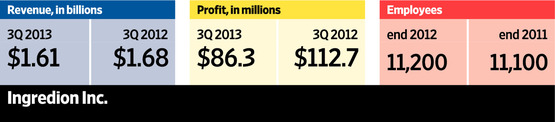
The 60-year-old CEO spoke to The Wall Street Journal last week after Ingredion reported a 23% decline in third-quarter profit. Edited excerpts:
WSJ: Why has South America been such a big problem?
Ms. Gordon: It’s a short-term effect, and we really believe long-term in Latin America. Brazil is starting to show signs of coming back. Next year [there is] the World Cup, [and they are] building infrastructure for that, and for the Olympics. [In Argentina,] we feel like we’re at the bottom. [Meanwhile] we’ve cut costs where it makes sense in our facilities, in overhead at the office. At the same time, we’re developing new products. My expectation in Argentina is that a year from now we’d be seeing a much better environment.
WSJ: You’re a middleman in a commodity industry. How do you avoid being squeezed?
Ms. Gordon: I actually love being in the middle. We pass those [raw material] costs on to our customers but we create formulations that [the food companies] don’t have the resources or the technical know-how to do. A lot of the food companies have fewer people in that development side than they used to, and they depend on companies like mine.
WSJ: What’s the most exciting trend in your industry right now?
Ms. Gordon: The prominence that texture is getting. If you look back a couple of years, everybody was talking about sweeteners—certainly they’re important, and people want different types of sweeteners—but they didn’t talk about texture. And what you’re having [now] is consumers of different age groups are looking for different textures. And the food companies are using that to compete.
WSJ: What are you doing to align Ingredion more with interest in healthier eating?
Ms. Gordon: The reality is that for us high-fructose corn syrup is one of a thousand ingredients. If you think about the [rest], it’s really all about delivering ingredients that make food taste good, creamy, healthy, depending on the trend and where it is around the world. Our acquisition of National Starch…added 300 scientists to our company. That was all about bringing on the capability to develop new products…that are addressing the different health and wellness trends.
WSJ: You’re not a consumer company. Why do you need a catchy name?
Ms. Gordon: We felt that the Corn Products name was misleading. We’re not a corn company. It was very important for our employees to wake up every day and say, ‘I work for Ingredion, we’re an ingredients company.’
WSJ: What challenges do you face today as a female CEO at a large company?
Ms. Gordon: I’ve always prided myself in my 30-plus [year] career on ignoring my gender. The challenges I face are [the same as] any other CEO, male or female. It’s all about continuing to deliver shareholder value.
WSJ: So you think it is a nonissue today—a level playing field?
Ms. Gordon: For CEOs I think it is. Where the issues exist are for those who are growing their careers, and trying to make their way into the C-suite. Both women and men have a lot of challenges in balancing their lives and developing skills that will make them successful.
WSJ: What advice do you give aspiring female executives?
Ms. Gordon: Get the right education. If you can get a STEM (science, technology, engineering and mathematics) degree, better. If you don’t have one, take courses now that build those skills. And I say to women, get a master’s [degree]. I’m a big believer in master’s of business. I think it gave me a leg up when I got my degree over 30 years ago, because it gave me problem-solving skills that I might not have had otherwise.
WSJ: When you’re looking at elevating people, does gender play a role? What do you look for?
Ms. Gordon: I certainly want to encourage [diversity] in my management team. You never want to trade off somebody’s capability to do a position for gender. [But] I insist that for every position…we have a diverse slate. [The diversity] might be cultural, it could be gender. But if you don’t have them on the slate of possible candidates, you’re never going to get there.
 About bambooinnovator
 Bamboo Innovator