Underdog Indian politician speaks for common man
November 6, 2013 Leave a comment
Underdog Indian politician speaks for common man
Wednesday, November 6, 2013 – 05:48
Nirmala Ganapathy
India Correspondent In New Delhi
The Straits Times
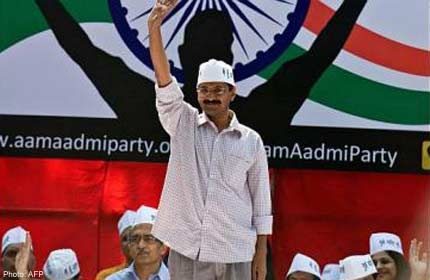
“Our most important agenda is a corruption-free Delhi,” said Indian politician Arvind Kejriwal, squinting into a webcam in his campaign office in Delhi. Watching him were about 50 Indians sitting miles away in a room in Singapore. They listened quietly as Mr Kejriwal – a newly minted politician of the Aam Admi or Common Man Party – talked about bringing in strict anti-corruption legislation and transparency in government – if he wins the Delhi assembly elections next month. Then he got down to the nuts and bolts.“First,” he said, “we need donations… Second, you can join our group, call up 30 people and convince them to vote for our party. And third, call up 20 of your friends and relatives in Delhi and ask them to vote for the Aam Admi Party.”
With elections in the Indian capital a month away, Mr Kejriwal, initially dismissed by the ruling Congress and opposition Bharatya Janata Party (BJP) as a lightweight, has emerged as a serious political contender with a shot at being chief minister of Delhi.
With his anti-corruption crusade and underdog stance, Mr Kejriwal and his party are winning supporters not just in India but also among the Indian diaspora.
So far, the party has received donation pledges worth four million rupees (S$80,600) from Indians in Singapore, party officials say. Contributions have also come from Hong Kong, the United Arab Emirates and the United States.
Mr Kejriwal, 44, is the former backroom boy for anti-corruption crusader Anna Hazare’s movement, which took off in 2011 on support from middle-class Indians tired of graft scandals but eventually petered out.
In November last year, Mr Kejriwal used what was left of the momentum to launch a political party in Delhi. Opinion polls do not predict a straight-out win but give him a big chunk of the votes.
A recent survey by television channel CNN-IBN, news magazine The Week and the Centre for the Study of Developing Societies predicted a hung assembly, with Congress and Aam Admi Party getting between 19 and 25 seats each out of the total of 70, and the BJP slightly ahead with between 22 and 28 seats.
But Mr Kejriwal, according to the poll, emerged as the most popular candidate for the post of chief minister of Delhi, held by Congress’ Sheila Dikshit, who has been in power for three terms.
“Whether they will be able to transfer or translate (the support) into anything concrete, that is a question for which we don’t have a clear answer yet,” said Professor Sandeep Shastri, pro vice- chancellor of Jain University in Bangalore, who was involved in the survey.
“No doubt he is challenging the entrenched way of politics.”
In a country where political party funds are secret, Mr Kejriwal has made public contributions to the party’s finances – 170 million rupees in total. Some supporters give as little as 10 rupees, an effective way of raising money, as shown by Mr Barack Obama’s campaign during the 2008 US presidential elections.
Mr Kejriwal has also opted for small intimate meetings with fund-raisers and voters over large rallies, targeting specific issues like bad roads in a particular locality.
Instead of a single manifesto for Delhi, the party has election manifestos for each of the assembly segments.
Campaigning is done through social networking sites, posters on three-wheeler vehicles and volunteers holding up placards.
“It’s more a people’s movement rather than a political movement,” said lawyer and social activist Ashok Agarwal, who left the Communist Party of India (Marxist) after 30 years and joined the Aam Admi party this year.
An engineering graduate from the Indian Institute of Technology in Kharagpur, Mr Kejriwal, who resigned as an income tax officer to become a social activist, came to national prominence for his work in pushing the Right To Information Act, which allows people to question government decisions.
He won the prestigious Magsaysay Award in 2006.
Critics call him sanctimonious, but supporters have nothing but praise for him.
“If they win… this will send a clarion call throughout the nation, that the common citizen can stand and win an election without the money and muscle power that have made Indian politics a closed club,” said banker Meera Sanyal, 52, who stood as an independent candidate in the 2009 elections.
Unlike other politicians who wear a kurta pyjama, Mr Kejriwal’s usual attire is a checked shirt and trousers, with a broom for a prop. His party symbol is the broom, symbolic for sweeping away corruption.
Over the last three weeks, Mr Bharat Gupta, a 36-year-old banker in Singapore, has made 160 calls to voters in Delhi to canvass support for Mr Kejriwal.
“Yes, sometimes people are very surprised to get a call from Singapore. But the response is good. Some 40 per cent of people are convinced,” said Mr Gupta.
 About bambooinnovator
 Bamboo Innovator