An index of financial secrecy: Lifting the veil
November 8, 2013 Leave a comment
An index of financial secrecy: Lifting the veil
Nov 6th 2013, 23:05 by M.V. | NEW YORK
EVERY two years the Tax Justice Network, a campaigning group, publishes a Financial Secrecy Index (FSI), showing which jurisdictions are friendliest towards tax evaders, money launderers and other financial ne’er-do-wells. Countries are ranked according to a combination of a secrecy score (based on 15 indicators, including banking secrecy, transparency of corporate ownership and international judicial co-operation) and a weighting that reflects the size of their financial sector.The latest FSI, released on November 7th, shows Switzerland once again at the top of the list, with a score little changed from 2011 (Zurich is pictured above). Though the Swiss have made some concessions, especially to America, these appear so far to have put only small dents in their overall financial-secrecy framework. Meanwhile, they have been striving to block or delay multilateral transparency initiatives. The government did recently agree to sign an OECD tax convention, but this calls only for “on request” (not automatic) exchange of information. Still, it would bring down the Alpine country’s secrecy score a bit, if ratified.
The index shows that the biggest player in the world of offshore secrecy is Britain, if it is lumped together with its island dependencies in the English Channel, the Caribbean and elsewhere. Britain itself is only in 21st place, but two of its satellites—Jersey and the Cayman Islands—are in the top ten, with Bermuda and Guernsey not far behind. Together they account for between a third and a half of the global market in offshore financial and corporate services. Much of the money they collect is funnelled through the City of London.
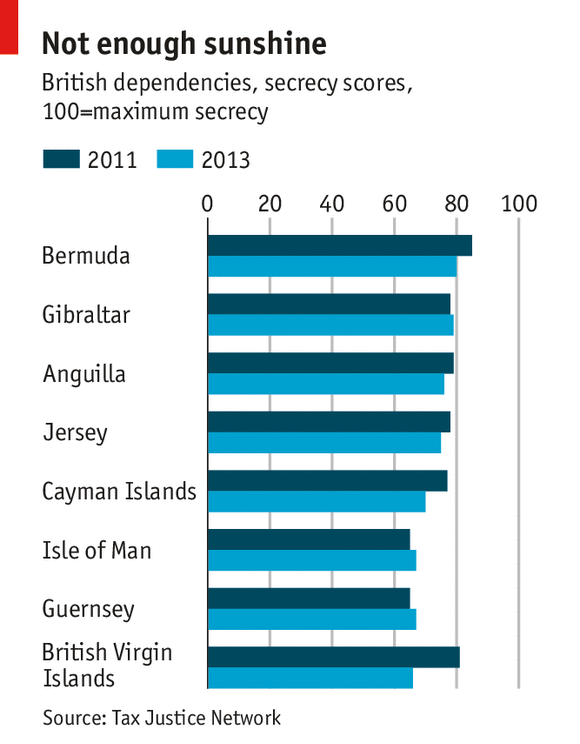
These islands have become a bit more open as international pressure on tax havens has intensified: most have seen their secrecy score drop since 2011, with the most dramatic fall in the British Virgin Islands, home to hundreds of thousands of offshore shell companies (see chart). All of them have signed new international tax agreements that allow for some degree of information exchange, or announced their intention to do so. But although some have curbed their secrecy offerings, others have expanded them. Earlier this year, for instance, Guernsey added foundations (the civil-law equivalent of trusts, which are common-law arrangements) to its stable of offerings. That helped to push up its secrecy score, though it remains one of the less opaque offshore financial centres.
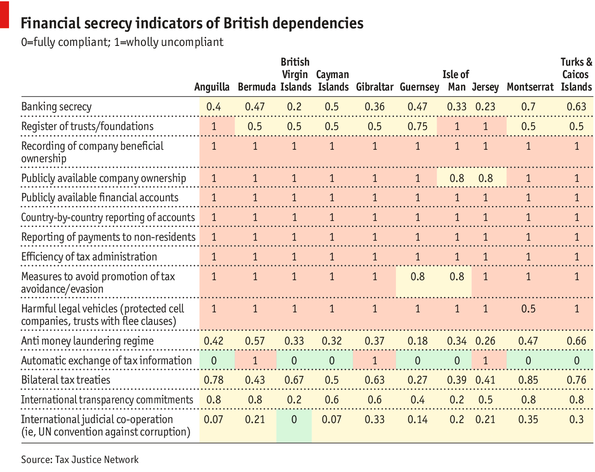
In September David Cameron, the British prime minister, told the House of Commons that: “I do not think it is fair any longer to refer to any of [Britain’s] overseas territories or crown dependencies as tax havens. They have taken action to ensure that they have fair and open tax systems.” As the table above shows, Mr Cameron’s comments may be somewhat premature: the British-linked jurisdictions all continue to score badly on the majority of the indicators tracked by the TJN. (Those jurisdictions argue that the index’s compilers don’t make a clear enough distinction between legitimate client confidentiality and crime-concealing secrecy.)
The ranking also confirms the continued rise of Hong Kong and Singapore as secrecy jurisdictions. Hong Kong is a growing force in offshore capital markets and company formation. Singapore is snapping at Swiss heels in wealth management and a rising star in trusts. Both have benefited as some European and North American offshore activity has been displaced eastwards, looking for places that are under less immediate pressure from western capitals to clean up their act. That said, they have had to make some concessions: in Singapore, for instance, tax evaders can now be prosecuted for money laundering, at least in theory.
The overall message of the index is that while there has been progress on international tax transparency, it has been more modest than tax haven-bashing politicians would have us believe. The good news is that automatic exchange of information has a good chance of developing, over time, into a global standard—helped not least by America’s powerful Foreign Account Tax Compliance Act, or FATCA. The bad news is that financial secrecy is still very much alive and well.
 About bambooinnovator
 Bamboo Innovator