Lord of the RINs? Vitol’s ethanol credit bonanza

Lord of the RINs? Vitol’s ethanol credit bonanza

1:19am EST

By Cezary Podkul

NEW YORK (Reuters) – Swiss trading company Vitol SA is among the biggest beneficiaries of an opaque U.S.-government-mandated trading scheme established to help boost the share of ethanol in the nation’s fuel supply, market sources say. As refiners scrambled this year to meet an expected steep rise in the amount of ethanol that must be blended into gasoline, trading in little-known credits used to enforce the quotas turned white-knuckled. RINs, or renewable identification numbers, have traded for years in a niche market for pennies apiece. In mid-July they soared to nearly $1.45 from about 5 cents last December, providing huge opportunities for oil traders and others in the market. Read more of this post
China’s Soviet-Style Suburbia Heralds Environmental Pain

China’s Soviet-Style Suburbia Heralds Environmental Pain

Take away the haze of air pollution and Waterfront Corso Mansions near Tianjin might seem like an urban idyll for China’s growing population of city dwellers. Inside a gated compound, residential towers and houses overlook a lake and manicured gardens. What’s missing from the neighborhood are shops and amenities, turning the block and hundreds like it in the suburb of Meijiang into a giant dormitory for Tianjin, 40 minutes away by car. Read more of this post

Hong Kong Seeks More Women Workers as Aging Population Looms

Hong Kong Seeks More Women Workers as Aging Population Looms

Hong Kong is seeking to attract more homemakers into the workforce as an aging population and low fertility rates threaten to curb economic growth. More than half a million women homemakers in the city are between the ages of 30 and 59, representing a “huge potential,” Florence Hui, the undersecretary for home affairs, said late yesterday at a Bloomberg seminar in Hong Kong. Read more of this post

Let’s Not Overstate the U.S. Manufacturing Revival

Let’s Not Overstate the U.S. Manufacturing Revival

The revival of the U.S. manufacturing sector has been sufficiently robust to convince many Americans that a factory renaissance is under way. Boston Consulting Group predicted that increased exports promoted by stagnant U.S. wages and lower energy costs will result in 2.5 million to 5 million new jobs by 2020 and a reduction of the 7.3 percent unemployment rate by two to three percentage points. Read more of this post

Buyout Opportunities Seen in Vietnam Imbalances: Southeast Asia

Buyout Opportunities Seen in Vietnam Imbalances: Southeast Asia

Franklin Templeton Investments (BEN)’ venture in Vietnam said the time is right for buyout firms to invest in the country as it expects monetary and fiscal reforms to take effect over the next three to five years. Low valuations, constrained bank lending and an improved corporate landscape mean private-equity investors have an opportunity to buy companies in the Southeast Asian country before the economy picks up again, said Avinash Satwalekar, chief executive officer of Vietcombank Fund Management, Templeton’s venture with Joint-Stock Commercial Bank for Foreign Trade of Vietnam. Read more of this post

The forex market is designed to encourage crime; Lax structure supplies the opportunity, big bonuses create the motive

November 6, 2013 6:43 pm

The forex market is designed to encourage crime

By Patrick Jenkins

Lax structure supplies the opportunity, big bonuses create the motive, says Patrick Jenkins

It is notoriously idiotic to leave the purchase of holiday currency until arriving at the airport – as I learnt to my cost (yet again) last week. With a choice of two currency outlets, both run by the same operator, there was one dreadful rate on offer: £1 would net me €1.05. Buying back £1 would cost €1.35. Outrageous as that near 30 per cent spread was, it looks like modest abuse compared with the alleged manipulation that was emerging at the same time, as regulators deepened their probes into the $5.3tn a day foreign exchange market. In the past fortnight, seven of the world’s leading banks have confirmed they are being investigated as part of the affair. Read more of this post

Spanish lenders had been making their loan books look healthier than they really were by refinancing big numbers of loans to struggling homeowners and businesses

Spain’s Banks Boost Books by Refinancing Loans to Homeowners

Bank Earnings Reveal Part of Answer to Question Puzzling Analysts

ILAN BRAT and CHRISTOPHER BJORK

Nov. 6, 2013 12:12 p.m. ET

MADRID—It has puzzled Spanish bank analysts for years: Why did the country’s mortgage delinquency rate rise so slowly even as unemployment soared above 26%? A big part of the answer—revealed by a spate of bank earnings reports in recent days—is that Spanish lenders had been making their loan books look healthier than they really were by refinancing big numbers of loans to struggling homeowners and businesses. Read more of this post

Quant funds suffer dismal ‘QE’ losing streak

November 6, 2013 10:04 am

Quant funds suffer dismal ‘QE’ losing streak

By Sam Jones

How does a hedge fund react to losing a quarter of its investors’ money in a matter of months? Double-up? Blow up? Or buy Lego and wait? Cantab Capital, a multibillion-dollar quant hedge fund, run by computers (or rather, run by maths geeks who run computers) went for option three. The irreverent – and until this year, highly profitable – Cambridge-based firm, set up by Goldman Sachs’ former head of quantitative trading, spent £2,000 on Lego to boost staff morale this summer after a painful losing streak struck hundreds of millions off its trading portfolio’s value. Read more of this post

US rental deals give rise to new asset class

November 7, 2013 9:43 am

US rental deals give rise to new asset class

By Tracy Alloway and Anjli Raval in New York

Hank Rosely says it all happened very quickly.

The retired lawyer sold his Palm Beach house to Invitation Homes, the rental unit of private equity giant Blackstone, back in August, in a transaction which closed within days. Blackstone is one of a number of large institutional investors – from private equity firms to hedge funds – that have spent the five years since the worst of the financial crisis snapping up tens of thousands of residential properties on the cheap and then converting them into rental homes. Read more of this post

The Rise And Fall Of The Largest Corporation In History

The Rise And Fall Of The Largest Corporation In History

BRYAN TAYLORGLOBAL FINANCIAL DATA NOV. 6, 2013, 1:48 PM 26,738 19

untitled-131

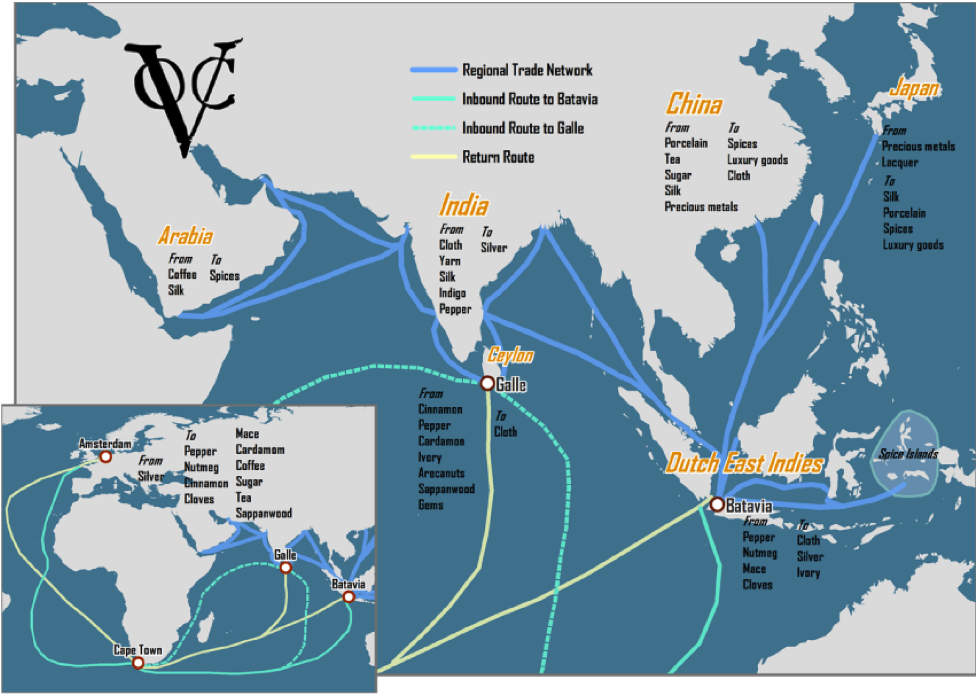
The Vereenigde Oost-Indische Compagnie (VOC), or the United East India Company, was not only the first multinational corporation to exist, but also probably the largest corporation in size in history. The company existed for almost 200 years from its founding in 1602, when the States-General of the Netherlands granted it a 21-year monopoly over Dutch operations in Asia until its demise in 1796.  During those two centuries, the VOC sent almost a million people to Asia, more than the rest of Europe combined.  Read more of this post

Startup Nation is growing up, but it’s not maturing with the years; The giant exits of 2013 don’t mean that Israeli high-tech is creating many jobs, benefiting local investors or generating much added value for the economy

Startup Nation is growing up, but it’s not maturing with the years

The giant exits of 2013 don’t mean that Israeli high-tech is creating many jobs, benefiting local investors or generating much added value for the economy.

By David Rosenberg | Aug. 23, 2013 | 2:44 AM

Another round of backslapping and hardy handshakes accompanied last week’s sale of the Israeli startup Trusteer to IBM for a reported $900 million. Websites and newspapers were full of pictures of smiling employees, who might now finally be able to afford to buy a home with their share of the payout. Venture capital funds were counting up their double-digit returns. Meanwhile, industry executives were explaining how the giant buyout – coming weeks after Google paid more than $1 billion for the navigation app startup Waze – marked a new phase for Startup Nation: Entrepreneurs and investors are more mature, they are ready to build businesses and think long-term, rather than look for a quick and easy exit. Read more of this post

With all eyes on Twitter IPO, Israel’s Wix heralds new chapter for startup nation

With all eyes on Twitter IPO, Israel’s Wix heralds new chapter for startup nation

After its own successful initial public offering, the DIY website creator hopes to transcend the traditional Israeli high-tech strategy and forge a global company.

By Dina Kraft | Nov. 7, 2013 | 3:00 PM

NEW YORK – High above Times Square on Wednesday in a boxy windowless conference room at the Nasdaq building, executives from Wix – Israel’s newest multimillionaires – were finally looking a bit relaxed. The closing bell (really a button) was only about an hour away and their stock was trading at a steady $16.50 a share – exceeding original expectations. Champagne glasses were scattered among laptops as congratulatory calls, texts and emails poured in from around the world. Read more of this post

A bright new day for Startup Nation? Or just another bubble? The record number of venture capital investments and parade of IPOs are more cause for caution than joy

A bright new day for Startup Nation? Or just another bubble?

The record number of venture capital investments and parade of IPOs are more cause for caution than joy.

By David Rosenberg | Oct. 29, 2013 | 6:08 PM

These are heady days for Startup Nation. In the third quarter of the year, tech companies raised $660 million in new capital, the most in any three-month period since 2000. This quarter looks like it’s on its way to beating that figure, with a stream of double-digit fund-raising rounds by the likes of Outbrain and Wilocity ($35 million apiece), SundaySky ($20 million), TabTale ($12 million), and Mintingo ($10 million) and a host of smaller fry. Read more of this post

Netanyahu: Cartels and monopolies are choking competition in Israel

Netanyahu: Cartels and monopolies are choking competition in Israel

In a taped address to an economic conference in Eilat, prime minister stresses need to encourage entrepreneurship.

By Eran Azran | Nov. 6, 2013 | 6:59 PM

Prime Minister Benjamin Netanyahu on Wednesday called cartels and monopolies the main cause of the lack of competitiveness in the Israeli economy. He was addressing, in a pre-taped speech, the Israel Democracy Institute’s Eli Hurvitz Conference on Economy and Society, in Eilat. Netanyahu said that cartels had joined forces with petty officials and used laws and bureaucracy to stifle competition. He said his government is pushing the so-called economic concentration bill through the Knesset in order to increase competition. Read more of this post

Digital banking: Third time lucky; Banks that have no branches are making a surprising resurgence

Digital banking: Third time lucky; Banks that have no branches are making a surprising resurgence

Nov 9th 2013 | PARIS |From the print edition

BEHIND the smoked glass of a nondescript building in central Paris young people in open-necked shirts interact with Twitter and other social-media networks. This has the feel of a start-up, but in fact it is an outpost of BNP Paribas, one of France’s biggest banks. Hello Bank!, with its catchy name and irritating punctuation, represents one of the most voguish trends in banking. It is trying to entice customers to abandon expensive bank branches and do most if not all of their banking on their mobile phones and tablets. Read more of this post

Dirty money: Mistrust the trusts; The crackdown on shell companies is a good start. The next target should be trusts

Dirty money: Mistrust the trusts; The crackdown on shell companies is a good start. The next target should be trusts

Nov 9th 2013 |From the print edition

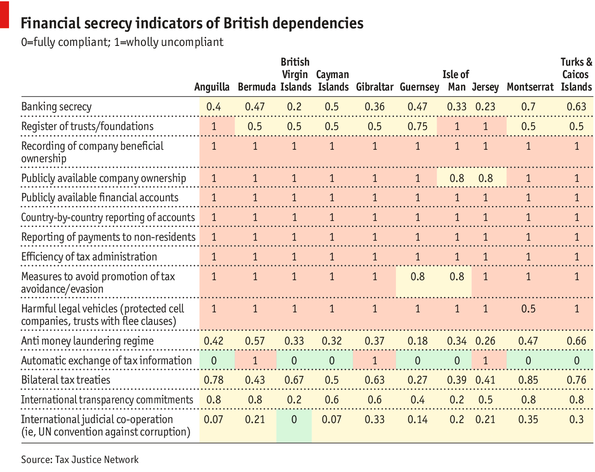
ONLY a fool holds dirty money in his own name. The world’s financial system offers safer and friendlier ways to hide the proceeds of crime. Shell companies—those with no real operations—are one, phoney trusts and foundations are another (seearticle). Belatedly, life is getting a bit more difficult for tax evaders, money launderers and those who abet them. One big move—now backed by the British government—is to oblige limited-liability companies to give details of their real owners. This newspaper has argued in favour of such a duty: limited-liability status is a kind of public subsidy (if the firm goes bust, the shareholders are not responsible for its debts). It was never meant to be a means of concealing ownership. Yet in many places it is just that: only six of 69 jurisdictions surveyed last year by Eurodad, an anti-corruption network, required all types of firm to record beneficial-ownership information. Read more of this post

An index of financial secrecy: Lifting the veil

An index of financial secrecy: Lifting the veil

Nov 6th 2013, 23:05 by M.V. | NEW YORK

20131109_woc740 20131109_woc739_595_0

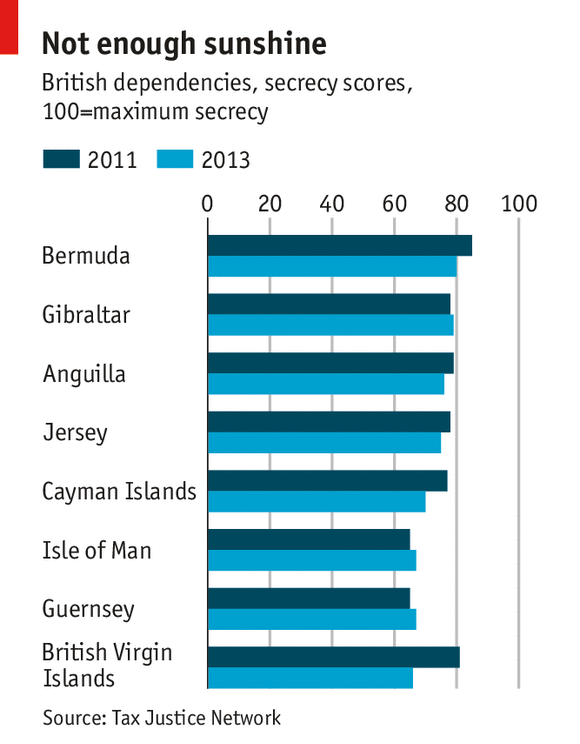
EVERY two years the Tax Justice Network, a campaigning group, publishes a Financial Secrecy Index (FSI), showing which jurisdictions are friendliest towards tax evaders, money launderers and other financial ne’er-do-wells. Countries are ranked according to a combination of a secrecy score (based on 15 indicators, including banking secrecy, transparency of corporate ownership and international judicial co-operation) and a weighting that reflects the size of their financial sector. Read more of this post

Little England or Great Britain? The country faces a choice between comfortable isolation and bracing openness. Go for openness

Little England or Great Britain?

The country faces a choice between comfortable isolation and bracing openness. Go for openness

Nov 9th 2013 |From the print edition

ASKED to name the European country with the most turbulent future, many would pick Greece or Italy, both struggling with economic collapse. A few might finger France, which has yet to come to terms with the failure of its statist model. Hardly anybody would plump for Britain, which has muddled through the crisis moderately well. Read more of this post

The Caribbean debt crisis: God v bondholders; Small, debt-ridden countries could benefit from divine intervention

The Caribbean debt crisis: God v bondholders; Small, debt-ridden countries could benefit from divine intervention

Nov 9th 2013 |From the print edition

THE pulpits of Grenada, a spice-scented Caribbean island of 100,000 souls, have been ringing with an ungodly phrase recently: debt restructuring. Ever since the government defaulted on its dollar bonds in March, churchmen have called for a write-off of two-thirds of its debt, using the term “jubilee” in its Christian sense, meaning a one-off forgiveness of sins. Priests of different denominations met with the International Monetary Fund (IMF) last month. They sit on a debt committee with government ministers. Keith Mitchell, the prime minister, recently thanked them for their support and quoted the Book of Matthew to explain the need for austerity measures. Read more of this post

The perils of falling inflation

The perils of falling inflation

In both America and Europe central bankers should be pushing prices upwards

Nov 9th 2013 |From the print edition

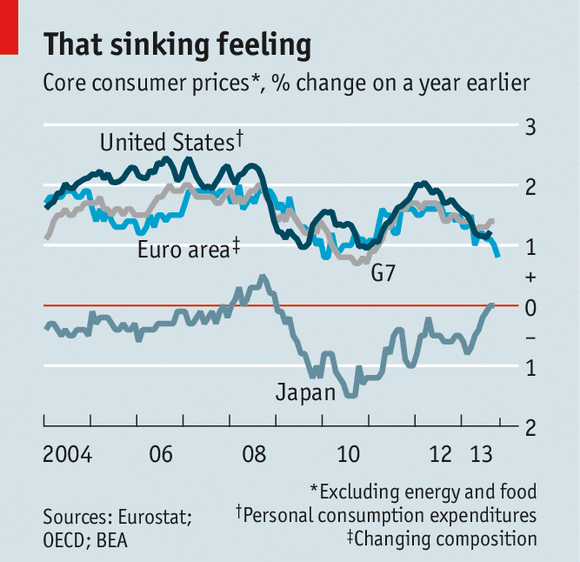
WHAT is a central banker’s main job? Ask the man on the street and the chances are he will say something like “keeping a lid on inflation”. In popular perception, and in their own minds, central bankers are the technicians who squeezed high inflation out of the rich world’s economies in the 1980s; whose credibility is based on keeping it down; and who must therefore always be on guard lest prices start to soar. Yet this view is dangerously outdated. The biggest problem facing the rich world’s central banks today is that inflation is too low. Read more of this post

Britain is surpassingly good at selling songs and talent shows on TV

Britain is surpassingly good at selling songs and talent shows on TV

Nov 9th 2013 |From the print edition

TWO MPS WITH quite different views employ the same metaphor for modern British politics. At times, they say, it is “like the X-Factor”. They mean it can be tawdry and shouty. But there is an obvious difference, too. “X-Factor”, a talent show created by Simon Cowell, is far more popular. Despite a glut of reality shows on television, an episode of “X-Factor” can draw as many as 10m viewers in Britain. It has conquered the world, too. Versions of it exist in about 40 countries, from Colombia to Kazakhstan. It is in the vanguard of British exports of reality-TV formats—a small industry, but one that Britain unquestionably dominates. Read more of this post

The price is a blight: The rich world, and especially the euro zone, risks harmfully low inflation

The price is a blight: The rich world, and especially the euro zone, risks harmfully low inflation

Nov 9th 2013 |From the print edition

20131109_FND001_0 20131109_FNC726

WHEN central banks adopted “quantitative easing” (printing money to buy financial assets) and other unorthodox means to buoy economies holed by the financial crisis, many feared that the result would be out-of-control inflation. Asset prices have certainly soared. But consumer prices have not. Indeed, the growing fear is that rich countries may be entering a twilight zone of ultra-low inflation. Read more of this post

Where will the boot land next? Investors and companies struggle with the arbitrary nature of new taxes and regulations; 2014 will be a busy year at the polls, with votes in Brazil, India and Indonesia plus America’s mid-terms

Where will the boot land next? Investors and companies struggle with the arbitrary nature of new taxes and regulations

Nov 9th 2013 |From the print edition

WHEN economists talk of political risk, they usually mean war, terrorism or, at the very least, national elections. And 2014 will be a busy year at the polls, with votes in Brazil, India and Indonesia (among the big emerging markets), plus America’s mid-terms. Countries with a combined population of more than 2 billion will be endorsing or rejecting their current governments. Read more of this post