What if the world’s icecaps melted overnight?
November 9, 2013 Leave a comment
What if the world’s icecaps melted overnight?
2013-11-08 02:00:50 GMT2013-11-08 10:00:50(Beijing Time) SINA.com
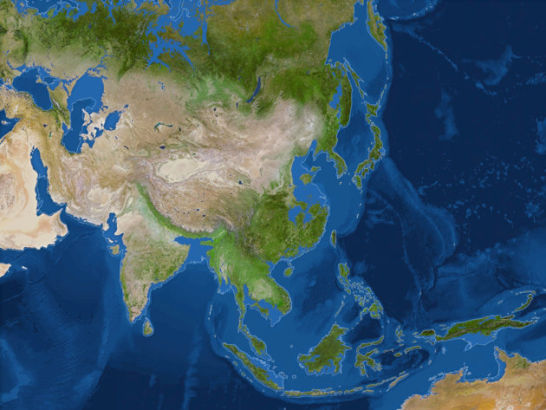
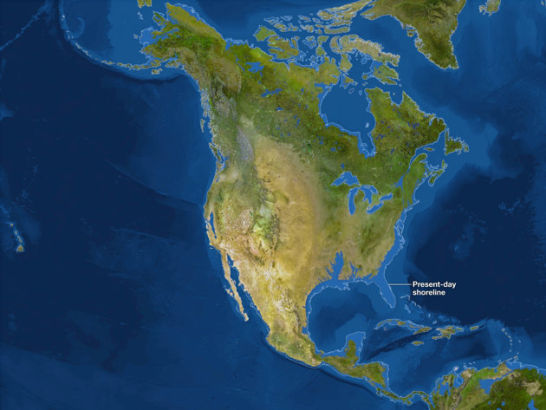
China would be most affected in Asia, with an area home to 600million people being lost to the sea; Much of the USA would be unharmed, but Florida and the Eastern seaboard would all flood. New maps show how the world would change if the polar icecaps completely melted – rising sea levels would flood large parts of Britain, Europe and the US
It sounds like the plot of a Hollywood disaster film – what would happen if the polar icecaps completely melted in one go? But you could also see it as the eventual product of global warming – as levels of carbon build up in the atmosphere, temperatures will one day rise to the point where all ice on Earth has melted. Luckily for the millions of people whose homes would be flooded by this change, scientists estimate that melting all the ice in the Arctic, Antarctica and Greenland would take at least 5,000 years. The total volume of ice on Earth is currently estimated at between 5million and 7.5million cubic miles. Melting all of it would cause the sea level to rise by a minimum of 216 feet (66m).The impact of such a drastic change to the sea level is shown by these National Geographic maps. Some parts of the world would be largely unaffected, but every continent would undergo significant changes. In addition, Antarctica would emerge as a landmass for the first time in 15million years.
The UK and Ireland would change enormously. The east coast of Britain would flood as far inland as Leicester and as far north as Harrogate. London and the Thames valley would all be underwater, with Kent and Norfolk reduced to a scattering of islands.
Much of western Ireland would flood, except for the highlands of County Mayo and Galway. Wales and Scotland would be less heavily affected.
In Europe, the Netherlands would be completely submerged. Denmark, Belgium, Estonia and Latvia would also be significantly flooded. The Black and Caspian Seas would connect directly to the Mediterranean, and huge areas of Russia and Kazakhstan would flood.
In North America, the eastern seaboard would all find itself underwater, and Florida would completely disappear. California would lose San Francisco and San Diego, and the Mississippi delta would become a large bay, but the rest of inland America would be largely unharmed.
In South America, only the areas around the Amazon and Paraguay rivers would change significantly, with the mountainous western coastline protecting most of the continent.
Asia would see the largest number of people affected. Flooding in northern China and Bangladesh would leave more than 760million people without a home. Large parts of Cambodia and Thailand would be affected.
Australia would look very similar but for the addition of an inland sea in South Australia. However, the coastal flooding that would affect the entire world would have huge repercussions in Australia, as 80% of the population lives on the coast.
According to National Geographic, this scenario could arise if humans were to burn the entire planet’s supply of fossil fuels – causing the average temperature to rise by more than 20 degrees by adding 5trillion tonnes of carbon to the atmosphere.
As well as flooding great swathes of the planet, it would also make much of the world intolerably hot to live in. So don’t feel too smug if you live on top of a hill.
 About bambooinnovator
 Bamboo Innovator