Hedge Funds Are Muscling Into the Stodgy World of Municipal Debt
November 12, 2013 Leave a comment
Hedge Funds Are Muscling Into Munis
Sharp-Elbowed Investors See Potential in the Stodgy World of Municipal Debt
MICHAEL CORKERY and MATT WIRZ
Updated Nov. 11, 2013 8:01 p.m. ET
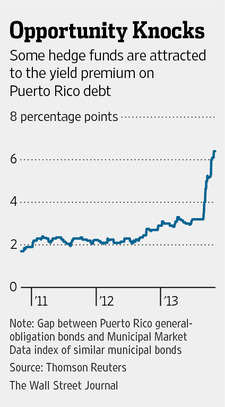
Hedge funds are making a large bet on municipal debt, bringing aggressive tactics to a $3.7 trillion market long known as humdrum. The strategies include demanding high interest rates in return for financing local governments, buying the debt of struggling municipalities on the cheap, and trying to profit on rising volatility as many mom-and-pop investors who have dominated the municipal-bond market for decades flee amid deepening fiscal problems in many U.S. cities and states.“Hedge funds are a new phenomenon in our market,” said Richard Larkin, director of credit analysis at brokerage firm H.J. Sims & Co., who has spent 38 years as a municipal-bond analyst. “And I don’t think there is any good that can come of it.”
The hedge-fund investments range from deeply discounted Puerto Rico debt to highly rated Stanford University bonds. In Jefferson County, Ala., which filed for bankruptcy protection in 2011, some hedge funds could make a return of about 33% on $900 million of sewer debt they bought at a discount, people familiar with the matter say.
Hedge-fund managers say their strategies can benefit all municipal bond investors by leading to more frequent trading, more transparent bond pricing and increased disclosure by government officials seeking to sell debt.
“The entire marketplace needs a broader capital base to be successful,” Hector Negroni, co-founder of hedge fund Fundamental Credit Opportunities, said at a conference sponsored by Bloomberg LP last week. He called the entrance of new investors a “terribly important evolution of the municipal marketplace” and a step toward “more robust pricing, more robust liquidity and greater investor security across the board.”
Hedge funds, which invest trillions of dollars on behalf of wealthy individuals, pension plans and college endowments, are barreling into the municipal-debt market at a time when many investors fear increasing defaults. Hedge funds now hold billions of dollars worth of distressed municipal debt, up from virtually no investments five years ago, municipal-bond analysts say.
The default concerns intensified after Detroit’s bankruptcy filing in July, the biggest financial failure by a city in U.S. history. Detroit’s turmoil drove down prices throughout the municipal-bond market to levels some hedge funds found attractive, because of the potential for whopping returns if the market rebounds.
Hedge funds can be a double-edged sword for municipalities. As eager buyers of new bonds, they are a source of liquidity as individual investors get more skittish. In return, they often want higher interest rates and more financial information from municipal officials than such officials are accustomed to providing. And hedge funds aren’t shy about pushing for improved disclosure and financial discipline.
Last month, an investor call hosted by the Government Development Bank for Puerto Rico drew 1,200 participants, an unusually large number for a municipal-investor presentation. During the call, hedge-fund managers peppered Puerto Rico officials with questions about pensions, energy policy and taxes.
In another sign of the hedge-fund industry’s growing interest, private-equity firm Carlyle Group LP’s Claren Road Asset Management hedge-fund unit hired one of Citigroup Inc.’s top municipal-bond traders in March. For his part, Fundamental’s Mr. Negroni ran municipal-bond trading at Goldman Sachs Group Inc. before joining his new firm last year.
In addition to cities and states, the market includes debt issued by colleges, charities and airports, among other entities. Earlier this fall, Scoggin Capital Management, of New York, bought an undisclosed amount of Stanford bonds, which have climbed roughly 3% since then.
So far, one of the biggest hedge-fund plays is Jefferson County, which includes Birmingham, Ala., and is burdened with $3.1 billion in sewer debt.
Hedge-fund firms Brigade Capital Management and Claren Road were among the debt holders who pushed for the recent restructuring with county leaders. “Self-interest being the dominant interest of hedge funds, they were some of the easiest creditors to deal with,” said Jimmie Stephens, a Jefferson County commissioner who helped negotiate the restructuring.
The funds helped drive the restructuring by agreeing to purchase new bonds from the county if no other buyers could be found, people familiar with the matter said. Jefferson County must issue the new debt to return cash to creditors.
A previous deal the same hedge funds helped broker fell apart in July when interest rates rose, increasing the cost of new debt for the county. Last month’s deal was struck after the county asked creditors to agree to lower repayments, cutting the amount of new debt it would need to sell.
Mr. Stephens said the hedge funds “were slow” to renegotiate but eventually agreed to $17 million in concessions. That still means the hedge funds will get 83 cents on the dollar for their holdings—much of which they bought at around 63 cents on the dollar—plus at least tens of millions of dollars in back interest payments, according to people familiar with the terms.
Some of the refinancing costs will be borne by future sewer-rate payers, as debt-service payments increase over the term of the bonds. The deal must be approved by a bankruptcy-court judge.
In Harrisburg, Pa., some officials are wrestling with the consequences of the city’s decision to borrow from a hedge fund two years ago. Pennsylvania’s capital city was running out of money and had defaulted on some bonds when it negotiated a deal with Rosemawr Management LLC. With few other willing lenders, Rosemawr was the only buyer of a $10 million bond backed by revenue from city-owned parking garages. The debt paid interest rates between 8.5% and 10.75%.
“It turned out to be a great deal for them,” said Steven Goldfield, a financial adviser to the receiver overseeing Harrisburg’s restructuring.
Harrisburg officials are trying to restructure all of the city’s outstanding debt, including the bond held by Rosemawr. But the hedge fund is sticking to the terms of the original deal, including $2 million of additional costs the city owes if it pays off the bond early.
Such payments are common in many municipal-bond deals, but Harrisburg officials say Rosemawr should give the city a break, as some other creditors agreed to do. Investment fund Fundamental Advisors recently approached Harrisburg with a financing offer, but city officials declined because interest rates on the deal would have been too high, Mr. Goldfield said.
Hedge funds are proposing short-term financing for Puerto Rico, according to David H. Chafey Jr., chairman of the Government Development Bank for Puerto Rico, which oversees the island’s bond deals. The U.S. territory has a sputtering economy, high unemployment among its population of 3.6 million and $70 billion in debt.
“They have shown a lot of interest in the past two months,” Mr. Chafey said. He says Puerto Rico has enough cash to last through June without raising new funds from the bond market or from hedge funds.
Hedge funds such as Avenue Capital Group, Scoggin and Pine River Capital Management snapped up Puerto Rico bonds after prices plunged in August and September, according to people familiar with the investments. Some of the bets likely have paid off big already, at least on paper. An index of Puerto Rico bonds is up 8% since Oct. 15, twice as much as the Dow Jones Industrial Average’s gain in the same period.
Other hedge funds are laying the groundwork for even bigger bets if default fears send bond prices lower again. Last month, about 25 investors met with Puerto Rico’s former governor Luis Fortuño at a two-hour reakfast hosted by bond broker Odeon Capital Group in a Los Angeles hotel, according to people who attended the meeting.
In addition to traditional asset managers like Capital Research & Management Co., Farallon Capital Management LLC, a large hedge fund, was on hand. Farallon asked Mr. Fortuño about Puerto Rico’s political and economic conditions.
“They can smell the blood and the fear,” said Mr. Larkin, the longtime municipal-bond analyst.
 About bambooinnovator
 Bamboo Innovator