Captive reinsurance: Life in the shadows; American life-insurers are less robust than they seem
November 15, 2013 Leave a comment
Captive reinsurance: Life in the shadows; American life-insurers are less robust than they seem
Nov 16th 2013 | NEW YORK |From the print edition
THE word reinsurance has a reassuring ring, conjuring up an image of layer upon layer of precaution. And that, roughly, is the intention of the product, allowing insurers to insure themselves. By assuming a share of the liabilities of many different insurance firms, reinsurance firms make it possible for mammoth claims following a storm or earthquake to be paid without bringing down the insurers that issued most of the policies in the affected area. A new form of reinsurance proliferating in America, however, does more or less the opposite.Life-insurers have relatively little need for reinsurance, as theirs is a fairly predictable business: there are no natural catastrophes triggering large payouts, just gradual changes in mortality rates. So it may seem odd that in the past decade American life-insurers have enthusiastically embraced reinsurance. It seems especially odd that, in most instances, the insurer ridding itself of the risk is part of the same group as the reinsurer buying it, since this “captive” set-up does nothing to disperse potential losses. Instead insurers are going through the motions of repackaging their policies purely to reduce the amount of capital regulators require them to hold.
Part of the wheeze is that the rules specifying the reserves insurers must hold to honour their policies—similar in nature to the cash banks must keep on hand to repay their depositors—are more exacting for life insurance than for reinsurance. It also helps that the reserve requirements for reinsurers vary among the states, which regulate the insurance industry in America. In the same way that pro-business Delaware is now the legal home of a big proportion of American companies, forgiving places like Vermont and South Carolina are becoming reinsurance hubs.
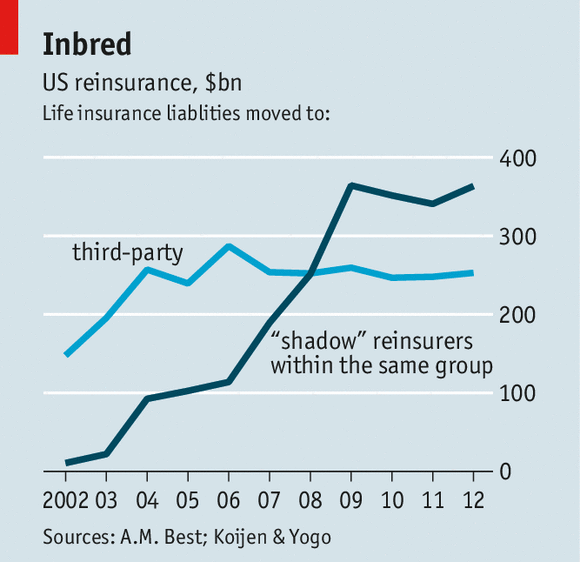
Turning one contract into another is a way for insurers to free cash, which can be used to underwrite more business or reward shareholders. But the effect is to transfer life-insurance policies, which in aggregate represent $4 trillion of customers’ assets, to entities which often do not have licences to issue insurance themselves and are beyond the scrutiny of credit-rating agencies. Such “shadow insurance” arrangements, as critics refer to them, reached $363 billion in 2012, up from $11 billion a decade earlier (see chart), according to a study by Ralph Koijen of London Business School and Motohiro Yogo of the Minneapolis Fed. Firms issuing half of America’s life-insurance policies now transfer 25 cents of every dollar insured to such schemes, the study found, up from just two in 2002.
Regulators in states that are losing reserves have cottoned on. Benjamin Lawsky, New York’s regulator, warns that this is “financial alchemy” of a sort that featured prominently in the financial crisis. “When you see billions of dollars being moved to lightly regulated, opaque vehicles, at the very least it’s troubling,” he says. He wants a national moratorium on the practice; other state regulators are less keen.
Insurance companies blame a 2000 law which mandated reserves beyond what their models indicate is necessary. This at first prompted them to do reinsurance deals with unaffiliated third parties, of which there continue to be some. But from 2002 another change made it easier to keep the risk (and profits) in-house. The insurers are unusually candid in justifying their use of such schemes. MetLife sees it as “a cost-effective way of addressing overly conservative reserving requirements”. The American Council of Life Insurers, an industry group, frets about “alarmist sentiments” being raised by the likes of Mr Lawsky. It says the intra-group arrangements are legal and lead to lower prices for consumers. But it agrees that more transparency would be a good thing.
The practice is more problematic than they make out. Shadow reinsurance undermines the measures of risk used by regulators and others to gauge insurers’ health. Credit-rating agencies admit to being confused—never a good sign. It took Mr Lawsky’s well-staffed unit a year to figure out the extent of the practice in his state. Regulators in Vermont or South Carolina are unlikely to be as experienced. Some intra-group deals involve letters of credit to serve as collateral; how useful these would be in a period of financial stress is anybody’s guess. Regulatory arbitrage of a similar hue made it easier for AIG, a large American insurer, to diversify into complex financial products which ultimately required a $182 billion bail-out in 2008.
 About bambooinnovator
 Bamboo Innovator